Clay Shirky: “I don’t think the numbers add up”

July 6th, 2010
Share

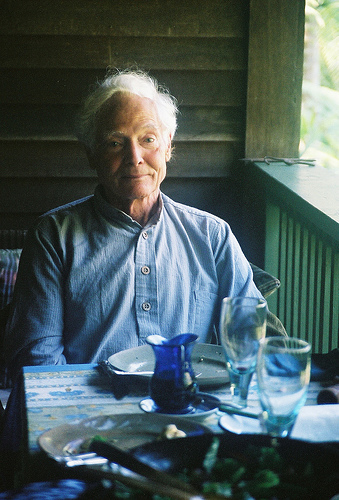
Clay Shirky speaking

Never heard of him?  Clay Shirky is the name du jour in  internet networking and social media.  He has bad news for those addicted to print newspapers — you know, the kind you can hold in your hand that leave ink on your fingers: it’s days are numbered.  If you are 25 or younger, you’re probably already reading all the news on a computer screen already. “And to put it in one bleak sentence, no medium has ever survived the indifference of 25-year-olds.”  Paywalls, he says, won’t work — “I don’t think the numbers add up” — and so far he’s had an uncanny tendency to be right.

Shirky is nevertheless illuminating, cheering —  a downright optimist.  The article in The Guardian (it’s here) continues:

“The final thing I’d say about optimism is this. If we took the loopiest, most moonbeam-addled Californian utopian internet bullshit, and held it up against the most cynical, realpolitik-inflected scepticism, the Californian bullshit would still be a better predictor of the future. Which is to say that, if in 1994 you’d wanted to understand what our lives would be like right now, you’d still be better off reading a single copy of Wired magazine published in that year than all of the sceptical literature published ever since.”

Prince: The internet is so yesterday

For an opposing opinion, go no farther than Prince.  For what it’s worth (and it’s not worth much), Prince disagrees  in a different British newspaper today:

“The Internet’s completely over,” he said. “I don’t see why I should give my new music to iTunes or anyone else. They won’t pay me an advance for it, and then they get angry when they can’t get it.

The internet’s like MTV. At one time MTV was hip and suddenly it became outdated. Anyway, all these computers and digital gadgets are no good.

They just fill your head with numbers and that can’t be good for you.”

UPDATE: One vote for Prince! It comes from Forbes magazine:

… he has the Internet completely figured out. In the digital world, where music is free and we’re inundated with easily-duplicated information, what is scarce? Human contact. Things that vanish in time. Things that are handcrafted, or have to be sought out. Things that identify your personal connection to a passion.  … From Prince’s point of view, there’s something to be said for making yourself scarce.


Nikolai Bukharin: The Movie

July 5th, 2010
Share

A torn picture of Nikolai Bukharin is the only original photo of him at Hoover archives. After his execution, the government confiscated all his records. (Photo: Hoover Archives)

July 1928.  Nikolai Bukharin rose to contradict Stalin at every point.  Stalin’s extraordinary measures had caused grain output to plummet wherever they had been implemented.  Eventually they resulted in a famine that would cost 6-7 million lives, but the immediate effect was unrest among the peasants.  The kulak — Stalin’s favorite scapegoat — was not to blame. The popular leader Lenin had dubbed the “Golden Boy of the Revolution” concluded:

BUKHARIN:  “We must immediately remove extraordinary measures which were historically justified and correctly enacted. They have outlived their time. But we now face a wave of mass unrest. There have been some 150 different uprisings throughout the union and dozens of terrorist acts [he described them].  Middle peasants are deserting to the camp of the kulaks. … We were victorious in gaining Soviet power, but we can also lose it.”

Stalin’s stooge Lazar Kaganovich, party head where much of the Ukrainian unrest occurred, protested that the Bolshevik leader was exaggerating.

BUKHARIN:  I could cite still more such examples given at the Central Committee plenum of Ukraine.

KAGANOVICH:  There were other speeches there.  You should cite them as well.

VOICE FROM THE CROWD, A BUKHARIN ALLY:  And the former general secretary of Ukraine, Comrade Kaganovich, comes here and doesn’t say anything about this?

KAGANOVICH:  Give me two hours like Comrade Bukharin, and I will tell you all and cite speeches.

BUKHARIN:  When Lenin encountered panic-mongers, he said they must be shot to maintain a united front.  But he never said that we should keep quiet about facts. … I don’t know whom I am contradicting.  I only know that I learned about this widespread peasant unrest yesterday.

This is an excerpt from Paul Gregory’s Politics, Murder, and Love in Stalin’s Kremlin, which I wrote about here.  If it sounds like a screenplay — well, you’re not the first one to think so.
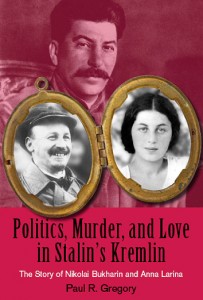
“Almost without exception, readers, including my editor, came independently to the conclusion that their story would make a great film — a kind of Darkness at Noon/Zhivago combination,” Paul Gregory told me.  “I sent the book to two producers, both of whom read the book and concluded it should be a movie. An appealing feature for filmmakers is that at least two of the roles — Anna and Stalin — would be exceptional roles for major actors. Their concern, however, was that Hollywood was not financing ‘good’ films these days and was only interested in sequels, comic books, and special effects. They felt it would either have to be made as an independent film or by cable TV concerns like HBO or SHO.”

The reason for the astonishing transcripts, said Paul, is the emergency of a huge amount of formerly secret documents, released from the Soviet archives beginning in the early 1990s; many exist on microfilm at the Hoover Institition, where Paul Gregory did his research.  They include the transcripts of Central Committee plenums (like the excerpt above), stenograms of the Politburo, transcripts of interrogations, correspondence.  (Irma Kudrova’s compelling Death of a Poet also made use of new documents — I reviewed it here.)

“This story is non-fiction fiction. It seems too good a story to be real,” he said.   “I have ten years of experience and could not have written this book without that ten years.  I may have been the only one with sufficient patience to make my way through all these records. I would classify among the more important finds the original transcript of Bukharin’s last statement to the court with Stalin’s edits in pencil, the official record of the carrying out of his execution, his ‘hunger strike’ speech before the Central Committee in February of 1937, his arrest warrant.”

Not new is his final letter to his beloved wife, Anna Larina, which she received 50 years late.  Neither of them ever lost faith in the revolution that executed Bukharin in 1938.

Anna Larina got his last letter 50 years late

Dear Sweet Annushka, My Darling!

I write to you on the eve of my trial…with a special purpose, which I emphasize three times over: no matter what you read, no matter what you hear, no matter how horrible these things may be, no matter what might be said about me or what I might say–endure everything courageously and calmly. Prepare the family. Help all of them. I fear for you and the others, but most about you.

Don’t feel malice about anything. Remember that the great cause of the USSR lives on, and this is the most important thing. Personal fates are transitory and wretched by comparison. A great ordeal awaits you. I beg you, my dearest, muster all your strength, tighten all the strings of your heart, but don’t allow them to break…. Regardless of what happens and no matter what the outcome of the trial, I will see you afterwards, and I will be able to kiss your hands.

Good-bye my darling, Your Kol’ka
January 15, 1938

San Francisco exhibit looks at Africa’s children of AIDS

July 2nd, 2010
Share

Children play hide-and-seek in the Saidia Children's home, a place for the Kenyan town's neglected and abandoned kids

The numbers are staggering:  About 22.4 million people have HIV in sub-Saharan Africa (more than the total population of Australia).  About 15 million children have lost one or both parents to AIDS – a figure that will grow to about 20 million by the year 2010.

Staggering, and defeating.  After all, what can you do about it when you’re not a doctor, a political leader, or a deep-pockets philanthropist?  For one writer and photographer, the answer was to hit the road.  Karen Ande’s and Ruthann Richter’s 7-year effort eventually became Face to Face: Children of the AIDS Crisis in Africa, a book that portrays the children who are growing up in the shadow of AIDS.

The World Affairs Council will be hosting a solo exhibit of Karen Ande’s photos at its San Francisco office at 312 Sutter Street.  The exhibit opens July 8 and continues through August 27 (there will be an 6-8 p.m. opening night reception).

Michael, abandoned as an infant, at a church orphanage

“Karen and I trekked through the grimy alleyways of the Nairobi slums and the pastoral villages of the East African bush to capture the stories of these youngsters, who were living under staggering conditions. Many had watched their parents die and then had to cope with the consequences of living alone or with little support, often without food, education or a stable, caring adult in their lives,” said Ruthann, the writing half of the team.

“We resolved to bring the issue to light.  We also chose to focus on what could be done, highlighting the remarkable people at the grassroots level who are working to transform these children’s lives.”

At age 98, Sara Nduku cared for her great-grandson after 5 children and a granddaughter fell to AIDS

Photographer Karen, who won the top honor at the Council’s “Global Vision” competition, first traveled to Kenya in 2002, on assignment with a Bay Area nonprofit that was working with kids in Kiberia, Nairobi’s notorious slums.  She later teamed with a former Stanford roommate, Ruthann.  “As a medical writer, I had covered AIDS for a daily newspaper in the Bay Area in the early days of the epidemic in the 1980s, when this strange disease had no name,” Ruthann writes in her introduction to the book. “But nothing in my experience would prepare me for what I would witness on that first trip to East Africa with Karen in 2004.”

Esther, before she left Saidia for a Nairobi tailoring school

They met children like Esther, a 13-year-old girl nursing a dying mother and taking care of three shoeless and threadbare younger brothers.  “She met the challenge with a dignity and grace that I would not have imagined possible in a teenager,” writes Ruthann.  They also met 2-year-old Mary, who had been living with her 4-year-old sister under a lean-to of plastic and cardboard.  She was skeletal, barely able to sit up and bent from malnutrition before she was taken to the Saidia Children’s Home, a shelter for children in Kenya.

They also met community leaders, advocates, activists, and others who are rescuing children from a present that is robbing their future — through malnutrition, homelessness, poverty, and illiteracy.

The bad news keeps coming:  A recent AP article explained that, in eight African countries, doctors are being forced to turn away people with HIV/AIDS  (meaning they will fall ill and almost certainly die) as donors cut funding amid the global economic meltdown.  What to do?

Follow this duo’s example, and take to the road — but for the next six weeks, you’ll only have to go as far as 312 Sutter Street in San Francisco.  Proceeds from the book go to support organizations working with these children – they’ve raised $70K so far.  The exhibition is co-sponsored by Kerry Olson, founder of the Firelight Foundation, a public charity dedicated to supporting the needs of orphans and vulnerable children in sub-Saharan Africa.

All photos by Karen Ande

*****

Kevin Waiharo (left) refused to be parted from the plaid green jacket given to him by the man he called “Daddy,” who had rescued him after Kevin’s mother was murdered.  Daddy had died of AIDS, but Kevin continued to hope for his return.  Finally, the coat finally came off, and Kevin settled into his new home at Saidia.

They chose well.

July 1st, 2010
Share

"It was a dark and stormy night..."

It has indeed been a busy week for news in the world of belles lettres.

In an annual ritual closely watched throughout the English-speaking world, San Jose State University announced the results of its annual Bulwer-Lytton Fiction Contest for the worst sentence of 2010 — in the words of the contest, “to compose the opening sentence to the worst of all possible novels.”  The award went to Molly Ringle of Seattle, Washington, for this doozy:

For the first month of Ricardo and Felicity’s affair, they greeted one another at every stolen rendezvous with a kiss–a lengthy, ravenous kiss, Ricardo lapping and sucking at Felicity’s mouth as if she were a giant cage-mounted water bottle and he were the world’s thirstiest gerbil.

The runners up, in our humble opinion, didn’t even come close.  You can judge for yourself here.

“I do like a very quiet life,” says Merwin, our new poet laureate

July 1st, 2010
Share

Merwin ... a genial presence

W.S. Merwin has been named the new poet laureate.  New York Times story here.  An excerpt:

“I do like a very quiet life,” Mr. Merwin said by telephone after learning of his appointment. “I can’t keep popping back and forth between here and Washington.” He said he does relish “being part of something much more public and talking too much,” however, and the job of the nation’s premier poet will enable him to do both.

Bill Merwin contributed to my forthcoming book, An Invisible Rope, so I’ve had the privilege of working with him.  In his remote enclave in Haiku, Hawaii, he continues his reputation as the genial father of the American poetry scene.  He doesn’t return phone calls promptly, doesn’t use fax or email.  He is pretty much a recluse, and likes it that way.

The position does not carry many formal duties, though laureates have traditionally undertaken projects that reach out to potential audiences.

What on earth were they thinking over at the Library of Congress? The Pulitzer prizewinning poet (receiving the award twice) doesn’t need another line on his resume.  Every possible honor has already been heaped on the octogenarian poet.

Mr. Billington said he is confident that Mr. Merwin can broaden the audience for poetry through technology, if not in person: “We even discussed the possibility of doing something using remote technology from Hawaii.”

That of course presupposes that Merwin wants technology in his life. So far he hasn’t.

Maybe it’s time that we start putting a thought into what the “poet laureate” gig is supposed to mean.  Robert Hass, another laureate, is renowned for his selfless public work.  I recall the activism of Joseph Brodsky as poet laureate, with his plan to put American poetry in every hotel room in the U.S., next to the Bible.  William Wadsworth, executive director of the Academy of American poets from 1989 to 2001, recalls Brodsky muscular approach to the job here:

We spoke on the phone three days before he died. I was still at the Academy and we were continuing to work with Joseph on the project of distributing poetry anthologies around the country. Joseph called me at the Academy, and said, “Bill, do you know what American poetry is all about?” “No, Joseph, I don’t. Please tell me.”  He said, “American poetry is all about wheels, it’s about the Open Road. It’s all about wheels . . . So, you know what you have to do?” “No, Joseph, what do I have to do?” “You have to call up the Teamsters. We have to get poetry on the trucks. So when milk is delivered in the morning to the grocery stores, they deliver poetry with the milk.”

Now the Teamsters Union is the most notoriously corrupt union in the U.S. I said, “Joseph, are you telling me that The Academy of American Poets should collaborate with organized crime?”  There was a pause. Then Joseph said, “Bill, one thing about organized crime: It’s organized.” This was the last thing he said to me.

What is the job supposed to do?  What do we want it to be?  Anything?

Expect a quiet year.

Wow. Why Hitchens won’t be in Palo Alto.

June 30th, 2010
Share

Christopher Hitchens

Back when Ayaan Hirsi Ali was visiting Palo Alto courtesy the Commonwealth Club, I mentioned Christopher Hitchens was to appear next on June 27.  He was plugging his new memoir, Hitch 22.

A few days ago, I received an email that his appearance was “postponed until further notice.”  I wondered what the story was.

It’s this:  Hitchens has esophageal cancer.  From Vanity Fair:

“I have been advised by my physician that I must undergo a course of chemotherapy on my esophagus. This advice seems persuasive to me. I regret having had to cancel so many engagements at such short notice.”

This is one of the nastier and more aggressive cancers.

Whatever one’s opinions of him, his books, his journalism — wish him well. (I was about to say Godspeed — a thought he would hardly have encouraged.)


<<< Previous Series of PostssepNext Series of Posts >>>