“Ghidul copilăriei retrocedate”

May 26th, 2010
Share

If you happen to be in Transylvania this weekend, you might check out Ghidul copilăriei retrocedate (Guide to a recovered childhood), which is having its world premiere at the National Theatre in Sibiu on May 31.

Andrei Codrescu

I just had lunch with Florentina Mocanu today at the Stanford Bookstore, and she is on her way to Romania in the next day or so for that very purpose.  She has good reason to go: she’s one of the playrights, along with Gavriil Pinte (who is also directing) and Andrei Codrescu, known to most Americans as a commentator on NPR’s All Things Considered since 1983.  Florentina is a graduate of Theatre Arts University in Târgu Mureş. At Stanford, she translated and directed Mr. Leonida by I.L. Caragiale and Ionesco’s Frenzy for Two or More.  I met her earlier this year while writing about her mentor, director Carl Weber, a protegee of Bertolt Brecht and a veteran of his Berliner Ensemble — also a veteran of WWII, where he was a teenage German POW in England.

Florentina

Florentina Mocanu

Ghidul copilăriei retrocedate was a far-flung collaboration:  Florentina lives in San Francisco, Piute is writing from Bucharest, and Codrescu is based in New Orleans.  The play is coming together for its debut in Codrescu’s beloved home town, Sibiu.

The play includes the poetry of Codrescu’s youth and explores the nature of memory as it shifts over the decades in a lifetime.  Wonder how he squares that theme with a New Year NPR broadcast, in which he recalls an earlier job in his literary career, writing fortune cookies for $5 a shot. The last fortune he got said: “You will know the future in time.” Now that it is the future, he offers this insight: “Time will make truth irrelevant.”

“Time is truth and there is no truth in time,” he said.

In any case, Sibiu won’t be a bad place to cool your heels:  It was designated European Capital of Culture for the year 2007, with Luxembourg. It is ranked as “Europe’s 8th most most idyllic place to live” by Forbes.  And if you can’t make it, check out the youtube preview (above, in Romanian), featuring several actors in the production — and at least get a few glimpses of faraway Sibiu.

Idyllic Sibiu

Congratulations, Señor Díaz

May 24th, 2010
Share

Díaz, flanked by Packer and Barry (Photo: Toni Gauthier)

I fell in love with Junot Díaz’s The Brief Wondrous Life of Oscar Wao while writing about the author’s appearance two years ago with ZZ Packer and Lynda Barry.  I didn’t mean to read half the book while writing a short article, but I was desperate to find out what he meant by the book’s “Dr. Manhattan structure—the exploded book.”

The author has retained a warm spot in my heart.  So I was pleased to hear he will serve on the Pulitzer Board (the Associated Press notes that the Pulitzer awards “the most prestigious prizes in journalism” — I guess AP forgot that they award prestigious prizes in poetry and fiction as well).

Díaz grew up in Parlin, N.J., and describes his childhood as ”working poor, welfare, Section 8, living next to a landfill.”  He described the appointment as a “wonderful honor” and said, “The Pulitzer Prize absolutely fundamentally changed my life and career as an artist.”

Co-chairman of the board David Kennedy, a Pulitzer historian himself, said the board is excited to have Díaz, and described him as a fresh new voice in the Pulitzer decision-making.  He is, apparently, the first Latino on the board.  Díaz’s reaction:

”How come I am not surprised?” said Diaz, who emphasized that he was only the second Latino in Pulitzer history to have received the prize in fiction. ”I guess that I’m standing in for hundreds of other qualified writers, artists who should have been in that position before me. That’s always what I think about when people tell you, oh, you’re the first. Man, that’s not really the way it should have been.”

Congratulations, Señor Díaz.

Rakove and “Revolutionaries” at Kepler’s tonight!

May 24th, 2010
Share

Jack Rakove‘s new book Revolutionaries: A New History of the Invention of America, also got a review at the San Francisco Chronicle yesterday — it’s here.

“Rakove shows us how these legendary figures were a bundle of results as well as forceful agents of history. They were made by the Revolution, he keeps reminding his readers, not just the makers of it. Too often, books about these men, taken together or presented individually, render them larger than life, and abstract them out of the dense social, cultural and political matrix that defined their opportunities and their challenges. Rakove manages to demystify the leaders of the Revolutionary era even while clarifying the terms on which they continue to deserve our admiration.  …

What makes this conclusion so important is its defiance of a common pathology in our thinking about our national origins. We too often treat the Founding Fathers as having set us upon a highly specific political course that it is our mission to follow as closely as possible, no matter how much the times change. Rather, we need to think our way through our own dilemmas, within the broad and flexible constitutional framework we owe to Rakove’s revolutionaries. We must not expect Samuel Adams and Thomas Jefferson to do our thinking for us. That we should do for ourselves.”

However, you can bypass persuasive endorsements altogether and see for yourself:  Rakove will be appearing tonight at Kepler’s — and presumably providing citations from his own book.  (There’s also an Amazon Q&A here.)

That’s at 7.30 p.m. tonight.

“Each step we take is a separate flare into darkness…”

May 23rd, 2010
Share

odysseyMy review of Gwyneth Lewis’s A Hospital Odyssey in the San Francisco Chronicle today here.  (I’ve interviewed the poet here, and written about her on the Book Haven here.)

From my review:

“Nevertheless, all the distracting and engaging dramatis personae serve only as a scrim for the fey intelligence behind them: the narrator who teases us in a literary hide-and-seek, Onegin-like, from behind the mask of her protagonist. What remains is a voice vibrant, lively and clear as a bell – not looking inward so much as in wonder at the world around her. And, pressed from her lines, a rare vintage of wisdom.”

As always when writing a review, there are little snippets of the book — in this case, it’s a novel in verse — that never quite make it into the final review.  (Given the strict and ever-shortening word limit nowadays, this should hardly come as a surprise.)  So here are three excerpts I would have liked to included:

gwyneth

Gwyneth Lewis

“When love’s so weary it hopes for nothing
it’s at its strongest, though it feels no power.
It pushes, persists and starts its streaming.
Clay relaxes to the touch of moisture,
it gathers force, pushes sand grains over

and, on its way, is fed by everything
It touches, now it’s flowing over,
It surges and begins to sing
words of mercy in the throats of gutters,
thoughts translated into sudden flowers.”

“Peace, Love and Death. Of these three
Peace is the least, the greatest one is Death.
When someone chooses it willingly,
Death includes the others.  It’s the roughest path,
but the kindest.”

“Neither of us will get out of here
alive unless I can re-order time
to a second body of words and rhymes.”

A haunted room at Berkeley — 10 years later

May 20th, 2010
Share
The lavish Morrison Reading Room in Berkeley

The lavish Morrison Reading Room in Berkeley

I wondered if the room was as lavish as I remembered it.  The last time I had been in this reader’s paradise was almost exactly a decade ago, in February 2000.  The occasion was Czesław Miłosz‘s poetry reading, and I was scheduled to interview him within a few days of the event.  I described it this way in California Monthly this way:

As seats fill up in the wood-paneled Morrison Reading Room of Doe Library, students climb to the mezzanine level, draping themselves between the balustrades like pensive, latter-day gargoyles. Below, journalists and photographers buzz like flies among the crowd, which chatters incessantly. The mood feels more like a gala theater premiere than a noon poetry reading.

In the commotion, no one seems to notice as the star of the day, Czeslaw Milosz, Berkeley’s only Nobel laureate in the humanities, enters. He’s dressed as quietly as his entrance, wearing a dark corduroy jacket with a maroon tie and puckered pocket square. His oxblood satchel contains his poems, computer-printed in oversized type to be easy on the eyes of the 89-year-old Polish poet. He moves slowly and decisively, with a cane. Milosz’s face is softer, paler, rounder than it appears in the photos that have made his face a literary icon, though the trademark bushy eyebrows still give him a slightly forbidding look.
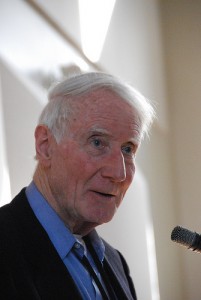
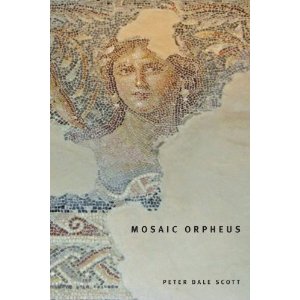
Peter Dale Scott

Peter Dale Scott

No one then knew it would be his last reading in Berkeley.  Within a few months, he was back in Kraków.  While he had been dividing his time between Berkeley and Kraków for some years, health problems had finally stranded him — not unhappily — in Poland for good.

So here I was again, on Friday, May 14, making the nerve-wracking rush-hour trek to Berkeley.  This time I was visiting at the invitation of poet Peter Dale Scott — a poet and former Canadian diplomat who was one of Miłosz’s very early translators and friends.  He had contributed to my forthcoming book, An Invisible Rope: Portraits of Czesław Miłosz.  I had reason to be grateful: he had been a courtly, kindly, and reassuring presence in what was not always a kind process of herding contributors against a deadline gun.

Peter gave UC-Berkeley’s Annual Stronach Lecture.  His topic:  “Poets Who Grow Gardens in Their Heads: Some Observations on Robert Duncan, Czesław Miłosz, and Judith Stronach.”  It was splendid.  A few of his comments:

“My intimacy with Milosz reinforced a contrast I had already felt in Warsaw: of the contrast between Poland  — a scott3powerful culture with only a perilously established state – and America – a powerful state with only an incipient and perilously established culture. I may have sensed this the more strongly as a citizen of Canada, where neither state nor culture are particularly strong, and uncertainties — as poets have to be aware — surround the future of both.  …
“Thus for Milosz ironic detachment was not enough; the poet has a responsibility to teach. In the same passage he wrote how in the debased conditions of wartime Warsaw people had dreams “about a beautiful future,” and how he gave these dreams expression:  ‘Sometimes the world loses its face. It becomes too base. The task of the poet is to restore its face, because otherwise man is lost in doubt and despair. It is an indication that the world need not always be like this, it can be different.’

As he wrote much later in Berkeley, ‘what is needed in misfortune is a little order and beauty.’” …

“In his later years Milosz returned to his theme that poets should enliven hope. Thus he criticized modern poetry, starting with Mallarmé, for its “increasing irrationality” and “disappearance of logically deducible meaning.”  In his Nobel Laureate lecture, he contrasted the irrelevancy of “autonomous” poetry with the power, even the danger, of poetry “in search of reality” milosz(or what Duncan called “the truth of things”):

‘There is, it seems, a hidden link between theories of literature as Écriture, of speech feeding on itself, and the growth of the totalitarian state. In any case, there is no reason why the state should not tolerate an activity that consists of creating “experimental” poems and prose, if these are conceived as autonomous systems of reference, enclosed within their own boundaries. Only if we assume that a poet constantly strives to liberate himself from borrowed styles in search for reality, is he dangerous. In a room where people unanimously maintain a conspiracy of silence, one word of truth sounds like a pistol shot.'”

And yes, the wood-paneled room — with its marble busts of Dante, Goethe, some Greek or other and a Roman or two — was as lavish as I remembered it.  So was the reception afterwards, where I had a chance to chat with Chana Bloch.  (By the by, I wrote about Milosz and Robert Hass‘s joint appearance at Stanford here.)

Library of the future … on the other hand, you could smash your Kindle

May 19th, 2010
Share

The San Jose Mercury discusses what may be the library of the future — as exemplified by the Stanford Physics Library.  According to the article, the new library will be only half the size of the current Engineering Library, “but saves its space for people, not things. It features soft seating, ‘brainstorm islands,’ a digital bulletin board and group event space. There are few shelves and it will feature a self-checkout system.”

There’s more:  it will have a completely electronic reference desk, with four Kindle 2 e-readers on site. An online journal search tool will scan 28 online databases, a grant directory and more than 12,000 scientific journals.

Here’s the problem with keeping books, which, in today’s library vernacular, are increasingly described as “units”:

Stanford is running out of room, restricted by an agreement with Santa Clara County that limits how much it can grow. Increasingly, the university seeks to preserve precious square footage.

Adding to its pressures is the steady flow of books. Stanford buys 100,000 volumes a year — or 273 every single day.

“Most of the libraries on campus are approaching saturation,” [Stanford’s Andrew] Herkovic said. “For every book that comes in, we’ve got to find another book to send off.”citylights

Can a backlash be far behind?  City Lights Bookstore,  launched by Beat  champion Lawrence Ferlinghetti in the 1950s, offers a different perspective at Booknewser, in the spirit of Allan Ginsberg’s “Howl”:

This is the current City Lights Books catalog. As you can see, it depicts a kind of Kindle graveyard. “Smash your Kindle,” City Lights seems to say, “we publish books in print.”

Stanford physics librarian Stella Ota expresses mixed feelings:

“When I look back, then there is a certain sadness for me. Any change is hard. And there are moments of joy, when I see bookplates of former faculty who owned and donated the book, and sometimes made notes on the side,” Ota said.

“But looking forward, I see an opportunity to create something new.”

Let’s hope her optimism is warranted.  As for me, my own real-book library is my sanctuary, and I long for more time away from a screen. It’s hard to beat a sunny afternoon with an old friend in the form of a well-worn book.

On the other hand, I too am running out of space…


<<< Previous Series of PostssepNext Series of Posts >>>
