“Writing gives you a second body — a strange kind of double life”

May 16th, 2010
Share

At last night’s production of Troilus and Cressida, I was seated directly behind Gwyneth Lewis and so had a chance to meet her amiable husband, the subject of her memoir, Two in a Boat: A Marital Rite of Passage and also the subject of her poetic journey, A Hospital Odyssey.  The occasion reminded me that I hadn’t yet posted her talk in the “How I Write” series (more about the series here).  I’ve interviewed Gwyneth here, and written about her on the Book Haven here.

A few highlights from the video, in which Gwyneth discusses the profession that, in the public eye, is “on par with Morris dancing”:

On a “creative writing” education: “They taught you how to revise, the technical thing, but they didn’t teach you about the whole life thing.  For example, the need for discipline.”

“There is a way in which poetry is a very shy animal, and comes only if you stand still for it. If you make a lot of noise, it won’t come.”

“Great poetry is perhaps some of the most intelligent, cerebral activity that you can have.”

“Writing gives you a second body — a strange kind of double life.  The second body is not like the first.  … The other, more impersonal Gwyneth …  comes through my own persona.  I don’t mean to make it sound like a Ouija board thing. It’s not.”

“The muse isn’t a person at all — it’s an aspect of language.”

*****************************************************************************************************************************

Gwyneth will be giving another reading of her work at 7 p.m. on Wednesday, May 19, in the Terrace Room of Margaret Jacks Hall.

*****************************************************************************************************************************

“If I didn’t write, I wouldn’t live”

May 13th, 2010
Share
Nussbaum: "Self-Portrait with Jewish Identity Card"

Nussbaum: "Self-Portrait with Jewish Identity Card"

My piece on Irena Sendler below reminded me again of a different kind of resistance — creative resistance, which I wrote about here, following a presentation on the subject by authors John and Mary Felstiner. My reflections on the subject were renewed after reading an article a few days ago in the New York Times (it’s here) about Russian-born novelist Irène Némirovsky, who died at Auschwitz in 1942:

“In the end, the biography and the stories leave one feeling both sad and intensely conscious of the disparity between Irène Némirovksy’s literary offenses and the fate that awaited her at Auschwitz. What we’re left with are the paradoxes. A woman who wrote so often about the terror of aging was never given a chance to find out if old age was really as bad as she feared. A woman obsessed with defining her own identity learned how little her opinion mattered to authorities with their own criteria for determining who she was.”

Although the world knows of Anne Frank and a few others, the Felstiners’ talk mentioned too many names unknown to most of us:  the artists Halina Olomucki (“I am an artist, only and always”), who is still alive; Felix Bloch, beaten to death by the S.S.; Lithuanian poet and partisan Abraham Sutzkever; artist Lea Lilienblum; artist Felix Nussbaum; artist David Brainin; artist Amalie Seckbach; and poet Itzhak Katznelson, who wrote in his diary before he was gassed at Auschwitz:

“Sure enough, the nations did not interfere, nor did they protest, nor shake their heads, nor did they warn the murderers, never a murmur.”

halina

Olomucki: "When will it end? Enough! Enough!" from the cycle "Camp"

There’s hope in numbers, for one of the surprising things about last month’s event at Hillel’s Koret Pavilion was the number of Stanford faculty in the audience:  I noticed Irv and Marilyn Yalom, Eva Domanska, David Riggs, Shelley Fisher Fishkin, Steve Zipperstein, Myra Strober, Tobias Wolff, Joe and Marguerite Frank, and, much to my surprise, someone I had met in 2007 at the Villa Decius an hour outside Krakow,  Nina Witoszek, who at that time was giving a rather controversial talk about the Velvet Revolutions.

The event was a seemed a sort of love fest for the Felstiners.  I arrived amid the leftover hors d’ouevres and champagne (the party started before I got there) and their talk ended with a standing ovation and presentation of flowers.  But more importantly: the heavy professorial presentation could signal a much stronger academic presence in the future of “creative resistance” — which turns away from Jewish traditions of diplomacy and negotiations, which failed them utterly in the face of merciless aggressors — and instead focuses on creative ways the victims resisted, even the simple scrawling of “Courage!” on the wall at Drancy.

I missed the hors d’ouevres, but students were selling challah downstairs after the event — and five bucks for chocolate-chip challah still hot from the oven was a deal.

But thoughts about the event have lingered — especially since, by sheer coincidence, I attended an excellent multimedia presentation of “They Left a Light” at the Temple Emanu-El in San Francisco a few days later.  Curiously, I heard Gideon Klein’s haunting “Variation on a Moravian Folk Song” — a work previously unknown to me — twice within one week.

Charlotte Salomon painted 1,300 autobiographical portraits in the last year of her life, as she waited for the Germans to take Paris. As history gained momentum on the young woman, she was painting so fast she used not images, but words.  In the beginning was the Word … and perhaps in the end as well.

amalie

Seckbach: "Flowers" in Terazin ghetto

Her oeuvre, Life? or Theater? An Operetta, extended her life way beyond what her tormentors could take from her. “Her very self is a work of art,” said Mary Felstiner, “she would paint her life instead of taking her life.” Tzvetan Todorov spoke a few days ago spoke about dictators’ craving for self-reinvention, especially a self-reinvention through art.  Where does the impulse come from?  And when is it restorative and regenerative — and when is it grandiose folly and self-delusion?

I’ve always been mistrustful of the glib assertion that moral courage is more important or difficult than physical courage.  However, many of these artists had plenty of both. Take Abraham Sutzkever, who worked with Lithuanian partisans and smuggled arms into the Vilnius ghetto, and spent his long life afterwards writing poems in Yiddish.  From his New York Times obituary:

“All that time he composed poems, writing, he once said, while crawling through sewers and even while hiding in a coffin.

“’If I didn’t write, I wouldn’t live,’ he said in an interview with The New York Times in 1985 while reminiscing over a glass of French cognac. ‘When I was in the Vilna ghetto, I believed, as an observant Jew believes in the Messiah, that as long as I was writing, was able to be a poet, I would have a weapon against death.'”

Clearly he did.

Krieger’s walk into darkness

May 10th, 2010
Share

;kriegerSusan Krieger faces daily what we all fear.

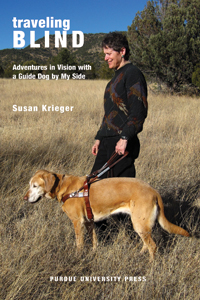
She’s blind.  Or rather, like most blind people, she is not completely sightless, but her vision is “impaired or unreliable.”  Traveling Blind (Purdue University Press) is Krieger’s discovery, with companions, of a new world and a new kind of vision as she journeys through cities, airports, and the deserts of the Southwest.

Krieger will be giving an “author talk” at 5:30 p.m. Tuesday, May 11, at the Stanford Bookstore.  She will also be on KQED-FM Forum Radio on Friday May 14, and on Technation Radio on Sunday, May 9, to discuss the new book.

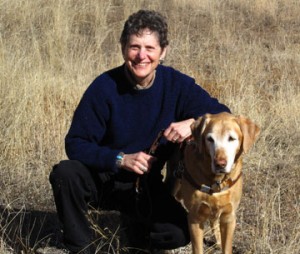
“I wrote it over a period of several years during which I revisited the desert places I loved, hoping they would not change as quickly as my eyesight,” she wrote.  She did not travel alone: the companions include her “golden dog” Teela, and her pseudonymous companion, “Hannah,” known to many of us as Estelle Freedman.

Krieger suffers from “birdshot retinochoroidopathy,” which she describes as a “rare autoimmune disease that causes inflammation on my retina and choroid and affects both my central and my periperal vision. … Although the severity of the condition — the amount of swelling and scarring — varies over time, the condition is chronic and progressive without a cure.”

authorpic2

Author and Teela

According to author Mary Felstiner,  “As the author takes to the road, we come to understand that to ‘see’ is some combination of perception, memory, and desire. As Krieger explores the commitments between humans and animals, she shows traveling as a challenge for both, but worth it all the time. Traveling Blind is an unforgettable experience, and at the same time a great read.”

Krieger, who teaches in feminist studies at Stanford, is the author of a previous book on blindness, No Longer There: A Memoir of Losing Sight and Finding Vision, and several other books.

A sense of wonder pervades her observations, as she pursues patches of light, the fading glow of a sunset, and random pinpricks of light.  Some passages hint at our existential condition:

“For me, there are many kinds of light, and I need to remember and value each one, all the more so as I become surrounded by increasing darkness.  The Christmas lights piercing the night sky reminded me of all the other lights.  They reminded me that no matter what my initial sense of disappointment or loss, my experiences could be converted into highpoints, brightness, and unexpected satisfaction.  I hope forever to keep an image of the night Hannah, Teela, and I drove around chasing Christmas lights, Hannah speeding off in search of a distant glow; me straining to see, yet delighting in my sight.”

Tzvetan Todorov and Kay Ryan, courtesy Adam Kirsch

May 9th, 2010
Share

todorovTzvetan Todorov discussed Heidegger’s attraction to Nazism a few days ago at the Stanford Humanities Center.  Adam Kirsch continues some of the same lines of thinking in the New York Times today here.  An excerpt:

For what makes Heidegger’s Nazism a challenge — as opposed to merely a scandal — is the fact that he did not drift into evil, but thought his way into it. And once we acknowledge the powerful attraction of his work, we are morally and intellectually bound to explore what part of that attraction is owed to ideas with a potential for evil.ryan_news

On a lighter note, Kirsch also had some thoughts on U.S. Poet Laureate Kay Ryan, the poet who praised the virtue of lightness during her recent visit here (I wrote about her here, and added a few notes from a 2004 interview with her on the Book Haven here), in a recent New Yorker article here.

The first “truly embedded” war journalist

May 8th, 2010
Share
freidin

Grisha Freidin

Gregory Freidin has a very good review in the April 30 Times Literary Supplement for his two recent volumes, Issac Babel’s Selected Writings and The Enigma of Isaac Babel.

If you have a subscription, it’s here.  If you don’t, you’ll have to settle for these excerpts (or my article here), unless you can find a paper copy of the TLS somewhere (good luck to you if you try):

babel1920_news

Isaac Babel

“Isaac Babel’s fellow writers resented his fame. It erupted in the early 1920s and persisted until his arrest in 1939 and execution at the beginning of the following year – and all for a mere 200 pages of miniature short stories, mostly from his work as the first truly embedded war journalist with the Sixth Red Cavalry Division and as the chronicler of Odessa’s Jewish and criminal quarters in his childhood and during the Revolution. Following his rehabilitation in 1954 and the slow recovery (still incomplete) of his fiction and letters, his achievement has come to seem even more extraordinary. Babel did for Russian prose what Hemingway did for English: he applied the rules of journalism – objectivity, graphic eyewitness accounts, language shorn of all superfluity – to fiction. But Babel went further than Hemingway: he condensed his similes and impressions into surreal epiphanies, he made his authorial persona a quivering, inadequate coward, not a macho role model, and he leaves his readers in a state of shock, as if they have not just witnessed, but participated in executions, rapes and pogroms. …

Babel’s death was one he himself foretold, and his choice of lovers and friends was as lethal as the themes of his prose. He slept with the babel2understandably unbalanced wife of Nikolai Yezhov, chief butcher of the terror, and almost everyone who slept with either of the Yezhovs was shot in early 1940. The only enigma is the fate of the papers and manuscripts that the NKVD took away with their victim. Did they burn them, lose them, or are they still filed away in the Lubyanka? If the FSB [Russia’s Federal Security Service] ever runs out of money, it could make itself the world’s best endowed literary publisher.

Books about Babel must therefore be provisional.”

Provisional nature of Freidin’s work notwithstanding, Babel is one of those cheering cases where a writer’s whole ouevre, or what we can find of it, is at the literary forefront largely because of one scholar’s indefatigable efforts — and for that we have reason to be grateful to Grisha.

Les Liaisons Dangereuses

May 7th, 2010
Share
todorov

Tzvetan Todorov

“I cannot predict the future.  Describing the present is already a risky task,” said Tzvetan Todorov, the French-Bulgarian philosopher and theorist.

He was speaking to a full house earlier this week at the Stanford Humanities Center during a series of lectures and seminars.  Though I was mostly tied up with the arrangements for the Bing Concert Hall groundbreaking and a Pasternak conference, I was able to drop in occasionally — to the lecture mentioned above, “Reflections on the Fall of the Wall” (alas, I had to miss the his talk on Germaine Tillion), and also for his seminar on “The Dictator as Artist.”

Todorov, author of Facing the Extreme: Moral Life in the Concentration Camps (1996) and Hope and Memory (2003), discussed the self-reinvention of dictators, treating themselves as a work of art.  Mussolini “transformed himself by effort of the will.” Hitler’s initial aspirations to be an artist are well-known.  Stalin, who dabbled in poetry as a youth,  “reinvented himself,” even changing his name and his birthdate.  He favored Chekhov, noted Todorov, which suggests “we should temper the idea that the great classics soothe the savage beast.”

Todorov commented on the dictators’ fascination with festivals, parades, architecture (take an architectural tour of Hitler’s beloved Munich for evidence), eventually they meddle with art and artists.  Hitler wrote to Wagner’s son that his father’s music was “the spiritual sword with which we are fighting today.”  Stalin referred to writers as “engineers of the human soul,” and killed several.

In these dictators’ utopia, “Everything had to be deliberately willed,” noted Todorov, “nothing merely accepted.” What he called “feminine values” of love, compassion, and affection were rejected, and “utopian language” often masked the sinister means to achieve them.

And the attraction of artists to dictators?  Even Pasternak fell under Stalin’s spell for awhile. Kornei Chukovsky recalled seeing Stalin during a Komsomol congress meeting he attended with Pasternak:

“The excitement in the hall!  And HE stood, a little weary, pensive and majestic.  One had a sense of power, an enormous assurance of authority and, at the same time, something feminine and soft. I looked about me.  Everyone had enamoured, tender, inspired and laughing eyes. To see him – simply to see him – was a joy for all of us. … When he was applauded, he took out his [silver] pocket watch and showed it to the audience with a delightful smile.  We all whispered one to another, ‘His watch, his watch, he’s pointing to his watch,’ and when we were leaving we again recalled that watch as we collected our coats and hats…Pasternak and I walked home together and we were both elated with joy.”  [I use the translation from Emma Gerstein’s Moscow Diaries.]

ninaw

Witoszek

At least one question was lively.  Nina Witoszek pointed out that the fascination with dictators continues into the present:  Slavoj Žižek openly admitted his admiration for Mao Tse Tung. (At the mention of Žižek, Todorov whispered to his neighbor, “Il est un provocateur!”)  While teaching at the University of Florence and the University of Oslo, she found that students were fascinated with Heidegger.

“What is your comment on these liaisons?” she asked. “Is it a desire for a surrogate God?”

jena

History on horseback

He answered, “Artists are attracted by power.”  He recalled Hegel admiring Napoleon riding through Jena: “I saw the Emperor – this world-soul – riding out of the city on reconnaissance. It is indeed a wonderful sensation to see such an individual, who, concentrated here at a single point, astride a horse, reaches out over the world and masters it … this extraordinary man, whom it is impossible not to admire.”

Todorov said “I don’t have an answer.” And repeated in English:  “Žižek is a provocateur.”

He continued: “Heidegger is not reducible to his admiration for Hitler.” Nevertheless, he said, “We have to analyze his blindness, which is not there by accident. It’s not the great philosopher and the weak man next to him – but something within the philosopher.”  Something “made it possible, but not compulsory.”

He also noted France’s postwar fascination with Nietzsche and Heidegger – “two names connected mentally, spiritually with fascism” – a fascination he said that Dostoevsky scholar Joe Frank, sitting a few seats away with his wife Marguerite, had witnessed, as a Paris denizen in the 1950s.

simone-weil

Weil

Not all the questions were so lively.  During his talk he quoted Simone Weil — a citation that I had been seeking for some time. I wanted the source.  Todorov obliged: it’s from “The Responsibility of Writers,” Simone Weil:  On Science, Necessity, and the Love of God, Oxford University Press, 1968:

“The essential characteristic of the first half of the 20th century is the growing weakness, and almost the disappearance, of the idea of value.  This is one of those rare phenomena which seem, as far as one can tell, to be really new in human history, though it may be, of course, that it has occurred before during periods which have since vanished in oblivion, as may also happen to our own period.”


<<< Previous Series of PostssepNext Series of Posts >>>