“In the Name of Their Mothers”

May 5th, 2010

Share
irena-sendler1

Irena Sendler

Next Wednesday marks the second anniversary of the death of Irena Sendler.  For most people that will mean little, as the name is little known outside Poland.

But for several hundred people at San Francisco’s Jewish Community Center on California Street, it will mean a lot more than it did a few days ago — thanks to last night’s screening of Mary Skinner’s brand new film, In the Name of Their Mothers.

The documentary describes the efforts of the young Polish social worker who, with her team of workers, saved 2,500 Jewish children in the Warsaw Ghetto from almost certain death in Treblinka.  Sendler’s life was the subject of a film on CBS last year, starring Anna Paquin (I wrote about it here after attending the Hollywood premiere), but Skinner has focused more broadly on the women of Żegota, the highly organized team of women who worked together to save lives, as well as the mothers and nuns who sheltered the children, at terrifying peril to themselves.

The film, six years in the making, uses interviews with Sendler, the children she saved (now elderly), and the women who opposed the Nazis.  Skinner also wove her tale with hitherto-unseen, or at least little-seen, archival footage of the Nazis in Poland, and of the Ghetto (some of it taken by Julien Hequembourg Bryan).  I attended the film with Russian filmmaker Helga Landauer, whose own film of Anna Akhmatova (I wrote about it here) made her appreciate the skill of crafting a film from ancient material, and told some stories about the endlessness of film editing — and she had some unusual insights to offer about the squelching of Sendler by the Soviets during the Communist years.  (She also persuaded me to watch A Film About Anna Akhmatova again — apparently I missed an early reference in the film to Purcell’s Dido and Aeneas.)

Skinner’s own mother was one of the Polish Catholics taken to a concentration camp, as a young girl barely in her teens.  She had been caught smuggling food.  Her father had been killed, her mother was dying, and her brother and sister had already been taken away.  She was the only one in the family to survive the war.  Years later, she told her American daughter of the “angels of mercy” in Warsaw who rescued the children who had were homeless, destitute, and orphaned by the war.  Skinner said, in her remarks after the film, that she was made aware of “how many wounded children there are in the world.”

She said she made the film “on behalf of all the mothers who extended themselves on behalf of children.”

Tad Taube, president of the Koret Foundation and founder and advisory board chair of Stanford’s Taube Center for Jewish Studies, offered not only praise, but help, saying the film “should be seen by every Jew in the United States.  It’s a memorial of man-gone-crazy, a memorial of courageousness,” and he pledged then and there to “distribute it on a very very broad basis.”

Under the circumstances, that could be quite an offer.  In Poland, the 50,000 DVDs of the movie were snapped up almost instantly.

WarsawGhettoChildren

Children of the Warsaw Ghetto

“Cerebral rock” in the news…

May 5th, 2010
Share
cd_glasswave_news

Camarillo, Edelstein, Wampole, Harrison & Harrison

“There are plenty in higher education who devote themselves to interpreting rock and roll as literature. Fewer devote themselves to the interpreting literature as rock and roll,” says Steve Kolowich in today’s  Inside Higher Ed.  Read the rest here.

He writes about the newest attempt, “Glass Wave,” a group that has just released a CDRobert Harrison (the Book Haven has discussed him here and here); his brother Thomas Harrison, a literature professor at UCLA (he’s taught courses on the music of Pink Floyd); Enlightenment scholar Dan Edelstein; and chanteuse Christy Wampole, a doctoral candidate in French and Italian with a background in cabaret; and Colin Camarillo, a Bay Area jazz drummer.  Last month, I wrote about the “Glass Wave” project here.

Harrison told Kolowich: “The lyrics can be absolutely fantastic. But if the music sucks, it’s going nowhere.”

Another country heard from

May 5th, 2010
Share

Over at the Cellar Door, student John Whipple gives his take on Holbrook’s take on Twain, and of my take on Holbrook’s take on Twain:

Much farther than a stones throw away from a Twain scholar myself, I find that Holbrook’s own answer to my question, “how can we regain morality in a society that seems to have lost it?”, gives us an accurate insight into Twain’s thoughts. …  He believes that we have lost an important tradition of “reading good books”, books that make you think, like Huck Finn.  I think by extension what he means is that we have lost the tradition of giving credence to the importance of reflection.  For example, Holbrook deplores how on television news programs, everyone interrupts and talks over one another, each opinion worse than the one before.

Well, that explains the bit about news programs I walked in on.  I think Sontag’s comments give a pretty good take on the role of books in developing a civilized sensibility — much in line with the thinking of her friend, Joseph Brodsky, who always contended that aesthetics is the mother of ethics.

Ed Hirsch: “If only I could sweat this much at the gym”

May 1st, 2010
Share
hirsch

Edward Hirsch

By any standard, Edward Hirsch is a bigshot in the literary world.  So what a pleasant surprise that he doesn’t act like one!

The award-winning poet, author of the best-selling How to Read a Poem and Fall in Love with Poetry, MacArthur “genius” fellow, president of the John Simon Guggenheim Memorial Foundation in NYC, is actually a modest, gentle, and affable kind of guy.  Or so he seemed at last week’s reading at the Humanities Center, followed by a discussion in the Terrace Room the next day.

“It was not (to start again) what one had expected…”  For one thing, the accent was vintage Jewish Chicago — land of Saul Bellow and Isaac Rosenfeld.  The facial features were large and friendly, and the boyish grin usually a few seconds away.

At the Monday night reading, he received fulsome praise from Eavan Boland, before coming to the podium and joking, “I feel understood.”

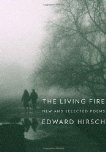
The 45-minute wide-ranging reading, largely from his new The Living Fire: New and Selected Poems, included poems about the electric green couch that he inherited and shuttled from house to house, city to city; Christopher Smart and his cat Jeoffry; his disillusionment and anger with God (and vice versa); Czesław Miłosz; and one poem, “In Memoriam: Paul Célan,” which concluded:

51VPHf8OtGL._SX106_

Lay these words on the dead man’s lips
like burning tongs, a tongue of flame.
A scouring eagle wheels and shrieks.
Let God pray to us for this man.

“If only I could sweat this much at the gym,” he said afterwards.

And then there were the questions and answers.

Question from Tobias Wolff: “The couch.  I want to know more about the couch.  Aside from its color, was it comfortable?”

Hirsch: “You can always tell a fiction writer. No wonder they need the whole page … No one ever asked me about the couch.”

Question: “About the books you were reading on the green couch, you were reading a lot of philosophy.”

Hirsch: “Are you upset with me for that?

Question: “Ah, yeah.”

Hirsch praised Martin Buber, and noted the “ancient battle between philosophers and poets – and we’re right.”

Question: “How do you know when your poems end?”

Hirsch interpreted this question as:  “Your poems to seem to just stop.”

“You’re working through something in a poem,” he said, and need to “come to some satisfactory conclusion.”

Sometimes, he said, he hadn’t “had the chops to make it conclude, haven’t had the emotional material…”

Question from Nicholas Jenkins: “The past is a huge theme in your poetry … I wonder whether you have a vision of your future as a poet.”

Hirsch: “You ought to be a professor!”

Prof. Jenkins: “It didn’t work out.”

Hirsch said he wanted his future to include “the largest possible embrace in terms of the world” …  “suffering and joy, agony and exultation.”

Question from John Felstiner: He flagged  “In Memoriam: Paul Célan,” as “standing out almost completely —  the reach and the surprise.”

“How does that sound to you?”

Hirsch: “That sounds swell.”

“Every so often you write something that shocks you. This is the gift of writing properly, and it still startles you.”

Question: The questioner raised the subject of God in Hirsch’s poem, specifically “A Personal History of My Stupidity,” a poem that begins with traffic and ends with:  “I did not believe in God, who eluded me.”

Hirsch: “I’ve thought about God – about why and how I’m still angry at him for no longer existing.”

“I can’t give you a full answer to my struggles with belief.  I don’t feel I have been gifted with belief, but I haven’t given up the longing.”

“What you might be hearing is a deep quest in me for something transcendental. … a longing for something else, and a critique of that longing.”

“It’s the poetry of a yearner – does that seem fair?”

In that spirit, two supernatural events occurred during the evening and the Tuesday discussion that followed the next day:

The first occurred during the Monday reading, as he discussed a 2001 trip, sponsored by the State Department on the fifth anniversary of Joseph Brodsky’s death, that took him to the Russian poet’s place of internal exile, Archangelsk.  “I was shocked about how cold it was!” said the native Chicagoan, who knows something about cold.  Suddenly, the lights flickered briefly.

“Those Soviets still have a lot of power,” he said, and recovered quickly, just as the lights did.  “If only I’d been reading James Merrill, I could have mistaken it for contact.”

The contact occurred instead the next day, during his Tuesday presentation.  In addition to extolling one of his favorite philosophers, Buber, he praised Pascal: “I love Pascal!” His microphone began to hiss with static.  “Whenever I say this, he gets my microphone. ‘If you love me so much, why are you Jewish?'”

Still seeking Susan Sontag …

April 30th, 2010
Share

sontag3Czesław Miłosz told me in 2000:  “It seems to me every poet after death goes through a purgatory, so to say.  …  So he must go through that revision after death…”

He was referring to T.S. Eliot — but he might as well also have been referring to prose writers, too, such as essayist and novelist Susan Sontag. We recently participated in the cyberspace roasting with Terry Castle here — but reading an interview with Sontag by my friend James Marcus (of House of Mirth blog fame) reminded me of how inspiring and impressive she was in the first place — a figure so relentless and towering that you craved her approval and patronage.  You can read the Marcus interview here.   An excerpt that reminds me why I’ve spent a lifetime with my nose in a book:

“Reading should be an education of the heart,” she says, correcting and amplifying her initial statement. “Of course a novel can still have plenty of ideas. We need to discard that romantic cliché about the head versus the heart, which is an absurdity. In real life, intellect and passion are never separated that way, so why shouldn’t you be moved by a book? Why shouldn’t you cry, and be haunted by the characters? Literature is what keeps us from shriveling into something completely superficial. And it takes us out of ourselves, too.”

“Perhaps some people don’t want to be taken out of themselves,” I suggest.

“Well, reading must seem to some people like an escape,” she allows. “But I really do think it’s necessary if you want to have a full life. It keeps you–well, I don’t want to say honest, but something that’s almost the equivalent. It reminds you of standards: standards of elegance, of feeling, of seriousness, of sarcasm, or whatever. It reminds you that there is more than you, better than you.”

Hal Holbrook: “We’re the clergymen of the world in disguise!”

April 28th, 2010
Share
twain2

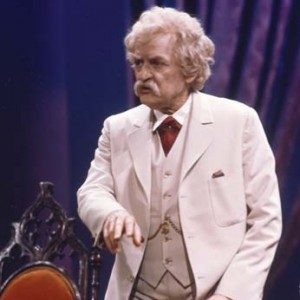
Hal Holbrooke, inevitably, as Mark Twain

I walked into the Piggott Theater only a few minutes late, but Hal Holbrook was already going at full gale force:  “They interrupt each other!” he exploded. He was talking about the downfall of television news, and I had entered the tirade at mid-point.  “Ninety percent of the American people don’t have an opinion worth putting on television!”

Even without the makeup, the famous white moustache, and the costume, Hal Holbrooke will always be Mark Twain.  There’s nothing I know quite like it in the history of theater: Holbrook first performed his one-man show at the Lock Haven State Teachers College in Pennsylvania over half-a-century ago, in 1954 — and his most recent enactment of Mark Twain Tonight! took place  Tuesday night in Memorial Auditorium.  This was a follow-up session with Stanford students and a few hangers-on, like myself, at a Q&A session in Piggott Theater.

Holbrook is an astonishing 85 years old, and by now it’s impossible to know where Holbrook leaves off and Twain begins.  It’s an miraculous meshing between the subject and his impersonator, between art and reality — to the benefit and ennoblement of both.

“The beauty of Mark Twain is that he lays a thought on your lap and walks away, and lets you handle it,” said Holbrook.  So here are a few thoughts from Holbrook, or Twain, for you to handle:

On American leadership:  “We take our opinions to the public trough, and follow the leader who makes the most noise.”

On Democrats and Republicans: He — or Twain? — disparaged the two-party system, which “turns voters into slaves and rabbits,” and praised the independent voter.

On the New York Times: “I know it leans to the liberal side, but so do I — so I have to watch out!” he said.  Hence, he confessed that he listened to Glenn Beck — then, with his hand, put a mock pistol to his head and jokingly fired it.  “It’s my job!” he said.  “We’re not supposed to all think alike — but we are all supposed to listen to each other.”

On the intelligentsia: “I admire it, it’s important … but now that we’re done for,” he shrugged.  “If the intelligentsia is not married to morality…”  Then Holbrooke launched into a jeremiad about the downfall of America, which Twain (or Holbrook?) had compared a great machine whose belt has slipped, but still goes on.

On morality: While many blame homeowners for taking on mortgages they couldn’t afford, Holbrook said that people have always been  suckers for things they can’t afford and morality enters with “your responsibility not to incite people to buy something they cannot afford” — an opinion that, taken alone and enacted into law, would cause major economic reform in America.

On performing villains: “You understand that people who are corrupt don’t get it — that’s the point.  They don’t know they’re corrupt,” he said.

Holbrook keeps detailed accounts of all his Twain engagements — his last at Stanford was in 2000, and he was surprised when he checked his records and found his subject had been “Money is God.”

“You see, I was thinking ahead of the bubble!” he said.  Looking around Silicon Valley, he felt “a lot that was happening here was chancy.  What causes  chanciness?  Greed.”

“He wrote this!  Great republics do not last.”  Money causes corruption, which “excites dangerous ambitions and brings the republic down.”

Holbrook reminisced about playing another larger-than-life American from the 19th century, Abraham Lincoln.  With corked shoes, Holbrook boosted his 6′ height a few inches to rival Lincoln’s 6′-3/4″ — but the size 14 shoes were beyond his reach.  He urged young actors to do their research. In his own reading on Lincoln, he noted that contemporary news reports of Lincoln’s debates described his voice most frequently as “high,” “shrill,” “flat,” “nasal,” and “unpleasant.”  A colleague described his speaking style: Lincoln planted his feet together, pointed forward, when he spoke, and didn’t move them while gesticulating wildly.  It’s not, Holbrook said, the picture one forms from the statue in Washington D.C.

And it sounded like he was going to conclude with a hymn to thespians:  “I think the acting profession is a noble profession. It’s been given a bad name by people who don’t know how to behave properly.”

“You have to believe in something beyond fame and money,” he said.  “We are the clergymen of the world in disguise.”

When I left a few minutes early he was still talking — “like a waterfall,” as he warned.


<<< Previous Series of PostssepNext Series of Posts >>>