Twain and the barbaric yawp

April 25th, 2010
Share

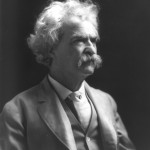
mark-twainWe’ve written about the centenary of Mark Twain’s death this week here and here, but for sheer liveliness, it’s hard to top Tom Wolfe’s take in the New York Times today here.

An excerpt:

“The rest of the world regarded Americans as a mob of barbarians who happened to live on top of a mother lode of precious minerals, fertile land, inexhaustible woodlands and waterways galore … but were as uncouth as they were rich … and spoke in barbaric yawps. This improbable yobbo, Mark Twain, had risen up from the buried life of the mines and the boiler rooms and done an amazing thing. He had turned the local yokel’s yawping yodels into … literature!

England gawked. Europe gawked. The whole globe gawked, even India. It has been recorded that Twain once returned from India and said to a friend, eyes wide, mandibles agape, soul in a state of utterly sincere self-awe: “In India, they know only three things about America … Wall Street … the Statue of Liberty …and Mark Twain!”

HOLB_LPostscript: Hal Holbrook in Mark Twain Tonight! on Tuesday, April 27, at 8 p.m., in Memorial Auditorium.  Sold out, I’m afraid, but there’s always a chance of returns… More info here.

“The right word may be effective, but no word was ever as effective as a rightly timed pause.” Mark Twain

Tomorrow: meet the authors — lots of them

April 23rd, 2010
Share

The seventh annual spring book salon, “A0804763615 Company of Authors,”  happens tomorrow (Saturday, April 24th) beginning at 1 p.m. and cbedeontinuing through the afternoon at the Humanities Center at 424 Santa Teresa Street.

The broad-minded book salon covers all genres from fiction to biography and  international politics to religion — rather like the Book Haven itself.  Unlike the Book Haven, however, the event gives the community a chance to meet the authors — lots of them.

This year’s authors will include, among others: Scotty McLennan on Jesus; Steven Zipperstein on Isaac Rosenfeld; John Felstiner, Robert Conquest, Terry Castle, and Patrick Hunt on poetry; Bert Patenaude on Trotsky; Kathryn Ma on prizewinning short stories; Tom Killion on Mount Tamalpais in art and poetry; Gail Lapidus and Alexander Dallin on Russia; Mark Lewis on China; Stan Yogi on civil rights; George Brown on the Venerable Bede; Denise Gigante on Romanticism; Herant Katchadourian on tintinguilt; Jean-Marie Apostolidès on Tintin; Jack Rakove on America; James Fishkin on democracy; and Sean Hanretta on Africa and Islam.

A Company of Authors is hosted by Peter Stansky and co-sponsored by the Palo Alto Weekly, the Stanford Humanities Center, and the Stanford Bookstore. Full schedule is available here.

In addition to refreshments, expect a 10 percent discount on featured books — with author signatures.

Happy Earth Day, Mother Earth!

April 21st, 2010
Share

atlasIt’s Earth Day, and the Nature Conservancy decided to celebrate with the release of The Atlas of Global Conservation, a lavishly illustrated new book that goes beyond the traditional atlas, providing an in-depth picture of the Earth’s animals, plants, and habitats. The story is largely told through maps — you can get a preview of the maps  here.

antelopes

Antelopes in the Botswana's Okavango Delta

“This is not about extrapolating trends toward some distant doom-and-gloom scenario.  This is about a complicated system of interacting species, changing climates, altered biogeochemical processes, and rapidly evolving human cultures shifting towards an entirely different global reality,” writes Paul Ehrlich in the book’s foreword.  “It is now widely accepted that our species could be entraining an extinction event as severe as the one 65 million years ago that wiped out all of the dinosaurs except for the birds.”

Sounds like a fancy way of saying what we’ve known for years — that we’re running out of time.  Gretchen Daily, Marilyn Cornelius, Charles Katz, and Brian Shillinglaw, however, write in the new volume that it has always been so:

buffalo

Cape buffaloes could not survive without seasonal floods

“However measured — in dollars raised or hectares saved — conservation has always been a race to buy time.  Now it needs to be about more, addressing head-on the root problem: that conservation too often is seen as being in conflict with human development.  How do we practice effective, enduring conservation in a world of growing numbers and aspirations of people?  We need to change our approaches quickly if we are to do anything more than temporarily slow the pace of biodiversity loss in a few places.”

waterbirds

Virginia salt marshes offer a smorgasbord for these whimbrels

The maps in this atlas represent “an unfailing faith in facts,” building from the best available data, writes Jon Christensen.  Every shape and color in this atlas has a database behind it.  He continues:

“Maps can inspire and inform. They can also limit and deceive. The more maps try to tell us, the more questions we should ask.  If these maps do not start some arguments, they will have failed.  These arguments matter.  Many of them are about priorities and actions. They are about life and death on Earth.”

We’ve decided to celebrate with a few of the book’s pictures, since nature’s story is best told that way — with apologies to Henry David Thoreau.

(All photos from The Atlas of Global Conservation, University of California Press, 2010.)

waterway

Brazil's Pantanal harbors jaguars, giant otters, the lesser anteater, and 650 species of birds

“Mark Twain threw it up in the air and I grabbed it”

April 21st, 2010
Share

nigger Shelley Fisher Fishkin‘s new book, The Mark Twain Anthology: Great Writers on His Life and Works, is surprisingly addictive, as noted below.  Though the essays are uneven (George Orwell’s essay is at once prescient and dated in its historical and cultural assessments, and I could have done without Erica Jong’s still-stuck-in-the-60s piece on “deliberate lewdness”), a quick perusal showed that Dick Gregory‘s short essay, taken from his 2000 “updated” memoir, Callus on My Soul, is still compelling and powerful.  Ironically, it’s one of the handful of essays written by someone who is not primarily a writer; though it lacks the timeless elegance of T.S. Eliot or Jorge Luis Borges, it has the immediacy of a punch. An excerpt:

“There have only been three geniuses in comedy: Mark Twain, Lenny Bruce, and Richard Pryor.  Mark Twain was the only one of the three who came out of the madness unscathed.  Of course writing is different from standing flat-footed onstage.  But he was so far ahead of his time that he shouldn’t even be talked about on the same day as other people.  Look what he did with his brilliant satire.  For the first time in the history of literature a White man talked about a relationship between a Black man and a White boy.  Black men didn’t even have names; they were referred to as ‘nigger.’  Then he wrote about The Adventures of Huckleberry Finn in 1884 and talked about ‘Nigger Jim.’  Today some people are outraged by that book and they have banned it from many school districts.  That’s really a shame, because the truth is that Twain was the first writer to refer to us as someone other than a nigger.  He attached a name to nigger and made Jim human. …callus

When asked why he called his earlier, best-selling autobiography Nigger, Gregory answered in his foreword, “Whenever you hear the word Nigger, you’ll know they’re advertising my book” — relevant to the rest of the essay in Fishkin’s book, which continues:

“People were afraid to ask for my book, and bookstore owners were afraid to put it in their stores.  Some Black folks would go into a bookstore and say, ‘I want one of Dick Gregory’s what-you-call-it.’  They just couldn’t say the word. And White folks would say, ‘You named that book a title I just can’t say.’ Or they would complain, saying, ‘I just can’t stand the name of your new book.’ I didn’t hear White folks complaining about the word nigger when I was growing up.  I only heard them using it.  If they had complained about the word nigger in the past, there would not have been a need to name my book Nigger. Titling my book Nigger meant I was taking it back from White folks.  Mark Twain threw it up in the air and I grabbed it.”

An interesting postscript from Editor Shelley:  Dick Gregory’s essay is one of my favorites in the book. I only wish he hadn’t made the same mistake that Hemingway & Leslie Fiedler & Norman Mailer and others made of referring to Jim as “Nigger Jim.” Twain never did — and he never would have. Twain’s first biographer, Albert Bigelow Paine, was the first to refer to Jim this way, and others followed suit. But any reader can see for herself that in the novel, Twain never refers to Jim by that name. — Shelley Fisher Fishkin

Celebrating Mark Twain, with or without Halley’s Comet

April 20th, 2010
Share

twainFor most famous dead people, we celebrate the anniversary of births rather than deaths, unless they’ve been assassinated or canonized.  This year, we’re making an exception for Mark Twain.

Or perhaps not:  While it’s the 100th anniversary of his death on Wednesday, this year also marks the 175th anniversary of his birth.  “I came in with Halley’s Comet in 1835,” he famously said in 1909.  “It is coming again next year, and I expect to go out with it.  It will be the greatest disappointment of my life if I don’t go out with Halley’s Comet.  The Almighty has said, no doubt: ‘Now here are these two unaccountable freaks; they came in together, they must go out together.’ Oh, I am looking forward to that.”

In any case, at 4 p.m. on Wednesday, April 21st, Shelley Fisher Fishkin will share excerpts from The Mark Twain Anthology: Great Writers on His Life and Works, which she edited for the prestigious Library of America series, at the Stanford Bookstore. (Zachary Baker will read a brief selection by Maks Erik that he translated for the book, in Yiddish and English.  Cintia Santana will read her translation of José Martí, in Spanish and English.)

The book is unexpectedly addictive, including writing from Marina Tsvetaeva, George Orwell, Charles Darwin, Thomas Edison, T.S. Eliot, Ralph Ellison, William Faulkner, Ernest Hemingway, William Dean Howells, William James, Helen Keller, Ursula LeGuin, Norman Mailer, Somerset Maugham, H.L. Mencken, Barack Obama, Eugene O’Neill, Franklin Roosevelt, George Bernard Shaw, Lionel Trilling, Gore Vidal, Richard Wright and others.

twain

Twain’s “Is He Dead?” at the Cinnabar Theater this month

For my money, I like Nobel laureate Toni Morrison’s essay:  “The brilliance of Huckleberry Finn is that it is the argument it raises,” she writes.

Twain would appreciate the attention, under any terms.  Fame enough for the man who said: “I can live for two months on a good compliment.”  Twain, who called himself “the most conspicuous man on the planet,” also said: “If it can be proved that my fame reaches to Neptune and Saturn, that will satisfy me.”

This year has also seen another performance of the play that Fishkin, author or editor of 33 books about Twain, rescued from oblivion and produced on BroadwayIs He Dead? just finished a 3-week run at Petaluma’s Cinnabar Theater.

Another book to celebrate this year: Mark Twain: A Tramp Abroad, Following the Equator, Other Travel Writings, edited by Roy Blount Jr., also from the Library of America.

Fishkin summarized the forever appeal of the journalist-turned-novelist for the Philadelphia Inquirer recently:  “He learned to tell the truth, and he learned to tell a fantastic tall tale.  Both stood him in good stead as a reporter and as an American writer.”

***

dipiero

W.S. Di Piero

The hour-long Fishkin reading leaves plenty of time to hike to over to the Terrace Room of Margaret Jacks Hall for a 6:30 reading by poet, translator and essayist W.S. Di Piero.

According to David Kieley over at Bookslut:

“…W.S. Di Piero reads like a cop. In his charcoal suit, burgundy shirt and silver tie, he looked a lot more like his South Philadelphia roots than his current home of San Francisco. His speech was punchy and accented, his commentary sparse and to the point. A few times during the reading I closed my eyes and laughed at the ease with which I could pretend that Al Pacino was reading me a poem.

I don’t mean to rag on Di Piero; it was the sense that he felt cornered at the podium that made him seem sincere and relieved my fear of literary pretense. So let’s trust that he still is W.S. from the block, even if he’s “mixing it up” in a teaching gig at Stanford, because his book, like his persona, is all about finding the shepherd in sheep’s clothing.”

A few words from the poet himself:


“Take away whatever you want,

but deliver me to derangements

of sweet, ordered, derelict words.

“Exile is when you live in one land and dream in another”

April 17th, 2010
Share
milani_hrz

Abbas Milani (Photo: L.A. Cicero)

“Philosophers have said writing is a pharmakon, a cure and a curse, a poison and an antidote,” writes Abbas Milani in Tale of Two Cities: A Persian Memoir.  The book, first published by Mage in 1996, when he was a professor in “the hospitable atmosphere of a small liberal arts college run by the Sisters of Notre Dame,” has been reissued in paperback.

Milani’s book is peppered with references to the way language, thought, and politics mix:

“Language is the source of problems for all revolutions. The structure of language, its ability to conjure memories of the past, interfere with the leveling goal of revolution.  Revolutions invariably strive to erase memory.  Memory, after all, defies the fiction of a totally new beginning. And so the Islamic Republic encouraged a new Arabicized lexicon. Everyday speech became a political act.  …

Revolutions are also about silence. Through a coercive reign of terror, the Islamic Republic milanicoverhad, unwittingly, enriched our language of silence and our society’s lexicon of gestures.  Literary language became more metaphoric and the language of gestures became textured with new layers.  Glances, brow movements, intonations, body language became pregnant with new precise meanings and possibilities. The faces, the crowd, the gestures of Khomeini’s frenzied burial can, I think, only be understood in light of this new vocabulary.”

Iran, after all, is the original home of ketman, which Czesław Miłosz limned in Captive Mind.  It’s not surprising that Shahryar Mandanipour discussed the same topics during a recent visit, with his friend Milani in the front row.  Milani’s remarks also bring to mind another writer’s immortal words on politics and language.

Milani’s remarkable rise to international prominence was described in a 2005 San Francisco Chronicle profile here.  It is hard to exaggerate the importance of Milani in mobilizing the Bay Area Iranian diaspora. I interviewed him last week, but not all questions made it into the final cut. Here’s one, in which Milani modestly neglects to mention his own role in unifying the Iranian diaspora he praises:


How is this Iranian diaspora in the U.S. supporting the movement for democracy in Iran?

The events since last June’s contested presidential election and the participation of millions in disciplined, peaceful, and profoundly uplifting protests have invigorated, and in some ways unified the hitherto divided, often dormant Iranian diaspora.

The first quarter century of Iranian-Americans lives in America was primarily dedicated to establishing for themselves and their families new lives and developing new roots. Just as the community was beginning to look into becoming more politically and socially active, the emergence of the singularly impressive and inspiring democratic movement in Iran acted as a catalyst for this politicizing process. The Moghadam Family’s endowment of our Iranian Studies Program at Stanford, Bita Daryabari’s generous endowment that allows us to vastly expand our ability to teach Persian literature and culture here were clear indications of the community ‘s success and new sense of social responsibility.

Much more can and needs to be done by this diaspora to help with the inevitable transition to democracy in Iran—from helping enrich the debate about Iran here in America to sending a strong message of support to those fighting for democracy inside the country. Many community leaders are working hard to map out a strategy for this auspicious beginning.

Here’s another exchange that didn’t make the final cut:

Some fear that any reaction from us at all to support Iran’s democracy movement will backfire on the dissidents – that they be seen as foreign stooges, and the U.S government further demonized as the great Satan.

The Iranian regime is bent on accusing the West of interfering in Iran’s domestic affairs, and on dismissing dissent as nothing but a concoction of the West, or America. Before them, the Shah too accused his critics and opponents of being “agents” of foreign powers. Ironically, when leaders of this regime were part of the opposition to the Shah—1963-1979—they consistently demanded that the West, and America in particular, cease their support for the Shah and offer political and moral support to the opposition. Now when the Iranian opposition asks the world for the same kind of moral support, the regime accuses them of “serving imperialism.” It also accuses the Obama administration of “interfering” in Iran’s domestic affairs when it offers any support for Iran’s suppressed democrats.

A melancholy sweetness hangs over many of his memories of Iran, inviting inevitable comparisons from his second city on the West Coast:  “Here, lovers are lonely monads, guarding turfs, who quickly ‘get on with a new life’ when the old love proves impractical.  In English, we ‘fall’ in love, whereas in Persian we ‘become’ in love.”  (Translator Dick Davis echoes many of the same sentiments — I’ve written about him here.)

“Exile is when you live in one land and dream in another,” writes Milani. “I am now a permanent exile.  I write in both English and Persian.  Persian connects me to my past, English is the language of my future.”


<<< Previous Series of PostssepNext Series of Posts >>>