More on Katyń …

April 17th, 2010
Share

More on Katyń from Timothy Garton Ash in the London Guardian hereGarton Ash focuses on the complicity of Western powers in the Soviet cover-up of an atrocity, particularly Britain.  He reflects on how the echoes of Katyń reverberate in the present:

ash2

Timothy Garton Ash

In 1943, confessing that “in cowardly fashion” he had turned his head away from the scene at Katyn, the head of the British Foreign Office wondered in an internal memorandum “how, if Russian guilt is established, can we expect Poles to live amicably side by side with Russians for generations to come? I fear there is no answer to that question.” But history may even now be producing a most unexpected answer, out of a second Katyn disaster.
The difference:

The first Katyn catastrope was concealed for decades by the night and fog of totalitarian lies; the second was immediately the lead item in news bulletins around the world. Most extraordinary has been the reaction of the former KGB officer Vladimir Putin, who has gone to exceptional lengths to demonstrate Russian sympathy, repeatedly visiting the crash site, announcing a national day of mourning today, and ordering Andrzej Wajda‘s film Katyn (which spares you nothing of the cruelty of the KGB’s forerunners) to be shown on primetime Russian TV.  [Will no one bring this film to Palo Alto? Please?  — ED]

Garton Ash is taking some hits for describing last weekend’s plane crash as a “second Katyń” — though of course, he wasn’t the first to coin the phrase.  An intelligent outlook on the future by Adrian Pabst in “This Is No Second Katyn” in Telos.  And a victim’s grandson, Kris Kotarski, remembers Katyń in another Guardian article “Memory Is Sacred Again in Poland“:

In the aftermath of the crash, Poles are avoiding the “second Katyn” moniker that was used by Timothy Garton Ash, calling this the “tragedy in Smolensk” instead. This is apt, since this time the victims do not have to wait decades for information, and people both in Poland and abroad have publicly poured their hearts out while the Russian authorities are assisting the families at every turn.

Postscript: Katyń is now available on DVD, and watching it tonight, it’s even better than expected — and I can expect a lot.  (Hadn’t seen anything by Andrzej Wajda since Ashes and Diamonds.)  Best after a bowl of borscht, “with an egg in it,” as Cary Grant says in Talk of the Town.  The only vodka in the house was, alas, Russian — not quite in keeping with the mood of the film.  Unforgettable movie, by an unforgettable director — one whose father, incidentally, was a Polish cavalry officer, murdered in 1940 during the Katyń massacre.


The forests of Katyń

April 12th, 2010
Share
katyn

Germans discover 4,500 Polish officers buried in mass graves, April 1943

The airplane crash that killed Poland’s President Lech Kaczyński and first lady Maria Kaczyńska — along with Poland’s deputy foreign minister and a dozen members of parliament, the chiefs of the army and the navy, church leaders, the president of the national bank, and others — dominated the news over the weekend (my interview with European historian Norman Naimark here).  The plane was en route to a commemoration for the victims of Katyń.

For many in the West, it was the first time they had heard of the forests that hid the mass graves following the 1940 Soviet massacre of about 22,000 people.  Most press accounts describe it as a massacre of Polish officers, but the list of the murdered included doctors, professors, lawmakers, police officers, public servants, and others in the intelligentsia — the kind of people Poland needed to function as a nation.

The Soviets denied the massacre for decades, blaming the Nazis for the atrocity.  And the Soviets controlled Poland — hence, it was not possible to speak openly about Katyń.  Any mention of the atrocity was dangerous; government censorship suppressed all references to the massacre.

herbertAs I wrote elsewhere: ‘Imagine, for a moment, an American equivalent: a world where we were not allowed to speak of 9/11 and could not remember the victims in any public way. A world, moreover, in which our nation was ruled by the terrorists who did the killing. The comparison misses the enormity, still: Poland was a much smaller country with a prewar population of 30 million, and the number of those murdered 5-7 times as great as those who died in the World Trade Center.”

In Year of the Hunter, Nobel laureate Czesław Miłosz, who survived the destruction of Warsaw, wrote: “The Soviet state went to great pains to convince the world of its innocence, and its allies took it at its word, or pretended to, so that the Poles were left to stand alone—with the truth, but with a truth proclaimed by the German enemies. And who would have believed them, since they were known for their anti-Soviet ‘complexes’?” Reading a book by an American correspondent in Moscow, Miłosz wrote, “I found the excerpt that reports on the trip by Western diplomats and journalists to Katyń; I read it and almost threw up.”

In 1981, Solidarność erected a memorial with the simple inscription “Katyń, 1940,” but it was dismantled by the police, to be hunterreplaced with an official monument “To the Polish soldiers—victims of Hitler’s fascism—resting in the soil of Katyń.”

Writers found ways to remember it:  Zbignew Herbert, still living in Poland with all the constraints that situation implied, made an oblique reference to Katyń in his poem “Mona Lisa,” when he refers to the “executed forests,” and also in his,”Report from a Besieged City,” using the 1981 imposition of martial law to make oblique comparisons to Poland’s recent past:

Wednesday: cease-fire talks the enemy interned our envoys

we don’t know where they are that is where they were shot

Heidi Durrow tonight and tomorrow at Stanford, Kepler’s

April 7th, 2010
Share

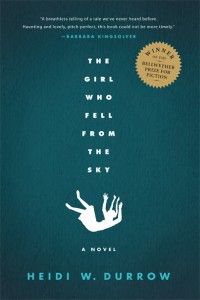
durrowIt’s 2010 census time, and controversy has erupted over which boxes to check for “race” — or whether one should check any at all.

Rachel, the heroine of Heidi Durrow‘s The Girl Who Fell From the Sky, could relate.  The daughter of a Danish mother and an African-American G.I., a family tragedy puts her under the thumb of her strict African American grandmother.  She moves uncomfortably in a new world where blue eyes and light brown skin are attention grabbers.

The book has already bagged one award:  the Bellweather Prize for Literature of Social Change.  The prize’s founder, writer Barbara Kingsolver, called it “a breathless telling of a tale we’ve never heard before. Haunting and lovely, pitch-perfect.” Joan Silber, author of The Size of the World, called it “a remarkable novel … Its core story about a mother’s desperate act recalls the insights of a writer no less than Toni Morrison. Durrow writes fearlessly about race, family, and memory — she is a writer to watch.”durrow2

The local community will have a chance to do precisely that tonight, when Durrow gives a reading at 5.30 p.m. at the Stanford Bookstore and tomorrow night, 7.30 p.m. at Kepler’s.  Beforehand, she’ll also be doing “a conversation over Sprinkles Cupcakes” at 4 p.m. (in CSRE Conference Room, Bldg. 360 at Stanford — for those not at Stanford, it’s off the Main Quad).

The publisher says the story is inspired by “true events.”

Durrow’s resume is substantial:  She’s a graduate of Stanford University, Columbia University’s Graduate School of Journalism, and Yale Law School.  She has won the Lorian Hemingway Short Story Competition, the Chapter One Fiction Contest, and the Roth Endowment Award and was nominated for a Pushcart Prize. She has received grants from the New York Foundation for the Arts and the American Scandinavian Foundation, and a Fellowship for Emerging Writers from the Jerome Foundation. She is cofounder and coproducer of the Mixed Roots Film and Literary Festival.

Durrow isn’t the only one thinking about biracial issues:  check out Michele Elam’s article at the Huffington Post here.

A film about Anna Akhmatova…

April 6th, 2010
Share
akhmatova3

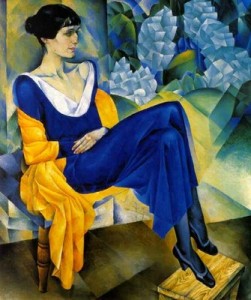
Akhmatova's famous portrait by Nathan Altman

Some time ago, I read Anatoly Nayman’s Remembering Anna Akhmatova — or at at least I started to.  My reading was interrupted by commissioned review, but I had read enough to understand that I had run across that rare phenomenon: in Akhmatova, Nayman had found someone whose every word, gesture, or action was of utmost importance, and must be recorded.

So when Elena Danielson, Hoover Archivist extraordinaire, told me that Helga Landauer’s  A Film About Anna Akhmatova was being shown at Wallenberg Hall on February 4, I was keenly interested.

Unfortunately, I was also in a wheelchair at the time, and the weather was miserable and the parking far away.  Elena told me later that even in the torrential rain, the auditorium was packed.

akhmatova2

Akhmatova's funeral: Brodsky at right, with Nayman behind him. Rein is at left.

I can see why.  Helga, a Moscow-born writer and filmmaker who lives in downtown Palo Alto, kindly sent me a DVD.

The same urgency comes across in the film, which features unusual footage of pre-revolutionary Russia, as well as Nayman’s testimony.  As Joseph Brodsky said of Nayman’s book, it’s “chief virtue … is the intensity of the author’s attention to his subject.” The film also features, unforgettably, Akhmatova reading her own poems.

Nitpicking:  some of the clips are used somewhat repetitively.  And unless I missed it, there’s no explanation of Purcell’s Dido and Aeneas in the soundtrack — it was one of Akhmatova’s favorite pieces of music, and became so for her protégé Brodsky as well.  Better translations of Akhmatova’s poetry into English are available than the ones used here.

The film takes a birth-to-death approach to Akhmatova’s life, rather than focusing on Nayman’s firsthand experience of Akhmatova in the late 1950s and early 1960s.  He was, after all, on of Akhmatova’s famous Pleiad, her “magic choir” — including poets Yevgeny Rein and Dmitry Bobyshev as well as Nayman and Brodsky (Nayman does show a few of Brodsky’s photos from the time — as I recall, the only mention of the Nobel laureate). Irena Grudszinska Gross, writing of the importance of literary friendships in the careers of young poets in Czeslaw Milosz and Joseph Brodsky: A Fellowship of Poets, notes that the cloudless period of this net of friendships lasted five years —  “In this history of literary friendships, it will endure forever.”

Well, if one wishes to be filled in on that part of the picture, one can always find his book.

The film also includes some memorable formulations from Nayman, a poet himself — I think particularly of his remark that poetry is the process by which word becomes law.

A trailer is here.

Edward Hirsch and wild gratitude

March 30th, 2010
Share
hirsch

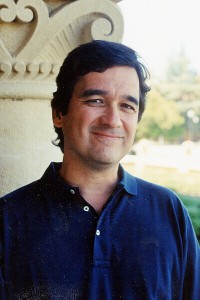
Hirsch (Photo: E. Thayer)

Edward Hirsch wears a number of hats:  Some think of him as president of the Guggenheim Foundation.  Some think of him primarily as an essayist, whose work has been published in The New Yorker, The New York Review of Books, American Poetry Review, and The Paris Review, and the author of a weekly column on poetry for the Washington Post Book World from 2002 to 2005.  My association is entirely different:  While on the faculty at the University of Houston with Adam Zagajewski, he shepherded American students to Poland to acquaint them firsthand with the wellspring of some of the greatest poetry of the 20th century, including making arrangements for the kids to meet Nobel poet Czeslaw Milosz.

But if he’s like most poets, Hirsch would rather be remembered for his verse.  On Sunday, the New York Times offered a rather enticing hors d’œuvre for Hirsch’s upcoming visit to Stanford in a review here.

The review, by Peter Campion, discusses the title of Hirsch’s new and selected, The Living Fire, taken from his poem “Wild Gratitude”:

On its surface, the poem seems to be about, well, a guy spending time with his cat. But as he listens to her “solemn little squeals of delight,” he begins to remember the 18th-century English visionary and madman Christopher Smart, who in his most famous poem, “Jubilate Agno,” venerated his own cat, Jeoffry. The memory leads to a chain of associations, and the poem ends in a nearly epiphanic moment:

And only then did I understand51VPHf8OtGL._SX106_
It is Jeoffry — and every creature like him —
Who can teach us how to praise — purring
In their own language,
Wreathing themselves in the living fire.

This passage could stand as an emblem for all of Hirsch’s poetry. Literary and allusive, but also domestic and intimate, as it rises toward praise, Hirsch’s voice resounds with both force and subtlety.

(Vis-à-vis Kit Smart’s madness and eventual confinement in an asylum, see Samuel Johnson: “I did not think he ought to be shut up. His infirmities were not noxious to society. He insisted on people praying with him; and I’d as lief pray with Kit Smart as any one else. Another charge was, that he did not love clean linen; and I have no passion for it.”)

Hirsch will be coming to Stanford on Monday, April 26.  Stay tuned.

From blog to book…

March 27th, 2010
Share
BakerKline

Baker Kline

In a She Writes radio broadcast yesterday: Kami Wicoff interviewed Christina Baker Kline about that formidable topic, creating a dynamite book proposal.  One message came across clearly:  Don’t underestimate the power of the internet.  It’s turned the whole world of publishing upside down.

One obvious example is the blog-to-book phenomenon — tricky to negotiate, because it has to be more than pouring your web content onto the printed page.  And if the blog suffers in the transition, it will hurt book sales, too.  Galleycat describes the negotiations here that resulted in Citadel Press acquiring book rights to PleaseFireMe.com.

The more high-end of these kinds of transitions won’t involve movie rights.  More scholarly authors actually have to develop an idea, a process that doesn’t lend itself to snippy blog posts.  I wrote about one solution here:

A scholar wants to tease out an idea for a book. He writes a paper. He flies across the state, nation or even world to deliver it for 10 minutes to a roomful of jet-lagged peers. He flies home. Lather. Rinse. Repeat.

But how does this time-honored academic cycle survive in the 21st century, when travel budgets are dwindling?

In the humanities, at least, an alternative is surfacing via the net: Arcade.

Roland Greene, head of Stanford’s Division of Literatures, Cultures, and Languages, launched the website in November. Pretty much by word-of-mouth alone, and some nifty technological know-how, it’s now attracting more than 5,000 visitors a day.

Greene_news

Arcade maestro Greene

Arcade provides a venue for scholarly articles, an intellectual network, a public conversation, a digital salon and a sounding board for ideas before they wind up between hard covers. “In my field, it’s really a boon,” said Greene, professor of English and of comparative literature. “There’s nothing like it on the web.”  Read more…

Had a chat with Zach Chandler, web editor for Arcade, over coffee yesterday.  He told me that Arcade does have an advantage over many other blogs:  The site features 30 bloggers, not one.  And each of those bloggers likely has a cadre of students, somewhere.  That’s not even calculating for the cross-traffic the site produces among contributors.  Zach still hopes the Arcade numbers will go up dramatically in the coming months.  (They’re currently at about 5,000 visitors a day.)

Meanwhile, if you want to hear Baker Kline’s webinar about “How to Write a Non-Fiction Book Proposal That Sells” — next Wednesday from 1 to 2 p.m. — check this out.


<<< Previous Series of PostssepNext Series of Posts >>>