
There goes a Johns Hopkins landmark: Dick Macksey’s magnificent home for sale!

July 8th, 2020

Share

His personal library. Part of it.

Hollis Robbins, Dean of the School of Arts & Humanities at Sonoma State University, tweeted a sad tweet last night. What a loss for Johns Hopkins University! We’ve written about the legendary Johns Hopkins polymath, Richard Macksey, Professor of Everything, here and here and here and here, and, well in Evolution of Desire: A Life of René GirardThe French theorist and Macksey were longtime colleagues.

Dick Macksey died last July, and now his home has been stripped of its magnificent personal library and its future is in the hands of realtors. Weep for it! Weep! Weep! Weep!

The library was a marvel for Johns Hopkins students, and Dick Macksey invited them into his home to teach and share his books. As I wrote about the photo above:

Behold the 70,000-volume personal library of retired Humanities professor Richard Macksey of Johns Hopkins University. He has sometimes claimed that his collection includes an autographed copy of Canterbury Tales and a presentation copy of the Ten Commandments. Unlikely, but I wouldn’t rule it out. More demonstrably, he has Marcel Proust‘s copy of Swann’s Way, and many first editions of William Faulkner, Edith Wharton, Henry James, and others.

But what is a home without it’s heart? I’ll tell you what it is:

Dick Macksey at home with friends.

“This stately Italianate Renaissance residence is situated on a well landscaped double lot boasting a private walled courtyard and secluded walled garden. Exquisite detail and proportions abound throughout. Lovely 30 foot entrance hall with distinctive “double-staircase” and palladian door to terrace, 36 foot living room with fireplace, handsome built ins, and access to terrace. Inviting dining room with fireplace and access to terrace. 12 sets of stylish arched french doors on first floor, 5-6 bedrooms, 3.5 baths. 26 foot library with fireplace and 14 foot ceiling. Take advantage of this rare urbane opportunity slip away.”

Well, as Hollis Robbins says, without the books, it’s just a house. But what a beauty it is nevertheless. You can look at more photos of it here. No price is listed. Are you surprised?

Below, the video of the home. Close your eyes, and imagine the books. Imagine it crammed with books.

Postscript on 7/9: It seems that everyone has a Dick Macksey story. Here’s one from Steve McKenna: “I actually attended a grad class in that house. I was 22. If you hadn’t read everything, he could be…hard to follow. So when I got lost, I would just scan book spines. He was a bit like Borges’ Funes the Memorious. Macksay held court in his library. He would begin by asking us what we’d just read, and would launch into a two-and-a-half hour disquisition that might go from Borges to Derrida to Catullus to Goethe to Hart Crane and always to … Proust (to which all roads returned for him, and from whom all roads also departed) … you didn’t come away with the sense that it was madness, just that he was moving on a level so stratospherically above us that we were idiots. But the shelves were amazing.”  Martha Reineke added: “Reflecting on what that home was, with the amazing books and conversations over so many years, makes the realtor video even more poignant. A house is never emptier than when its shelves are bereft of books.”

Martin Amis on the failure of the intellectuals: “The truth about Russia dawned in cloud and mist.”

July 6th, 2020
Share

Martin Amis calls it like it is.

Martin Amis goes on a rant about Lenin and the Soviet Union in the New York Times. As rants go, it’s top drawer. Enjoy for the verbal fireworks.

He begins: “It was a very bad idea from the outset, and one forced into life — or the life of the undead — with barely imaginable self-righteousness, pedantry, dynamism, and horror. The chief demerit of the Marxist program was its point-by-point defiance of human nature. Bolshevik leaders subliminally grasped the contradiction almost at once; and their rankly Procrustean answer was to leave the program untouched and change human nature. In practical terms this is what “totalitarianism” really means: On their citizens such regimes make ‘a total claim.'”

He continues:

As one historian of Russia put it, it is to the intellectuals that we turn for “real prowess of wrong-headedness.” But it wasn’t just the pundits, the writers (H. G. Wells, G. B. Shaw) and the philosophers (J.P. Sartre, A. J. Ayer) who swallowed the Moscow line; so did historians, sociologists, politicians, and even businessmen. To its supporters the allure of the Communist Party was twofold. The secondary appeal was that it gave you the (not quite delusive) impression that you were playing your part in world events; the primary appeal was that the program looked wonderful on paper, and spoke to the optimism and idealism of many of the most generous hearts and minds.

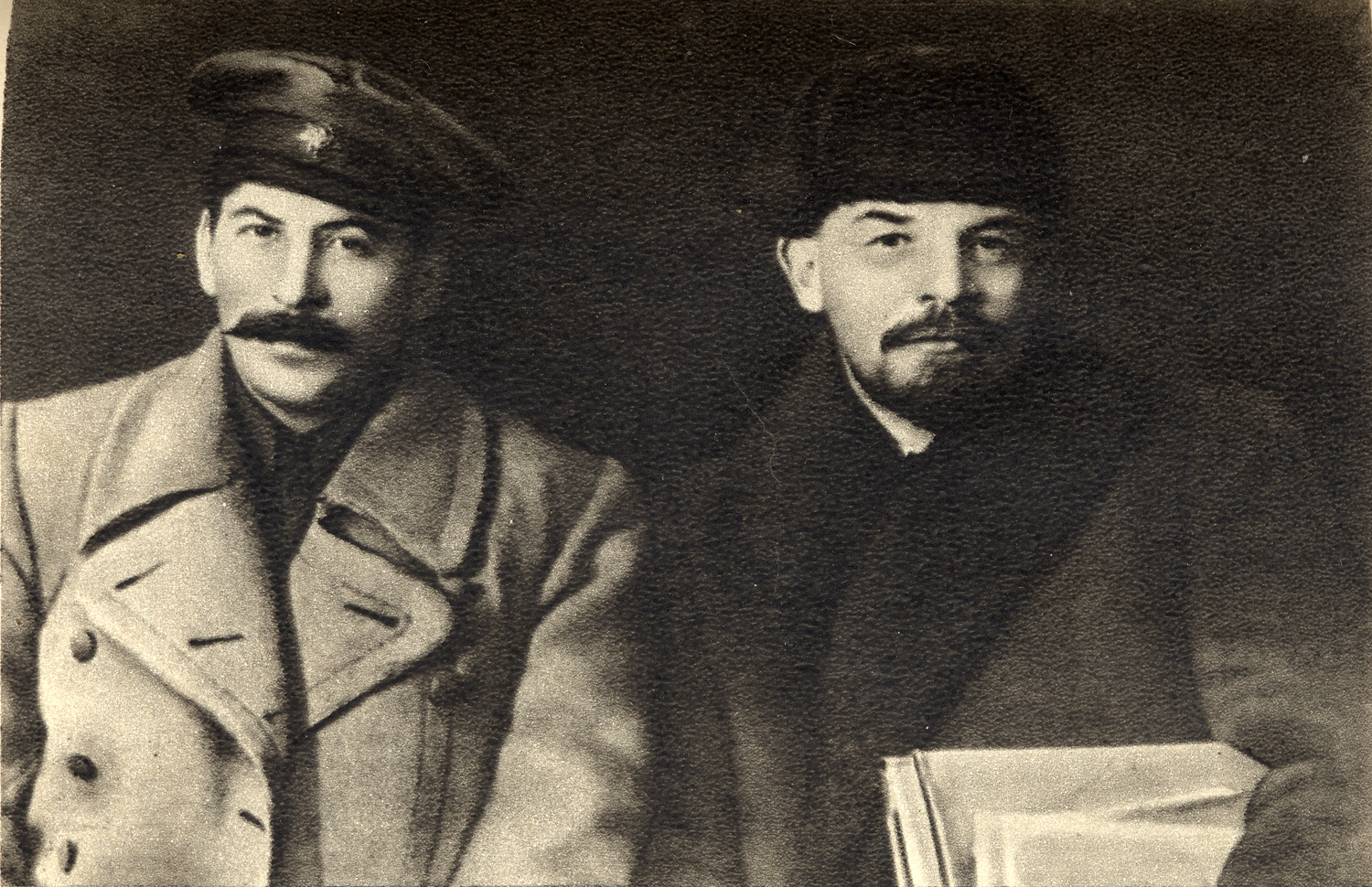
Two of a kind. Read about Lenin’s brain here.

It was vaguely understood that there had been some loss of life: the terror and famine under Lenin, the Civil War, forced collectivization (“Ten millions,” Stalin said to Churchill, holding up both palms, in the Kremlin in 1942), the burgeoning system of state slavery known as the gulag (created under Lenin), the Great Purge of 1937-38.All that could be set aside, for now, because (a) revolutions are always violent, and (b) the ends supposedly justify the means.

As for the first point, the French revolutionary terror lasted from June 1793 to July 1794, and claimed more than 16,000 victims, no more than a busy couple of weeks for the Bolsheviks (and imagine if Robespierre had kept at it until 1830). As for the second point, well, there is a counterproposition: Means shape ends, and tend to poison them. We all know, now, what we think of the Good Intentions Paving Company. Anyway, the means were all the Soviet citizen was ever going to get. Western doublethink and selective blindness on this question is a very rich field; the wisest and most stylish guide to it is Reflections on a Ravaged Century (2000), by Robert Conquest, to whom we will necessarily return.

Nabokov was the first one to see it with an “illusionless eye,”  the critic Edmund Wilson, his longtime correspondent, indulged the Bolsheviks. Amis does not indulge Wilson:

Conquest working at his Stanford home. (Photo: L.A. Cicero)

By 1972 Wilson might have found time to read the three outstanding memoirs of the period: I Chose Freedom, by Viktor Kravchenko (1946), Journey Into the Whirlwind, by Eugenia Ginzburg (1967), and Hope Against Hope, by Nadezhda Mandelstam (1970).

Kravchenko was an apparat high-up who defected immediately after the war; Ginzburg was a provincial don and journalist who was found guilty of Trotskyism; and Mandelstam was the wife, and then the widow, of the great poet Osip (1891-1938). Cumulatively, these books persuade you of a disconcerting truth: Compared with Stalin’s Russia, Hitler’s Germany was a terrestrial paradise — except for Communists and Jews (and, later, Gypsies and homosexuals).

Kravchenko, Ginzburg and Mandelstam show us a society from which the concept of trust had been completely excised — a society where the conversational meaning of the question “Do they write?” was “Do they write letters of denunciation to the secret police?” You couldn’t trust your parents; you couldn’t trust your children. In addition, everyone was terrified all the time, right up to and including Stalin, who feared assassination at every waking minute. When he flew to Tehran for the first Big Three summit, his plane was escorted by 27 fighters; when he entrained for Potsdam (the third and final summit), his bodyguards numbered 18,500. By contrast, ordinary Germans knew no panic until 1943, as the reckoning loomed, and as the cities were being bombed nightly, then daily, then daily as well as nightly.

Solzhenitsyn in a long tradition.

The truth about Russia dawned in cloud and mist. The first consciousness-shifting book was Conquest’s The Great Terror (1968). Very soon the samizdat version was circulating in Russia; and freshly enlightened parents would wonder if their growing teenagers were “ready for Conquest” and the attendant shock. Conquest had time to add The Nation Killers and Lenin, but not long enough to add Kolyma: The Arctic Death Camps (1976) — before the translation of Aleksandr Solzhenitsyn’s The Gulag Archipelago was complete in its three volumes (1973-75). This was and is a visionary nonfiction epic written by an artist in the Russian Orthodox, old-regime tradition of Gogol, Dostoyevsky and Tolstoy. Hereafter the great argument (like the original Marxist idea) had only a vampiric existence — technically dead, but still animate.

Read the whole thing here.

Christopher Lydon, Robert Pogue Harrison discuss our “worldwide theater of imitated desire”

July 2nd, 2020
Share

“HISTORY IS A TEST FOR MANKIND, BUT WE KNOW VERY WELL THAT MANKIND IS FAILING THAT TEST.” – RENÉ GIRARD

Is Geryon an image of our time?

The tables are turned on Entitled Opinions’ Robert Pogue Harrison: public radio show host Christopher Lydon recently interviewed the interviewer for Open Source in Boston. The wide-ranging conversation considered the French theorist René Girard’s mimetic theory, the nature of warfare, the dangers of biotechnology, and the social media.

A recording of the conversation is available at the Los Angeles Review of Books’ Entitled Opinion channel here.

Mankind is an imitative species “with a terrible envy built into it, a competitive desire to be like some ideal of the other person,” Harrison said, citing the work of Girard. Facebook is the “perfect mechanical vehicle” of such envy. Facebook services mimetic needs with “a prosthetic self and a prosthetic social life and prosthetic friends.”

“We have this illusion that there’s nothing more proper to my inner self than my own desires,” said Harrison – but Girard challenges that assumption, showing that our desires are the result of imitation. No coincidence, then, that Facebook was “a worldwide theater of imitated desire on people’s personal computers,” he said. Certainly his former Stanford pupil Peter Thiel, an early investor in Facebook, understood the importance of Girard’s legacy when he said: “I suspect that when the history of the 20th century is written circa 2100, he will be seen as truly one of the great intellectuals, but it may still be a long time till it’s fully understood.”

Radio host Lydon

Imitation leads to violence, and Harrison noted that Girard is “more compelling in his diagnosis of the problem of violence rather than what he offers as an alternative.” Girard’s solution? “The refusal to retaliate he believed was the only sane recommendation in the face of this vortex that international violence could create,” said Harrison.

Harrison also took on the gene-editing boom: “In the name of doing good, you can license a lot of harm,” he said. “Mengele in Auschwitz will eventually be recognized as a visionary of the 20th century, although his methods will be condemned and his Nazi affiliations never endorsed.”

Radio host Harrison

Harrison, a Dante scholar, pointed out that the Inferno’s portrayal of sea-faring Ulysses was the “archetype of scientific discovery,” always heading to new frontiers of exploration and knowledge, which ultimately led to his death. “The line that’s being crossed today is taking the role of creation into our own hands and presuming to know better than nature.” He asked what the motivations behind biotechnology are. Dante’s Geryon, the furry monster who represents fraud in the Inferno, “has the face of a gentle, kind, smiling man, and the tail of a scorpion,” he said. “I want to know where the scorpion tail is hiding in this new explosion of biotech.”

Listen to the whole thing at The Los Angeles Review of Books here.

“THE ONE WHO BELIEVES HE CAN CONTROL VIOLENCE BY SETTING UP DEFENSES IS IN FACT CONTROLLED BY VIOLENCE.” – ROBERT HARRISON

Joseph Brodsky’s 80th birthday, and the day he arrived late for his talk at the Commonwealth Club

June 29th, 2020
Share

On California Street, San Francisco (Photo by Grisha Freidin on https://thenoiseoftime.blogspot.com/2020/01/an-afternoon-with-joseph-brodsky-in-san.html?m=1

On May 24, Joseph Brodsky would have turned 80 years old. You know that. I wrote about it already, here. But someone else beat us all to it: Grisha Freidin, Stanford Professor of Slavic Languages and Literatures emeritus, made his eightieth birthday post in January on his blog The Noise of Time. The month of death was momentarily confused with the month of birth. Perhaps this post will be the final word. He writes:

On the way back to his room, I asked him to pose for me and my new Pentax camera, with my favorite wide-angle lens. The son of a photographer, he appreciated the camera, played with it a little and took a few shots (none came out well). He and I loved the quirky fog city, traversed it on foot on many occasions, and had a warm spot for its jerky cable car, especially for the fact that it was totally legit to ride on its footboard. An unquestioned taboo in Russia, it gave us a frisson to avail ourselves of a harmless San Franciscan libertinism. I was able to take this shot just as a cable car was crossing behind him.

Then they realized he was half an hour late leaving for the Commonwealth Club – and that’s not counting traffic. No one arrives late at the August Commonwealth Club – not if you’re scheduled to speak. The Russian poet arrived forty minutes late. Everyone had waited. 

This year Joseph would have turned 80. I miss him as much as a quarter century ago when I first learned of his death. I had recently mailed him a pair of Soviet Navy undershirts — they were all the rage among boys in our childhood — wishing him and his wife happy sailing together. He was touched and sent me a post-card with a poem, in English. The verse was addressed to me and invoked my book about our other favorite Joseph, Osip Mandelstam (A Coat of Many Colors). The very language of the poem alluded to an underlying motif in our friendship: the love of English we shared and our life-long dedication to the cause of making it our own. Our friendship, in fact, may have begun back in the 1960s in Moscow over a discussion of Auden’s poetry. He began reciting “Memory of W. B. Yeats” in his vatic baritone, and I finished it for him in my own Muscovite high-pitched voice.

Read the whole thing here. Bonus prize: you get to see the post card with the poem Joseph Brodsky wrote to him on it.

Can birdsong heal the soul? One writer thought so.

June 24th, 2020
Share

Hudson had 240 bird calls in his mind.

We know about W.H. Hudson‘s adventures in the jungles of South America – Stanford discussed them during its Another Look evening on the author’s Green Mansions. I remember the prominence of exotic birdsong in the featured novel.

But who would have guessed that birdsong would be the very thing that we would need two years later, facing a global pandemic? On my daily walks, I’ve suddenly become aware of the birds around us, and especially their chirping and trilling and singing that gives me a momentary thrill, a sense of  a wilder world coexisting with the desk-bound life I live.

“To sit and listen to any birdsong is to meditate on the wildness of birds,” Jason Wilson writes in the current issue of Britain’s StandpointAlthough Hudson was reared in Argentina, he spent a number of winters cooped up in Paddington with his wife, an opera singer and his former landlady. Paddington took a toll on his spirits, as it has for many others. What restored him? Birdsong, in part. “Hudson teaches us that bird song is a medicine that restores freedom and wildness to our minds,” Wilson writes.

An excerpt:

In one of its essays on sparrows, which for Hudson stood for wild nature in an urban wasteland, he wrote, “it is always possible to find something fresh to say of a bird of so versatile a mind”. When I first read this, I was surprised not only by that word “fresh” but by the notion that a sparrow has a “mind”. Hudson praises this humble little bird for “its greater intelligence” and “individual character”. He found that, despite their ubiquity, “the individual sparrow is little known to us”. Here was Hudson looking at a common bird as if for the first time.

“A bird of so versatile a mind…” (Photo: Thorsten Denhard)

He was especially interested in the gatherings of the birds that Londoners then called “a sparrows’ chapel”. They congregate in a tree or hedge after a rain shower or at sunset and “their chorus of ringing chirruping sounds has an exceedingly pleasant effect; for although compared with the warblers’ singing it may be a somewhat rude music, by contrast with the noise of traffic and raucous cries from human throats it is very bright and glad and even beautiful, voicing a wild, happy life”.

All passerines—the order includes more than half of the different species of birds—have a habit of concert singing at sunset and expressing that “overflowing” of life that Hudson sought. There is no need to hanker for the exotic—the common birds around you can provide the thrill of untamed wilderness. Hudson suggests that really listening is to escape your worrying mind by concentrating on the emotion you feel when a bird sings. It is to range beyond yourself and self-absorption. When he was writing about the birds he knew as a young man in Argentina, he could hear over 240 bird calls in his mind. Bird music seemed lodged in a different area of his brain. Each time he heard a bird sing, it renewed his store of primitive bird song.

He described a starling’s song thus: “the airy whistle, the various chirp, the clink-clink as of a cracked bell, the low chatter of mixed harsh and musical sounds, the kissing and finger-cracking and those long metallic notes”. He said that however familiar one may be with the starlings, “you cannot listen to one of their choirs without hearing some new sound”. I have listened carefully to the rich variety of sounds they make and it is as if the songs of ten birds come out of a single throat.

Read the whole article here.  It’s delightful. And read our previous post on starlings here. (And by the way, while looking for a photo of a sparrow, I found this rather remarkable story about one.)

What future for literature? Thinking fondly of “The Book People” in Farenheit 451

June 20th, 2020
Share

Oskar Werner meets with The Book People in “Farenheit 451”

I don’t go to movies often, but at some point in a few decades ago I saw François Truffaut‘s Farenheit 451, based on Ray Bradbury‘s dystopian novel of a future where books are banned and “firemen” destroy any they find.

I don’t remember much of it (lots of it seemed fairly incoherent), but the final scene was remarkable to me. And, perhaps, prophetic. We couldn’t anticipate then an era where books could be burned or banned again – now we can. The world where they are little regarded outside academia is already here. Joseph Brodsky, as always, put it well: “There are worse crimes than burning books. One of them is not reading them.”

Truffaut’s ending for Farenheit 451 puzzled many people when it came out in 1966. It doesn’t for many people who remember the Cold War world, when Anna Akhmatova had her friends memorize her poems, and then burn them. Memorizing allows you to become what is memorized; it becomes so internalized that it is forever a part of you.

Adam as always…

What is the answer? Adam Zagajewski told me years ago, when I asked him about a world that now longer turns to great literature, and specifically poetry, as it attempts to come to grips with the world and the self. What future for literature? “We’ll be living in small ghettos, far from where celebrities dwell, and yet in every generation there will be a new delivery of minds that will love long and slow thoughts and books and poetry and music, so that these rather pleasant ghettos will never perish — and one day may even stir more excitement than we’re used to now.”

In his introduction to Edward Snow’s translations of Rainer Maria Rilke. he elaborated:

“We have a new sorrow today: after the terrible catastrophes of the twentieth century, after the disasters that entered both our memory and imagination, we tread gingerly at the point where poetry meets society; “Don’t walk beyond this line,” as the sign on every jetliner’s wing warns us. And yet the central issue for us is probably the question of whether the mystery at the heart of poetry (and of art in general) can be kept safe against the assaults of an omnipresent talkative and soulless journalism and an equally omnipresent popular science—or pseudo-science. It also has a lot to do with the weighing of the advantages and vices of mass culture, with the influence of mass media, and with a difficult search for genuine expression inside the commercial framework that has replaced older, less vulgar traditions and institutions in our societies. In this respect, it’s true, poets have less to fear than their friends the painters, especially the successful ones, who, because of the absurd prices their works can now command, will never see their canvases in the houses of their fellow artists, in the apartments of people like themselves, only in vaults belonging to oil or television moguls who don’t even have time to look at them. Still, the stakes of the debate and its seriousness are not very different and not less important than a hundred years ago.”

There will be a future, for books and for reading them. See Ray Bradbury’s notion of it in his 1953 novel, Farenheit 451. Or watch Truffaut’s ending in the video clip below. (And let me know which book you would become… I’m curious…)


<<< Previous Series of PostssepNext Series of Posts >>>