An Advent villanelle from Philadelphia’s Frank Wilson: “one of those memories that are like photographs”

December 1st, 2019

Share

The first day of Advent this year, on a footpath in Yonkers, NY. Photo courtesy Izabela Barry.

Today is the first day of Advent. Is there any poem to commemorate the day? I had to look no farther than “Books Inq.,” the blog of Frank Wilson, retired book editor at the Philadelphia Inquirer

Walking home

The poem began when he was visiting his friend, the composer Harold Boatrite, who had set another villanelle of his to music. Frank had been studying piano with the composer, who lived on a short, tree-lined street in the heart of Philadelphia, and the lessons often finished with discussions of religion. “As I left his house one day, I looked up at the sky and around at the trees, and the first line just came to me,” Frank recalled.

“Advent had just begun and I must have been thinking of it, because the third line, which of course rhymes with the first, then came to me. I had nice long walk home ahead of me and, like Wallace Stevens, that’s when I liked to work on poems. The second line reference to winter, despite the clear and sunny, not-so-very cold day, gave the line the context I needed, and I had the first stanza of a villanelle. If memory serves, it was mostly – if rather roughly – done by the time I got home.”

“That opening line coming to me just after I left Harold’s has been with me ever since, one of those memories that are like photographs. I never look at the poem without being back at that moment of that day.”  

Advent

The leaves are fallen, but the sky is clear
(Though winter’s scheduling an arctic flight).
The rumor is a rendezvous draws near.

Some say a telling sign will soon appear,
Though evidence this may be so is slight:
The leaves are fallen, but the sky is clear.

Pale skeptics may be perfectly sincere
To postulate no ground for hope, despite
The rumor that a rendezvous draws near.

More enterprising souls may shed a tear
And, looking up, behold a striking light:
The leaves are fallen, but the sky is clear.

The king, his courtiers, and priests, all fear
Arrival of a challenge to their might:
The rumor is a rendezvous draws near.

The wise in search of something all can cheer
May not rely on ordinary sight:
The leaves are fallen, but the sky is clear.

Within a common place may rest one dear
To all who yearn to see the world made right.
The leaves are fallen, but the sky is clear.
The rumor is a rendezvous draws near.

Happy birthday to the Book Haven! We’re ten years old!

November 30th, 2019
Share

We began on November 19, 2009. And we’ve been going ever since. For years we’ve anticipated this special tenth anniversary (alright, alright, we’re eleven days late; we’ve been busy).

What did we imagine? We had envisioned champers and brie and little pink cakes! We had hoped for international acclaim and cybercards and cyberroses … oh well, why bother? Instead: one solitary woman at a computer, cranking out books and articles (and even the occasional blogpost) faster than any reasonable person should.

However, the occasion of our tenth anniversary was not entirely unmarked. The Book Haven has made it’s debut appearance in The Smithsonian Magazinewith this paragraph in the current issue, on a subject we know startlingly little about. It generated a scholarly query last week in my inbox, so it’s good to know our July 11, 2018, post is getting some attention

The end result, according to a blog post by Stanford University’s Cynthia Haven, was a masterful collection of 1,299 gouaches, 340 transparent text overlays and a total of 32,000 words. One painting finds the artist cuddling in bed with her mother; another shows a seemingly endless parade of Nazis celebrating Adolf Hitler’s appointment as Germany’s chancellor while swastikas swirl above their heads.

Maybe next year?

Read more here.

What else has happened, since we last wrote about ourselves, five years ago, here? Some time ago, we hit a record high of 45,000 hits in a month. However, gone are the days when we used to wake up in the morning, pull the laptop out from under the bed, and compulsively check our numbers on Google Analytics. We have our following, and we get our bouquets and our punches … and our letters. Like this one a few days ago, from the U.K.: “I am just writing a very quick thank you for introducing Edna St Vincent Millay to me. I had been searching for Sara Teasdale and found a wonderful article written by you at The Book Haven. If it wasn’t for your article I wouldn’t  have found and fallen in love with Edna.” We’re glad you did, sir!

This year alone: We’ve posted on the controversy surrounding the Stanford University Press here and here. After the death of the notable Johns Hopkins polymath and bibliophile Richard Macksey, we were quoted in The Washington Post and the Baltimore Sun and wrote about his passing here and here and here. We’ve forged a partnership with The Los Angeles Review of Books to create an Entitled Opinions channel, as well as a series of articles.

Books, books, books. We’ve written about many books. We wrote about our debut in Wall Street Journal, The New York Times, The Nation, plus reviews of Evolution of Desire: A Life of René Girard. (Too many to list – put it in the Book Haven search engine). Plus… we were named a 2018-19 National Endowment for the Humanities public scholar, the inaugural Milton Cottage resident, and oohhh, so much more.

Sorry, maybe for 2020.

The Book Haven broke the national news of President Trump‘s plans to scuttle the National Endowment for the Humanities and the National Endowment for the Arts – but other media outlets were close on our heels. We memorialized fallen greats at Stanford, many of them friends: Dostoevsky scholar Joseph Frank and theater director and Brecht protégée Carl Weber, French intellectual Michel Serres and Milton Scholar Martin Evans, and of course, the French theorist René Girard. And, this month, another cherished friend, the French scholar Marilyn Yalom.

The Book Haven has taken you to Bergen, Sigtuna and Stockholm, Kraków and London, Warsaw, Paris, and Avignon, among other locales.

We’ve described how we brought about the acquisition of Russian Nobel poet Joseph Brodsky Papers at Stanford, and our debut on Russian TV … and later the acquisition of Russian poet Regina Derieva‘s papers.

We’re still here. So many excellent blogs and online journals have folded – Elegant Variation, House of Mirth, Bookslut – and journals, too, such as Quarterly Conversation and Smart Set. We’re still here, and looking forward, in six weeks time, in joining you for the brand new decade for all of us.

C’mon, December, we’re ready to take you on – to the end of the year and beyond. Our vision going forward is 2020.

Happy birthday to us! Long may we live!

René Girard in Europe’s prestigious “Neue Zürcher Zeitung”!

November 25th, 2019
Share

Usually gifts are for Christmas and not Thanksgiving, but I’m getting my presents early! My article on René Girard was published over the weekend at Neue Zürcher Zeitung, one of Europe’s leading newspapers. The article (in German) is here. Or below, if you can read the tiny, tiny type.

There’s more: Not only did the article look handsome on the page, but it was also presented on the cultural channel of the Swiss radio, which chooses an article from the Swiss/German press every morning and discusses it to bring it to the attention of potential readers.

Matching wits with Marilyn Yalom in Palo Alto: a game of chess in 2004

November 22nd, 2019
Share

How did the queen become so powerful? (Photo: Chris Stewart//San Francisco Chronicle)

No sooner did I tweet the news of author and French scholar Marilyn Yalom‘s death on Twitter, than lit critic John McMurtrie, formerly book editor at the San Francisco Chronicle, tweeted right back. (See below.)

Since her death, a few people have asked me which is my favorite of Marilyn’s books. After John’s tweet, I think the answer would have to be the one I haven’t read yet: The Birth of the Chess QueenThat’s because of his story in the Chronicle fifteen years ago.

His charming tale of a memorable match in Palo Alto begins:

The chessboard before me is full, and my mind, it so happens, is suddenly a blank.

“My, these are nice-looking pieces,” I think to myself in a daze, scanning the dignified Nordic figures in this replica of the famous “Lewis chessmen” set from the Middle Ages. My pieces have their backs turned to me and they’re ready to enter the breach at my command. Now if I can only pull my thoughts together and put these little warriors in the right squares.

My opponent makes her first move. Here we go – time to kiss my kingdom goodbye.

On the opposite side of the board is Marilyn Yalom, the author of “Birth of the Chess Queen: A History” (HarperCollins, $24.95). The book explores the rise of the game’s queen vis-a-vis the rise of real queens in Europe. Yalom says she doesn’t play the game well, but surely she must be understating her prowess: She’s a senior scholar at Stanford’s Institute for Women and Gender who just wrote an entire book on chess. My knowledge of the game, on the other hand, never progressed much beyond childhood “matches” on the beach, when all it took to put an end to a game was the arrival of another game – any other game.

But there was no getting out of this match today. A challenge was laid down (silly me), and e-mail and phone calls were exchanged. As with war, once the plans have been drawn up, there is no easy way to back down. This battle was going to be waged.

Yalom, 72, stumbled upon this bit of knowledge six years ago and was intrigued. Many historians have written about the game’s evolution, she says, “but they’re not asking the questions that I’m asking.” Namely, what outside forces helped put a woman on the board, then made her the most powerful piece in the game?

In the midst of the chess game, John recalls “getting lost looking out the big back window of Yalom’s spacious house, taking in the soothing sounds of a nearby rooster. Amazing that one can be in Palo Alto, not far from Stanford, and still hear farm animals.” And it’s still that way. The redwood-and-stone home is where a reception after was held after her funeral today. She will be much missed. Read the rest of John’s story here

Matching wits at the July 23, 2004, game. (Photo: Chris Stewart//San Francisco Chronicle)

Remarkable spirit: remembering scholar, author, feminist Marilyn Yalom (1932-2019)

November 20th, 2019
Share

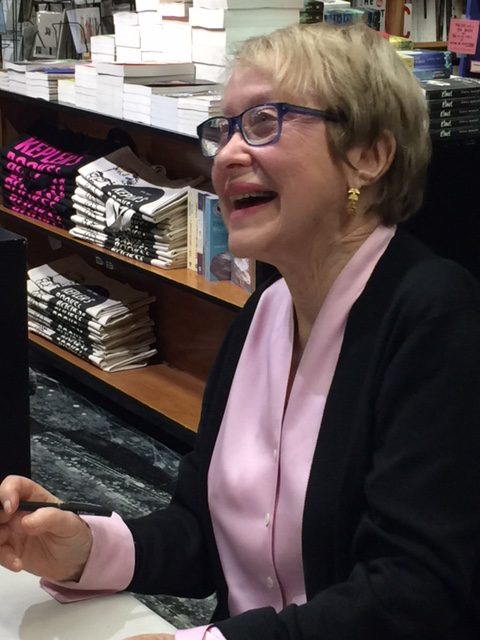
In the pink: signing books at Kepler’s. (Photo: Margo Davis)

Marilyn Yalom, a popular French scholar and author, a founder of feminist studies at Stanford, and beloved wife of the celebrated author and psychiatrist Irv Yalom, died this morning of myeloma. She was 87.

Her illness was swift, but long enough for friends to express their love and appreciation. On September 1, a surprise party was held at her home by women writers who were part of her Bay Area women writers’ salon. A book of letters was presented to her then from the  salonnières.

Marie-Pierre Ulloa, a lecturer in Stanford’s French and Italian Department, also collected letters for a book, this time from the Stanford community. The fate of the book, which was presented to Marilyn in unfinished form a few days ago, remains up in the air, but Marie-Pierre is allowing me to publish my contribution here, as a sort of eulogy.

Dearest Marilyn,

You don’t remember our first meeting, so I’ll remind you: in 1983, I interviewed you to discuss your anthology, Women Writers of the West Coast.

The setting was your charming home on Matadero Avenue, though I have few memories of the house that would eventually become so familiar to me. I disappeared from your life then, and returned nearly a quarter century later, when the legendary Diane Middlebrook died in 2007, and I somewhat timidly joined the Bay Area women writers salon that had become your own endeavor, extending the note that your closest friend had sounded.

Working on Evolution of Desire: A Life of René Girard, I came to know your academic beginnings as the French theorist’s first graduate student: a young woman in a high-powered program at Johns Hopkins, arriving in 1957. “The dedication to our work was, for me, beyond anything I had experienced at Wellesley or Columbia or the Sorbonne,” you told me. “We were true believers. The life of Johns Hopkins was the life of a scholar.” You received your doctorate with distinction. We would talk meet again in the redwood and stone home nestled among the oaks and tall pines – sometimes taking tea in Wedgwood cups, among the hundreds of books, the Balinese masks, the framed art photographs, and a serene Buddha; at other times, sharing a glass of your son Reid’s Cabernet at night, as we waited for your husband Irv to return home from a meeting.

We spoke about your years as a harried graduate student and mother of several children, living in the housing assigned to young psychiatrists in residency at Johns Hopkins Hospital. In that era of more limited expectations for women, perhaps few anticipated that you would become such a popular and acclaimed author in your own right, with a shelf of books to your credit. Our friendship ripened during the years you published How the French Invented Love: Nine Hundred Years of Passion and Romance (HarperCollins, 2012) and then The Amorous Heart in 2018, a few months before my own book. I attended your public events for it, at Kepler’s, at the Stanford Humanities Center, and wrote about them (here and here).

That was the public part. But then there was the unseen part, the salon part: encouraging women to write; guiding their publishing decisions; coaching them to absorb your own authorial dignity and tact, though few of us mastered those lessons as well as you had. You even persuaded a few of us to get top-notch author’s photos from another friend, the notable photographer Margo Davis. At each gathering on Matadero or at your apartment in the City, the salonnières would describe our most recent triumphs and challenges, and one of two of us would present our newly published books. You did more: I remember the launch party for Evolution of Desire, with cases of fine French wine, guests from around the world, and armloads of orchids from my garden – and a special guest, the French consul Emmanuel Lebrun-Damiens. You encouraged us to keep writing, keep writing, keep writing, as you did.

And as you do still. Even now, you are writing a book with Irv, jointly documenting this last year of your journey together, a story that began when you were teenagers in Washington D.C. In our most recent phone call a week or two ago, you assured me that illness had not stopped your work. You are still working on the manuscript, together.

I describe all this because it is an inspiring model for all of us. Your lifetime’s effort will live through us, and touch so many others who will never have a chance to meet you. I want it to be remembered, beyond this year and beyond Stanford. There is no one like you, and no one will take your place. Our gratitude to you is deep, and our love deeper still.

Postscript: One thing I should have written, and didn’t: She was a class act, a woman of extraordinary poise, graciousness, and charm.

A surprise party for Marilyn at her Palo Alto home in xxx. (Photo: Reid Yalom)


Emily Dickinson desecrated in biopic, George Eliot reworked in a novel.

November 18th, 2019
Share

Will the real Emily Dickinson stand up? And hurry.

Can’t we just leave her alone? Poet A.M. Juster (we’ve written about him here and here) is not amused by the new re-creations of the life of Emily Dickinson. And he says so in the current issue of The Commentary, where he writes: 

“’Tis the season for digging up and desecrating Emily Dickinson. First came last year’s Wild Nights with Emily, a flimsy film starring Saturday Night Live alum Molly Shannon, which the Washington Post said threatened “to reduce the writer’s life to the punchline of a literary version of Rodney Dangerfield.” Now the perpetrator is Apple TV’s 10 half-hour episodes of its strange new series, Dickinson.”

I haven’t seen it, and for good reason. I avoided it. Mike Juster was not so wise, but we share a common grievance:

Definitely not this.

Read the whole thing here.

Over at the Financial Times  reviews a fictional retelling of the author of Middlemarch and her vexed love life:

In this compelling fictional reworking of George Eliot’s later life, her second husband John Cross orders champagne on his wedding night with the words: “I want the best, because I have the best. I am married to the best.”

But by the time we reach their honeymoon in 1880, towards the end of the novel, Kathy O’Shaughnessy’s tender and haunting study suggests that for those who are acclaimed as the best, the most brilliant and most visionary, relationships can be fraught with misunderstanding.

Was it only men? Hardly. her charm apparently transfixed women as well: 

Not that she was short of female companionship. In Love with George Eliot recreates with touching, sometimes excruciating, precision the devotion that Evans inspired and expected from other women. “Nearly worshipful” is the look that her adoring friend Maria Congreve gives her, while poor Edith Simcox, the feminist writer who fell hopelessly for Evans and assiduously kept the George Eliot flame burning for years after her idol died, is consumed for the rest of her life by her “hungry love”.

Read the whole thing in the Financial Times here.


<<< Previous Series of PostssepNext Series of Posts >>>