
“Not ordinary speech, but extraordinary speech”: Robert Pinsky on John Milton and the American imagination

May 4th, 2019

Share

Milton’s man in America

“Great art is great not because it enters an academic curriculum, and neither is greatness affirmed by the awarding of prizes or titles. But great is not necessarily a vague term. It can indicate work that penetrates the shapes, feelings, ideas, and sounds of a culture, as in the cadences of speech. Sometimes that kind of penetration is so deep, so transforming, that it is nearly invisible, or barely acknowledged.” So writes Stanford poet (and friend) Robert Pinsky, in “The American John Milton,”  a 2008 article I just discovered in Slate.  Milton’s ideal “is not a poetry based on ordinary speech—which has been one Modernist slogan—but extraordinary speech.”

Two excerpts from the former U.S. poet laureate’s article:

Here is an interesting, continuing conflict in American writing and culture: the natural versus the expressionistic, or simplicity versus eccentricity, or plainness versus difficulty. American artists as different as Robert Frost and William Carlos Williams belong more or less in the “ordinary speech” category. On the other, “Miltonic” side of that division about word order in the mother tongue, consider the expressive eccentric Emily Dickinson, who in her magnificent poem 1068 (“Further in Summer Than the Birds”) writes this quatrain about the sounds of invisible insects in the summer fields:

Antiquest felt at Noon
When August burning low
Arise this spectral Canticle
Repose to typify

In these lines, the natural and the mysterious become one, an effect arising not just from the words (“Canticle”) but also from their order.

***

In the days when the Fourth of July was celebrated on town greens, the occasion was marked by fireworks, band music, and speeches—speeches that almost invariably quoted John Milton, the anti-Royalist and Protestant poet. Anna Beer, in the preface to her useful new biography Milton: Poet, Pamphleteer and Patriot, points out Milton’s considerable influence on the Founding Fathers. English writer Peter Ackroyd published, in the ‘90s, a novel called Milton in America, imagining the poet’s actual immigration—an outgrowth, in a way, of the more remarkable, actual story of Milton’s work in the American imagination.

I once heard the great American poet and iconoclast Allen Ginsberg recite Milton’s poem “Lycidas” by heart. Nearly every page of John Hollander’s indispensable anthology Nineteenth Century American Poetry bears traces of that same poem. In Ginsberg’s published journals from the mid-’50s, he assigns himself the metrical task of writing blank verse (and succeeds with subject matter including his lover Peter Orlovsky’s ass: “Let cockcrow crown the buttocks of my Pete,” another perfect pentameter).

By the way, Derek Walcott made his students memorize “Lycidas” – so Ginsberg wasn’t alone. Read Robert Pinsky’s article in its entirety here.  
“The fuel for my books is a 50/50 mix of dark roast java and printer toner”: jazz scholar Ted Gioia on writing.

May 2nd, 2019
Share

I didn’t know that I had quite so much in common with jazz scholar and friend Ted Gioia until I read  “Award-Winning Historian and Bestselling Author Ted Gioia On The Keys To Productive Research and The Most Important Rule Of Writing” over at the Writing Routines website.

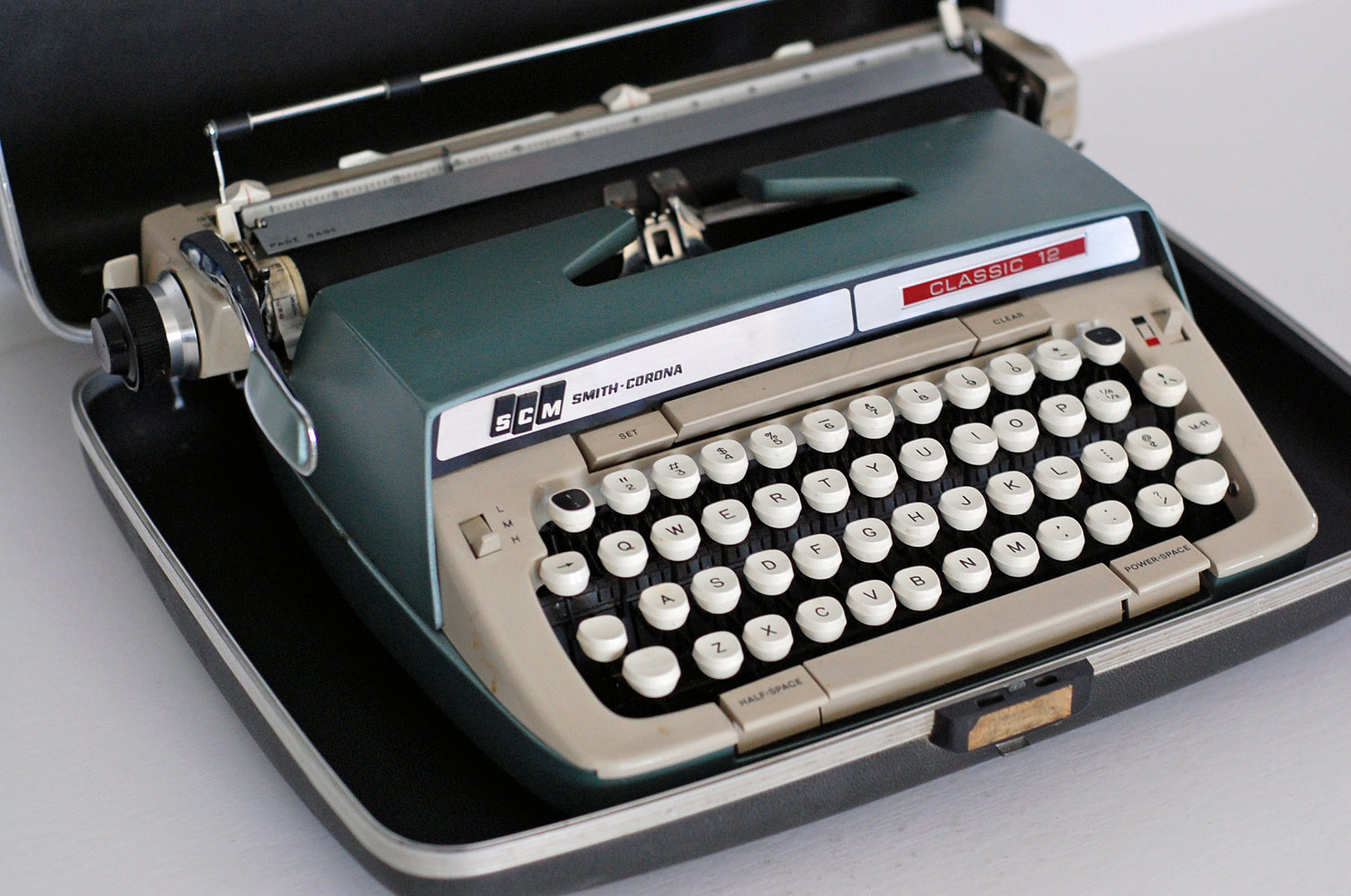
Unlike Ted, however, I left pad and pencil behind at my first newspaper job, as a 17-year-old cub reporter at the Pontiac Press. I was writing, literally writing, a story when an editor brushed by me and said, “Here, we compose on the typewriter.” And so I did. (That’s right – typewriter. Remember those?)

Other than that, we differ only in the brand of coffee. Mine at right. Brew it strong enough and you can stand a spoon up in it.

An excerpt from the Q&A:

When and where do you like to write? Are you the same-thing-every-day kind of writer or can you write anytime, anywhere?

Over the years, I have tried every possible writing routine. My first book was written longhand while sitting at a desk in a library—and I had to hire a typist to turn my scribblings into a publishable manuscript. By the time, I wrote my second book, I had purchased one of the very first Apple computers, but adapting to the digital age was challenging. The floppy disk containing two chapters of that book somehow got damaged, and I had to recreate the text from various notes and earlier drafts. But I persisted with digital technology, and now can’t imagine working without it.

Writer’s block? Ha! (Photo D, Shafer)

Today I write in a quiet home office with two computers, and my large personal library near at hand for consultation.

Do you have any pre-writing rituals or habits before you sit down to write?

Probably the only essential pre-writing ritual is a cup of coffee—preferably Major Dickason’s Blend from Peet’s. Other pre-writing rituals can easily become distractions, so I avoid them. But the coffee is essential. The fuel for my books is a 50/50 mix of dark roast java and printer toner.

What do you do when the writing doesn’t come easy? Do you struggle at all with that dreaded enemy of writing: writer’s block? Do you think such a thing exists?

I don’t believe in writer’s block. If I waited for inspiration before I began writing, I would never get anything finished, or even started, for that matter. I set aside time every day to write. When I sit down and start, I am prepared—because I have spent much of my life in preparation for the writing projects I undertake.

Read the rest here

Australian poet Les Murray is dead at 80: “The deadliest inertia is to conform with your times” – and he didn’t.

April 30th, 2019
Share

With the Russian poet Regina Derieva in Stockholm, 2007 (Photo: Tomas Oneborg)

The Nobel evaded him, and now he shall never get it, though he was considered among the greatest poets of our era. The Australian poet Les Murray died peacefully yesterday at 80. In 2012, the National Trust of Australia classified Murray as one of Australia’s 100 living treasures, but he was much more than that, from the beginning.

David Mason – a new Australian

David Mason, writing in today’s First Things: “Murray grew up in dire poverty on a farm with no electricity or running water, and always felt exiled from the privileged classes. Largely self-educated, at university he was so poor he ate the scraps he found on plates in the cafeteria. Profoundly asocial, he once called himself ‘a bit of a stranger to the human race.’ He also suffered at times from debilitating depression, and was bullied in school for being bookish and fat. Yet he transformed his sense of personal injury to a poetic voice of rigor and flexibility, humor and empathy, and enormous formal range. He was a generous anthologist and editor as well as an essayist, poet, and verse novelist. ‘It was a very great epiphany for me,’ he once said, ‘to realize that poetry is inexhaustible, that I would never get to the end of its reserves.’”

We had mutual friends, among them Alexander Deriev, whose wife was the late Russian poet Regina Derieva, and the poet Dave Mason himself, who is now an Australian poet by choice rather than birth. He had corresponded with Murray, who published some of his poems (presumably in the Australian Quadrant, where Murray was poetry editor) but they never met face to face.

Here’s another treat: if you want to know something about him, you might go to this soundcloud 1985 PEN recording of Joseph Brodsky, Derek Walcott, and Richard Howard in conversation with Murray. I’m still listening to it…

“The body of work that he’s left is just one of the great glories of Australian writing,”said his agent of three decades, Margaret Connolly. “The thought that there will be no more poems and no more essays and no more thoughts from Les – it’s very sad and a great loss.”

David Mason, writes: “Murray deserves to be ranked among the best devotional poets—from Donne and Herbert to Eliot and Auden—but his work has an earthiness and irreverence of its own, a tragic sense of human life and a Whitmanesque sympathy for the lives of animals. His wordscapes and landscapes were local, Australian, with everything that distinction signifies—including the transported convict’s sense of justice and the nation’s thoroughly multicultural heritage. His art wasn’t bound by pieties, political or otherwise, because he understood the position of poetry—and of language itself—in relation to reality.”

Faced with the theological question “Why does God not spare the innocent?,” Murray replied in a quatrain that is perhaps one of his best known poems, perhaps because of, rather than despite, its economy of words:

The answer to that is not in
the same world as the question
so you would shrink from me
in terror if I could answer it.

Les Murray, Daniel Weissbort and Alexander Deriev having meal after the Ars Interpres Poetry Festival. Stockholm, 2004.

David notes that the poem, called “The Knockdown Question,” is a minor epigram in the Murray oeuvre, “but it partakes of the same theological experience as Eliot’s Four Quartets. Murray was not always so blunt.”

David Malouf told the ABC that Murray was “utterly unorthodox” and described his work as “undoubtedly the best poems anybody has produced in Australia.”

“He knew that he could be difficult — nobody pretends that he wasn’t — but he was always difficult in an interesting way.”

He told the Paris Review:  I’m a dissident author; the deadliest inertia is to conform with your times.”

Is Stanford University Press doomed? “This is a reprehensible moment for one of the richest universities.”

April 28th, 2019
Share

Alan Harvey directs Stanford U’s press. (Photo: L.A. Cicero)

Prof. Peter Stansky opened his annual “A Company of Authors” event on Saturday with a somber comment: “Those in the Stanford community who are interested in books may be interested to know that the provost of the University has decided, it appears, to terminate significant financial support of the Stanford University Press which will result in the downgrading of the press, making it unworthy of this University. In fact the University should increase its support and pursue a search of an endowment for the Press that would make it, as is the university of which it is a part, a press as strong as those at its peer institutions such as Harvard, Yale, and Princeton.  It is peculiar thinking that the Press, unlike the rest of the University, should be self-supporting.” 

I didn’t realized the story had already appeared the day before in The Chronicle of Higher Education: The article began this way: 

“Stanford has the world’s third-largest university endowment, valued in 2018 at $26.5 billion. Yet it is crying poverty to explain why it can no longer provide yearly $1.7-million subsidies to its acclaimed press. The announced cut, which became public in a Faculty Senate meeting on Thursday, has confounded and outraged faculty members and other press supporters, and is seen by many as a backhanded way of closing the scholarly publisher.

“‘This is a reprehensible moment for one of the richest universities in the world and a diminution of intellectual inquiry. It really boggles the mind,’ said Woody Powell, a Stanford sociology professor, a former member of the press’s editorial board, and a current adviser to it.”

Read the rest here.

Hundreds of signatures have already been collected on a petition (below). Anyone with a Stanford affiliation is urged to sign the online petition here. People not affiliated with Stanford, but support academic presses, sign here.

A University Press is a Vital Part of Stanford’s Identity as a University.

It is Not Meant to Be a Profit-Making Entity.

To President Marc Tessier-Lavigne and Provost Persis Drell:

A letter from members of the Stanford academic community has been circulating in support of Stanford University Press. We are members of the larger academic community who rely on the Press for our own work. We want to add our voices to those of your own scholars at Stanford. The intellectual value of Stanford University Press extends far beyond your campus.

You have announced the elimination of the modest annual subsidy (~$1.7 million) to Stanford University Press, a move that will be severely damaging and likely fatal to the Press. Academic presses are vital to the life of the university and to the world of learning. They are the means by which we communicate the results of our research, and the entire university mission of teaching and scholarship relies upon them. Stanford University Press is the oldest press in the western United States, with a long tradition of publishing major works in many areas of inquiry. It provides a vital public service that Stanford should be proud of.

If we use a purely financial metric to assess the value of academic books, the scholarly mission of the academy will be lost. Presses will publish only profitable books, graduate students will write only profitable dissertations, and tenure will be awarded based on scholarship that is profitable. This will skew research and publication in exactly the wrong direction, away from the mission and purpose of a university, which is pursuit of knowledge and truth, and toward marketability The proposed elimination of Stanford University Press’s subsidy is an attack on academic freedom and free inquiry.

While of course a university needs enough money to continue functioning, no single unit need be “self-sustaining,” much less profitable, when viewed in isolation. We note that, according to Stanford Daily, the “net annual cost [of the athletic department at Stanford] is … around $67 million.” The Stanford Athletic Department thus appears not to be “self-sustaining.” Why have you chosen to single out the University Press for this application of supposed “business models” when other units on campus similarly do not turn a profit? The point of a University Press, or any academic department, is not profit. Nor, obviously, is this the mission of a major (non-profit) research university.

We urge you to rethink your approach to the Press and to recommit Stanford to its long tradition of fostering new knowledge, path-breaking intellectual work, and free inquiry. The Press forms part of the core mission of the great university that Stanford is and that, we hope, it will remain.

Please join us for Madame de LaFayette’s “The Princesse de Clèves” on Wednesday, May 1!

April 25th, 2019
Share

Please join us for the “Another Look” book club discussion of Madame de LaFayette’s The Princesse de Clèves. The final event of our seventh season will take place on Wednesday, May 1, at 7:30 p.m. at the Bechtel Conference Center of Encina Hall, 616 Serra Street on the Stanford campus.

Madame de LaFayette’s The Princesse of Clèves was published anonymously in 1678. Although the title character is fictional, most of the others are historical, and the people and their intrigues are rendered with precision and authenticity.

The plot centers on the 16-year-old heiress Mademoiselle de Chartres, who comes to the court of Henry II to make a good match. The beautiful and virtuous girl marries the stolid Prince of Clèves, but then falls in love with the dashing and seductive Duke de Nemours. Considered by some to be the first modern novel, The Princesse of Clèves portrays a milieu of appearances and deceptions, rife with suspicion, passions, temptations, and jealousy. This penetrating, finely wrought novel reveals a society where competition is unending – whether in war, in courtly games and gestures, or amorous adventures.

Nota bene: this is a historical novel, with Madame de Lafayette writing about events that took place in the previous century, when Mary Queen of Scots is still a 16-year-old girl and Queen of France. This seems to confuse a lot of publishers choosing cover illustration, who often get the wrong period. The Oxford World Classics edition edition, for example, features Anne of Cleves (no relation), the fourth wife of Henry VIII and a generation earlier before the action of this novel.

Speaking personally, I’m excited by this little book (it’s one of three novellas in the Oxford edition), not only a forerunner of the modern psychological novel, but an important work by a largely overlooked woman. That’s not why I adore it, however. The story is absolutely gripping.

Panelists include: Another Look Director Robert Pogue HarrisonChloe Edmondson, a Stanford graduate student studying French literary and cultural history; and a special guest, Yale Prof. Pierre Saint-Amand. The Yale expert in the philosophy of the Enlightenment (photo at left) will be a real treat for Bay Area audiences – the inside word is that he’s great fun! However, he has suggested that readers be patient for the first twenty pages, which introduce many names and titles from the French court. After the characters are in place (and you’ve sorted out the names and titles), the pace accelerates to its inexorable conclusion.

Oh yes, the most important part: The event is free and open to the public! Come early for best seats! (The parking areas closest to Encina Hall are Memorial Drive and Parking Structure 7, located off Campus Drive, underneath the Knight Management Center-Graduate School of Business. For parking information, contact the Parking and Transportation Department’s Visitor Parking page.)

Stanford authors, scintillating books at “A Company of Authors” this Saturday – be there!

April 23rd, 2019
Share

It’s that time of year again. For the 16th consecutive year, an impressive array of Stanford writers will be discussing their recently published books. The Book Haven has often presented at the event – last year for Evolution of Desire: A Life of René Girardthe year before for the Another Look book club (those events discussed here and here). But this year I will be mercifully silent, except for moderating one of the panels. (See schedule below.)

Here’s how it works: each author will make a brief presentation and be available for conversation and book signing. The even takes place Saturday, April 27, 2019, beginning at 1:00 p.m. at the Stanford Humanities Center, 424 Santa Teresa Street. The event is free and open to the public.  Light refreshments will be served. Come when you can, stay as long as you like. The event has been called the literary equivalent of “speed-dating.”

This program is hosted as always by the genial Peter Stansky, emeritus Field Professor of History. Better yet, spend the entire afternoon in the company of these bright, entertaining, and stimulating writers.

At the event, the Stanford Bookstore will sell books at a 10 percent discount, and authors will sign copies. There will even be a few copies of Evolution of Desire at the event.

Here’s the line-up:

1:00 pm: Welcome (Peter Stansky) 

1:05-1:35 pm: War and Its Study
Peter Stansky, Chair
Joan Ramon Resina, Josep Pla: Seeing the World in the Form of Articles
Elena DanielsonHoover Tower at Stanford University
Lisa Nguyen, ed., We Shot the War: Overseas Weekly in Vietnam 

1:45-2:15 pm: The World Beyond
Cynthia Haven, Chair

Alexander Key, Language Between God and the Poets Ma’na in the Eleventh Century
Ari Y. Kelman, Shout to the Lord: Making Worship Music in Evangelical America
Fiona J. Griffiths, Nuns’ Priests’ Tales: Men and Salvation in the Medieval Women’s Monastic Life 

2:25-2:55 pm: The Wider World
Larry Horton, Chair
Rob Reich, Just Giving: Why Philanthropy Is Failing Democracy and How It Can Do Better
John L. HennessyLeading Matters: Lessons from My Journey
Francis Fukuyama, Identity: The Demand for Dignity and the Politics of Resentment

3:05-3:45 pm: History Here and There
Paul Robinson, Chair
David Como, Radical Parliamentarians and the English Civil War
Jonathan Gienapp, The Second Creation: Fixing the American Constitution in the Founding Era
Ana Raquel Minian, Undocumented Lives: The Untold Story of Mexican Migration
James T. Campbell, Mississippi Witness: The Photographs of Florence Mars 

3:55-4:25 pm: Poetry, Feminism, and Design
Charles Junkerman, Chair

Karen Offen, Debating the Woman Question in the French Third Republic, 1870-1920
Albert Gelpi and Barbara Charlesworth Gelpi, Adrienne Rich: Selected Poems, 1950-2012 and Adrienne Rich’s Poetry and Prose
Ge Wang, Artful Design: Technology in Search of the Sublime 

4:30-5:00 pm: Fictions
Tania Granoff, Chair
Daniel Mason, The Winter Soldier
Jennifer deVere Brody, ed. of James Baldwin’s Little Man, Little Man: A Story of Childhood
Peter Stansky, afterword of Elisabeth de Waal’s Milton Place 

This program is co-sponsored by Stanford Continuing Studies and the Stanford Humanities Center, with special thanks to the Stanford Bookstore. 


<<< Previous Series of PostssepNext Series of Posts >>>