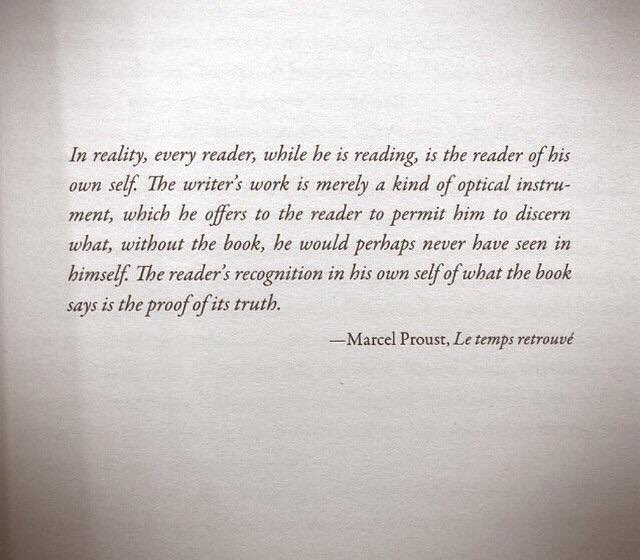
And speaking of Proust … another wonderful quotation on the anniversary of his death

November 19th, 2018
Share

Luftmensch Paul Holdengräber is on a roll with Marcel Proust, and we posted his quote on the anniversary of the French author’s 1922 death yesterday. He followed up with this one today, and we couldn’t resist reposting it (see below). The reason: we use the same citation from Proust at the tail-end of the introduction to Evolution of Desire: A Life of René Girard:

Why? Why? Why?

I had a more modest view of my book and it would be incorrect to say even that I was thinking of those who might read it as ‘my readers.’ For, to my mind, they would not be my readers but the very readers of themselves, my book serving only as a sort of magnifying glass, such as the optician of Combray used to off er to a customer; my book might supply the means by which they could read themselves. So that I would not ask them to praise me or to speak ill of me, but only to tell me that it is as I say,if the words which they read within themselves are, indeed, those which I have written.

The passage I cite was translated by the matchless Richard Macksey, a colleague of René Girard’s at Johns Hopkins University.

Incidentally, the whole introduction to Evolution of Desire was published in America Magazine over the weekend here. Notre Dame published it earlier, and it was linked in Hacker News, here. (Several people wondered why Artur Sebastian Rosman picked a golden image for the article, entitled “Golden Thoughts for a Nuclear Age” – you might note that it’s the “Mask of Agamemnon,” one of the findings of Heinrich Schliemann at the Troy excavation, an archaeological adventure described in the first paragraph of my intro.)

Remembering Marcel Proust, on the anniversary of his death…

November 18th, 2018
Share

We’ve been awfully busy in Denver for several days talking about Evolution of Desire: A Life of René Girardand it’s time for bed, but we didn’t want to let the weekend pass without observing that this is the day Marcel Proust died in 1922. Luftmensch Paul Holdengräber helped us remember with the quote below:


A night for W.H. Hudson and Green Mansions: his love for animals was deep and his opinions were fierce

November 15th, 2018
Share

About 150 devoted book fans braved the campus-wide construction at Stanford to attend our Another Look fall event on William Henry Hudson’s Green Mansions on Tuesday, October 30, at 7:30 p.m. in the Bechtel Conference Center of Encina Hall. The event launched Another Look’s seventh season.

First published in 1904, Green Mansions seamlessly blends nineteenth-century romanticism with the ecological imperatives that would come to the forefront in the twentieth century. Discussants included Prof. Robert Pogue Harrison, director of Another Look, Prof. Laura Wittman, and the Dean of Continuing Studies, Charles Junkerman.

Harrison at the podium.

The book had more fame back then than it does now – despite a 1959 film with Audrey Hepburn and Anthony Perkins. Said novelist Ford Madox Ford of the novel: “There was no one – no writer – who did not acknowledge without question that Hudson was the greatest living writer of English … I have never heard a writer speak of him with anything but reverence that was given to no other human being. For as a writer he was a magician.” According to Joseph Conrad, “Hudson’s writing is like grass that the good God made to grow, and when it is there you cannot tell how it came.”

The plot: Abel Guevez de Argensola, flees to the Venezuelan interior after launching a failed coup in Caracas with his friends. In the remote jungles and savannas, he lives among the native people, learning their language and their ways. While exploring the terrain, he hears strange bird-like singing and discovers a young woman with a mysterious story. His love for her desolates and transfigures his life.

Hudson was better known as a naturalist and ornithologist, and his opinions were fierce, particularly about cruelty to animals. On his grave is written: “He loved birds and green places, and the wind on the hearth, and saw the brightness of the skirts of God.”

But his opinion of his fellow man could be harsh. In 1915, he wrote to a friend, “You think it is a ‘cursed’ war. I think it is a blessed war. And it is quite time we had our purification from the degeneration, the rottenness that comes with everlasting peace. The blood that is being spilled will purge us of many hateful qualities – of our caste feeling, or our detestable partisanship, our gross selfishness and a hundred more. Let us thank the gods for a Wilhelm and a whole nation insane with hatred of England to restore us to health.”

Photos of the event, as always, by Another Look aficionado David Schwartz. And the podcast for the event is here.

Jill Lepore: “The academy is largely itself responsible for its own peril.”

November 13th, 2018
Share

Writer and historian

Evan Goldstein interviews the New Yorker’s Jill Lepore for The Chronicle of Higher Education.  Lepore, an historian, is the author of These Truths (W.W. Norton), a new history of America.

She insists “facts come from the realm of humanities.” Do they? We don’t know what kind of facts you can find in Li Po or Euripides or Anna Karenina, but she nevertheless has some interesting observations about the state of the humanities in America, always an important subject at the Book Haven. A few excerpts below:

A. That transformation, from facts to numbers to data, traces something else: the shifting prestige placed on different ways of knowing. Facts come from the realm of the humanities, numbers represent the social sciences, and data the natural sciences. When people talk about the decline of the humanities, they are actually talking about the rise and fall of the fact, as well as other factors. When people try to re-establish the prestige of the humanities with the digital humanities and large data sets, that is no longer the humanities. What humanists do comes from a different epistemological scale of a unit of knowledge.

Q. How is the academy implicated in or imperiled by this moment of epistemological crisis?

A. The academy is largely itself responsible for its own peril. The retreat of humanists from public life has had enormous consequences for the prestige of humanistic ways of knowing and understanding the world.

Universities have also been complicit in letting sources of federal government funding set the intellectual agenda. The size and growth of majors follows the size of budgets, and unsurprisingly so. After World War II, the demands of the national security state greatly influenced the exciting fields of study. Federal-government funding is still crucial, but now there’s a lot of corporate money. Whole realms of knowing are being brought to the university through commerce.

Congratulations in order? (Photo: L.A. Cicero)

I don’t expect the university to be a pure place, but there are questions that need to be asked. If we have a public culture that suffers for lack of ability to comprehend other human beings, we shouldn’t be surprised. The resources of institutions of higher learning have gone to teaching students how to engineer problems rather than speak to people.

***

Q. You did your graduate work at Yale in the early ’90s in a post-structuralist American-studies department. You read a lot of Derrida and Foucault. You’ve said that you grew uncomfortable with how you were trained versus how you wanted to write.

A. I should say that I happened to land at a place where there were people writing in their own way. John Demos was my adviser. I also worked with Bill Cronon, who’s a tremendous writer. And Jon Butler. All of whom read my dissertation prospectus and said, OK, this is not a dissertation prospectus but we’re going to pass it because we love it. They were the exception.

Like any Ph.D. program, what you’re being trained to do is employ a jargon that instantiates your authority in the abstruseness of your prose. You display what you know by writing in a way that other people can’t understand. That’s not how I understand writing. Writing is about sharing what you know with storybook clarity, even and especially if you’re writing about something that’s complicated or morally ambiguous. Also, I like to write about people who are characters, who have limbs and fingers and toes and loves and desires and agonies and triumphs and ages and hair colors. But that’s not how historical writing is taught in a Ph.D. program.

***

Last of a kind. (Photo: Bernard Gotfryd)

Q. In your 2010 book, The Whites of Their Eyes, about the rise of the Tea Party, you note that Richard Hofstadter, who died in 1970, was one of the last academic historians to reach readers outside the academy “with sweeping interpretations both of the past and of his own time.” You seem to occupy a Hofstadter-like space in American life. How do you see your role?

A. You can see in Hofstadter’s life why so many academics from his generation and the generation that followed retreated. Hofstadter was stricken by student protests at Columbia. Something had gone wrong in American political life, which had become zealous. It would be best for historians to therefore not be part of it.

Since serious academic historians have to a large degree retreated, that space is taken up by other people. Again, generally by presidential historians, most of them journalists. That’s not to say they’re not excellent journalists and brilliant biographers. But what they write is presidential history, and what they offer is political punditry that emphasizes the power of the presidency. Just this week I was frantically reading about the attempted assassinations, possibly, of Trump critics, and the Pittsburgh synagogue shooting, and I just knew I was going to see Michael Beschloss tell a story about LBJ. That’s the casting call for the historian. I’m not convinced that it’s a great contribution, especially when you think of the incredible work scholars do studying patterns of political expression, social movements, the history of political violence; none of that is gathered up in a one-clause quote from Michael Beschloss. What I’ve tried to do in The New Yorker is figure out a different way for a historian to offer a contribution. It doesn’t refuse to engage with what’s going on in the present, but it also doesn’t offer up the comforting anecdote or the disquieting anecdote.

There’s lots more to be said on all this, and so much I want to question in what she says. You can read the whole article here.

“He never returned”: on the centenary of the end of World War I

November 11th, 2018
Share

Today marks the hundredth anniversary of the armistice that ended World War I. Out of all the rivers of words I’ve read and pictures I’ve seen, I found this image especially poignant today, from Catherine Lambert on Facebook:

“I lived in a tiny village called Essendon in England for a few years. We had a neighbor who had a tree in the front garden with a big knot – as you can see below. The story she told was that her grandfather tied the knot in the tree when he left to fight in World War I, telling his young bride that he would untie it on his return from the war. He never returned.”

“The tree died while we lived in Essendon and our neighbor actually gave us this knot – which I’ve had ever since as it makes me remember the forgotten lives of that painful war.”

L’art pour l’art in Paradise Lost

November 11th, 2018
Share

He’s got his priorities straight. (Screenshot from news footage)

Paradise has been destroyed – the city leveled to smoke and ashes, with 25 killed so far. We’ve been breathing the smoke in Palo Alto all weekend. “Three fires began Thursday — the largest in Northern California, where a Sierra Nevada town of 27,000 was destroyed by a fast moving-fire that quickly grew into the state’s most destructive on record. In Southern California, two fires were burning in the drought-stricken canyons and hills north and west of downtown Los Angeles,” according to the Associated Press today.

During my decade living in the Sierra foothills, I fled three wildfires before walls of flame. The first, which came within blocks of my home, was the year’s most destructive wildfire. I remember returning, several days later, not knowing if I’d have a home or merely cinders. The third and smallest started on my front lawn, when an old car backfired sparks onto the dry grass as it passed. Within a few hours, scores of helicopters were circling overhead, dropping chemical retardants and water.  (I made a post about those wildfire years here.)

I recall the process of sorting through what to take with our family (which then included two or three cats and a dog). My laptop first, of course. But after that … a Dali, a Chagall, and a few other original works of art. Family heirlooms. Clothes, of course, clothes. But I was living to live in my skivvies to save the my art and my labor and my history.

So I fully understand John Mescall, a cellist for the Paradise Symphony Orchestra. As the town was burning, he tried to flee by car. But his car wouldn’t start. So he grabbed his bike and pedaled to safety with his cello on his back. He’s headed for Chico.

He tells the story on Chico’s KCRA in the clip below. (You can read his story here.)


<<< Previous Series of PostssepNext Series of Posts >>>