Stanford’s loss is Iowa’s gain: We look forward to your novel, Elaine Ray!

August 5th, 2018

Share

Elaine with another Stanford legend, choreographer Aleta Hayes

This week, one of the most magnificent women ever to grace the Stanford org charts leaves for the harsher climate of the Iowa Writers Workshop, where she will be a resident fellow. (In fairness, any weather would necessarily be harsher than idyllic Palo Alto’s.)

Elaine Ray was the director of the Stanford News Service when I returned to Stanford as the humanities and arts writer for the university over a decade ago. It was an award-winning and nationally recognized institution, with plaques at the entryway signaling its many honors to all visitors. Elaine, a former Boston Globe journalist, was one reason why it was exemplary.

It was also one of the happiest workplaces I have ever known (and had a Stanford-wide reputation for being so). Elaine was a big reason for that, too. Said News Service staffer Pamela Moreland at one of her farewell parties a fortnight ago:

She is a wonderfully demanding editor who allows you to have your own voice and try new things while still adhering to the stylebook and expectations. She sees the big picture while at the same time, she will sweat every detail that you sweat and then some. She knows things before they happen. She never gave me bad advice.

In preparing for this event, I asked a few people to tell me a few things about Elaine. The superlatives came tumbling down:

Best confidante ever
Most considerate person ever
Kindest
Compassionate
No-nonsense in the best way
Best friend a person could have
Consistent
Best running buddy ever

So why is this remarkable woman leaving? The technical reason is “retirement.” But the real reason is that she’s been admitted to the Iowa Writers Workshop, the preeminent training ground for the nation’s best writers. It’s a creative and surprising way to spend a so-called “retirement.”

Elaine and daughter Zuri Adele, actress of “Good Trouble” fame

I wrote about the inspiring turning point to her story on the Book Haven some time ago, and at the party, former News Service videographer Jack Hubbard gave a shout out to me and the Book Haven for my post, “A writer to watch: Elaine Ray wins prize for her first published fiction.”

That was in January 2017, when I wrote: “one of the most beloved people at Stanford for her generosity and kindness, had emerged in fiction with an utterly new voice. We agree with the judge who called it ‘mercilessly exposed and utterly enigmatic,’ throwing light on a lost world that as foreign to most of us as the Incas.” More:

Her reaction to the $1000 award? “Blown away and humbled. The first piece of fiction I’ve ever gotten published wins an award.” According to one of the judges, Thomas McNeely, author of Ghost Horse: “In fewer than twenty pages, Pidgin sketches a world of its narrator of color’s post-colonial migration, political activism, and imprisonment within the choices offered him by history. At the same time, it’s a narrative that seems shaped by mysteries that transcend and yet throw into sharp relief its political moment, the chief one being the brilliant voice of its narrator, who is at once mercilessly exposed and utterly enigmatic. Elaine Ray is a writer who plays by her own rules, and is a writer to watch.”

You can read the entire post here.

“Elaine gets her chutzpah from her mom, who raised the family after Elaine’s father died when she was 13,” said Lisa Trei, the former social science writer at the News Service. “Elaine knew that her dad had worked in the composing room of the Pittsburg Courier but she didn’t know that he had also written a weekly column for The New York Age focusing on racial injustice. In 2010, quite by chance, Elaine stumbled upon the columns and created a blog about them. The fact that she wrote for Essence and The Boston Globe before she ever knew about her family legacy shows that printer’s ink is in her blood, for sure.”

Godspeed! We look forward to your novel, Ms. Ray.

“I have my freedom of speech,” he said – and then the cops dragged him away.

August 4th, 2018
Share

The octogenarian dissident in China speaks out. Now one knows where he is. (Photo: Youtube)

Here’s the news you probably didn’t hear this week: 84-year-old professor and activist Sun Wenguang in China was speaking on Voice of America when the Chinese authorities burst into the room and dragged him away. His final words to the world: “I have my freedom of speech.”

He hasn’t been seen since. Is he dead? Is he beaten? We don’t know. From the Washington Post:

Viewers listened as Sun recounted his ordeal live on air. “Here they come again, the police are here to interrupt again,” Sun said in Chinese. “Four, five, six of them.”

Sun asked what the men were doing in his home and threatened to get a knife. “It is illegal for you to come to my home,” he said. He defended his VOA interview and called on the security officials to respect his rights.

They didn’t, of course.  According to Hu Jia, a prominent human rights activist in Beijing,  “They did that on air, and they didn’t care if it was in front of the whole world. This is an attack on press freedom, too. It just shows that they are willing to pay any price” to silence him.



At the time of his … shall we call it arrest? … he was criticizing China’s foreign investments: “People [in China] are poor. Let’s not throw our money in Africa. Throwing money like this is of no good to our country.”

Who is Sun Wenguang? He retired physics professor from Shandong University, he spent more than a decade in and out of prison at various times from the 1960s to the 1980s for criticising communist leader Mao Zedong. According to the BBC:

The long-time government critic is one of the original signatories of “Charter 08”, a manifesto which called for political change in China.

In 2009, Prof Sun was beaten while visiting the grave of Zhao Ziyang, a communist leader who was purged for supporting the Tiananmen protests of 1989.

The then 75-year-old said at the time he had suffered three broken ribs and injuries to his hands and legs. He was later admitted into hospital.

Prof Sun has also been denied a passport, according to the New York Times, and so is unable to leave the country.

Perhaps it’s time for Google to reconsider its confidential plan to release a censored version of its search engine for China. It’s own employees are furious. Read about it at The Intercept  here. Meanwhile, you can hear the Voice of America recording of his abduction below.

Two plays, two very different women: Euripides stars at the Stanford Repertory Theater

August 2nd, 2018
Share

Doomed Polyxena (Lea Claire Zawada) mourns the life she will never have. (Photo: Frank Chen)

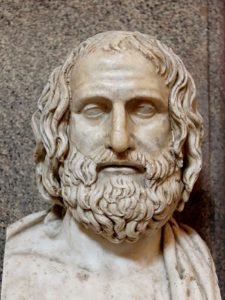
Euripides‘s play Helen is the most lyrical and tender of the playwright’s canon, and the most surprising as well. Here’s the story: Helen was never carried off to Troy by Paris; she was whisked away by the gods to Egypt to cool her heels while the Trojan War raged. (She is, after all, the daughter of Zeus … or maybe Tyndareus.) In her place, an eidolon – a specter, a lookalike, a double – went to the doomed city. Now the war is over. Menelaus is presumed dead. And the King of Egypt wants to marry Helen, twenty years older but still a humdinger. She’s clinging to a sacred shrine that offers sanctuary against his unwanted advances. What’s a queen to do?

Joe Estlack as Odysseus, Polymnestor, Menelaus (Photo: Zachary Dammann)

The story has its precedents. Herodotus advanced the same tale in his Histories. And the poet Stesichorus said the same in his Palinode. But Helen – almost a romantic comedy, really, but too tinged by tragedy to make it so – is most memorably told by Euripides. Too bad it’s not told often enough. So that’s one reason to see the Stanford Repertory Theater’s current production, Hecuba/Helen, in the Roble Studio Theater.  It opened last weekend and runs through August 19.

“Like the Odyssey and, even more, like the late Shakespearean romances, Helen has in some ways ‘got back to the fairy tale again,’ with its sunlit clarifications, reunions, and happy ending,” wrote poet Rachel Hadas about the play. “But its brightness is porous; plenty of suffering makes its way through. The enormous and tragic waste of the war, the pain of exile, isolation, and blame – the beauty of Helen shines through these elements without ever avoiding or denying them.”

The play is ingenuously paired with a very different offering from Euripides, Hecuba. Like the tragedian’s Trojan Women, it’s a rending,  agonized lament from the female denizens of Troy, now orphaned and widowed and childless, as they are about to be hauled into slavery and worse. The threnody is interrupted occasionally by men, kings, soldiers, messengers, coming to relate the latest disastrous news or murderous decision. It’s one steady momentum downward, to Hecuba’s final revenge against her betrayer, before the Trojan queen’s descent into becoming, as prophesied, a howling dog.

African American poet Marilyn Nelson describes Hecuba as “the distillation of the pain described in the slave narratives” – “Her children dead or stolen, her husband slain, her homeland lost forever, her nobility reduced to rags: again and again, I read Hecuba’s stories in the slave narratives. Children torn from their arms and sold, lovers beaten and sold or murdered, no place to run, no place to hide, their very bodies a badge of inferiority.” And so it is.

Courtney Walsh as Hecuba, Doug Nolan as Agamemnon. (Photo: Zachary Dammann)

All the roles are doubled up, or trebled up. Stanford Rep regular Courtney Walsh revels in the exhausting challenge of playing both Helen and Hecuba – though I think her touch is made for the dark-edged comedy of Helen more.

Two men in particular give an array of arresting performances  – Doug Nolan as Agamemnon a hardened soldier softened by the surprise of love. Less than an hour later he is the bullying Theoclymenus, the duped King of Egypt, alternately petulant and belligerent. Joe Estlack is the stalwart yet doubting Spartan king Menelaus – and also the oleaginous traitor Polymnestor. (He won me over when he inventively and energetically portrayed an entire shipwreck all by himself, with gurgling, coughing, spitting, and sputtering.) Props to Jennie Brick as the chorus leader and also the lippy portress-cum-bouncer at the Egyptian palace. And Stanford undergraduate student Lea Claire Zawada makes a moving and anguished Polyxena, whose life is sacrificed to the ghost of Achilles.

Thank you, sir.

The epigrammatic Greek Chorus is always a challenging convention in modern drama. Aleta Hayes‘s choreography updates the concept while hewing to its origins. It’s effective, though my own preferences run towards a plainer, less stylized interpretation, where the chorus women deliver their lines simply, singly, as lookers-on and occasional participants. The projections on the screen were more distracting than helpful, and opened the drama outward when it needed intimacy and tension.

The doubling and trebling of roles, as we watch very different characters and emotions shine through the same faces we saw minutes before, remind all of us how we each take so many roles in a lifetime – all but the best and worst of us swing from hero to villain, buffoon to sage, and back again. During Hecuba/Helen, a killer becomes lover and then a killer again, the powerful are humbled, a betrayer becomes the betrayed … and the smart-mouthed portress who kicks Menelaus away from the threshhold morphs into the benevolent prophetess Theonoe.

As the “Nevertheless, She Persisted” theme of the double show demonstrates, Euripides was an early champion of women. He was also deeply horrified by war, having lived through the long and bitter struggle between Sparta and Athens. Euripides shows both in the case of the Trojan women of Hecuba, and in Helen, which showcases a woman who been scapegoated for a war she never caused, and just wants to go home to Sparta.

Artistic director Rush Rehm translated these texts from the Greek for this production, and the final piece is stageworthy, more so, perhaps, than the more lyrical rendering of poets who have tried their hands at the task:

The gods reveal themselves in many ways,
bring many matters to surprising ends.
The things we thought would happen do not happen.
The unexpected gods make possible,
and that is what has happened here today.

Courtney Walsh (Hecuba), Lea Claire Zawada (Polyxena), and in the chorus Emma Rothenberg, Jennie Brick, Brenna McCulloch, Gianna Clark, Regan Lavin, Amber Levine. (Photo: Zachary Dammann)

Voices from the chorus: Brenna McCulloch, Amber Levine, Regan Lavin (Photo: Zachary Dammann)

Evolution of Desire: A Life of René Girard: “an important biography … beautifully felt and written”

July 30th, 2018
Share

Arielle Emmett and friend Lu Ze in Harbin, China

We’re having a bumper crop of reviews and articles for Evolution of Desire: A Life of René GirardThis one appeared as a LinkedIn essay, “Mob violence and the roots of martyrdom: Cynthia Haven’s exploration of the philosopher René Girard.” It’s provenance is impeccable: journalist Arielle Emmett, a 2018-19 Fulbright Fellow headed for Africa. She has written for Smithsonian Magazine, Newsweek, The Boston Globe, and others. The LinkedIn piece is here and below:

This book about French anthropologist René Girard should put Cynthia Haven in the ranks of top literary biographers. Her exploration of Girard, a philosopher who developed a stunning theory of mob violence, scapegoats, and martyrs, is beautifully felt and written – illuminating for those who care about the origins of violence and religion, the schisms between Continental and Analytic philosophy, and the impact that mimetic desire and Greek tragedy has had on the evolving story of civilization.

Haven’s meticulous research displays deep historical knowledge and passion for the machicolated fortresses of Avignon, Girard’s birthplace, along with the American campuses – Indiana University, Johns Hopkins, University of New York Buffalo, among others – he frequented and taught in post WWII until his death in 2015. The author’s greatest strength is placing Girard’s ideas about “mimetic desire” and copycat scapegoatism within the context of 20th and 21st century war and mob violence. Haven’s resurrection of Girard is an important reminder of why wars still happen – and why strict adherence to religious ideologies are just as likely to tear societies apart than heal them.

Girard took on virtually every school of modern philosophy, replacing French structuralism, deconstructionism, American pragmatism and Freudian thinking with a more streamlined theory of collective desire. Clans, tribes, and whole societies are ruled, in the main, by competitive jealousy beyond envy, a universal need to have or be what the “Other” is having or being. Accounting for Homeric myth and even the modern mob story (read Shirley Jackson‘s “The Lottery”), Girard began his lectures on a seminal book, Violence and the Sacred (1972), with this observation: “Human beings fight not because they’re different, but because they are the same, and in their accusations and reciprocal violence have made each other enemy twins.”

The desire to find scapegoats and to invest individuals – whether women, ethnic minorities, Nazi collaborators or modern power figures – with the murderous guilt of an entire tribe or civilization also produces an “opposite” phenomenon: the sacred anointing of martyrs. “Human society begins from the moment symbolic institutions are created around the victim, that is to say when the victim becomes sacred,” Girard explained. Think Iphegenia and Helen of Troy, Joan of Arc, Emmett Till, John F. Kennedy, and Martin Luther King, to name a few. “With Violence and the Sacred, René Girard would present all human history as a crime thriller, in which the murderer escapes undetected, and the private investigator – in this case, Girard himself – is left only with hints and clues,” Haven writes. “Girard,” she continues, “was a theorist, but one with a complicated relationship to the very notion of theories…He wished his own work not to be taken as a foolproof formula, but as a working dynamic of human society.”

Haven attacks the Girard story with a combination of biography, “you are there” journalistic observation, and direct, often witty interviews with the philosopher himself. She knew Girard for eight years. As part of the story – and some readers may find her descriptions of academic politics somewhat daunting – Haven describes the rude ego battles between French structuralists and the “new wave” of post-structural thinkers, among them Jacques Derrida and the neo-Freudian Jacques Lacan, a psychoanalyst who emphasized the importance of language in subjective constitution. René Girard stood apart from them both, assigning greater weight to the realities of human inheritance and social behaviors.

Though he was ultimately elected to the prestigious L’Académie Française, Girard was certainly never as celebrated or as controversial as many of his French contemporaries. Haven therefore deserves much credit for choosing to explore Girard’s life and work. The philosopher drew from a careful study of anthropology, history, and literature to illuminate, even presage the repeat cycles of horror and violence in 20h and 21st century life. And Haven draws important connections between Girard’s work and the salient examples of mob violence and martyrdom creation in America – for example, the murders of blacks during the Civil Rights Era, the attacks of September 11, 2001, the shootings and riots in Baltimore, and lately, the mass beheadings of Americans – on video – by ISIS.

Toward the end of his life, Girard increasingly focused on the contributions of forgiveness in breaking cycles of vengeance among competitive clans and tribes. His ability to draw connections between religiosity and war, forgiveness and healing are instructive as we face a world where ethnic violence and scapegoating not only continue, but frequently escalate.

For the totality and relevance of this analysis – and the care for which she devotes herself to Girard’s biography and foundational ideas – Haven has delivered an important biography that readers of philosophy and desire will thoroughly enjoy.

“Even My Revolts Were Brilliant with Sunshine”: The Solar Humanism of Albert Camus

July 28th, 2018
Share

“THE SUN THAT REIGNED OVER MY CHILDHOOD FREED ME FROM ALL RESENTMENT.”

“If that is justice, then I prefer my mother.”

Those words marked a turning point for French-Algerian author Albert Camus. The context was the Algerian war for independence, which Camus ultimately opposed. He made the statement after revolutionaries began planting bombs on tramways in Algiers, where his mother still lived.

Camus was all for “l’instant.”

Jean-Marie Apostolidès, playwright, psychologist, and French professor at Stanford, and Entitled Opinions host Robert Harrison trace Camus’s long intellectual and spiritual journey, from his impoverished Algerian childhood to the car crash that killed him at the age of 46. It’s the latest podcast up at the Los Angeles Review of Books here.

In particular, they discuss his complex relationship with fellow traveller Jean-Paul Sartre, who was the greater philosopher and the more rigorous thinker of the two, while Camus was the greater writer and perhaps the greater soul. Their conflict fascinates intellectuals in France and around the world to this day.

“Camus’s strong bond with his mother is beyond and sometimes against words,” says Apostolidès. Yet Camus’s own mother never read a word of his many books. She was illiterate, half-deaf, and a speech impediment made it difficult for her to hold a conversation.

Apostolidès notes it would be a mistake to think of Camus’s adult life as serene and happy: he had several alcoholic crises, and his family life was undermined by his promiscuity. Yet his psyche was shaped by his sun-drenched childhood in Algeria, so strongly at odds with the bourgeois French upbringing of Sartre, who attended Paris’s premier École Normale. The Nobel Prizewinning Camus held to “the wisdom of a different tradition,” says Harrison, describing the sensibility of the Mediterranean basin and African that was a world away from the Nietzschean northern temperament of Europe. As a result, Sartre was interested in the arc of history; Camus was interested in l’instant of plays, journalism, theater.

Jean-Marie: “Nature has no lessons.”

“This was the main idealogical divide between the solar humanism of Albert Camus and the militant Marxism of Jean-Paul Sartre,” says Harrison. “For Sartre, history was everything, and those who allied with it had to change the world, at all costs. For Sartre, there’s nothing redemptive in the sun and sea.” Sartre kept his “eyes fixed on the Medusa head of reality.

“That is finally the decisive difference between Sartre and Camus, and the reason why the dustbin of history awaits the one, and not the other.”

“I WAS POISED MIDWAY BETWEEN POVERTY AND SUNSHINE. POVERTY PREVENTED ME FROM THINKING THAT ALL WAS WELL IN THE WORLD AND IN HISTORY; THE SUN TAUGHT ME THAT HISTORY IS NOT EVERYTHING.”

POTENT QUOTES:

Jean-Marie Apostolidès:
“At the end of the line of history, there is death.”
“Nature has no direct lesson to teach us. Therefore our values are relative. Nevertheless, we have to create them.”
“Camus did not want a revolution, but at the same time he did not want to accept the passivity of the bourgeois attitude towards life. So he coined this median way between revolution and acceptance. He called it rebellion.”
On Meursault in The Stranger: “He refuses all the different figures of the father – the priest and the judge. By choosing death and blood, he tries to tries to find something equivalent to the sun.”

Robert Harrison:
“Absurdity is a weapon that you have in your heart, in your mind. Keep it present to remember always the constant of the human condition.”
“It’s very easy to be on the side of justice when nothing is at stake.”
If ever history, with its rage, death, and endless suffering, were to become everything, human beings would succumb to madness. History is reality.”
“For Sartre, there is nothing redemptive in the sun and sea. We must keep our eyes fixed on the Medusa head of reality.”
“The difference between a northern and southern sensibility is the difference between acceptance of life and an assault on life.”

Albert Camus:
“Even my revolts were brilliant with sunshine.”
“I was poised midway between poverty and sunshine. Poverty prevented me from judging that all was well in the world and in history, the sun taught me that history is not everything.”
“Poverty, first of all, was never a misfortune for me; it was radiant with sunlight. I owe it to my family, first of all, who lacked everything and who envied practically nothing.”
“The sun that reigned over my childhood freed me from all resentment.”

That feeling you got when the boy who left flowers at your locker was the creepiest guy in high school? Yeah, that.

July 26th, 2018
Share

Not everyone’s cup of tea: the Prince Regent was widely reviled.

It was a love-hate relationship. He loved her; she hated him. But the man who was one of the more disgusting prince regents, the future George IV, was the first buyer of Jane Austen’s Sense and Sensibility

The story is told in The New York Times and The Guardian.

Austen sided with Princess Charlotte, the much betrayed wife of the prince. “Poor woman, I shall support her as long as I can, because she is a Woman, & because I hate her Husband.”

She wasn’t alone in her distaste. According to The New York Times: “The man’s reputational troubles began at birth, when a courtier in attendance announced that he was a girl. By the time of his death in 1830, he had spent so extravagantly, and entertained such a long string of mistresses, that an early biographer accused him of contributing more ‘to the demoralization of society than any prince recorded in the pages of history.’”

Yet she owed the man a debt: he was the first one to purchase a book of hers ever. According to The Guardian:

Nicholas Foretek, a doctoral student at the University of Pennsylvania, was delving through Windsor Castle’s Royal Archives as part of his research into 18th-century printing and publications when he came across a bill of sale revealing that the future King George IV bought a copy of Sense and Sensibility for 15 shillings from his booksellers, Becket & Porter. The purchase was made on 28 October 1811 – two days before the first public advertisement for the novel appeared. Published anonymously, Sense and Sensibility was not an immediate hit, only selling through its first print run by summer 1813 after positive reviews.

“[This] is perhaps the earliest known transaction of any Austen novel,” said Foretek, announcing his discovery.

Austen was also informed that if she “had any other novel forthcoming she was at liberty to dedicate it to the prince.” And so she did. She held her nose and did what had to be done. She wrote her dedication to the prince in her 1815 novel Emma: “To his Royal Highness, the Prince Regent, this work is, by His Royal Highness’s Permission, most Respectfully Dedicated by his Royal Highness’s Dutiful and Obedient Humble Servant.” One scholar called it “one of the worst sentences she ever committed to print.”

His passion never waned; hers never waxed. After he became king in 1820, he bought two copies of Pride and Prejudice in 1813, alongside a second copy of Sense and Sensibility, as well as Mansfield Park in 1814. He also owned a gift copy of Northanger Abbey – and a gift copy of Emma, with one of the most reluctant dedications ever written.


<<< Previous Series of PostssepNext Series of Posts >>>