Posts Tagged ‘Artur Sebastian Rosman’

A hot fire on a cold night: Peter’s denial and “Mitsein”

Wednesday, September 27th, 2023


Share
“Saint Peter’s Denial” by Caravaggio

It’s hard to pick a favorite essay from my new anthology, All Desire Is a Desire for Being: Essential Writings – all of the pieces by French theorist René Girard are exceptional, otherwise I wouldn’t have picked them – but the essay on Peter’s Denial is certainly high on the list. So I was very pleased when the University of Notre Dame decided to publish the piece in its eminent Church-Life Journal, under the editor and friend Artur Sebastian Rosman, who is also a Czesław Miłosz scholar.

An excerpt from “The Question of Mimesis and Peter’s Denial“:

After Jesus had been arrested, the disciples fled in all directions, but Peter alone or, according to John, Peter and another disciple, followed at a distance right into the courtyard of the High Priest’s palace, and, I quote: “there he remained, sitting among the attendants, warming himself at a fire.” John says that “the servants and the police had made a charcoal fire, because it was cold, and were standing round it warming themselves.” And Peter too “was standing with them, sharing the warmth.”

The text shifts to inside the palace, where a hostile and brutal interrogation of Jesus was taking place. Then we shift back to Peter and, again I quote:

Meanwhile Peter was still in the courtyard downstairs. One of the High Priest’s servant girls came by and saw him there warming himself. She looked into his face and said, “You were there too, with this man from Nazareth, this Jesus.” But he denied it: “I do not know him,” he said. “I do not understand what you mean.” Then he went outside into the porch; and the girl saw him there again and began to say to the bystanders, “He is one of them,” and again he denied it.

Again, a little later, the bystanders said to Peter, “Surely you are one of them. You must be; you are Galilean.” At this he broke out in curses, and with an oath he said: “I do not know this man you speak of.” Then the cock crowed a second time; and Peter remembered how Jesus had said to him, “Before the cock crows twice you will disown me three times.” And he burst into tears.

Auerbach makes some shrewd comments on that text: “I do not believe,” he writes, “that there is a single passage in an antique historian where direct discourse is employed in this fashion in a brief, direct dialogue.” He also observes that “the dramatic tension of the moment when the actors stand face to face has been given a salience and immediacy compared with which the dialogue of antique tragedy appears highly stylized.” It is quite true, and I am not averse to using such words as “mimesis” and “mimetic realism” to describe the feeling of true-to-life description which is created here, but I do not think that Auerbach really succeeds in justifying his use of the term “mimesis.”

Careful and sensitive as he is as a reader, Auerbach did not perceive something that is highly visible and which should immediately strike every observer: it is the role of mimesis in the text itself, the presence of mimesis as content. Imitation is not a separate theme but it permeates the relationship between all the characters; they all imitate each other. This mimetic dimension of behavior dominates both verbal and non-verbal behavior. Peter’s behavior is imitative from the beginning, before a single word is uttered by anyone.

In Mark and John, when Peter entered, the fire was already burning. People were “standing round warming themselves.” Peter too went to that fire; he followed the general example. This is natural enough on a cold night. Peter was cold, like everybody else, and there was nothing to do but to wait for something to happen. This is true enough, but the Gospels give us very little concrete background, very few visual details, and three out of four mention the fire in the courtyard as well as Peter’s presence next to it. They mention this not once but twice. The second mention occurs when the servant girl intervenes. She sees Peter warming himself by the fire with the other people. It is dark and she can recognize him because he has moved close to the fire and his face is lighted by it. But the fire is more than a dramatic prop. The servant seems eager to embarrass Peter, not because he entered the courtyard, but because of his presence close to that fire. In John it is the courtyard, upon the recommendation of another disciple acquainted with the High Priest.

A fire in the night is more than a source of heat and of light. A fire provides a center of attraction; people arrange themselves in a circle around it and they are no longer a mere crowd; they become a community. All the faces and hands are jointly turned toward the fire as in a prayer. An order appears which is a communal order. The identical postures and the identical gestures seem to evoke some kind of deity, some sacred being that would dwell in the fire and for which all hands seem to be reaching, all faces seem to be watching.

There is nothing specifically Christian, there is nothing specifically Jewish about that role of fire; it is more like primitive fire-worship, but nevertheless it is deeply rooted in our psyches; most human beings are sensitive to this and the servant girl must be; that is why she is scandalized to see Peter warm himself by that fire. The only people who really belong there are the people who gravitate to the High Priest and the Temple, those who belong to the inner core of the Jewish religious and national community. The servant maid probably knows little about Jesus except that he has been arrested and is suspected of something like high treason. To have one of his disciples around the fire is like having an unwelcome stranger at a family gathering.

The fire turns a chance encounter into a quasi-ritualistic affair and Peter violates the communal feeling of the group, or perhaps what Heidegger would call its Being-together, its Mitsein, which is an important modality of being. In English, togetherness would be a good word for this if the media had not given it a bad name, emptying it entirely of what it is supposed to designate.

This Mitsein is the servant girl’s own Mitsein. She rightfully belongs with these people; but when she gets there, she finds her place occupied by someone who does not belong. She acts like Heidegger’s “shepherd of being,” a role which may not be as meek as the expression suggests. It would be excessive in this case to compare the shepherd of being with the Nazi stormtrooper, but the servant maid reminds us a little of the platonic watchdog, or of the Parisian concierge. In John she is described as precisely that, the guardian of the door, the keeper of the gate.

This Mitsein is her Mitsein, and she wants to keep it to herself and to the people entitled to it. When she says: “You are one of them, you belong with Jesus,’ she really means, ‘You do not belong here, you are not one of us.”

We always hear that Peter acts impulsively, but this really means mimetically. He always moves too fast and too far; but still, why move so close to the center, why did the fire exert such an attraction on him?

Read the rest here.

Robert Harrison speaks on creation at the University of Notre Dame: it may be “the single best, and most deliciously surprising, conference talk” you’ve ever heard!

Thursday, November 17th, 2022
Share

Last week, the University of Notre Dame’s de Nicola Center held a three-day conference on creation, brought together more than a hundred leading thinkers to discuss ethics, culture, and public policy from the points of view of a range of disciplines: theology, philosophy, political theory, law, history, economics, and the social sciences, as well as the natural sciences, literature, and the arts.

The keynote address that launched the conference was Stanford’s Robert Pogue Harrison, of Entitled Opinions fame, and his talk was entitled, “The Thin Blue Line.” About a thousand people attended in-house, with hundreds more virtually – a big turnout by just about any standards. Artur Rosman, editor of Notre Dame’s online Church-Life Journal (we’ve written about that effort here and here) was glowing about the Stanford professor’s talk afterwards: “‘The Thin Blue Line,’ on what he calls sacramental geocentrism, was perhaps the single best, and most deliciously surprising, conference talk I’ve ever heard. I mean, the whole thing rocks. The whole notion of a sacramental geocentrism blew everyone’s minds. It’s a great provocation.” You’ll hear all about “sacramental geocentrism” during the last ten minutes of the Youtube video here.

For this year’s conference, the De Nicola Center partnered with Stanford University’s “Boundaries of Humanity” project, which seeks to advance dialogue on “human place and purpose in the cosmos, particularly with respect to conceptions of human uniqueness and choices around biotechnological enhancement.”

A surprising guy.

But back to the talk. Here’s how Robert Harrison began:

“One month after NASA’s Lunar Orbiter 1 took the first photos of Earth from the moon’s orbit on August 23, 1966, Martin Heidegger sat down with two journalists from the German magazine Der Spiegel to answer some pointed questions about his thought and his involvement with the Nazi regime in the 1930s.  Late in the interview, which was published after his death in 1976, Heidegger decried modern technology’s deracinating effects on humanity, claiming that technology is not a tool and that humankind ‘has not yet found a way to respond to the essence of technicity.’  That essence, as Heidegger understood it, consists in an unmastered will to master nature by rendering all things orderable, fungible, and reproducible through objectification and manipulation.  Somewhat perplexed, the interviewers declared: ‘But someone might object very naively: what must be mastered? Everything is functioning.  More and more electric power companies are being built.  Production is up.  In highly technologized parts of the earth, people are well cared for.  We are living in a state of prosperity.  What really is lacking to us?’ A perfectly reasonable query, to which Heidegger responded as follows:

Everything is functioning.  That is precisely what is uncanny, that everything functions, that the functioning propels everything more and more toward further functioning, and that technicity increasingly dislodges man and uproots him from the earth.  I don’t know if you were shocked, but [certainly] I was shocked when a short time ago I saw the pictures of the earth taken from the moon.  We do not need atomic bombs at all [to uproot us]—the uprooting of man is already here.  All our relationships have become merely technical ones.  It is no longer upon an earth that man lives today. (Heidegger: The Man and the Thinker, 1981).

“Whereas the popular imagination at the time saw in those photos a wondrous revelation of our mother planet and cosmic home, Heidegger saw in them stark evidence of modern technology’s deterrestrialization of the human species – its increasing alienation from, and loss of essential relations with, the earth.”

You can watch the whole talk on Youtube, here.

Robert Harrison at the podium, on technology and the future of Mother Earth.

And speaking of Proust … another wonderful quotation on the anniversary of his death

Monday, November 19th, 2018
Share

Luftmensch Paul Holdengräber is on a roll with Marcel Proust, and we posted his quote on the anniversary of the French author’s 1922 death yesterday. He followed up with this one today, and we couldn’t resist reposting it (see below). The reason: we use the same citation from Proust at the tail-end of the introduction to Evolution of Desire: A Life of René Girard:

Why? Why? Why?

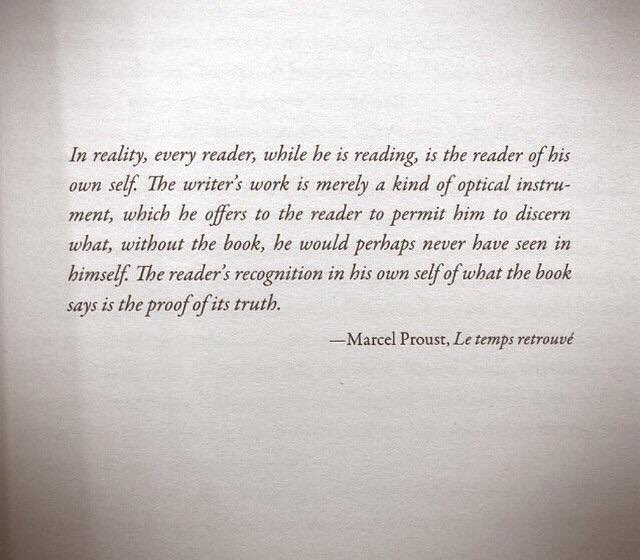
I had a more modest view of my book and it would be incorrect to say even that I was thinking of those who might read it as ‘my readers.’ For, to my mind, they would not be my readers but the very readers of themselves, my book serving only as a sort of magnifying glass, such as the optician of Combray used to off er to a customer; my book might supply the means by which they could read themselves. So that I would not ask them to praise me or to speak ill of me, but only to tell me that it is as I say,if the words which they read within themselves are, indeed, those which I have written.

The passage I cite was translated by the matchless Richard Macksey, a colleague of René Girard’s at Johns Hopkins University.

Incidentally, the whole introduction to Evolution of Desire was published in America Magazine over the weekend here. Notre Dame published it earlier, and it was linked in Hacker News, here. (Several people wondered why Artur Sebastian Rosman picked a golden image for the article, entitled “Golden Thoughts for a Nuclear Age” – you might note that it’s the “Mask of Agamemnon,” one of the findings of Heinrich Schliemann at the Troy excavation, an archaeological adventure described in the first paragraph of my intro.)

René Girard, meet the techies: Evolution of Desire climbs the charts at Hacker News.

Saturday, November 10th, 2018
Share

Even though the Book Haven lives in the heart of Silicon Valley, I generally avoid the sphere of computer nerds and techies, except when I need my Macbook Pro repaired or I’m battling a spam attack. But every so often, I get something that sends me into this brave new world.  So it was with yesterday’s news on Evolution of Desire: A Life of René Girard.

Artur gave me the heads-up.

It began when I received a Facebook message from Artur Rosman at 6 a.m.: “Happy news, a techie link picked up your book excerpt that we ran earlier this year. It has 1,700 hits today so far. You’re going to crash our site!”

He was referring to the introduction to Evolution of Desire, which was excerpted on a Notre Dame University journal as “Golden Thoughts from a Nuclear Age” here. The techie link was an unknown website to both of us, but that’s what Wikipedia is for. I looked up Hacker News there:

Hacker News is a social news website focusing on computer science and entrepreneurship. It is run by Paul Graham‘s investment fund and startup incubator, Y Combinator. In general, content that can be submitted is defined as “anything that gratifies one’s intellectual curiosity”.

The site was created by Paul Graham in February 2007. Initially it was called Startup News or occasionally News.YC. On August 14, 2007, it became known by its current name. It developed as a project of his company Y Combinator, functioning as a real-world application of the Arc programming language which Graham co-developed.

Paul Graham turns out to be kind of a big deal. Computer scientist, entrepreneur, venture capitalist, author and essayist.

But meanwhile, back in Indiana, Artur was beginning to panic. The numbers kept climbing minute by minute. He was pondering whether he should take the page down quickly so the server wouldn’t go boom. It didn’t, but meanwhile it quickly racked up 2,700 visits in a few short hours.

Paul gave us the lift-off.

Faithful Book Haven reader George Jansen, who runs a terrific blog 20011 (we’ve added it to our blogroll), also saw us on Hacker News. “I was going to post about this on my own blog, but then figured that you should get first dibs.” We let him go first.

From his blogpost: “I often check the Hacker News to see what topics interest the tech world. Perhaps 60% of the linked items have to do with computing, science, or mathematics, another 20% to do with politics or economics, and the remainder can be curiously assorted. Over the last couple of days a link to an article about whether Nero killed Agrippina has been in the first few pages.

“Though I do now and then see them, I don’t go to Hacker News looking for links to pieces about the humanities. I was surprised, then, today to see what was evidently an item by Cynthia Haven about René Girard on the first page… A sometime co-worker has made it to the first page of Hacker News a few times. However, his blog mostly has to do with old computer hardware, which suits what I take to be the interests of most of the Hacker News readership. I am interested to see that the techies find mimetic desire so well worth reading and arguing about.”

In the Hacker News comment section, Oliver Jones urged people to read the article over at Notre Dame: “Our trade is strongly influenced by René Girard’s understanding of competitive mimetic desire and its violence. Why? The people who organize the ad-driven internet know all about Girard. Peter Thiel invested in Facebook because he saw its potential for harnessing mimetic desire to drive engagement. (reference: https://www.lrb.co.uk/v39/n16/john-lanchester/you-are-the-pr…)

“Facebook-style social media is addictive precisely because of the fear of not being as good as ‘friends.’ Mimetic desire is the the human yearning behind the Fear of Missing Out. Driving engagement is most effective when it exploits that fear. It works very well indeed. Other attempts at building social media networks (Stack Overflow, Linked In, Slack, for example) try to avoid that exploitation. They try to use other motivators than FOMO [“Fear of Missing Out” to the rest of us. – CH] to drive engagement. Can they be successful without overusing mimetic desire? It’s the key question they must answer to be successful. The obligatory panel of customer logos just below the fold on SaaS landing pages engages mimetic desire in IT buyers. ‘Wow! Schwab uses this! I want to be like Schwab!’ It’s benign in these cases.

“Girard offers a good unifying framework for understanding the human nature behind all sorts of marketing work. Convincing people their hair is ablaze and offering them ways to put it out is the heart of building new businesses. Getting people to set each others’ hair on fire, then putting it out, is the holy grail of new businesses.

“It’s no accident that Silicon Valley employs that framework in lots of ways: he was a scholar at Stanford’s Hoover Institution. [He wasn’t – CH.] It can be a hard slog to learn about him. But it’s worth your trouble.”

I hope I’ve made the job a little easier for Oliver and the others with Evolution of Desire: A Life of René Girard. Meanwhile, read the whole discussion here. It includes the best quote ever from Peter Thiel, who studied with René at Stanford: “To believe yourself invested with divine self-sufficiency is not the mark of a strong individual, but of a person who has mistaken the crowd’s worship – or jeering – for the truth. The single greatest danger for a founder is to become so certain of his own myth that he loses his mind. But an equally insidious danger for every business is to lose all sense of myth and mistake disenchantment for wisdom.”

The excerpted introduction to Evolution of Desire, “Golden Thoughts for a Nuclear Age” is here.

Postscript: Speaking of signal honors, I received this Facebook comment, from another gentle reader, Marianne Bacon: “Cynthia, we are re-reading your book. Aloud. I am absorbing much more deeply and we are both loving it!”

Golden thoughts for a nuclear age: from the introduction of Evolution of Desire: A Life of René Girard

Sunday, March 4th, 2018
Share

My colleague and friend, Artur Sebastian Rosman at the University of Notre Dame (we met via Czesław Miłosz) has been eager to run an excerpt from my forthcoming Evolution of Desire: A Life of René GirardHe finally did so at his Notre Dame magazine last week. It begins at the beginning, the very first page of my book:

Armed with a copy of the Iliad and a shovel, Heinrich Schliemann set out to find Troy in 1871. Two years later, he hit gold.

He was vilified as an amateur, an adventurer, and a con man. As archaeologists refined their methods of excavation in the subsequent decades, Schliemann would also be deplored for destroying much of what he was trying to find.

Nevertheless, he found the lost city. He is credited with the modern discovery of prehistoric Greek civilization. He ignited the field of Homeric studies at the end of the century. Most importantly, for our purposes, he broke new ground in a figurative, as well as literal, sense: he scrutinized the words of the text, and believed that they held the truth.

“I’ve said this for years: in the global sense, the best analogy for what René Girard represents in anthropology and sociology is Schliemann,” said the French theorist’s Stanford colleague, Robert Pogue Harrison. “Like him, his major discovery was excoriated for using the wrong methods. The others never would have found Troy by looking at the literature—it was beyond their imagination.” Girard’s writings hold revelations that are even more important, however: they describe the roots of the violence that destroyed Troy and other empires throughout time.

Like Schliemann, the French academician trusted literature as the repository of truth, and as an accurate reflection of what actually happened. Harrison told me that Girard’s loyalty was not to a narrow academic discipline, but rather to a continuing human truth: “Academic disciplines are more committed to methodology than truth. René, like Schliemann, had no training in anthropology. From the discipline’s point of view, that is ruthlessly undisciplined. He’s still not forgiven.”

I have appreciated Harrison’s analogy, though some of Girard’s other friends will no doubt rush to his defense, given Schliemann’s scandalous character—but Girard scandalized people, too: many academics grind their teeth at some of Girard’s more ex cathedra pronouncements (though surely a few other modern French thinkers were just as apodictic). He never received the recognition he merited on this side of the Atlantic, even though he is one of America’s very few immortels of the Académie Française.

For Girard, however, literature is more than a record of historical truth, it is the archive of self-knowledge. Girard’s public life began in literary theory and criticism, with the study of authors whose protagonists embraced self-renunciation and self-transcendence. Eventually, his scholarship crossed into the fields of anthropology, sociology, history, philosophy, psychology, theology. Girard’s thinking, including his textual analysis, offers a sweeping reading of human nature, human history, and human destiny. Let us review some of his more important conclusions.

He overturned three widespread assumptions about the nature of desire and violence: first, that our desire is authentic and our own; second, that we fight from our differences, rather than our sameness; and third, that religion is the cause of violence, rather than an archaic solution for controlling violence within a society, as he would assert.

He was fascinated by what he calls “metaphysical desire”—that is, the desire we have when creature needs for food, water, sleep, and shelter are met. In that regard, he is perhaps best known for his notion of mediated desire, based on the observation that people adopt the desires of other people. In short, we want what others want. We want it because they want it.

Read more here.

“Everything Came to Me at Once”: my new opuscule on René Girard!

Friday, July 28th, 2017
Share

The première of my opuscule at University of Notre Dame. It’s the one with the bright blue cover.

I was finishing Evolution of Desire: A Life of René Girard (out next spring with Michigan State University Press), when Joshua Hren, founder of a fine-press publishing house called Wiseblood, approached me to see if we could adapt and republish one of the chapters as a stand-alone. Dana Gioia had suggested the project to them, so … how could I say no?  Voila! This week’s publication of Everything Came to Me at Once: The Intellectual Vision of René Girard.

From the jacket:

French theorist René Girard promulgates a sweeping vision of human nature, human history, and human destiny, but few understand the mysterious experience that gave birth to his theories: “Everything came to me at once in 1959. I felt that there was a sort of mass that I’ve penetrated into little by little,” he said. “Everything was there at the beginning, all together. That’s why I don’t have any doubts . . . I’m teasing out a single, extremely dense insight.”

The tough question was: what color for the cover? Blue. It had to be blue. But Dana had already made a clear and dignified blue statement with his covers. Blue was “taken.” Red was simply out of the question. Yellow, Joshua suggested. How about yellow? But René was not a yellow kind of guy. So I picked a bright sky blue. But I nervously awaited the final to see if the white letters would “pop” enough. I think they do.

Artur Rosman, literary scholar, translator, and blogger at Cosmos the in Lost, (we’ve written about him here and here) generously served as a blurber: “René Girard devoted his career to tracking down the twists and turns of mimetic desire in literature, philosophy, and anthropology. Cynthia Haven’s primer makes an invaluable contribution to Girard studies by tracking down the places where Girard discussed how his theories emerged from a personal process of intellectual and spiritual conversion—and its public consequences. What emerges is a compelling picture of Girard as a post-secular thinker who tears down artificial boundaries, such as the ones between the religious and the secular, between the private and public. Haven invites would-be Girard readers to see themselves as participating in a common struggle rather than scapegoating each other. This is a must-read book for a time when mimetic competition, shorn of scapegoating safeguards, rends the fabric of civil society.”

Trevor Cribben Merrill congratulated me on the final essay – an “opuscule,” he called it. That was a new word for me, and I liked it. Now I use it all the time. I roll it around my tongue. I find ways of working it into the conversation. “Have you seen my little opuscule?” Well… I guess “little” is redundant.

Any, the opuscule (see? I did it again) begins this way:

“Midway in the journey of our life I found myself in a dark wood, for the straight way was lost.” – Dante Alighieri, Inferno, Canto 1, trans. Charles Singleton

René Girard had reached the traditional midway point of life—35 years old—when he had a major course correction in his journey, rather like Dante. The event occurred as the young professor was finishing Deceit, Desire, and the Novel at Johns Hopkins University, the book that would establish his reputation as an innovative literary theorist. His first book was hardly the only attempt to study the nature of desire, but Girard was the first to insist that the desires we think of as autonomous and original, or that we think arise from a need in the world around us are borrowed from others; they are, in fact, “mimetic.” Dante’s “dark wood” is a state of spiritual confusion associated with the wild, dangerous forests. Three beasts block his path; the leopard, the lion, and the wolf represent disordered passions and desires. Dante’s conversion begins when he recognizes he cannot pass the beasts unharmed. Girard experienced his “dark wood” amidst his own study of the disordered desires that populate the modern novel. His conversion began as he traveled along the clattering old railway cars of the Pennsylvania Railroad, en route from Baltimore to Bryn Mawr for the class he taught every week. …

Buy it here.

Postscript on July 31: Kind words from Frank Wilson over at Books Inq.: “Perhaps the most interesting thing I’ve read this year is a mere 20 pages long and takes less than half an hour to read.” Read it here.