Posts Tagged ‘Boris Dralyuk’

“There is no art that I love more than opera,” says Dana Gioia. And he’s written a book to prove it.

Wednesday, November 20th, 2024

Share

Poet and former National Endowment for the Arts chairman Dana Gioia has been busy. He’s just published a spate of new books: Poetry as Enchantment and Other Essays (Paul Dry Books); Dana Gioia: Poet & Critic (Mercer University Press, edited by John Zheng and Jon Parrish Peede); and last and shortest (205 pages), Weep, Shudder, Die: On Opera and Poetry, also with Paul Dry Books. He calls the last “an idiosyncratic book about the extravagant and alluring art of opera.” He also calls opera “the most intense form of poetic drama.” We couldn’t agree more.

From the Preface:

“This is a poet’s book about opera. To some people, that statement will suggest writing that is airy, impressionistic, and unreliable, but a poet also brings a practical sense of how words animate opera, lend life to imaginary characters, and give human shape to music. And a poet knows about love. There is no art that I love more than opera. I have written this book for those who, sharing the devotion, have wept in the dark of an opera house.”

He adds that “the libretto is not a shabby coat rack on which the magnificent vestments of music are hung. Operas begin with their words. Strong words inspire composers, weak words burden them. Ultimately singers embody the words to give the music a human form for the audience.”

A mutual friend of ours, poet Boris Dralyuk, author of My Hollywood and Other Poems, concurs: “As an opera lover myself, I agree with him. Especially when it comes to the way that libretti tends to be overlooked for music: “The literary elements of opera are misunderstood. There is an assumption that in opera words hardly matter, that great operas can be built on execrable texts. But the libretto is not a shabby coat rack on which the magnificent vestments of music are hung. Operas begin with their words. Strong words inspire composers, weak words burden them. Ultimately singers embody the words to give the music a human form for the audience.”

He continues: “Dana Gioia has done as much as any living poet in the last half century to restore music and drama to the increasingly tuneless and predictable realm of American verse. Now, with Weep, Shudder, Die, the fruit of a lifelong love affair with opera, he restores poetry and drama to their rightful place in the realm of classical music. Gioia argues that ‘in opera the words come first,’ but that the real gift of the medium—to poet, composer, performers, and audience—is the opportunity to collaborate in the creation and experience of a uniquely stirring work of art, a meeting of Muses like no other. This brief book is itself a showcase of critical acuity and stylistic flair, which, like the best librettos, will leave you humming long after the performance is complete.”

Leading poetry critic Marjorie Perloff has died at 92: “Her passion was brilliant.”

Monday, March 25th, 2024
Share

Marjorie Perloff, one of America’s leading poetry critics, has died at 92. At Stanford, she was the Sadie Dernham Patek Professor of Humanities emerita. There will be many tributes in the days and weeks to come. Meanwhile, a few words of an early Facebook tribute from Stanford’s Hilton Obenzinger, who interviewed her for his “How I Write” program:

Marjorie Perloff

She lived a full life, fleeing Vienna as a child and ending up a leading critic. She always had an acute vision of current poetics, and she could be raucous and demanding and irritating and sometimes oddly narrow-minded, racially blinded on occasion, but she cultivated new experimental directions in poetry with a passion that was brilliant. I remember she sponsored a series of readings by avant-garde poets at Stanford. There were good turnouts – but with a remarkable absence of English Department faculty. She participated in a “How I Write” conversation. All I had to do was get her going and I didn’t have to say very much, she would just roll on in brilliant and funny bursts. Here’s an excerpt from the book that came from those conversations,. How We Write: The Varieties of Writing Experience:

Marjorie Perloff finds her subjects in a serendipitous or meandering fashion. She was asked to write an “omnibus review” of a hundred books of poetry, but she veered off when she discovered the work of one poet, Frank O’Hara, in an anthology. She was completely enthralled, and was compelled to write one of the earliest critical books about O’Hara’s work. “You’re going to write about something that speaks to you,” Perloff explained. “It does not mean it’s the greatest work; it just speaks to you. Nobody could be more different from me than Frank O’Hara, an Irish-American, gay, Catholic, male poet.” But she loved his work, his sense of humor; and she knew she liked the kinds of irony that O’Hara employs—so this became her project. Perloff explained that she has had to understand her own taste, “knowing what you like and don’t like,” and consequently her subject becomes a very personal choice, one that grows from that self-knowledge. “There are going to be certain things I never do like, that are, for me, sentimental,” and O’Hara was not one of those.

But it’s not only taste; it’s what she can offer to the conversation. Poets would often ask Marjorie Perloff why she hadn’t written about them or why she hadn’t written about some other writer. “It doesn’t mean you don’t like them,” she explained; but she may not have anything particular to say that hasn’t been said already. “There are a lot of people I like that I haven’t written about because I don’t feel I have anything to say that other people haven’t said. But that doesn’t mean that I don’t find them very interesting; it just means—Let’s take somebody like Faulkner, for instance. I adore Faulkner. But I don’t have anything to say about Faulkner, particularly.”

From Boris Dralyuk on Twitter: “I had this theory (ha…) that Marjorie was related to Shelley Winters. Like SW, she was a force, magnetic and grand. It was a joy to get her notes when she caught pieces of mine she liked, and it hurts to think that ’25 will arrive without one of her sumptuous New Year’s letters.

From Derek Beaulieu on Twitter: “Rest in peace Marjorie Perloff (1931-2024); an incredible scholar, critic, and colleague … Marjorie passed away peacefully, surrounded by her family. She was herself to the end – funny, opinionated, generous, and fiercely devoted to her friends and family.

Postscript from Peter Y. Paik of the University in Seoul, South Korea: “Ages ago when I was an undergrad interested in avant-garde poetry, it was Marjorie Perloff who made me want to pursue an academic career. I admired the clarity and grace with which she wrote on the most demanding sorts of texts, so much the inverse of much of the theory-heavy scholarship at the time. While my research interests moved in other directions, one of my fondest memories of graduate school was of getting to meet her in person at a conference in Cornell in 1995. She had an unabashed love for what she studied, which gave an invigorating and spirited quality to her conversation. Marjorie always retained the passion that drives one to study literature but which too often flags and flares out in the grind of the ivory tower. I pay my respects to a life well-lived, and offer the prayer that there will be more like her in the future.

Postscript on March 29: There’s more. From Robert Pogue Harrison (read the whole piece here):

“At Stanford, Perloff had a profound and lasting impact on her students and colleagues. Robert Pogue Harrison, the Rosina Pierotti Professor of Italian Literature, Emeritus, team-taught Introduction to the Humanities and two graduate seminars on the French 19th century poets Charles Baudelaire and Arthur Rimbaud with Perloff in the late 1990s. ‘No one who spent an hour in Marjorie’s company could ever forget her,’ said Harrison, professor of French and Italian. ‘In addition to being the best scholar of modern poetry of her generation, she was multi-lingual, immensely articulate, and a tour de force of wit and storytelling. She gave greatly more to Stanford than she took from it. Team-teaching with her was an exhilarating experience that I will always cherish.’” 

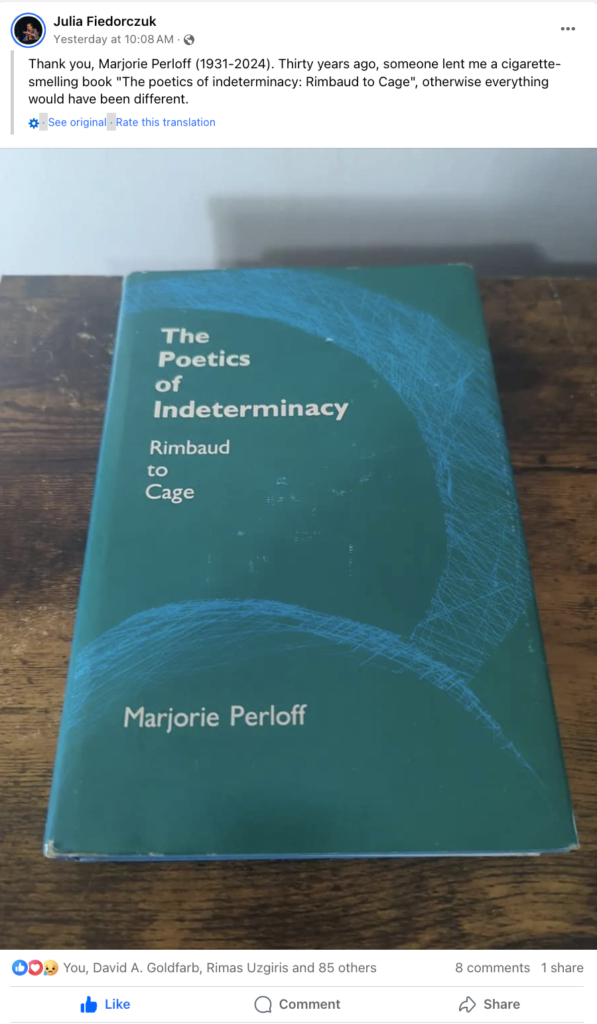
Postscript on March 26, from Polish poet Julia Fiedorczuk:

“This book will change the way you see the world around you”: Zabolotsky’s “Columns”

Friday, March 1st, 2024
Share
His poems took Leningrad by storm

When Columns, a slim volume of poems written by an unknown young Russian poet named Nikolai Zabolotsky, appeared in 1929, it took the literary world of Leningrad [St. Petersburg] by storm. Zabolotsky was not part of the city’s artistic elite, having arrived in Leningrad from the provinces only eight years earlier, but the privations and confusion he found in the city following the 1917 Revolution and ensuing civil war stimulated his poetic imagination. Zabolotsky’s translator Dmitri Manin describes his poetry as portraying “a worldview with no oppositions, no differences between the living and dead, abstract and concrete, naive and sophisticated, artful and artless, meaningful and meaningless, high and low, important and trivial, funny and sad. It’s all mixed inseparably…”

Now you will have a chance to hear his translator, Dmitri Manin, discuss the new published Columns ((ARC Publications, 2023) at the Stanford Bookstore on Thursday, Mar 7 2024, 5 – 6:30 p.m. The event is free and open to the public. What’s more, I will be moderating the discussion. I’d love to see you there!

Los Angeles Review of Books editor emertis, the poet Boris Dralyuk,  wrote: “The early poems of Nikolai Zabolotsky present to us images of such stark and surprising vividness that they continue to stun nearly a century after their publication. Dmitri Manin’s translations retain the freshness of Zabolotsky’s vision – that of an imaginative outsider thrust into a world torn apart and remade, haphazardly, by a bloody revolution and civil war – as well as the solemn music that effectively counterpoints the poet’s cavalcade of novel images. This book will change the way you see the world around you.”

Dmitri Manin, translator of Columns 

Dmitri Manin is a physicist, programmer and award-winning poetry translator. His translations into Russian span the range from Robert Burns to Allen Ginsberg to contemporary American poets. His translations into English have been published in journals and anthologies, including The Best Literary Translation, forthcoming in 2024 from Deep Vellum. Nikolai Zabolotsky’s Columns is Manin’s first book in English.

Cynthia L. Haven is a National Endowment for the Humanities Public Scholar and book author. She writes regularly for The Times Literary Supplement, numerous other periodicals and her award-winning blog, “The Book Haven”.

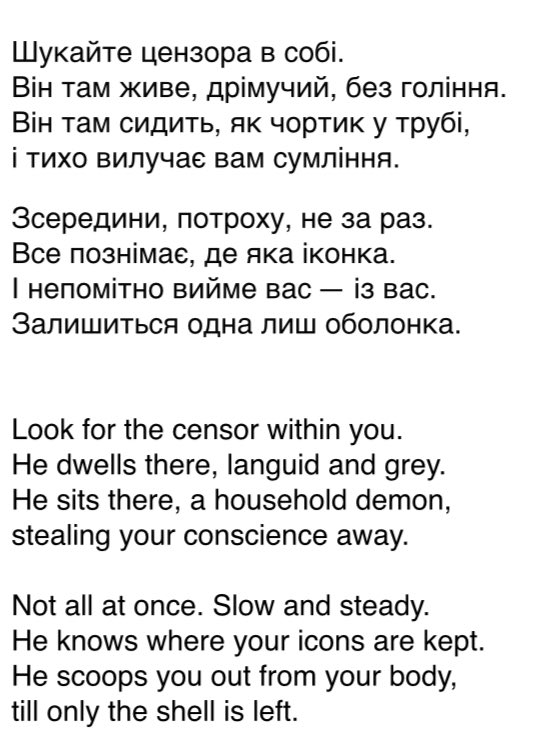
Legendary Ukrainian poet Lina Kostensko: “Look for the censor within you.”

Tuesday, December 6th, 2022
Share
The poet in 1948

The legendary Ukrainian lyric poet Lina Kostenko is 92 and still going strong. “We truly only value our life if we have something far more important, far more precious than the life itself,” she has said. Clearly her time is now.

Recently, she shared a few of her poems with the gifted Russian-American poet, essayist, publisher, and translator Boris Dralyuk.

According to Boris, Kostenko is known “not only for her immense lyrical gift but also for her refusal to bow to political pressure.” You can see that in the first poem below, “Look for the censor within you,” excellently translated by Boris. Never was it more timely, wherever you are in the world.

Kostenko is not only a poet, but also a novelist, and something of an aphorist, too. In 2005, an attempt was made by then-President Viktor Yushchenko to decorate Kostenko as a Hero of Ukraine,  the highest state honor. However, Kostenko refused the prize, declaring, “I will not wear political jewelry.”

During the 2022 Russian invasion of Ukraine, she criticized the use of obscene language and publicly opposed its legalization. She wrote on the social media, “There is, perhaps, no other such thing [as the Ukrainian language] in the whole world. The language is a nightingale, while the devil is blabbering on.”

The second poem strikes a more natural note, prompting Boris to tweet (along with his translation): “May both the landscape of Ukraine, now scarred, and the beautiful names of its rivers and valleys, towns and villages, arise and flourish!” We couldn’t agree more.

The verdict? “This is genius,” said Peter Pomerantsev on Twitter, where you can follow Lina Kostenko here: @L_Kostenko

Boris Dralyuk’s “My Hollywood” in the TLS: “microscopic close-ups of experience.”

Monday, July 25th, 2022
Share
Poet Boris Dralyuk…

Boris Dralyuk‘s My Hollywood (Paul Dry Books) continues to get high praise (we wrote about it here and here), this time in the Times Literary Supplement. The critic is the eminent poet Rachel Hadas (we’ve written about her here), writing: “The formal panache and ingenuity that make My Hollywood so pleasurable to read also serve to heighten its poignant blend of celebration and elegy.'”

An excerpt:

My Hollywood, Boris Dralyuk’s debut collection of poems, is so thematically coherent, so satisfying as an achieved gesture and mood, that it is easy to overlook just how multidimensional Dralyuk’s art is. While admiring the integrity of the collection as a whole, we can appreciate the minute details that stand out – “No molds or lasers, just the human touch”, as “The Minor Masters” has it. Or can we only take in the pattern of the whole when we have studied the details of Dralyuk’s craft? However we approach them, these poems reward close attention.

… and poet Rachel Hadas

Some lines offer almost microscopic close-ups of experience. Looking at old LPs in “Universal Horror”, the poet notices that “Motes build tract housing in the grooves of vinyl”. “Plants in Pots”, a couplet dedicated to the late Samuel Menashe, shares Menashe’s compressed wit and fondness for wordplay: “Calm captives, inch by inch, they make their flight, / and reach the window, bent on seeing light”. In “Notation” the view is closer still: “I was the tangled sheet / still clinging to your feet, / holding your ankles bound”.

Dralyuk’s imagery is consistently precise and unexpected, especially when it comes to technology. Thus, “A crow clacks in the branches overhead, / like a projector slowly going dead” (“Aspiration”); memories are “like VHS tapes after years of viewing / and spooling backwards to the sweetest spot” (“Bargain Circus”). In “Babel at the Kibitz”, “ACs burr and wheeze like old hasidim”.

The whole thing behind an inevitable paywall here.

Want to visit the homes of the stars? Why?

Monday, August 16th, 2021
Share
Editor extraordinaire

Editor-in-chief Boris Dralyuk of the Los Angeles Review of Books may be a celebrated poet and translator now, but he had a brief, humiliating, all-too-youthful stint hawking maps to the homes of the film industry luminaries decades ago. An excerpt from his blog:

For exactly one Saturday, in the summer of 1996, I stood on the corner of Sunset Blvd. and Ogden Dr. hawking maps to the movie stars’ homes. Earlier in the week, six of us, all immigrants from the former USSR, had been rounded up for the job by a Fagin-like fellow — stringy, squinty, coils of white hair sticking out like fried electrical cords from the back of his baseball cap. I don’t remember whether I had my mother sign a minor’s work permit or simply forged her signature, but I do remember that I sold exactly one map.

Unforgettable too was the look of disgust on our Fagin’s face as he peeled a fiver off his soggy roll of bills at 5 pm: my salary. The pay was piddling, the task demeaning. There was little shade on the corner, and I was too easily wounded by the reactions of some of my potential customers, their rude sneers and pitying frowns. To this day I accept every flyer handed to me on the street with a smile, recalling my own unhappy turn as a peddler.

Sellers of star maps were ubiquitous during my early years in Hollywood, but something drove them off them off the streets in the 2000s. I suppose it was the double threat of the internet, which made celebrity addresses free and easy to find, and reality television, which fed viewers the illusion of round-the-clock access to certain celebrities’ private lives: why drive around in the hope of spotting a star in the distance when you can sit at home and watch them squabble in their own kitchens?

Read the whole thing here.