
Posts Tagged ‘Leonid Pasternak’

Rilke’s last days: “…that someone, somewhere, in France or England, knows me, is translating me, mentions me…”

Thursday, August 14th, 2025

Share

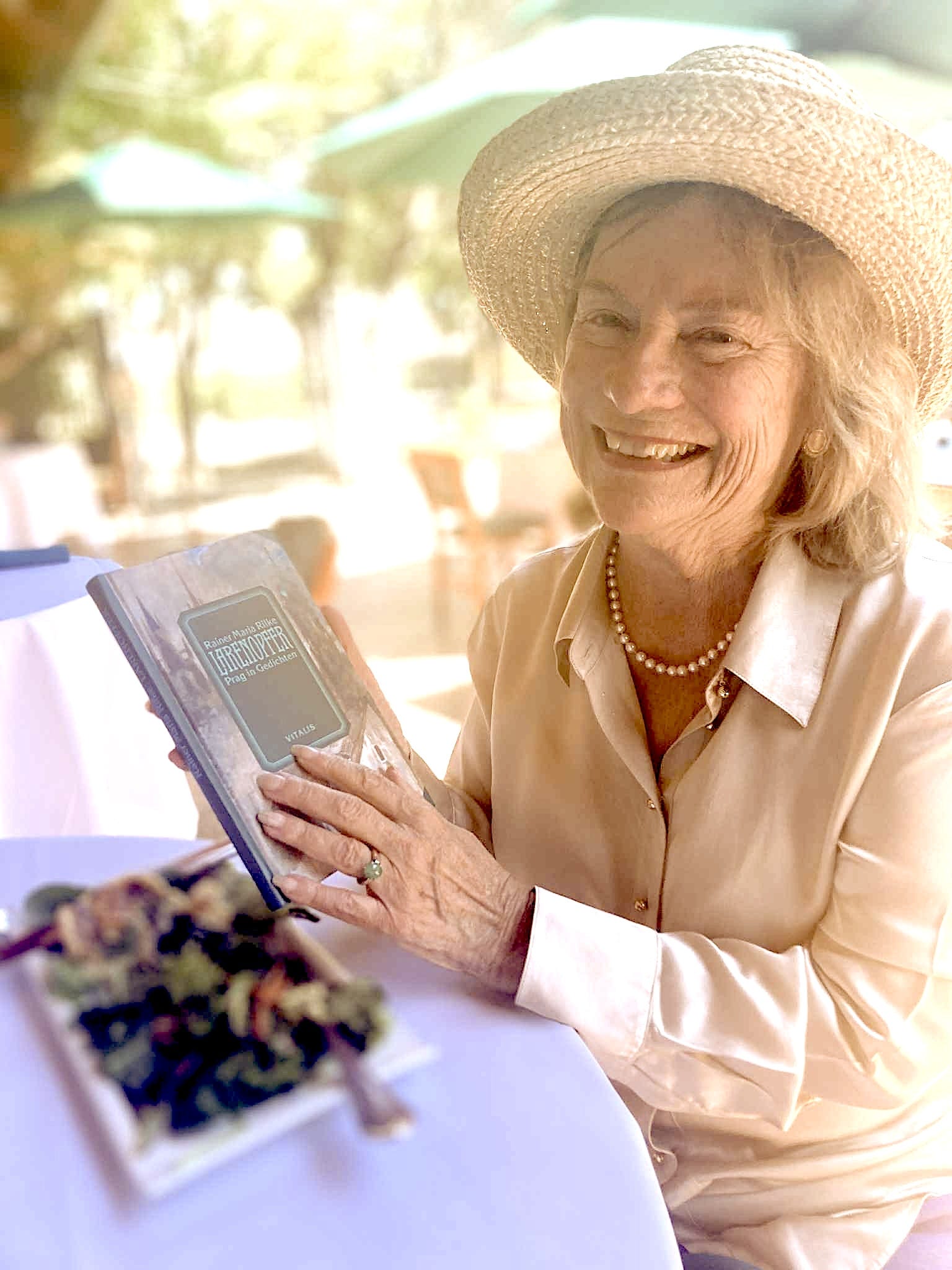
Archivist extraordinaire Elena S. Danielson (at right) kindly took me out to the Stanford Faculty Club for lunch last week. The kindness didn’t stop with the tiramisu. The former director of the Hoover Library & Archives also gave me a new edition of Rainer Maria Rilke‘s “Larenopfer” – to celebrate the 150th anniversary of the poet’s birth. The volume includes ninety of Rilke’s early poems from turn-of-the-century Prague, in German and English. Another treat, a copy of a 1926 letter from Rilke to Leonid Pasternak, the Russian poet’s father, an eminent painter.

In the letter dated March 14, 1926, the celebrated poet, already seriously suffering from the fatal illness that would end his life nine months later, wrote a lengthy, detailed, and graciously cordial letter to a Russian artist living in Berlin, Leonid Pasternak (1862-1945), the father of poet and novelist Boris Pasternak, who remained at that time in Moscow. Despite premature rumors of Rilke’s death, news reached Leonid that he was still alive, though ill, and celebrating his 50th birthday. Elated by the good news, the artist sent the great writer a birthday greeting by way of his publisher, since he didn’t have Rilke’s mailing address.

Rilke responded as soon as the letter finally reached him at the isolated medieval stone tower where he was writing his final masterpieces in an obscure corner of Switzerland. He starts out in Russian, which they had once used for their correspondence, but he switches quickly to German as his Russian skills had faded; he knew Pasternak, originally from multicultural Odessa, was fluent in German. (On the original paper, someone, possibly a family member, lightly penciled in a translation of the brief Russian phrases into German.) Rilke goes on to emphasize his continuing love of Russian culture and his faith that it will be restored, despite the chaos cause by war and revolution. And he renews their ties of friendship.

Before the Great War, Leonid had met the then unknown poet, just in his mid-twenties in Moscow in 1899, and once again by chance at a train station with the artist’s 10-year-old son Boris in 1900. A couple more brief encounters in Italy in 1904 and a few letters. That is all.

And yet they both remembered each other with great fondness. Both had a talent for lasting intellectual friendships. In his memoirs Leonid writes of the 1899 meeting: “Before me in my studio stood a young, very young, delicate, blond foreigner in a Loden coat … And already after the first short conversation we were like good old friends (which we later became).” (Die Familie Pasternak: Erinnerungen, Bericht, Geneva: Éditions Poésie Vivante, 1975, p. 62) The cordial feelings lasted even though they had no contact during the turbulent war years.
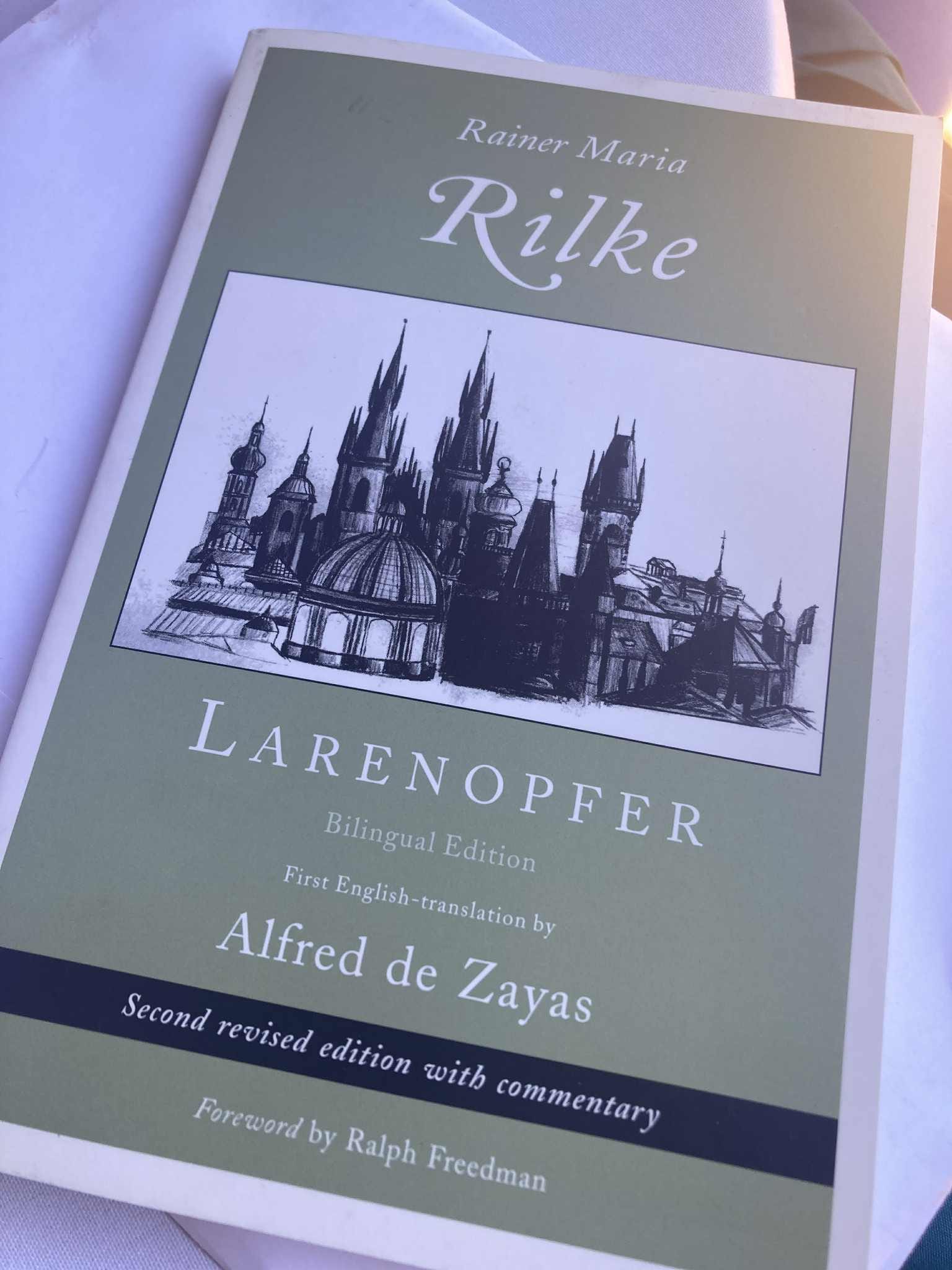
The 1926 letter in question – the first page shown here – had been published in German, but the original artifact with its still elegant handwriting, despite serious illness, conveys far more meaning than the copy in cold print. The Pasternak family carefully preserved this artifact for many years through the trauma of war, relocation, and exile. It was treated as something of a holy relic for the family. Starting in 1996, the Pasternak family began donating family papers to the Hoover Institution Archives at Stanford University for safekeeping. Among the many treasures in the collection is this original letter. In the published version, there is a brief postscript printed at the end. The original document shows this added afterthought displayed prominently in the upper left-hand corner of the first page. This brief note, crammed at the top, was even more important than either the writer Rilke or the recipient Leonid Pasternak realized at the time:

Gerade in ihrer Winter-nummer, hat die sehr schöne grosse pariser Zeitschrift “Commerce”, die Paul Valéry der grosse Dichter herausgibt sehr eindrucksvolle Gedichte von Boris Pasternak gebracht, in einer französischen Version von Hélène Iswolsky (die ich auch in Paris gesehen habe.)

Here is a translation of the note: “Just now, in its winter issue, the very beautiful, big Paris journal, Commerce, that Paul Valéry, the great poet publishes, are very impressive poems from Boris Pasternak, in a French translation by Hélène Iswolsky (whom I also saw in Paris).”

The full significance of the letter, especially the note in the corner, was not well understood in the English-speaking world until Nicolas Pasternak Slater translated and published the family correspondence in 2010. (Boris Pasternak: Family Correspondence 1921-1960, translated by Nicolas Pasternak Slater, Stanford: Hoover Institution Press, 2010. Reviewed in The Book Haven in 2011 here.) Leonid did not forward the original letter from Berlin to Boris in Moscow – he feared it might be lost – so he gave it to his daughter Josephine, who was also in Germany. Boris had previously written in August 1925 that he was devastated when he heard (erroneously as it turns out), that Rilke had already died.

When Boris learned about the letter from Rilke to his father, and got the news that Rilke was not only still alive and but had actually mentioned his poetry in the March 14, 1926 letter, Boris wrote to his sister from Moscow: “Our parents told me about Rilke’s letter, which has so thrown me that I haven’t been able to work today. What excited me wasn’t what probably pleased Papa and Mama, since after all I only got to hear of it by ricochet—that someone, somewhere, in France or England, knows me, is translating me, mentions me—but naturally I haven’t seen any of this with my own eyes…you need to know what Rilke was for me, and when this all started. This news was a short-circuit between widely separated extremes of my life. The incongruity of it shattered and devastated me, and now I don’t know what to do with myself.

Boris had told his sister that he had been dreaming, in fact quite unrealistically, of visiting Rilke – whom he had briefly encountered as a child 26 years earlier – in the poet’s medieval Swiss tower. At this point Boris was just trying to survive in Moscow after the devastations of the Great War and the catastrophic conditions precipitated by the Russian Revolution and Civil War while his father, mother, and sisters enjoyed the temporary safety of Germany. They would later be forced to leave Germany for England.

On top of everything else, you need to know who Valéry is—assuming this really is Paul Valéry, which is totally unlikely!” (Correspondence p. 43.)

(At right: the poet Rilke, painted by Leonid Pasternak)

Once Boris Pasternak in Moscow knew that Rilke was still alive, he and his dear friend, the poet Marina Tvetaeva, living in France, began a brief but passionately poetic three way-epistolary romance with Rilke in Sierre, Switzerland just before Rilke died. Rilke wrote something on the order of 17,000 letters in his lifetime, corresponding right up to the end of his life December 29, 1926. (The exact number of letters is not knowable, but it is certainly more than 10,000.) Of this remarkable correspondence, the last letters with Rilke in Sierre, Switzerland, Tsvetaeva in Paris, and Boris Pasternak in Moscow are among the most lyrical and most beautiful. And this remarkable exchange was initiated by the March 14, 1926 letter in question.

More on the two photos: “Rilke (1875-1926) in Moscow,” by Leonid Pasternk, an oil painting made in 1928, so a posthumous portrait based on earlier sketches depicting Rilke as a young man when he visited Moscow, prior to World War I, as an unknown poet. Apparently painted in Berlin some two decades later, the portrait is now in the Pinakothek Museum in Munich. A version in pastels is preserved at the Ashmolean in Oxford, in the UK where many family members live today.
The trail of “an Arab and his horse”: Poet Boris Pasternak, artist Leonid Pasternak, and Oxford

Sunday, November 20th, 2011
Share

The poet as a boy, 1898 (Photo: Ashmolean Museum, University of Oxford)

The poet Marina Tsvetaeva said that fellow poet Boris Pasternak looked like “an Arab and his horse.”

He does, really.  It’s an amazing, slightly Asiatic face.

I had ample opportunity to gaze at the visage of the Nobel laureate at the Ashmolean Museum, in the inconspicuous Print Room in a secluded corner on the second floor.

Not enough people know the author of Dr. Zhivago – for example, that he was primarily a poet, not novelist – but even fewer know the prominent members of his family.  His father, Leonid Pasternak (1862-1945), was a brilliant painter and friend of the Tolstoys.

In the Print Room, the helpful librarians brought out a large portfolio of the artist’s chalk and watercolor sketches and paintings of his family, of the leading figures of his times, of still lifes and landscapes.  With the white cotton gloves the museum provided, I lifted and examined each in turn, including portraits of Albert Einstein, Rainer Maria Rilke, and others.

I met the Pasternak family during the Pasternak celebration at Stanford last year (I wrote about it here). I was delighted to renew the acquaintance with two of them in Oxford – Ann Pasternak Slater and Catherine Oppenheimer, both nieces of the poet and granddaughters of the artist.  Catherine is an eminent psychiatrist; Ann is professor emeritus of English literature at Oxford (she is currently writing about Evelyn Waugh).

Ann is also a formidable critic, and a matchless champion for Pasternak’s work.  She wrote last year in The Guardian:

As a public speaker he was incomprehensible. His work is notoriously hard to translate. …

Pasternak’s work is also difficult because his mind-set is unpredictably complex, evocatively associative, synaesthetic and polysemous. His vocabulary is exceptionally wide, and his intellect has a pronounced metaphysical cast. In an uncollected letter to TS Eliot, Pasternak explores their shared aesthetic in ambitiously faulty English. Eliot’s art, he writes, like his own, is “a casually broken off fragment of the density of being itself; of the hylomorphic matter of existence . . .” Pasternak became much more accessible in his later work. Doctor Zhivago was suicidally vivid and forthright. The poems that accompany it are translucent.

"The Yellow Tree: Autumn Landscape," 1918 (Photo: Ashmolean Museum, University of Oxford)

From his schooldays, Pasternak tells us, Yury Zhivago had dreamed of writing “a book of impressions of life in which he would conceal, like sticks of dynamite, the most striking things he had so far seen”. Doctor Zhivago was that book. It was packed with dynamite and, as Pasternak expected, it blew up in his face.

I talk a little about that explosion here.

I had lunch with Ann and Catherine in the former’s Oxford home, which is almost a museum of their grandfather’s artwork.  (A link for the Pasternak trust is here.) Of course we talked about the translations of the poet (Ann dissed the newest Pevear-Volokhonsky translation in the article I’ve quoted).

Ann describes her uncle’s poetry this way: “Boris’s poetry is formally rich, regularly rhymed, and metrically precise. It is full of delectable assonances, at once musical and wholly natural. My mother’s first priority was to reproduce his aural effects. She did. This difficult demand inevitably exacted its own price. Her English is flawed – it sounds Russian. But it sings, as Pasternak’s poetry does.”

My inevitable question:  Which of the Pasternak translations does she favor?  Her answer: Mother knows best.  (The link, here, also has rare recordings of Pasternak reading his poems in Russian.)

Ann kindly gave me an out-of-print volume of her mother’s translations.  Here’s an example of Lydia Pasternak Slater‘s translation:

Sultry Night

It drizzled, but not even grasses
Would bend within the bag of storm;
Dust only gulped its rain in pellets,
The iron roof – in powder form.

Rainer Maria Rilke, 1921-24 (Photo: Ashmolean Museum, University of Oxford)

The village did not hope for healing.
Deep as a swoon the poppies yearned
Among the rye in inflammation,
And God in fever tossed and turned.

In all the sleepless, universal,
The damp and orphaned latitude,
The signs and moans, their posts deserting,
Fled with the whirlwind in pursuit.

Behind them ran blind slanting raindrops
Hard on their heels, and by the fence
The wind and dripping branches argued –
My heart stood still – at my expense.

I felt this dreadful garden chatter
Would last forever, since the street
Would also notice me, and mutter
With bushes, rain and window shutter.

No way to challenge my defeat –
They’d argue, talk me off my feet.

Boris Pasternak: Family Correspondence: British praise, American silence … so far

Tuesday, February 1st, 2011
Share

Portrait of the artist as a young man: cover painting by Leonid Pasternak, the Nobel laureate's father

In general, Hoover Press isn’t known for its groundbreaking literary fare — its more usual titles embrace such topics as Social Security: The Unfinished Work and The Wave: Man, God, and the Ballot Box in the Middle East. So last summer, as I attended a reception for the appearance of Boris Pasternak: Family Correspondence, 1921-1960, I wondered how how much press attention the first English of the Nobel laureate’s family letters would get.

So here’s the upshot:  some reviews in top-notch British literary journals — The Times Literary Supplement and The Literary Review; zip in America. All the votes have not been cast, of course — the slower literary journals may yet make an appearance (perhaps they’re teaming it up with the new Peavear/Volokhonsky translation of Doctor Zhivago, but the surprise is that some of the more mainstream dailies on both sides of the Atlantic have ignored it.

Or rather, not a surprise.  The point is (and here is where I turn into a scold), that is exactly what the prominent reviewers and their editors used to do: ferret out the good from a basket of seasonal rubbish.  But book reviews have been shaved and then butchered; unemployed and hungry literary critics are feeding out of dumpsters.

That’s the bad news.  Here’s the good.  The book has received two awards: the American Library Association’s  Choice award for Outstanding Academic Title for 2010.  It also received the BookBuilders West prize.

One American has written about the book:  moi.  Here’s what I wrote about the book last summer (the rest is here):

The newly published correspondence is important: The Pasternak family was a close-knit one, and leading figures like Leo Tolstoy were family friends. Boris’ father, Leonid Pasternak, was an important post-Impressionist painter, and his mother, an accomplished pianist; they immigrated to Germany in 1921. After 1923, Pasternak was never to see his parents or two sisters again, except for one visit with a sister.

Slater said he originally began translating these letters out of a feeling of family loyalty. Pasternak did not write much about arrests, imprisonments and executions, but his intimate letters to his family have been considered works of art in themselves.

As the Nazis took power in Germany, Pasternak’s Jewish parents began to consider returning to Russia. According to Slater, “Boris found himself writing contorted letters in which he on the one hand assured his parents that he would love to have them living with him, and that they wouldn’t be a burden, but simultaneously tried his hardest to dissuade them from coming – since he knew, but couldn’t tell them, that their lives would be in danger if they came.

“I don’t think they understood his hints, and they probably did find him a bit inhospitable.” (They took refuge with Slater’s parents at Oxford instead.)

The book has, at least, gotten a few favorable reviews in the British press.  Peter France, writing in the Times Literary Supplement:

“It is not a complete translation, and one may regret the omission of certain passages discussing poems in detail, and above all the natural decision to focus on the letters of Pasternak himself. But the translator, Nicolas Pasternak Slater, the poet’s nephew, has done an admirable job, writing with enough freedom to bring across the meaning strongly, but enough faithfulness to convey something of the sheer oddity of Pasternak’s range: his exalted tone, his obscurity and his idiosyncratic eloquence. …

At Hoover reception: Anastasia Pasternak, great-granddaughter of the poet; Oxford scholar Ann Pasternak Slater, niece of the poet; Maya Slater, editor of the new volume, and her husband Nicolas Pasternak Slater, translator of the new volume and nephew of the poet. Anastasia Pasternak, great-granddaughter of the poet; Oxford scholar Ann Pasternak Slater, niece of the poet; Maya Slater, editor of the new volume, and her husband Nicolas Pasternak Slater, translator of the new volume and nephew of the poet.

Boris Pasternak has sometimes been seen as a happy man who survived miraculously when his fellow writers were meeting tragic fates.  What comes over most strongly here, however, is the sheer difficulty of his life: the anxiety, fear and depression with which he struggled for decades. … It was an increasingly hard place to be, with the arbitrary arrests, exiles, and executions, the horrors of collectivization, and, less tangibly, what Pasternak calls ‘the dark night of materialism.'”

And George Gömöri (one of the contributors, incidentally, to An Invisible Rope: Portraits of Czeslaw Milosz … couldn’t resist the plug for my book), wrote in the Literary Review’s “Prisoner of Peredelkino” that the new volume of letters “will remain an indispensable source of information for future biographers” writes that Pasternak’s fortunes worsened considerably after the trial and execution of Nikolai Bukharin (we’ve written about that here, following the publication of Paul Gregory‘s engrossing book on the subject, The Story of Nikolai Bukharin and Anna Larina, last year).

One American had some nice words to say about the kudos drifting in from awards committees — even if from the very farthest corner of America, the far-flung islands to the west. John Stephan, professor emeritus of the University of Hawaii wrote:

“The Pasternak book richly deserves the awards. It’s a pleasure to see intellectual integrity and scholarly quality win public recognition.

It’s a marvelous work, rich in literary and historical insights, meticulously edited and handsomely produced.  Its utility for researchers is enhanced by an excellent index–notable not only for completeness and accuracy but for bio info (years of birth & death–and in some cases manner of death) of each individual mentioned in the text.  A standard all editors should emulate.”