
Posts Tagged ‘Maxim Shrayer’

“The most selfless guardian of Brodsky’s heritage”: Valentina Polukhina (1936-2022), requiescat in pace

Tuesday, February 8th, 2022

Share
Valentina Polukhina in 2010 (Photo: Yuri Leving)

She was a woman from another era, in the finest sense of the word. The up-to-date term “networker” would trivialize Valentina Polukhina‘s indefatigable labors – yet never was it more apparent since her death in the early hours this morning how wide her network was. The Keele University professor who was one of the world’s leading scholars on Nobel poet Joseph Brodsky seemed to know everyone, and kept up a wide circle of correspondence. Her Facebook page was flooded with reminiscences and condolences.

Joseph Brodsky and Valentina Polukhina

She died quietly at her home in Golders Green, London, in the early morning hours of February 8, at age 85. There is no one like her, and no one to take her place. She will be very much missed – and not only in the world of Brodsky scholarship. She was a generous scholar, a kind and wise human being, and a dear friend. She was the recipient of the A. C. Benson Medal and the Medal of Pushkin. Valentina, the widow of translator Daniel Weissbort, will be remembered most of all, I think, for her tireless work on the multi-volume Brodsky Through the Eyes of His Contemporaries. That unique masterwork will grow in importance and meaning with time.

And what a fascinating effort it was: a massive collection of in-depth interviews with those who knew the Russian Nobel poet – including friends from his Leningrad days before his 1972 expulsion from the USSR, which brought him to Ann Arbor and the University of Michigan, and the new friends he made in exile. The volumes include interviews with fellow Nobelists Seamus Heaney, Czesław Miłosz and Derek Walcott, Swedish author Bengt Jangfeldt, Lithuanian poet Tomas Venclova, British author John le Carré, Susan Sontag, and dozens and dozens of others, some famous, others relatively unknown colleagues from Russia. Think of it: a firsthand record of what it was like to live, love, and work with one of the great geniuses of our time. She took flak for this effort – not least of all from Brodsky himself – but I have no doubt these volumes (two in English, three in Russian) will stand the test of time, and be an endless literary and cultural goldmine for generations to come.

Yuri Leving of Dalhousie University, who has written about Brodsky’s artwork, agrees: “While reading obituaries and sketches today about the main and, without exaggeration, the most selfless guardian of Brodsky’s heritage, I involuntarily caught myself thinking of the bright portraits in Brodsky Through the Eyes of his Contemporaries. I took this photograph (above) at her home in Golders Green in August 2010 when her husband, the remarkable poet and translator Daniel Weissbort, was still alive. The following ten years included a few more meetings and regular correspondence – everything about Brodsky was sacred to her, and it could not help but attract her. In 2021, when I was preparing to go to London again, Valentina wrote: ‘Alas, I can no longer cook dumplings. Instead, I will invite you to lunch at my club Athenaeum, where Joseph appeared in jeans at the invitation of Sir Isaiah Berlin. You really need to be in a suit and tie for this.’ My trip was exactly a week after Valentina was discharged from the hospital (she had been injured in a fall) so we agreed to postpone the appointment. Now is forever and ever.”

She was a 21st century networker, but also something from a much older tradition: one of those Russian women (some scholars, some not) who dedicate their lives to a timeless literary figure, one such as Joseph Brodsky. Among her many books: Joseph Brodsky: A Poet for Our Time (Cambridge University Press, 1989, 2009), Brodsky’s Poetics and Aesthetics (Macmillan Press, 1990), Joseph Brodsky: The Art of a Poem (Macmillan Press, St. Martin’s Press, 1999), and others. That’s in addition to the two thick volumes of Brodsky Through the Eyes of His Contemporaries, which I reviewed for The Kenyon Review a decade ago.
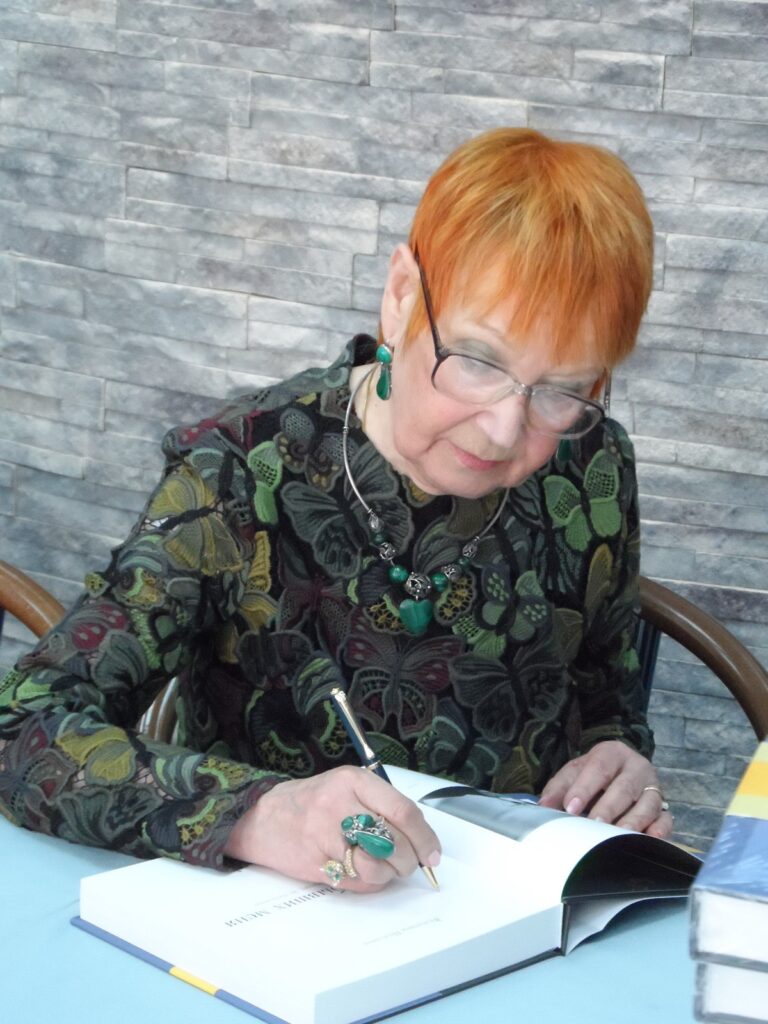
Book signing

From author Maxim D. Shrayer of Boston College: “The passing of Valentina Polukhina, literary scholar best known for her writings about Joseph Brodsky, is a terrible loss. Our family and Valentina have been friends for over twenty-five years. She was endowed with a remarkable and rare talent—to love and cherish poetry and poets, and to do so outside the grid of literary politics. How bitter it is to realize that Valentina Polukhina is gone. Memory eternal.”

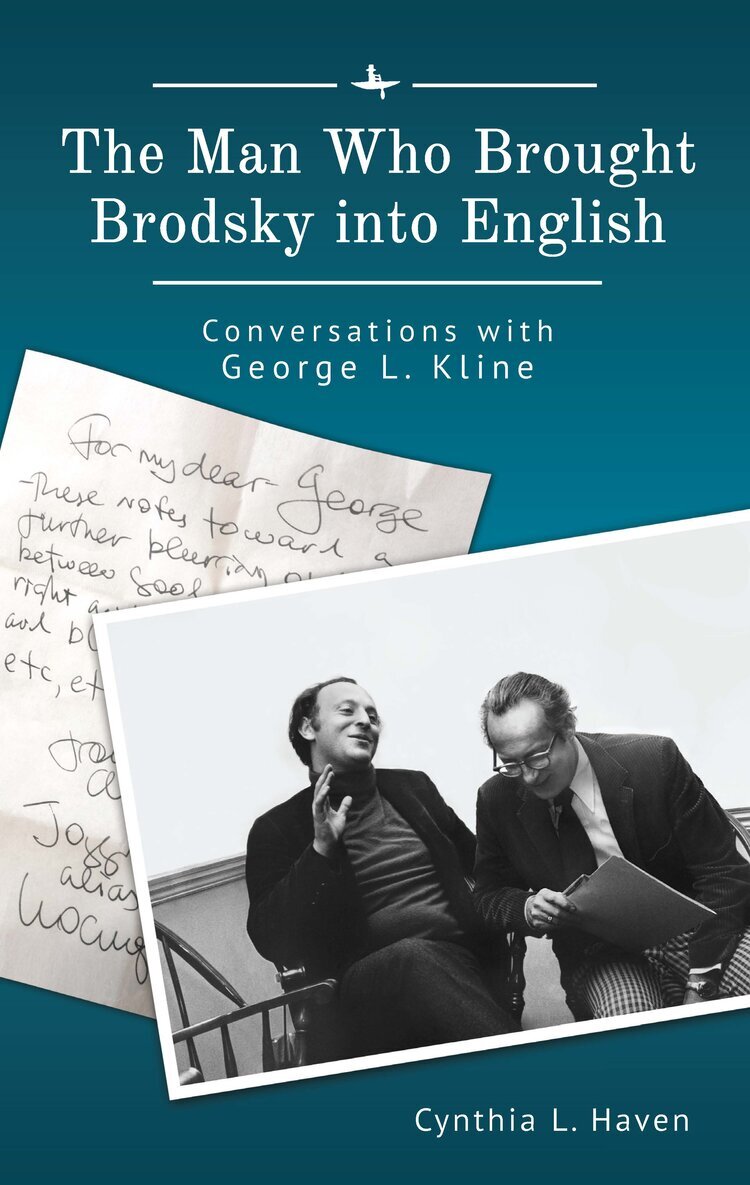
I was a recipient of her generosity during our work with The Man Who Brought Brodsky Into English: Conversations with George L. Kline. She was an invaluable firsthand source. I will always treasure the time we spent together in London back in 2018. The advice she gave, the additional material she supplied from her own rich archive, all enriched the small volume.

She was a matchless hostess as we worked, for she generously invited me to stay in her charming Golders Green home for a week. And that was an unforgttable event, too – a place infused with her history and memories, her Russian taste, her vivid colors, her rich Orthodox heritage, made an indelible impression.

We were going to get together in London to celebrate with champagne the publication of The Man Who Brought Brodsky into English … when the coronavirus epidemic subsided, when travel resumed. Now I will have to lift a glass of bubbly to her memory by myself – here, far away, on the shores of the Pacific.

Postscript on February 11: Over at her blog The Stone and the Star, poet and publisher Clarissa Aykroyd remembers meeting Valentina at a reading: “I asked her about her writing and work and she told me that she had written many books about Brodsky. She then mentioned that her husband was the late Daniel Weissbort. I was a bit dumbfounded – Daniel Weissbort died only a few months ago and I had read many tribute articles and obituaries. He was the founder of Modern Poetry in Translation, along with Ted Hughes. She herself was Valentina Polukhina, not only a Brodsky expert but a major scholar and advocate of Russian literature for English speaking audiences. I told her that I didn’t know a lot about Brodsky but that I adored Mandelstam, and she said “The advantage of Mandelstam is that he has been translated by many different people, so you have a lot of choice.” I also told her, quite sincerely, that I would rather read Modern Poetry in Translation than most journals dedicated to contemporary English-language poetry, and she seemed happy about that. When we introduced ourselves, she said to me that the name Clarissa was also found in Russia, but that it was considered quite aristocratic. It was a lovely, striking encounter.” Read the whole thing here.

Also, Britain’s premier publisher of poetry, Bloodaxe Books, has a summary of her career here.

Postscript: A small example of her cultural efforts on behalf of the Brodsky legacy in 2018, in The Guardian here.

At the Russian Cultural Center in Kensington, 2018. Valentina at lower left, and me in the Harris tweed.

“The Man Who Brought Brodsky into English”: a Q&A

Saturday, March 27th, 2021
Share

Boston College”s Prof. Maxim D. Shrayer, author of Waiting for America and Leaving Russia, interviewed me about my new book just out this month: I’m happy to say The Man Who Brought Brodsky into English: George L. Kline in Conversation is now available wherever you buy books. The interview:

Cynthia, let me begin by asking you to describe your path to the book—a double path that led you to Joseph Brodsky and to George L. Kline.

9781644695135.jpg

I studied with Joseph Brodsky at the University of Michigan—his first port of call in the U.S. It was psychological and aesthetic jolt, like sticking your finger into a light socket. And yes, we memorized hundreds of lines of poetry in his classes.

For many of us, Brodsky’s Selected Poems in 1973 was a radical reorganization of what poetry can be and mean in our times. However, I didn’t connect with the book’s translator, George Kline, until after I published Joseph Brodsky: Conversations in 2002. George and I stayed connected with Christmas cards and occasional phone calls. But we’d never actually met face to face—so I had no real sense of his age, until in late 2012, when he mentioned that he was almost 92.

George was a champion for Joseph Brodsky and his poetry—many people know that, but many don’t know that he was also a wise and kindly supporter of poets, Slavic scholars, and translators everywhere. He had never given a full account of his collaboration with the Russian-born Nobel poet, however, and I realized time was running out. So we began recording conversations.

His health was failing, and our talks became shorter and more infrequent. Towards the end, he urged me to augment our interviews with his articles, correspondence, and papers, reconstructing a portrait of his collaboration with Brodsky. George died in 2014.

His death was a huge loss for the field of Russian studies. But for you and your work, unimaginable… What was it like continuing without him?

The effort was more than a jigsaw puzzle. I felt like I was carefully gluing together a model airplane to take us to another world – a world that began with Soviet Leningrad in the 1960s where George met the young red-headed poet and ended with the poet’s death at his home in Brooklyn in 1996. More than that, it was the world that Brodsky created with his poems, which they both inhabited.

What role did Kline play in Brodsky’s life and literary career, and what did Brodsky mean to Kline?

George translated more of Brodsky’s poetry into English than anyone else, with the exception of Brodsky himself. Poetry was an avocation for George, but my goodness—look at how George evolved as a translator from his early “Elegy for John Donne” to his stunning translation of “The Butterfly” a decade later!

Incidentally, many people also do not know that Kline was a highly regarded Slavic scholar, writing about Russian religion and philosophy. His obituaries in journals focused on that work, not his work with Joseph Brodsky!

Joseph Brodsky was the adventure of George Kline’s life, I think. He found himself lunching with world poets and attending the Nobel awards ceremonies in Stockholm. But it wasn’t his world or natural habitat, and George knew that.

How would you describe Kline’s approach to translating Brodsky? Why do you think Brodsky—who at times wasn’t easy to please—appreciated Kline’s translations?

It was an unlikely partnership, in temperament and training, but one trait they shared was a commitment to maintaining the formal scheme—rhyme, meter, and so on—of the original poem.

George was also insistent that nothing be added to or subtracted from the poem. Of course, Joseph changed his poems freely, but that was the poet’s prerogative—not the translator’s.

I said that George evolved as a translator—well, Brodsky changed, too. He was extremely lucky to have found Kline early in his poetic career. But as he became an internationally recognized writer, he had a greater range of translators to choose from, some of them outstanding poets in their own right: Anthony Hecht, Richard Wilbur, Derek Walcott among them. George sometimes felt sidelined, inevitably. But George had a full, rich life of his own.

A riveting teacher at the University of Michigan
(Photo: Terrence McCarthy)

Where do you think Brodsky’s poetry, often described as “metaphysical,” found common ground with Kline’s own philosophical interests and pursuits?

They both had a sacred vision of the world—and of the word. Both defy easy categorization. Kline was loosely “Unitarian,” Brodsky caught or suspended between Judaism and Christianity. At one point he described himself as a Calvinist, at other times his vision seemed almost Catholic—given his love of Italy, how could it be otherwise?

George remembers seeing a volume of Nikolay Berdyaev on Brodsky’s desk when he first visited the poet’s his Leningrad room—The Philosophy of the Free Spirit. That may indicate his turn of mind as well. Another point of connection with the philosophy professor.

One poem Kline loved, and that he unfailingly presented at readings, was Brodsky’s “Nunc Dimittis.” It’s Jewish and Christian, illustrating the transition between the Hebrew Bible and the New Testament, both powerfully represented. The dying Simeon and the infant Christ, who grows in cosmic and historical dimensions. That poem alone shows the fusion of those two sides of himself.

The years since his early days have seen many more translations. How do you feel about more recent English retranslations of Brodsky’s poems? 

The more the merrier. Kline himself wanted to see more translations of Brodsky’s work, he was a translation “liberal.” There are always trade-offs in translation. He wanted to see what others would do. Brodsky is said to be untranslatable. If so, the best we can do is have multiple translations and triangulate meaning. As English speakers living in 21st century America, we also need to have a better understanding of the art of translation—and its necessary choices, sacrifices, limits. That’s what this book is for.

Finally, Cynthia, if one were to play devil’s advocate or dismiss totalizing explanations by suggesting that Kline wasn’t the only person who “brought Brodsky into English”—there were after all W.H. Auden and Carl Proffer—what might your response be?

Oh heavens! I would never wish to diminish the legacy of either of those remarkable men. Both are pivotal in Brodsky’s story. I’m delighted that mine is the second book—after Ellendea Proffer Teasley’s Brodsky Among Us—to appear in the book series you curate for Academic Studies Press. Both the Proffers had vital roles in Joseph’s life and work. There should be a statue to them in Russia. I’ve said that before.

Carl Proffer brought Brodsky to America, meeting him in Vienna, changing the poet’s plans and planes, diverting him to the U.S., and finagling a University of Michigan appointment for the young man who had dropped out of school at 15. Joseph himself said that Carl Proffer “was simply an incarnation of all the best things that humanity and being American represent.”

W.H. Auden’s foreword in Selected Poems was critical. It launched Brodsky’s first important book in the West. It also began a personal friendship that was foundational for Brodsky as a poet and a human being. But Auden didn’t bring the poems into English.

George made a home for Joseph in the English language, beginning in the first days of his exile, as they revised poems together at Goose Pond in the Berkshires. George Kline is behind the Selected—not only in his translations, but in getting it published at a high level where it would get the world attention it merited.

Don’t forget that when Kline heard about the Nobel prize on the radio, he called London to offer his congratulations to Brodsky. The poet replied, “And congratulations to you, too, George.”

Cynthia, congratulations to you on the book, and may it have a long life.


Joseph Brodsky teaching at the University of Michigan, Spring 1973 (Photo: Terrence McCarthy)