Posts Tagged ‘W.H. Auden’

The spirit of L.A.:”What happens to a civilization that grows up alongside the constant vision of dust?”

Wednesday, September 6th, 2023

Share

Our Tuesday, Sept. 19, hybrid event on John Fante‘s 1939 novel Ask the Dust  is coming up fast. Join us at 7 p.m. (PST) in Levinthal Hall in the Stanford Humanities Center, 424 Santa Teresa Street on the Stanford campus. REGISTER FOR THE EVENT ON THE LINK HEREThe event is free and open to the public. Walk-ins are welcome, but registration is encouraged whether you plan to attend virtually or in personRead more about the event here.

This event is co-sponsored by the Continuing Studies Program and the Division of Literatures, Cultures, and Languages at Stanford, and also the Italian Cultural Institute of San Francisco.

Two weeks ago, we published a story how Joel Williams’s life as a convict turned around when he read Fante’s 1939 novel. “There were no creative writing classes in prison,” he wrote, but with the help of Fante scholar Stephen Cooper, he became a writer. Read about it here. But meanwhile, here’s an excerpt from another successful author, Alan Rifkin. According to NPR: “One of the true L.A. originals, Alan Rifkin is easy to catch in the act of being brilliant.” Here’s another chance to do so, as he discusses Ask the Dust.

Rifkin: “terminal desert from the depths of the paradise dream…”

Every Los Angeles writer at the outskirts of vision feels a connection to Ask the Dust, the 1939 novel that, more than any other, seems to weep over this city’s corpse in the ecstasy of possessing it. (“Los Angeles, give me some of you! Los Angeles come to me the way I came to you, my feet over your streets, you pretty town I loved you so much, you sad flower in the sand, you pretty town.”i We all are sufferers. We’re not sure, exactly, if the intimacy of our suffering will survive the novel’s journey to the big screen, to the masses, to the world. But on the page, it’s strictly ours.

Stephen Cooper’s history with Ask the Dust is even more personal. “I was seeking to fill that absence that I didn’t even consciously know defined me,” he says. “And that was the loss of my father. So I would spend my days just mooning around, moving about, like most young writers, haunted by characters, trying to compose them and failing, failing, failing, failing, failing. . . . And then when I came upon Ask the Dust, it was a time in my life when I was living with every pore open to possibility.” (Citations are from Rikfin’s interviews with Cooper.)

Living, in other words, like Bandini himself, who finally writes his look-at-me novel, only to hurl it to the sands where his goddess went mad. “He’s gotten what he wanted, in terms of having written the book … to be on the shelf next to the big guys. But desire is such that it outlives its fulfillment. And so he must desire something else. … It turns to dust, doesn’t it, the fulfillment of desire. So getting what you want is, if you will, just a beginning of the eternal and unattainable story of desire.”
***

Stephen Cooper was my graduate professor at Cal State Long Beach, and as I was writing this essay, he coined a name for this school of writing: Southern California Dream Realism. Maybe Southern California Dream Realism is just the ultimate extension of anybody else’s literary mode—a way of seeing life stripped of time’s pretense. It’s a manner of always seeing the terminal desert from the depths of the paradise dream, or paradise from the stretches of life’s dry march.

I do know that in our past, in the dark of that pantry, I see the East Coast. Some remnant of ancestry, a quaint hope of continuity, a proper burial gone wrong—Waugh’s mortuary. I see how fooled my childhood was by every architectural simulation of history.

But I don’t know what happens to a civilization, and a literature, that grows up alongside the constant vision of dust. Does the rest of the country even make sense to us here? Was all this aftermath built in from the start? Even the apocalypse, in Los Angeles, feels like history now, the erasures of paradise barely detectable, the age of visions five minutes from over.

That is one scenario for where L.A. literature is heading. Then there is Francesca Lia Block’s view, which she offers in an unpunctuated e-mail: “life/death magic/reality young/old spirit/body masculine/feminine the walls seem to be dissolving and the worlds blending” (from correspondence to Block). In other words, “Paradise Next.”

*Claremont McKenna professor Jay Martin has pointed out that what W. H. Auden called “West’s Disease” — an L.A. collision of foolishness, desire, and illusion named after Nathanael West — could just as well have been named after Fante.

REGISTER FOR THE EVENT ON THE LINK HERE

W.H. Auden: “what it means to love one’s neighbor as oneself”

Friday, May 20th, 2022
Share

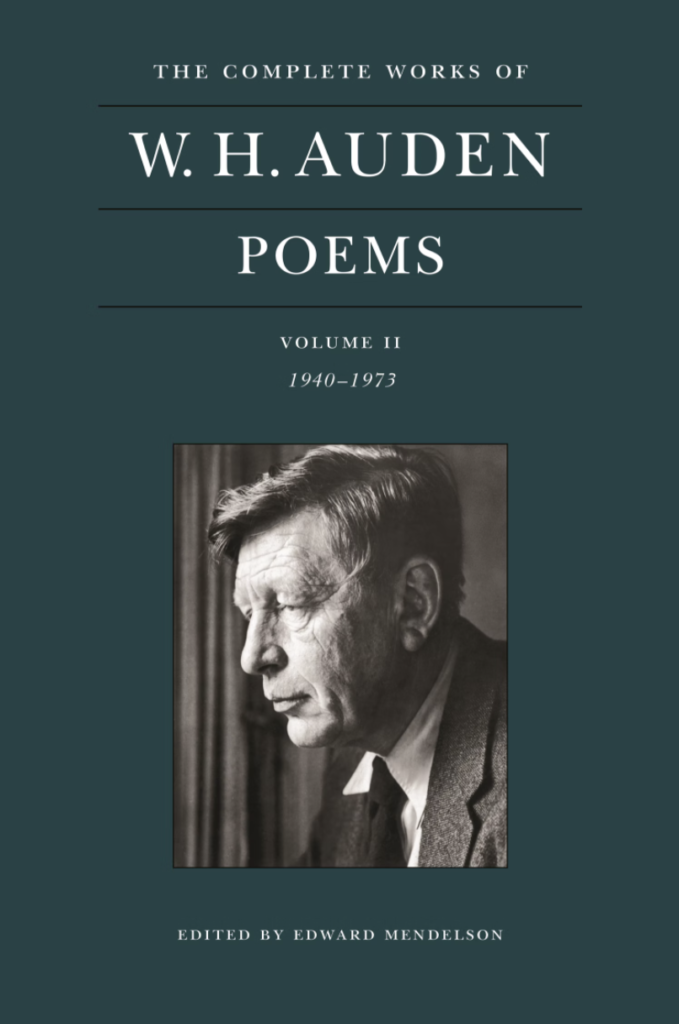
Some good news in a sad year: Princeton University Press has just published the two-volume set of the complete poems of W.H. Auden, one of the foremost poets of the twentieth century. The volumes, edited, annotated and introduced by leading Auden scholar Edward Mendelson, include unpublished poems, songs, juvenilia, original texts and revisions. Together, the two volumes total nearly 2,000 pages.

There’s significance in the publication date: 2022 marks the hundredth anniversary of the year Auden began writing poetry. Had Princeton waited another eleven years, it would have marked the centenary of another remarkable event in his life, which Mendelson describes in his introduction:

“At the same time, when he was looking publicly toward social revolution, he was quietly approaching an inner one. In May 1933 he wrote a sestina, ‘Hearing of harvests rotting in the valley’, one of his bravura historical summaries of many centuries in a few rapid stanzas. After describing earlier centuries’ fantasies of escape from ‘the sorrow’ of unhappy cities to the happiness of utopias somewhere else, the poem ends by imagining a different kind of transformation, not an escape from sorrow, but the sorrow itself melting into a revitalizing flood, after which ‘we rebuild our cities, not dream of islands.'”

“A few weeks later, in June 1933, he experienced what he later called, in a lightly-disguised autobiographical essay, a ‘Vision of Agape.’ This occurred when, sitting with three fellow teachers at the Downs School, he knew for the first time, because he was experiencing it, ‘what it means to love one’s neighbor as oneself.'”

An excerpt from the essay:

“One fine summer night in June 1933 I was sitting on a lawn after dinner with three colleagues, two women and one man. We liked each other well enough but we were certainly not intimate friends, nor had any one of us a sexual interest in another.

Incidentally, we had not drunk any alcohol. We were talking casually about everyday matters when, quite suddenly and unexpectedly, something happened. I felt myself invaded by a power which, though I consented to it, was irresistible and certainly not mine. For the first time in my life I knew exactly—because, thanks to the power, I was doing it—what it means to love one’s neighbor as oneself…. My personal feelings towards them were unchanged—they were still colleagues, not intimate friends—but I felt their existence as themselves to be of infinite value and rejoiced in it.”

Morgan Meis doesn’t give a crap about COVID. And then takes on Auden’s (arguably) most famous line.

Friday, June 12th, 2020
Share

Morgan Meis, a contributor to The New Yorker, doesn’t want to hear what you have to say about coronavirus. (We wrote last week about his new book here.) His latest, “Assist One Another,” from Close Reading, the Slant Books blog:

“You may have noticed that there are a lot of writers writing a lot about the coronavirus. As every day passes, I want to read these pieces less and less. I don’t care about the subtleties of your daily experience under lockdown, Sensitive Writer Person. I don’t care about your analysis of how everything is going to change or about how everything is actually not really going to change, Journalist. I am indifferent as to your recommendations, Pundit. I give not a crap about your brilliant reading of Camus in light of COVID-19, Essayist. I’m in a boycott, a deep boycott. I will read nothing about coronavirus until 2030; this is my current and most solemn pledge.”

Then he breaks his word immediately by taking on the soggy thinking of Princeton’s Jan-Werner Müller, a political science prof, in a March 19 opinion The New York Times, who wrote, “But apart from sheer destruction, crises could lead to something more constructive: a commitment to mutual aid, a sense, to paraphrase W.H. Auden, that we must assist one another or die.”

That’s quite a drift from Auden’s original “we must love one another or die,” or the poet’s later correction, “we must love one another and die.”

He reconsidered…and rewrote.

“Müller, however, wasn’t especially comfortable with the word ‘love’ in that beyond-famous line by Auden, and decided that Auden’s point would be improved if he permitted himself some off-the-cuff paraphrasing and changed the word “love” to the word “assist.” Assist one another. People helping one another step down from the bus and whatnot, I suppose. A nice thing to do. I mean, I’m not sure anyone is really going to die if they don’t get some assistance with whatever task is at hand. We must assist one another getting our luggage into the overhead compartments—or die! We must pick up the pencil that someone in line at the DMV just dropped—or die! We must hold the door open at the supermarket. Or die!”

I disagree with the revision from Auden’s original, for reasons I’ve discussed here. Morgan favors the revision, “We must love one another and die.” But he has a lively riff on love I thought I’d share here:

“One loves because one loves. Love itself is the reward for love. Pain is also the reward. And suffering. And the gnawing ever-present, if generally repressed knowledge, that whatever and whoever one loves will ultimately die, be lost in the overwhelming flow of time, and that we too will die. The point of loving is to be exposed to all of this. The point of loving is to be raw to all that will never be controlled or understood or managed, but which must be what it is, and in so being, in being the utterly unaccountable reality that is so very real and true and beautiful and terrifying and insurmountable, in being in love with all of this we will somehow also be adequate to it, right there with the big swirling beautiful mess of the world, and only insofar as we allow ourselves to receive it, all of it. We must, in other words, love one another and die.”

Read the whole thing here. It’s short, and worth it.

“Eliot did not merely reflect his times, but showed a way out of them.”

Wednesday, June 10th, 2020
Share

A lot depends on “Four Quartets”

Does T.S. Eliot still matter, and matter in a big way? Novelist Douglas Murraargues just thats: “He is the modern poet whose lines come to mind most often. The one we reach for when we wish to find sense in things. And certainly the first non-scriptural place we call when we consider the purpose or end of life.”

It’s a bold claim, but I prefer bold claims to timid ones. I would take strong exception to some of his assertions, like this one: “W.H. Auden has perhaps three-quarters of his reputation still.” Also take issue (minorly) with his point that if English-speakers know Dante today, it’s probably because of Eliot. That certainly wasn’t the case for me. Dante is rather, well, basic.

But his central contention is interesting: “The more letters emerge, the clearer we see how Eliot did more than stare into, or balance over the abyss. The extremity of his knowledge of personal and cultural breakdown meant that he learned not just how a person or culture can be shattered, but how also they might be put back together.”

It may be why he wanted, as he wrote to his brother in 1930, he wanted “to leave as little biography as possible.” A fascinating excerpt the dense crowding of references that are an Eliot trademark:

Still fundamental…

In early Eliot this already seems to be more than a quirk, or mere attempt to jolt the reader. Already it seems something that is possible, though with no attempt to explain how that might be so. A reader might take this as simply one more demonstration of the breakdown of everything, so that characters even wander in and out of time, so much have things fallen apart. It is only once Eliot meditates on the nature of time in Four Quartets that he fully finds, and expands, a Christian metaphysics that justifies this early intuition of his about the potential recoverability of time: that all time might be eternally present, and redeemable.

There is a practical consequence of this view of time, and a practical utility which follows on from it that I have often seen in readers of Eliot. First-time readers, especially of his early work, often feel battered by the number of references packed into “The Waste Land” in particular. It is possible that—like the third movement of Luciano Berio’s Sinfonia—this could all be seen as a skilful waste-tip of a culture: what has been left over after everything has come apart. But Eliot does not just present the jumble, he causes the reader to dig and wish to know more. He invites—in fact shows—people how to take things from the ruins. …

While other artists showed how culture could be either shown off, strewn about or destroyed utterly, Eliot demonstrated how it could be reclaimed. He showed how the remnants could become seedlings and sprout again, in another time or place. While repeatedly proving that he had a great artist’s ability to innovate, he also performed that second function of the great artist and demonstrated how culture can be transmitted. He didn’t just show the fire; he showed his readers how things could be saved from it.

He concludes that “through the course of his poetic career Eliot did not merely reflect his times, but showed a way out of them. Indeed a way out of all time.”

Read the whole thing over at the U.K.’s Standpoint here.

Hannah Arendt remembers W.H. Auden: “an expert in the infinite varieties of unrequited love”

Friday, December 7th, 2018
Share

The one thing he knew well…

I was unaware the philosopher Hannah Arendt knew the poet W.H. Auden, and I certainly didn’t know that she had left a memoir of the poet. She did, and The New Yorker, which first published the piece in 1975, has republished it here. It’s a gem. A must-read. 

A few excerpts:

I met Auden late in his life and mine—at an age when the easy, knowledgeable intimacy of friendships formed in one’s youth can no longer be attained, because not enough life is left, or expected to be left, to share with another. Thus, we were very good friends but not intimate friends. Moreover, there was a reserve in him that discouraged familiarity—not that I tested it, ever. I rather gladly respected it as the necessary secretiveness of the great poet, one who must have taught himself early not to talk in prose, loosely and at random, of things that he knew how to say much more satisfactorily in the condensed concentration of poetry. Reticence may be the déformation professionnelle of the poet. In Auden’s case, this seemed all the more likely because much of his work, in utter simplicity, arose out of the spoken word, out of idioms of everyday language—like “Lay your sleeping head, my love, Human on my faithless arm.” This kind of perfection is very rare; we find it in some of the greatest of Goethe’s poems, and it must exist in most of Pushkin’s works, because their hallmark is that they are untranslatable.

***

If you listened to him, nothing could seem more deceptive than this appearance. Time and again, when, to all appearances, he could not cope anymore, when his slum apartment was so cold that the plumbing no longer functioned and he had to use the toilet in the liquor store at the corner, when his suit (no one could convince him that a man needed at least two suits, so that one could go to the cleaner, or two pairs of shoes, so that one pair could be repaired: a subject of an endless ongoing debate between us throughout the years) was covered with spots or worn so thin that his trousers would suddenly split from top to bottom—in brief, whenever disaster hit before your very eyes, he would begin to more or less intone an utterly idiosyncratic version of “Count your blessings.” Since he never talked nonsense or said something obviously silly—and since I always remained aware that this was the voice of a very great poet—it took me years to realize that in his case it was not appearance that was deceptive, and that it was fatally wrong to ascribe what I saw of his way of life to the harmless eccentricity of a typical English gentleman.

***

The sad wisdom of remembrance…

Now, with the sad wisdom of remembrance, I see him as having been an expert in the infinite varieties of unrequited love, among which the infuriating substitution of admiration for love must surely have loomed large. And beneath these emotions there must have been from the beginning a certain animal tristesse that no reason and no faith could overcome:

The desires of the heart are as crooked as corkscrews,
Not to be born is the best for man;
The second-best is a formal order,
The dance’s pattern; dance while you can.

***

It seems, of course, very unlikely that young Auden, when he decided that he was going to be a great poet, knew the price he would have to pay, and I think it entirely possible that in the end—when not the intensity of his feelings and not the gift of transforming them into praise but the sheer physical strength of the heart to bear them and live with them gradually faded away—he considered the price too high. We, in any event—his audience, readers and listeners—can only be grateful that he paid his price up to the last penny for the everlasting glory of the English language. And his friends may find some consolation in his beautiful joke beyond the grave—that for more than one reason, as Spender said, “his wise unconscious self chose a good day for dying.” The wisdom to know “when to live and when to die” is not given to mortals, but Wystan, one would like to think, may have received it as the supreme reward that the cruel gods of poetry bestowed on the most obedient of their servants.

Read the whole thing here.

Martin Amis: “I think you have to be suspicious of any instant cult book.”

Monday, June 25th, 2018
Share

A talker (Photo courtesy Knopf)

My goodness. Does this man ever have a bad interview? Like him or hate him, agree with him or not, Martin Amis is always fascinating, incisive, opinionated, controversial. The current Q&A at The Los Angeles Review of Books is proof.

“Despite the variety of subjects, the guiding theme of most of these pieces is the impact of time on talent and the rarity of a long, multichaptered literary career,” said interviewer Scott Timberg.

The Book Haven was greedy and wanted to quote everything, but we calmed down and settled for two excerpts. The first discusses poet Philip Larkin‘s appeal for novelists. A timely topic, because Stanford’s Another Look book club recently featured Larkin’s little-known novel, A Girl in Winter:

Timberg: You have a great line on Larkin in one of your essays, where you say he’s not exactly a poet’s poet — he’s too widely embraced for that — but a novelist’s poet. Tell me what you mean by that.

Martin Amis: Well, it was suggested to me by the poet-novelist Nick Laird. We were talking about Zadie [Smith, Laird’s wife] loving Larkin, and Nick said, “All novelists love Larkin.” That resonated for me, and when I came to write that piece I saw just how true it was — that he belongs with the novelists rather than the other poets. “A poet’s poet” is usually very much in danger of being precious, or exquisitely technical. Larkin is technically amazing, but he doesn’t draw attention to it. It’s his character observation and phrase-making that put him in the camp of the novelists, I think.

A grasp of ordinary people

There’s something oddly visual about Larkin too, for someone who squinted his life away through thick glasses. I feel like I can see those poems, the curtains parting and the little village and the ships on the dock.

Yes — and very thickly peopled. He has a grasp of ordinary character — which is very hard to get. The strangeness of ordinary people.

That may be why people who don’t read a lot of poetry respond to Larkin, if they read him at all. It’s like Auden. You might not understand everything in those guys’ work, but you get something out of it if you try.

Yes — though Auden is a lot more difficult. And a greater poet, I think, in the end. But — yes — Larkin doesn’t need much interpretation from critics in the way other poets do.

The authors you write about in your book are mostly novelists. Do you read much poetry, contemporary or otherwise?

Yeah, I do. It’s much harder to read poetry when you’re living in a city, in the accelerated atmosphere of history moving at a new rate. Which we all experience up to a point. What poetry does is stop the clock, and examine certain epiphanies, certain revelations — and life might be moving too swiftly for that.

He reads “The Greats.”

But I still do read, not so much contemporaries, as the canon. I was reading Milton yesterday, and last week Shakespeare — it’s the basic greats that I read.

It’s amazing how much poetry dropped out of the literary conversation in the States over the last few decades. It’s not gone entirely, but it doesn’t show up very much. I find British and Irish people, especially those born in the 1940s and ’50s, much more engaged with verse. It’s really changed over time.

It really has, and also the huge figures are no longer there, in poetry. Lowell, Seamus Heaney was one of the last. And I’m convinced, for that reason, that we live in the age of acceleration. Novels have evolved to deal with that, as the novel is able to do — just by moving a bit faster. Not being so speculative, digressive, intellectual. But poetry moves at its own pace, I think — and you can’t speed that up.

***

Your book is about the effect of time on talent — you take the long view on Nabokov and others. Each career is different, but did you perceive any patterns in the way these things go? Bellow, Nabokov, Roth — they all had robust careers. But we could contrast those with shorter or less successful ones — Joseph Heller, maybe, or Alex Chilton. Musicians, artists, writers who seemed exciting at first, but didn’t really keep up.

Indefatigable Nabokov

You get a sense reading a novel sometimes that this novelist has a big tank. A huge reserve. And some people don’t — and they exhaust it quite quickly. You can watch that process in any artist, I think. They arrive fresh, and then they use up, sometimes, their originality, and then are reduced to rephrasing that. You only see it fully when they’re coming to the end of their careers; then you can assess the size of that tank.

But you do go from saying hi, when you arrive on the scene, to saying bye, making your exit. Medical science has given us the spectacle of the doddering novelist. As I say in the first of the Nabokov essays, all of the great novelists are dead by the time they reach my age [68]. It’s a completely new phenomenon, and it’s a dubious blessing. Novelists probably do go on longer than they ought to, now.

Philip Roth has done the dignified thing, just quit. I know others who’ve done that. It seems to me that rather than gouging out another not-very-original book, you should just step aside.

Sometimes it’s easy to tell, but sometimes it’s harder. If we were reading, back in the 1960s, Goodbye, Columbus alongside Catch-22, would we have been able to tell which of the careers would last six decades and which would peak right out of the gate?

Catch-22? Embarrassing.

It’s hard to predict. But again, you do get an idea of the size of the reserves. Writers who start late sometimes go on longer, because the tank stays full longer.

My father and I used to disagree about Catch-22. He thought it was crap. He used to say of me that I was a leaf in the wind of trend and fashion.

Every father says that about his son!

I think you have to be suspicious of any instant cult book. See how it does a couple of generations on.

I looked at Catch-22 not long ago and I was greatly embarrassed — I thought it was very labored. I asked Heller when I interviewed him if he had used a thesaurus. He said, “Oh yes, I used a thesaurus a very great deal.” And I use a thesaurus a lot too, but not looking for a fancy word for “big.” I use it so I can vary the rhythm of what I’m writing — I want a synonym that’s three syllables, or one syllable. It’s a terrific aid to euphony, and everybody has their own idea of euphony. But the idea of plucking an obscure word out of a thesaurus is frivolous, I think.

Read the whole thing here