Archive for March, 2010

Edward Hirsch and wild gratitude

Tuesday, March 30th, 2010

Share
hirsch

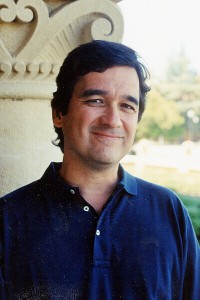
Hirsch (Photo: E. Thayer)

Edward Hirsch wears a number of hats:  Some think of him as president of the Guggenheim Foundation.  Some think of him primarily as an essayist, whose work has been published in The New Yorker, The New York Review of Books, American Poetry Review, and The Paris Review, and the author of a weekly column on poetry for the Washington Post Book World from 2002 to 2005.  My association is entirely different:  While on the faculty at the University of Houston with Adam Zagajewski, he shepherded American students to Poland to acquaint them firsthand with the wellspring of some of the greatest poetry of the 20th century, including making arrangements for the kids to meet Nobel poet Czeslaw Milosz.

But if he’s like most poets, Hirsch would rather be remembered for his verse.  On Sunday, the New York Times offered a rather enticing hors d’œuvre for Hirsch’s upcoming visit to Stanford in a review here.

The review, by Peter Campion, discusses the title of Hirsch’s new and selected, The Living Fire, taken from his poem “Wild Gratitude”:

On its surface, the poem seems to be about, well, a guy spending time with his cat. But as he listens to her “solemn little squeals of delight,” he begins to remember the 18th-century English visionary and madman Christopher Smart, who in his most famous poem, “Jubilate Agno,” venerated his own cat, Jeoffry. The memory leads to a chain of associations, and the poem ends in a nearly epiphanic moment:

And only then did I understand51VPHf8OtGL._SX106_
It is Jeoffry — and every creature like him —
Who can teach us how to praise — purring
In their own language,
Wreathing themselves in the living fire.

This passage could stand as an emblem for all of Hirsch’s poetry. Literary and allusive, but also domestic and intimate, as it rises toward praise, Hirsch’s voice resounds with both force and subtlety.
(Vis-à-vis Kit Smart’s madness and eventual confinement in an asylum, see Samuel Johnson: “I did not think he ought to be shut up. His infirmities were not noxious to society. He insisted on people praying with him; and I’d as lief pray with Kit Smart as any one else. Another charge was, that he did not love clean linen; and I have no passion for it.”)

Hirsch will be coming to Stanford on Monday, April 26.  Stay tuned.

From blog to book…

Saturday, March 27th, 2010
Share
BakerKline

Baker Kline

In a She Writes radio broadcast yesterday: Kami Wicoff interviewed Christina Baker Kline about that formidable topic, creating a dynamite book proposal.  One message came across clearly:  Don’t underestimate the power of the internet.  It’s turned the whole world of publishing upside down.

One obvious example is the blog-to-book phenomenon — tricky to negotiate, because it has to be more than pouring your web content onto the printed page.  And if the blog suffers in the transition, it will hurt book sales, too.  Galleycat describes the negotiations here that resulted in Citadel Press acquiring book rights to PleaseFireMe.com.

The more high-end of these kinds of transitions won’t involve movie rights.  More scholarly authors actually have to develop an idea, a process that doesn’t lend itself to snippy blog posts.  I wrote about one solution here:

A scholar wants to tease out an idea for a book. He writes a paper. He flies across the state, nation or even world to deliver it for 10 minutes to a roomful of jet-lagged peers. He flies home. Lather. Rinse. Repeat.

But how does this time-honored academic cycle survive in the 21st century, when travel budgets are dwindling?

In the humanities, at least, an alternative is surfacing via the net: Arcade.

Roland Greene, head of Stanford’s Division of Literatures, Cultures, and Languages, launched the website in November. Pretty much by word-of-mouth alone, and some nifty technological know-how, it’s now attracting more than 5,000 visitors a day.

Greene_news

Arcade maestro Greene

Arcade provides a venue for scholarly articles, an intellectual network, a public conversation, a digital salon and a sounding board for ideas before they wind up between hard covers. “In my field, it’s really a boon,” said Greene, professor of English and of comparative literature. “There’s nothing like it on the web.”  Read more…

Had a chat with Zach Chandler, web editor for Arcade, over coffee yesterday.  He told me that Arcade does have an advantage over many other blogs:  The site features 30 bloggers, not one.  And each of those bloggers likely has a cadre of students, somewhere.  That’s not even calculating for the cross-traffic the site produces among contributors.  Zach still hopes the Arcade numbers will go up dramatically in the coming months.  (They’re currently at about 5,000 visitors a day.)

Meanwhile, if you want to hear Baker Kline’s webinar about “How to Write a Non-Fiction Book Proposal That Sells” — next Wednesday from 1 to 2 p.m. — check this out.

“A lesson in how couples should get along”

Friday, March 26th, 2010
Share
Joseph and Marguerite Frank

Joseph and Marguerite Straus Frank (Photo: L.A. Cicero)

One of the more memorable images from the recent Pevear and Volokhonsky talk earlier this month:  Joseph Frank, perhaps the world’s leading expert on Fyodor Dostoevsky, listening attentively in the front row, leaning forward, chuckling, hugging his cane, with his wife, Marguerite Straus Frank, at his side.

I caught Joe before his last class with a small group of a  half-dozen or so students, and asked him what he thought of the translation duo’s gig.  “I knew them twenty years ago in Paris.  He was a translator from the French – of Bonnefoy,”  he recalled.  “I saw him on and off during the Paris years.  Suddenly, he showed up as a translator of Russian with a wife.”

The class asked him about his own latest, a condensation of the thousand-page Dostoevsky: A Writer in His Time — Mary Petrusewicz was recruited to condense the book, he said, since “I couldn’t bear the idea of cutting it myself.” He recalled it was “the heaviest book at the book celebration.”

What do you think of Steven Cassedy’s Dostoevsky’s Religion? Do you know him?” another student asked.

“Yes, Stephen Cassedy was once my T.A.,” he said, and gave a characteristic cackle.

He remembered the young Irish-American teaching assistant — also the author of To the Other Side: The Russian Jewish Intellectuals Who Came to America and Building the Future, Jewish Immigrant Intellectuals and the Making of Tsukunft — taking the trouble to learn Yiddish.

“I was impressed by that fact, since his name is ‘Cassedy’” — commented the Jewish nonagenarian from New York City.

And Joe disagrees with me, regarding my earlier remarks about the effectiveness of translating in rhyme and meter.  “Rhymes highjack the poetry,” he said.  (Not so:  Think Richard Wilbur.  Think Anthony Hecht.  Think Sir Charles Johnston, who inspired Vikram Seth‘s masterful novel-in-Pushkinian verse, The Golden Gate.)

Joe noted the upcoming Pevear/Volokhonsky translation of Pasternak’s Doctor Zhivago (can we wait?)  And perhaps Nicolai Leskov is in their future, as they mentioned in a 2007 Barnes & Noble interview:

Barnes & Noble:  Is there any writer in that period in Russia who readers of English don’t know about at all?

Volokhonsky: Well, it’s not that you don’t know him at all. He is known but only a little in the West, and partly owing to the fact that he is very difficult to translate. His prose is so rooted, so bound with the element of Russian language that it really is hard to convey its qualities in English.

Pevear: Do you have a name?

Volokhonsky: Yes, the name! [LAUGHS] Nikolai Leskov. He has been translated. He has been translated, inevitably, very poorly, and his translations go out of print, then someone revives them, and the cycle repeats itself.

Pevear: It’s the same book that keeps moving from publisher to publisher. If he’s known, it’s for the story that is the basis of the Shostakovich opera, Lady Macbeth of the Mtsensk District. It’s a great story.

Barnes & Noble: Are you going to rectify Leskov’s neglect in the West?

Pevear: We are going to try.

Barnes & Noble: Is there one book in particular that represents his best work?

Pevear: No. He wrote short stories. Well, he wrote longish short stories. And one big chronicle called Cathedral Folk. Slavist teachers are always in agony, because there’s no Leskov for them to use with their students. For Russians, he’s almost equal to Tolstoy. He’s very high. Some people like him even more.

Volokhonsky: But I think it’s exaggeration.

Pevear: He’s the least Western. He’s the least open to Western influences. He’s very Russian. But he’s an extraordinary writer. We’re going to try.

Back to Joe, recalling the visit of the husband-and-wife translating team:  “I was very impressed with their act,” he said.  “A lesson on how couples should get along.” One might say the same of the Franks, pictured here.

“This Dust of Words”

Wednesday, March 24th, 2010
Share

More news from John Felstiner, whose “wreathing” we described two days ago here:

Elizabeth Wiltsee

Elizabeth Wiltsee

This Dust of Words, an hour-long documentary by Bill Rose and based on John Felstiner’s memoir of Elizabeth Wiltsee, will be shown on KQED-TV, Channel 9, this Sunday, March 28, at 6 p.m. — link is here.

felstiner

John Felstiner

Liz Wiltsee, an English major at Stanford, wrote a brilliant senior thesis with John on Samuel Beckett. After that, her life as an aspiring writer took strange turns with a tragic end. John Felstiner figures as a narrator.

John wrote movingly about his student in article a decade ago, here.

Said editor Kevin Cool:

“Elizabeth Wiltsee turned a corner somewhere that led down a dark, strange path, and she couldn’t find her way back. But her descent into mental illness was only part of her story, a story that Felstiner has attempted to make whole. In his care, she emerges alive and full of expression, a sonnet to the undiminishable beauty of a verdant mind on display.”

Byron’s wreath, today’s poets

Sunday, March 21st, 2010
Share

byronwreathLord Byron died in Greece, 1824.  His body was returned to England by sea on the brig Florida. Mourners lined the streets of London as the black-draped coffin and catafalque went to Great George Street, where it lay in state for a week.

The Greeks of Missolonghi had this laurel wreath (left) made for the coffin — he had been something of a freedom fighter in Greece. The laurel wreath of Byron was eventually returned to the people of Greece.

160  years later, archaeologist and author Patrick Hunt held it in his hands:  “In its old box, all dusty, faded and dried out, yet still intact and said to date from 1824, was this incredible treasure, poetic but real. I will never forget that this box was then placed in my hands.”

fields

Ken Fields, earlier wreathed

So much so that he has reinstated the custom of laurels for his colleagues.  Weaving European laurels from his “Homeric” garden, he wreathed Al Young, then poet laureate of California, in 2007. He followed with British poet and Persian translator Dick Davis, poet Ken Fields, and Pulitzer prizewinning poets W.S. Merwin and  Ted Kooser, a former U.S. poet laureate.

Earlier this month,  he bewreathed John Felstiner (right), author of Can Poetry Save the Earth? (NPR discussed the book last April — podcast and story here.)

davis

Dick Davis, another wreathed poet (Photo: Linda Cicero)

“I’ve been reading John’s work for decades, from his Neruda translations and essays on poetry to his articles in the American Poetry Review and many other achievements, so he’s formative to my own growth as a poet,” said Patrick. “He either knows personally or has worked with every other poet who has been recently wreathed in this revival of the classical tradition. Last but not least, he’s been a great encouragement to many poets who hold him in highest esteem.”

Hunt wreathes Felstiner earlier this month

Hunt wreathes Felstiner earlier this month

“John is not only a muse but a kind man,” he concluded.

John looked “historically right” for the occasion, which took place before a joint meeting of two of John’s current Stanford poetry classes, Patrick told a brief history of ancient laureates with laurel wreaths, also about having held Byron’s wreath in Greece in 1984 and how life-changing that event was. “Then I mentioned how this ancient tradition was being revived in some way with modern poets by using the laurel tree in our Homeric garden. Then John was wreathed…”

“I’m a detective. That’s what a biographer is.”

Thursday, March 18th, 2010
Share

The San Francisco Chronicle has a short Q&A with biographer Carol Shloss here.  Carol recently settled a groundbreaking lawsuit against the James Joyce estate, which had been persecuting her for some years (see New Yorker article here).

Not much new in today’s article — but we do learn about her current work-in-progress, Modernism’s Daughters, a trilogy that includes the daughters of James Joyce, Ezra Pound, and Sigmund Freud.

We also learn that she’s a dachshund lover and a detective novel fan, currently reading Elizabeth George’s Careless in Red.