Archive for February, 2018

“The Skin of Our Teeth”: did Thornton Wilder bite off more than he could chew?

Tuesday, February 27th, 2018

Share

Overbite?

The American Interest isn’t generally our thing – we’re hardly policy wonks at the Book Haven – but I was intrigued when Rachel Hostyk, the associate editor for the journal, wrote a thoughtful review of the Constellation Theatre Company‘s recent production of Thornton’ Wilder‘s The Skin of Our Teeth. Fortunately, her discussion of Wilder’s challenging, infrequently performed play popped up in my news feed. I’ve seen the long, allegorical play before, and found it problematic. Doesn’t everyone? The characters are, well, too allegorical to really come to life – a great contrast to his 1938 play Our Town, which finds humanity and meaning in the most trivial gestures of our lives. Wilder finished his ambitious play only a month after Pearl Harbor, and it was first produced in 1942. America was still recovering from the Depression, and had entered the second major war of the century. The play takes the Antrobus family from Adam and Eve, and prehistory, right up to the ever-moving present moment.

A few excerpts from Hostyk’s provocative review:

The first act of the play is its most effective, a gem almost worth the price of admission by itself. We are in mid-Ice Age, the glaciers sweeping across North America and freezing everything in their paths. In the midst of the chaos, Mr. Antrobus keeps trekking to the office every day to invent the wheel and compile the alphabet. (He’s particularly proud of “separating n from m.”) Mrs. Antrobus is a homemaker in charge of two unruly children, a pet mammoth and dinosaur, and a dark secret. Wilder made a clever choice in pairing the archetypal mid-century family, artificial in its own right, with the absurdity of a bureaucracy that invents letters. He emphasizes the rickety foundations of human civilization with sympathy, not condescension. And when deployed against a descending wall of ice, the chin-up attitude of wartime is especially poignant.

***

Malinda Kathleen Reese cuddles with her “pet,”  Ben Lauer (photo by Daniel Schwartz)

I can’t help but see the shadow of the 1940s, of a society tired of watching war and poverty ravage people who were no worse or better than their luckier neighbors. It’s a deus ex machina ending without deus. True, blind luck is often what saves people from disaster. Yet there are aspects to the Noah story that inspire even if you don’t believe in God—the fortitude of Noah’s family, their organizational capacity, their craftsmanship, the love and cooperation that see them through the near-total destruction of their world. Deprive the narrative of God, and you deprive humanity of its grandeur in rising to meet God’s expectations. Generally, what we find inspiring amid the carnage and despair of war are those people, religious and not, who prove so much better than their circumstances.

***

The Antrobuses make a choice in the face of certain death, as people freeze on the roads out of town. The glaciers are within sight of their house. Certainly, giving away food that could feed your children for another week or two is heart-wrenching—Mrs. Antrobus is against it at first. Yet selfishness is often borne of hope, and there is none here. Nor are there the logistics of a future to consider. In our times, immigration policy is made by those who face election next year, or who have to reknit a society made up of both newcomers and natives. We should still be kind and merciful, of course, and the Antrobuses’ generosity is inspiring. But the mercy of a new life is much more difficult to offer than the kindness of a last meal. An allegory that doesn’t wrestle with this fact is less useful for all of us. In certain ways, reality is sadder than Wilder lets on—and yet still, people do the decent thing.

***
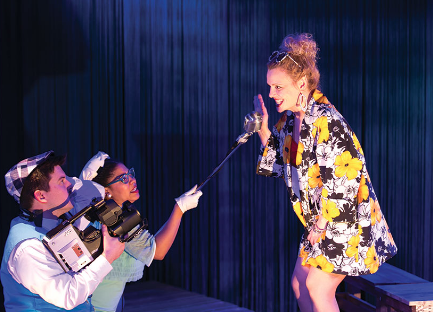
The maid Sabina (Tonya Beckman) shares the news.

The lesson of this allegory is emphasized with a sledgehammer: Humans have survived and will keep surviving. With the help of books, they will restart society from the worst of ruins (Mr. Antrobus makes sure to save his volumes of Shakespeare). Yet after the initial and rather basic achievements of the wheel and the alphabet, we see nothing more of human inventiveness in action. The great philosophers are analogized to the hours in the day, as if they were simply features of existence like the passage of time. (Homer, the Muses, and Moses wander in with the refugees of the first act, but as humanity is still stuck at “n,” they seem more like natural resources than human achievements.) Yet it’s impossible to understand the great epochs of horror and survival independently of the knowledge gained (or not), or the cultures that endured and perpetrated them.

I can’t help but admire a play of such cleverness and ambition, especially in this splendid production. And perhaps it’s carping to suggest that Wilder bit off more than he could chew; no two-and-a-half-hour play is going to be the final word on human history. You might argue that the Antrobuses are average by definition. But if they are given to feats of cruelty like total warfare, why not other, nobler extremes of human behavior?

Read the whole thing here.

Postscript on 2/27: A comment from journalist Jeff Selbst that is a mini-review in itself: This is one of my favorite plays, a classic of absurdism. Sabina is an unforgettable creation: housemaid, temptress, fatalist, and yet an eternal American sort of optimist. The third act gets a bit heavy with the overt Cain-and-Abel references, but it has Wilder’s sometimes flinty New England scholarly poetics in its blood.”

Early praise for Evolution of Desire: A Life of René Girard: “A penetrating account of an important thinker—and as agile, profound, and affecting as its subject.”

Sunday, February 25th, 2018
Share

A review of my Evolution of Desire: A Life of Rene Girard was just published in Kirkus ReviewsThe first paragraph, as is customary with Kirkus, describes the book. Then comes this:

Haven was a close friend of Girard’s, and that privileged perch allows her to consider his life both personally and intellectually. Many aspects of his history would be hard to adequately comprehend without this dual perspective. For example, she offers an impressively incisive account of his conversion from atheism to Christianity in 1958 (“It was something no one could have anticipated, least of all himself. ‘Conversion is a form of intelligence, of understanding,’ he said; it’s also a process…and as such would absorb him for the rest of his days”). In addition, her rendering is as panoramic as his thought—she considers a vertiginous array of diverse subjects insightfully, including Girard’s trenchant criticisms of Camus’ The Stranger, the ways in which the French and Americans view each other, and desire’s metaphysical aspects. Furthermore, Haven ably, even elegantly synopsizes the central tenets of Girard’s beliefs, in particular his pioneering views on mimesis—a kind of updated version of Rousseau’s amour propre—the notion that the desires and violent conflicts that often spring from people have their root cause in the gregarious mimicking of others. In this intimate but philosophically searching book, the author’s writing is marvelously clear. She expertly unpacks Girard’s ideas, making them unusually accessible, even to readers with limited familiarity.

A penetrating account of an important thinker—and as agile, profound, and affecting as its subject.

Read the whole thing here. Better yet, you can pre-order the book on Amazon here

Ismail Kadare: “There is real literature, and then there is the rest.”

Friday, February 23rd, 2018
Share

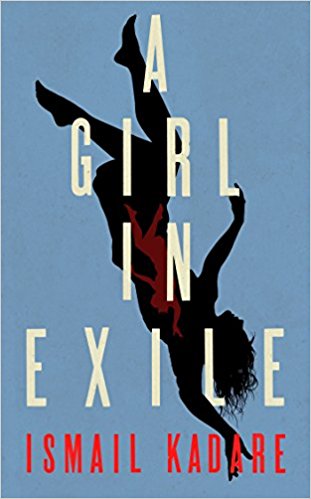
My review is online at The New York Times Book Review today here, and in the print edition this weekend.  The book under discussion: the Albanian maestro Ismail Kadare‘s A Girl in Exile. Every year, the Nobel committee seems to look the other way while a matchless collection of novels, plays, essays pours out from Paris and Tirana, his dual homes.

An excerpt from my review:

Kadare is still mapping out the boundaries of Albanian, a relatively recent literary language, where everything is new and newly sayable. He is the first of its writers to achieve an international standing. But how to describe something beyond words? “Better if you don’t know” is a repeated phrase in the book, along with variations of “it’s complicated.”

The two girls, “daughters of socialism, as the phrase went,” resolve their eternal love triangle with a stunning metaphysical selflessness. And they reply to injustice and repression not by resistance or retaliation, but with an utterly new, unconditioned response that leaves the reader lightheaded, transcending even that which we value as “freedom.” In Kadare’s words, they move “beyond the laws of this world.”

Read the whole shebang here.

Are you listening, Stockholm? (Photo: Lars Haefner)

Kadare’s relationship to his mother tongue intrigued me, especially given its affinities with classical Greek. I googled the language. I reached out to a Albanian Facebook group. I tried phoning the consulate. No joy anywhere. Who could tell me more? The most informative source turned out to be … Kadare himself. So I read more about it over at The Paris Review. “For me as a writer, Albanian is simply an extraordinary means of expression—rich, malleable, adaptable,” he explained to his interviewer, Shusha Guppy, in 1997. “As I have said in my latest novel, Spiritus, it has modalities that exist only in classical Greek, which puts one in touch with the mentality of antiquity. For example, there are Albanian verbs that can have both a beneficent or a malevolent meaning, just as in ancient Greek, and this facilitates the translation of Greek tragedies, as well as of Shakespeare, the latter being the closest European author to the Greek tragedians. When Nietzsche says that Greek tragedy committed suicide young because it only lived one hundred years, he is right. But in a global vision it has endured up to Shakespeare and continues to this day. On the other hand, I believe that the era of epic poetry is over. As for the novel, it is still very young. It has hardly begun.” 

He’s just warming up:

“Listen, I think that in the history of literature there has been only one decisive change: the passage from orality to writing. For a long time literature was only spoken, and then suddenly with the Babylonians and the Greeks came writing. That changed everything.” It’s a bracing interview because of the unexpected turns the conversation takes. He never takes the predictable position, the weathered road.

Faster than a speeding bullet

“For example, they say that contemporary literature is very dynamic because it is influenced by the cinema, the television, the speed of communication. But the opposite is true! If you compare the texts of the Greek antiquity with today’s literature, you’ll notice that the classics operated in a far larger terrain, painted on a much broader canvas, and had an infinitely greater dimension: a character moves between sky and earth, from a god to a mortal, and back again, in no time at all! The speed of the Iliad is impossible to find in the modern author. The story is simple: Agamemnon has done something that has displeased Zeus, who decides to punish him. He calls a messenger and tells him to fly to earth, find the Greek general called Agamemnon and put a false dream into his head. The messenger arrives in Troy, finds Agamemnon asleep and pours a false dream into his head like a liquid, and goes back to Zeus. In the morning Agamemnon calls his officers and tells them that he has had a beautiful dream, and that they should attack the Trojans. He suffers a crushing defeat. All that in a page and a half! One passes from Zeus’s brain to Agamemnon’s, from the sky to earth. Which writer today could invent that? Ballistic missiles are not as fast!”

In sum: “All this noise about innovations, new genres, is idle. There is real literature, and then there is the rest.”

After a few paragraphs to lure you in, the Paris Review interview is behind a paywall … well, I’ve effectively done the same, haven’t I? But my review is free. It’s here.

Postscript on 3/2: Guess what new offering made the top seven books of the week over at the New York Times Book Review? That’s right. Kadare’s Girl in Exile. It’s here.

“The greatest woman poet since Sappho”? Consider the work, not the life.

Thursday, February 22nd, 2018
Share

Today is Edna St. Vincent Millay‘s birthday. (We’ve written about her here and here and here.) Every so often, someone calls for a revival of her delicious verse, and today it’s Amandas Ong’s turn, over at The Guardian. She notes that Millay is more remembered for her wild and crazy life than lines like these:

What lips my lips have kissed, and where, and why,
I have forgotten, and what arms have lain
Under my head till morning; but the rain
Is full of ghosts tonight, that tap and sigh
Upon the glass and listen for reply,
And in my heart there stirs a quiet pain
For unremembered lads that not again
Will turn to me at midnight with a cry. … (Read the rest here.)
.
An excerpt from Ong’s article (which is online here):

Where should one begin with Millay? She had a famed predilection for Petrarchan sonnets and rhyming couplets, at odds with prominent experimental modernists of the era, such as TS Eliot and Wallace Stevens. But Millay expanded the scope of these poetic forms, presenting a bold, sexually charged vision of the female experience. Her verses serve as a kind of elaborate architecture, housing the fickle, frenetic movements of the heart that falls in love and then out of it. Renascence and other poems (1917), which includes the 200-plus line poem that brought her acclaim, also boasts six sonnets, all of which are outstanding in this respect.

“If I should learn, in some quite casual way, / That you were gone, not to return again —,” she muses in Sonnet V, she would not cry in a public place, like a train; no, she’d “raise my eyes and read with greater care / Where to store furs and how to treat the hair.” This is classic Millay – how else can one grapple with the end of a love affair than to instinctively busy oneself with the mundane?

But Millay never approached love and its vicissitudes with passive melancholy. In “No Rose That in a Garden Ever Grew,” she ponders cynically on the temporal nature of infatuation that drives the stories of women such as Lilith, Lucrece and Helen: “And thus as well my love must lose some part / Of what it is, had Helen been less fair, / Or perished young, or stayed at home in Greece.”

Happy birthday, Edna. You deserve a revival. And a little cake.

Adam Zagajewski and “the battle to imbue life with maximal meaning”

Tuesday, February 20th, 2018
Share

A distinctive, insistent, civilized stance.

Adam Zagajewski is an absolutely foundational figure for many of us – not only because of his own poems and essays, but for his quietly insistent, civilized stance towards a world that teeters on the edge of chaos – we’ve written about him here and here and here and here. I once asked him, in an email interview a dozen years ago, what do we do in a world that seems to be averting its face from the non-consumerist values of reading, literature, poetry, philosophy? His reply: “We’ll be living in small ghettos, far from where celebrities dwell, and yet in every generation there will be a new delivery of minds that will love long and slow thoughts and books and poetry and music, so that these rather pleasant ghettos will never perish — and one day may even stir more excitement than we’re used to now.” It’s starting to sound like a good idea. Yet he remains in Kraków, and I stay put in Palo Alto.

So it was a privilege to review Slight Exaggeration, his book-length essay on… oh, just about everything. It’s up today at The Weekly Standard (and on the home page, too, no less). Read the whole thing here.

Meanwhile, an excerpt:

Gone, but still with us…

Zagajewski’s conversational style is distinctive, and the cadence is recognizable in his poems and essays. (Translator Clare Cavanagh conveys it well.) I was introduced to it a decade ago, an afternoon conversation that stretched into early evening, as we walked along the Planty, the public park that encircles Kraków. His words are tentative, unassertive, provisional, yet self-assured. The slight tonal “uptalk” lift at the end of his sentences as he turns a problem round, exploring its different angles, cannot ruffle his considerable authority. Czesław Miłosz, Zbigniew Herbert, Wisława Szymborska are dead: Zagajewski has survived the generation of greats, and matched it with a greatness of his own, a postwar brand of metaphysical heft and gravity that shoulders the singular legacy of Polish literature into the 21st century.

The recurring Romanian…

Slight Exaggeration patiently picks up where the poet left off a dozen years ago with A Defense of Ardor, extending his line of thought on painters, poems, composers, and history. Initially, the observations seem disconnected and a little unpruned, until certain names begin recurring (French-Romanian writer E. M. Cioran, for example, or composer Gustav Mahler, poet Rainer Maria Rilke, novelist Robert Musil)—and each time he repeats, the impression on the reader is richer. Clearly, he is weaving on a very large loom, and the shuttle that disappears out of sight swings back to pull the threads tighter. The disparate reflections weave into a long thought, the result of years, decades, a lifetime. And occasionally his trademark associative musings open into seminal mini-essays.

The battle for clear vision…

Zagajewski wonders why the wartime letters of the lawyer Helmuth James Graf von Moltke, who resisted Hitler’s abuses nonviolently, move him so much with their impeccable moral brilliance; those of a favorite poet, the wily and self-protecting Gottfried Benn, so little. He also admires artist and writer Józef Czapskis integrity, too: “Czapski sometimes speaks of himself—but always in terms of the ceaseless battle he wages for clear vision, for full use of his gifts, the battle to imbue his life with maximal meaning.” And Simone Weil? “Weil tortured Czapski, and she still tortures us.” What does it mean that we celebrate the birthday of Mozart and the “liberation” of Auschwitz on the same day? (He hesitates to use the word “liberation,” which implies a certain energy and esprit, for the Allied soldiers’ entry into hell.)

Time teaches tolerance for what cannot be changed. And in the course of his telling, time overlaps and leaves traces on the present. For example, he observes that the Gestapo occupied his Kraków apartment during the occupation: “A Gestapo officer no doubt occupied the room in which I now write.”

Read the whole thing here.

Want some “alone” time? Try the Inferno, says Rachel Jacoff.

Sunday, February 18th, 2018
Share

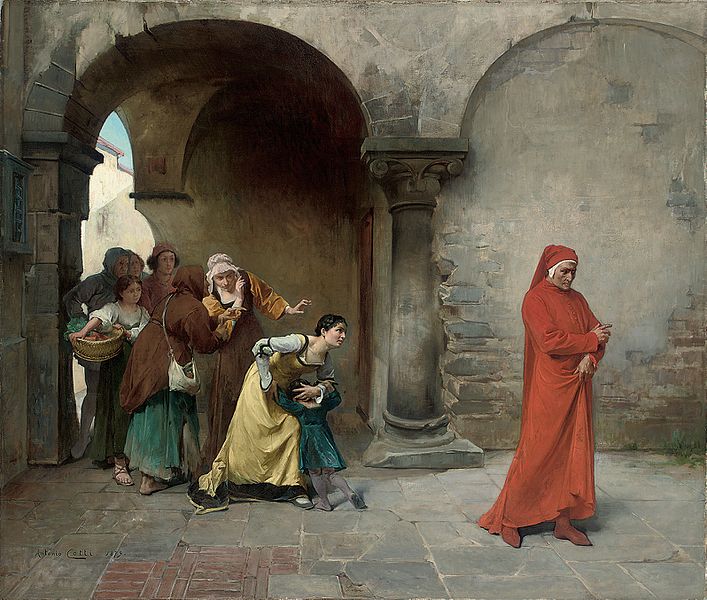
Are other people hell? Artist Antonio Maria Cotti seemed to think so.

“FOR DANTE, SIN IS A VIOLATION OF COMMUNITY. THERE ARE NO SINS THAT DO NOT HAVE SOCIAL CONSEQUENCES.” – RACHEL JACOFF

Rachel Jacoff is one of the leading lights in the small, close-knit world of Dante scholarship. In this Entitled Opinions episode on The Divine Comedy, she continues her conversation on The Inferno with her former student, our Entitled Opinions host Robert Harrison, himself a major Dante scholar. (Go to the podcast at the Los Angeles Review of Books here.)

Harrison begins by quoting Homer’s Iliad:

As the generation of leaves, so is that of humanity.
The wind scatters the leaves on the ground, but the live timber
burgeons with leaves again in the season of spring returning.
So one generation of men will grow while another dies.

Virgil and Dante … together at last.

Virgil picks up this evocative metaphor in The Aeneid, but its tone is more ominous and rueful among the dead of the underworld. No surprise, then, that Dante continues the figure of speech in Canto 3, as a nod to Virgil — but with an important difference. Dante emphasizes the singularity of each of the sinners, rather than their anonymity. Each resident of Dante’s infernal world chooses, rather than simply suffers, his or her individual fate. The damned not only make choices, but they reenact those choices and their rationalizations in their soliloquies. And Dante the Pilgrim is drawn into each of their vices as he speaks to them.

Eventually, Dante and Virgil hit bottom: “You think that the climax of The Inferno is going to be encounter with Satan – especially if you come to Dante from Milton,” says Harrison. “But Dante’s Satan is really a very uninteresting encounter. There’s no dialogue. Satan is just this horrible, slobbering, three-mouthed figure. So the real terror does not come from this canto, but from the canto before, where Dante meets the figure of Ugolino.”

Jacoff and Harrison discuss how the sins of the Inferno have social consequences, and are a violation of community – hence, hell is a lonely place, even when the characters are paired. Other people are part of their torture.

This is the second of three Entitled Opinions episodes on Jacoff and Dante. (Part 1 is here. Podcast for this episode is here. And yes, you really can watch them out of sequence. It’s okay. It works.)

“AN EYE FOR AN EYE IS ONE THING, BUT AN EYE FOR AN EYE FOR ETERNITY BECOMES REALLY PROBLEMATIC. … WE WANT A WORLD OF MERCY, WE WANT A WORLD OF GRACE.”  – ROBERT HARRISON

Here are some more quotes from the episode:

“For most of the characters in the Inferno, their sins are dispositions that inform every stance they take – the way they relate to Dante, the way they relate to other sinners in their group.” – Rachel Jacoff

“Part of the reason that The Inferno is full of solitaries is that sinners have cut themselves off.” – Rachel Jacoff

“In a horrible way, people are grouped together, but they’re so alone. The presence of other people is part of the torture.” – Rachel Jacoff

“In Dante, Ulysses does not go home at all. He’s the figure of the explorer, the man who lives for knowledge. He’s a forerunner of the figure of the great age of discovery in the Renaissance, the discovery of the New World, the scientific spirit. Everything that Dante called male curiosità, bad curiosity, within a century would be exalted as one of the premiere virtues of the humanism of the Renaissance.” – Robert Harrison

“Each canticle ends on the stars. They come out of The Inferno seeing the stars again, and they come out of Purgatory ready to go to the stars. And then … The Paradiso.” – Robert Harrison