Winter is a great time for reading. Here’s our suggestion for 2026. The next “Another Look” book club event at Stanford will feature a Nobel prizewinner. You won’t want to miss it. (Did we mention that “Another Look” is the biggest book club in the world?)
On Wednesday, 18 February, 2026, Another Look will present Nobel prizewinning Patrick Modiano’s 2007 novella, In the Café of Lost Youth(New York Review Books). The event will take place, as always, at 7 p.m. at Levinthal Hall, 424 Santa Teresa Street on the Stanford campus.
Panelists will include Stanford Prof. Robert Pogue Harrison, author, director of Another Look, host of the radio talk show and podcast series Entitled Opinions, and a regular contributor to The New York Review of Books, and Stanford Prof. Tobias Wolff, one of America’s leading writers and the founding director of Another Look, as well as a recipient of the National Medal of Arts.
They will be joined by Chloe Edmondson, a lecturer in Stanford’s Department of French and Italian. She is the France-Stanford Center Fellow for the Roxane Debuisson Collection on Paris History. You will remember her from our event Madame de LaFayette’s The Princesse de Clèves in 2019. Valerie Kinsey, a Stanford lecturer in Writing and Rhetoric Studies, will round out the panel.
The Nobel announcement recognized Modiano’s “consistent exploration of memory and the elusive nature of personal history, often set against the backdrop of occupied Paris.”
He has been praised for his “subtle, clear style and his ability to bring anonymous lives to light, making him a modern-day Proust in the eyes of some.”
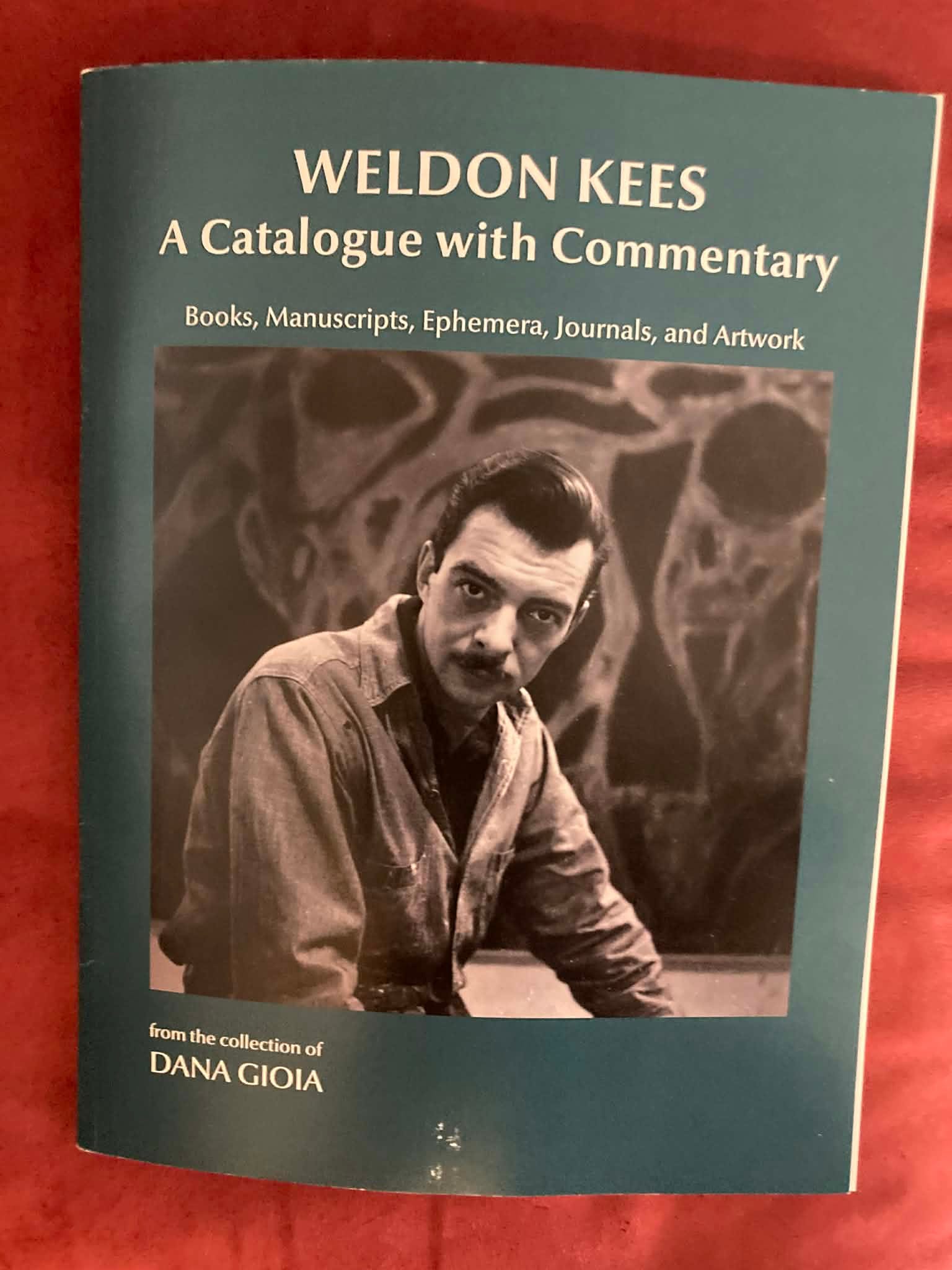
From my mailbox: Dana Gioia, poet and former chairman of the National Endowment for the Arts, sent me the latest fruits of his labors. Dana has long been a champion of the of the overlooked poet Weldon Kees (1914-1955). According to poet Donald Justice, “Kees is original in one of the few ways that matter: he speaks to us in a voice or, rathre, in a particular tone of voice that we have never heard before.” Dana has just published a catalogue of his own collection with commentary, including works of fiction and non-fiction, broadsides, journals, music and recordings, critical works, and more. Here is the preface:
I first discovered the poetry of Weldon Kees in 1976—fifty years ago—while working a summer job in Minneapolis. I came across a selection of his poems in a library anthology. I didn’t recognize his name. I might have skipped over the section had I not noticed in the brief headnote that he had died in San Francisco by leaping off the Golden Gate Bridge. As a Californian in exile, I found that grim and isolated fact intriguing.
“I had found the poet I had been searching for.”
I decided to read a poem or two. Instead, I read them all, with growing excitement and wonder. I recognized that I was reading a major poet. He was a head-spinning cocktail of contradictions—simultaneously satiric and terrifying, intimate and enigmatic. He used traditional forms with an experimental sensibility. He depicted apocalyptic outcomes with mordant humor. I had found the poet I had been searching for. Why had I never heard of him? Embarrassed by my ignorance, I decided to read everything I could find by and about him.
It was a Saturday afternoon. I had the rest of the weekend free. I drove to the main branch of the Minneapolis Public Library, heady with anticipation. I was eager to read all of his books. I also wanted to see what other readers thought about him. I knew my way around libraries—an important skill in those pre- internet days. Whatever books and commentary existed, I would find.
What I found after two days of searching was nothing. There was not a single book of any kind by or about Weldon Kees in the Minneapolis library system. His work, I also discovered, did not appear in standard anthologies. (I had read one of the only two anthologies that had ever featured a large se- lection of his poems.) There was no biography. There were no entries about him in the standard reference works. Nor were there chapters on him in the numerous critical books on contemporary poetry.
He went unmentioned in the biographies of his contemporaries. There had never even been a full-length essay published on his work.
By Sunday evening, I realized why I had never heard of Kees. Hardly noticed during his lifetime, in death he had been almost entirely forgotten. A suicide at forty-one, Kees had succeeded in his last endeavor—vanishing. His body had never been recovered. Kees had been washed away from posterity with- out rites or remembrance. All his work was out of print. Worse yet, most of it—the stories, novels, plays, and criticism—had never been collected. Some of it, such as his first novel, had been lost entirely. Only the poems, a small, brilliant body of work, survived precariously—without criticism or commentary, almost without readers.
I decided then I would write a long, comprehensive essay on his work. It was not the sort of thing I had done before. I could not begin, however, without knowing more. I did not own any of his books. I knew few facts about his life. I began to search, gather, and collect. I not only found books, journals, and eventually manuscripts; I found people who had known and worked with him. I also discovered I was not alone in my intense admiration.
Three years later I published my essay in a special issue of the Stanford literary magazine, Sequoia, edited by my brother [jazz scholar] Ted Gioia. The issue stirred up a surprising amount of interest. I was soon planning an edition of his short stories, which had never been published in book form. That task led me to new material and new people. I had not realized that Kees had been a true polyartist who had not only mastered fiction and poetry, but also painting, photography, filmmaking, and jazz. I kept working on new projects, and the collecting never stopped. His audience also grew, though not among academics. His admirers were writers, artists, printers, and musicians.
This catalogue documents some of what I found in my search for Weldon Kees. It is not a conventional bibliography. It describes a personal collection with commentary. It tries to tell the story of a writer through his books. It evokes Kees’ polymathic imagination from his art, music, and photography. It also reveals the existence of three of his large notebooks which document his prime years as a poet. I wrote this little book mostly for myself and a few friends. I hope it appeals to other readers, writers, and collectors. If this book is for you, you’ll know it.
Find some of Weldon Kees’s poems at the Poetry Foundation here.
Robert Harrison‘s radio show Entitled Opinions has devoted fans all over the world – from Australia to China, Mexico to Russia. One blogger called the intellectually powered interviews, initially broadcast from Stanford’s radio station KZSU (90.1 FM) and available for free download on iTunes. It’s been called “one of the most fascinating, engaging podcasts in any possible universe.”You can explore the range of his interviews over at his new website here: https://entitled-opinions.com/
“Entitled Opinions” was born before “podcast” was even a word. iTunes was born only three months earlier. It found an international audience quickly. Now the program has come of age – it’s twenty years old.
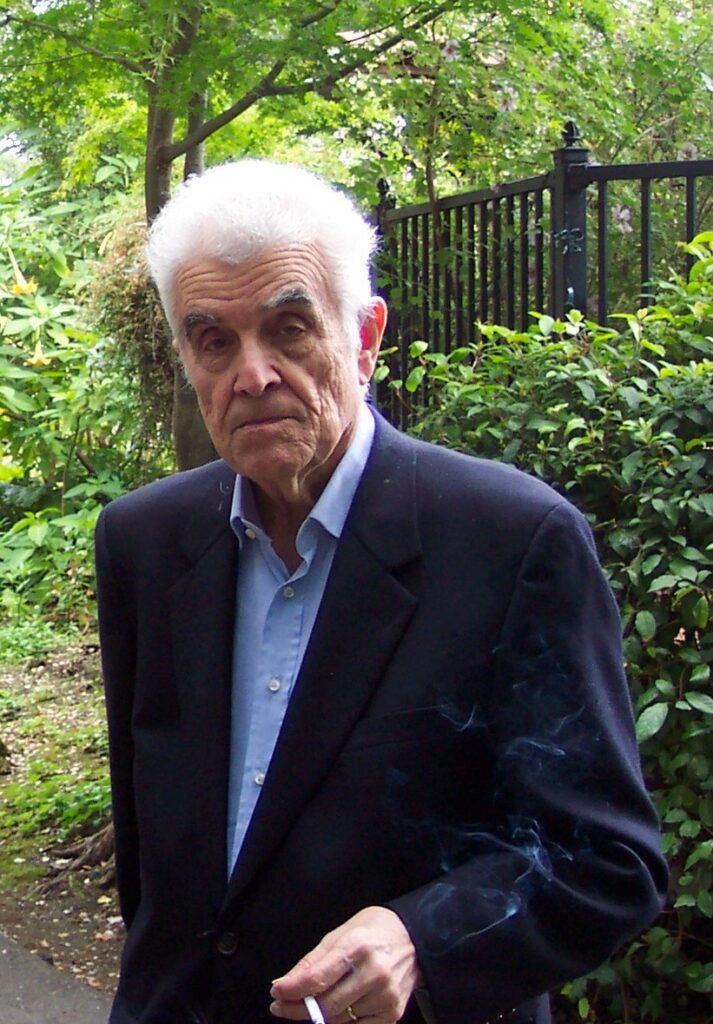
The Rosina Pierotti Professor in Italian Literature, who is also an acclaimed author and regular contributor to the New York Review of Books, has recorded more than 300 conversations since 2005, featuring some of our era’s leading figures in literature, philosophy, science, and cultural history, including Richard Rorty, René Girard, Peter Sloterdijk, Shirley Hazzard, Orhan Pamuk, Colm Tóibin, Marilynne Robinson, Paul Ehrlich, Michel Serres, Hayden White, andAbraham Verghese.
To celebrate, he’s recorded a retrospective podcast with Christy Wampole, one of his former students who was there with him from the beginning. She is now assistant professor of French at Princeton University.
What did a fourth/fifth century saint from north Africa have to teach us about René Girard‘s mimetic theory?Philosophy professor Alexander Douglas of the University of St. Andrews has kindly allowed us to publish an excellent excerpt from his new and acclaimed book, Against Identity: The Wisdom of Escaping the Self, Penguin). Here it is:
“Three quarters of what I say is in Saint Augustine,” René Girard said in an interview some years ago.1 To understand Girard’s view of the human predicament, we can look at the Confessions of this early saint. One story that Augustine tells of his youth, with much contrition, is about how he and his friends stole some pears:
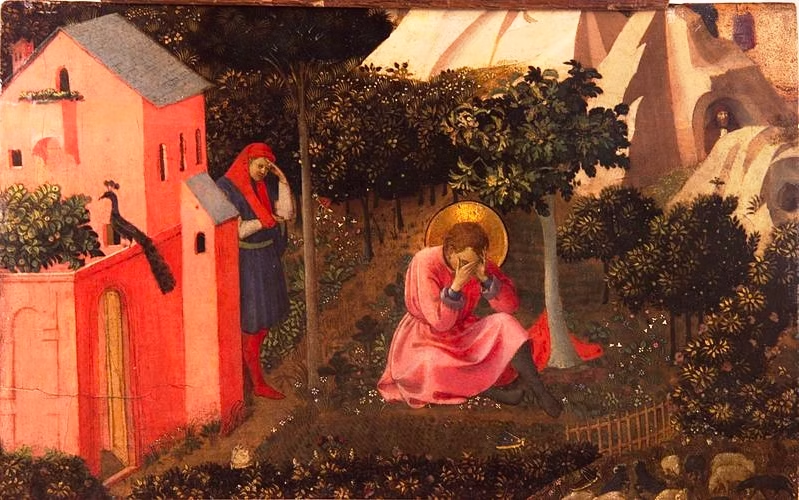
“Close to our vineyard there was a pear tree laden with fruit. This fruit was not enticing, either in appearance or in flavour. We nasty lads went there to shake down the fruit and carry it off at dead of night, after prolonging our games out of doors until that late hour according to our abominable custom. We took enormous quantities, not to feast on ourselves but perhaps to throw to the pigs; we did eat a few, but that was not our motive: we derived pleasure from the deed simply because it was forbidden.”2
At first it seems odd for Augustine to make so much of what seems like a minor teenage prank. But the imagery – the fruit that is enticing because it is forbidden – makes it clear that Augustine is using this episode as an allegory for the Fall of humanity.3
What Augustine wants to do with this story is probe into the mystery of our fallen condition. He is troubled by the fact that “there was no motive for my malice except malice”; his petty crime “lacked even the sham, shadowy beauty with which even vice allures us.”4 The object was not to eat the pears, nor to upset the owner of the vineyard, nor even entertainment – the theft was not challenging enough to constitute an exciting heist. It was simply to demonstrate his ability to act however he willed. Responding to no reasons, done to no conceivable purpose, this wanton act was meant to express his radical freedom. To conjure an action out of nothing, for no reason at all – what could be more radically free?
However, as Augustine looks back on the act, he realizes that it was not as original as he thought. In two ways, it was imitative, not original. First, his urge to express his own radical freedom was less a self-expression than an imitation of God’s omnipotence: a crippled sort of freedom, attempting a shady parody of omnipotence by getting away with something forbidden.”5 Secondly, he engaged in the act only because his friends did it too: “as I recall my state of mind at the time, I would not have done it alone; I most certainly would not have done it alone.”6 Augustine struggles to work out the reason for this. It is not simply that he did it for the sake of camaraderie. Nor was it only to share a joke. It was simply that “to do it alone would have aroused no desire whatever in me, nor would I have done it.”7
The theory of mimetic desire is very close to the surface of what Augustine writes here. His desire to act was prompted, or at least enhanced, by the apparent desire of his friends. Yet they were in the same position – only wanting to do it because the others did. This might look like a circular explanation, but in fact it shows how desire can emerge from nearly nothing, creating the illusion of the spontaneous will. We are prone to desire what others around us appear to desire, and this appearance can be a matter of a misread signal, a rumor, an accident mistaken for a ploy.8 Once an imitator has taken on a desire from the apparent desire of a model, however, she immediately becomes a model to others, and the mimetic cycle begins. Desire really does emerge where there was none before. It is never conceived by a radically free subject from nothing. Instead, it can emerge from a mimetic cascade, seeded by misperception.
Augustine’s story brings out two crucial aspects of Girard’s theory of identity. The first is that we readily believe ourselves to be little centres of omnipotence: freely deciding what to do, breaking rules, overcoming constraints and resisting impulses. The second is that the more we entertain this myth, the more profoundly we are in fact influenced by the examples of others. The radical egoist is an avid imitator in denial. This combination of prideful egoism and unconscious mimesis is the formula for the fallen condition in Augustine, and in Girard.
An excerpt from a Free Press conversation between historian Niall Ferguson and Bari Weiss, newly named editor-in-chief at CBS News. Listen to the whole thing here . Meanwhile, an excerpt below:
It’s been two years since the October 7 massacre. Over at The Free Press, the event was remembered with with an hour-long conversation about anti-semitism, terrorism, between A different kind of loss. You can listen to the full podcasthere. Niall Ferguson on October 7 and Our Changed World
Historian Niall Ferguson in conversation with Bari Weiss of at The Free Press. Towards the end, the conversation turned to a topic dear to my heart: the importance of reading.
I’ve written about that a lot on Werner Herzog: “Our civilization is suffering profound wounds because of the wholesale abandonment of reading.”
An excerpt from the conversation:
Ferguson: Conspiracy theories have been in the ascendant for some time. I think that they’ve benefited from the internet, but what makes you susceptible to a conspiracy theory is that you are actually post-literate or pre-literate. You haven’t really read the books that would make you skeptical about the Protocols of the Elders of Zion or skeptical about some of the claims that are now being made by [Tucker] Carson and other people on what Jim Lindsey calls the “woke right”… The problem is that people are highly susceptible to old conspiracy theories, and of course conspiracy theories have for centuries made Jews the villains if they have not read any real history. And I think that is part of what concerns me about the way history is taught in our schools, in our universities.
It is no longer being taught in the way that might make people able to defend their minds against this kind of poison.
You asked, ‘What can we do?’ Well, it sounds banal, but I think reading books is not a bad start. After all, what made me able to recognize the intentions of the perpetrators on October 7, 2023, was that I’ve read a lot of accounts of the violence against Jews that occurred in the early stages of the Holocaust, before the Holocaust was industrialized in Auschwitz, when the Holocaust was a series of wild pogroms directed against the Jews of Eastern Europe.
You know, if you’ve read accounts of those hideous events, then you know what a pogrom is like. You don’t need to have experienced one. You’ve read about it. I think reading firsthand accounts of historical events is still the most powerful way to prepare yourself for what the present and future may throw at you.
And I don’t think that people read enough. I don’t think they read nearly enough of the kind of books I read when I was researching “War of the World,” the kind of books I assigned when I was teaching the Third Reich special subject at Oxford.
I’ll just give you one example, the one thing that I would urge people to read. The Diaries of Victor Klemperer, who was Jewish, although converted to Christianity, but defined as a Jewish professor in Dresden in the 1930s and 1940s, are a wonderful account of what it is to be a Jew in a society where your rights are whittled away. You start thinking you’re a German with full civil rights. The diaries begin pre-Hitler. And then with every passing week after 1933, your rights are whittled away until you have none at all and are made to wear a yellow star and are waiting for deportation to the death camps.
I think those are some of the most important books that have ever been published about the experience of life in a totalitarian regime. People who get confused, who think somehow we’re on a path to totalitarianism, should read those volumes. It’s a good reality check. And we should read those volumes wherever we live and ask ourselves the question: “Is some similar process at work? Is that the feeling that Jews in Britain have started to feel?” I begin to think that it is, even if the source of the threat is a very different one from National Socialism. If the source of the thread is Islamism and its useful idiots on the left, that’s a very different source.
But what if the end result is the same? If you haven’t read any history, if you haven’t read Klemperer, you don’t really know what to look for. So that’s my banal advice. I guess the historian has nothing left in the end to offer but books.
Bari Weiss: You have so many to read of yours that if people have not read, for example, The Tower and the Square, and so many others of your incredible works, I recommend that they go and do that immediately.