“A window opening when doors were slamming shut all around me”: how John Fante changed a convict’s life

August 25th, 2023

Share

Please join us at Stanford on for a discussion of John Fante‘s 1939 novel Ask the Dust at 7 p.m. (PST) on Tuesday, Sept. 19, at Levinthal Hall in the Stanford Humanities Center, 424 Santa Teresa Street on the Stanford campus. It’s a hybrid event, so come virtually or in person. REGISTER FOR THE EVENT ON THE LINK HERE! The event is free and open to the public. Walk-ins are welcome, but registration is encouraged, whether you plan to attend virtually or in person. Read more about the event here.

Another Look takes on authors and books that we think deserve more attention.  Fante’s Ask the Dust was forgotten for decades after first appearing in 1939. Since being rediscovered in the 1980s, the novel has gained an enthusiastic international audience and influenced many writers. How much of an influence did Fante’s Ask the Dust have? Read the story below, from a Shoshone-Paiute American Indian prisoner whose life was changed by an encounter with Fante’s remarkable novel. Author Joel Williams’s story, republished from Fordham University Press’s John Fante’s ASK THE DUST: A Joining of Voices and Views (2020) with his permission, comes to us courtesy Stephen Cooper, English Professor at California State University, Long Beach. He is perhaps the world’s leading expert on John Fante.

In addition to the Italian Cultural Institute of San Francisco, this event is co-sponsored by the Continuing Studies Program and the Division of Literatures, Cultures, and Languages at Stanford.

I remember exactly where I was and what I was doing when I first heard about the Los Angeles writer, John Fante. The year was 2008 and the place was Mule Creek State Prison, a maximum-security California penitentiary where I was dragging in my twenty-second year on a twenty-seven-to-life sentence.

I was on the yard, hanging out with a couple of other skins near the pull-up bars, when we heard the gunshot. Men everywhere dropped. It was the guard tower’s mini-14, a totally different sound from the usual 40mm “Big Bertha” riot-control block gun. I had suspected something was about to go down ever since another skin — the term we Natives used for each other — had warned me to keep on my toes. Somebody was going to get moved on.

Stretched out prone in the dirt I lifted my head an inch to eyeball the yard. Guards with batons out and keys jangling on their utility belts ran past with medical staff trailing behind. Cordite filled the air as one man was hoisted onto a gurney and another was led off in handcuffs. Beside me Bear, a skin nicknamed for his size, rested his chin on a paperback.

“What book you got?” I asked.

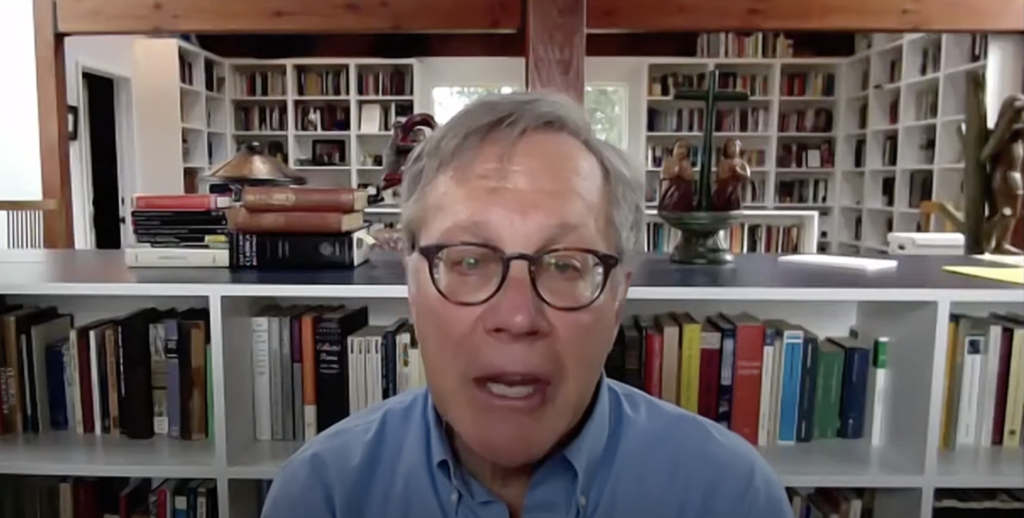
Fante expert Stephen Cooper with Joel Williams.

“You don’t wanna read this.”

“Why’s that?”

“Cause you won’t give it back!”

I smiled and he tossed it over, something to while away the next several days when the whole prison would be on lockdown. Hours later, when we were told to get up and go back to our cells, I stuffed the book in my back pocket.

My neighbor, Norm, later told me through the vent that the guy who got stabbed on the yard was my cellmate, a Maidu Indian named Lance. I was stunned. Sure, Lance had a gambling jones and was always in debt. Sure, he smoked too much herb. But hell, he was a nice enough guy and for me that counted, what with most everyone else out to pick your pocket and cut your throat. So sure, the news hit me hard.

To get my mind off things I picked up Bear’s book. It didn’t look like much — no flashy cover, no promise of action or sleaze. The title was an odd one, Ask the Dust, by a guy from my stomping grounds in Los Angeles. His name was John Fante and I’d never heard of him but as I flipped through the first few pages I saw Bukowski’s name. I knew who he was so I read his introduction. And Bukowski revered John Fante. My literary hero, Bukowski, had a hero himself. I stirred up a cup of instant coffee, climbed into my bunk, and set off on a long night of reading.

And what a night it turned out to be. Fante’s character Arturo Bandini pulled me into a Los Angeles I’d never experienced, an earlier world colored with subtle shades of poetry and streaks of vivid emotion. Bandini was exuberant, alive, searching. I reread sentences, whole passages, soaking in the beauty of Fante’s words, wringing every nuance of meaning from his prose. And as always happened when I savored another writer’s work, I felt the tug of jealousy. I too wanted to create beautiful works and move people, and once again I’d been beaten to the punch.

Read the rest of this entry »
“Los Angeles come to me the way I came to you … you sad flower in the sand.” Come join us Sept. 19 for John Fante’s “Ask the Dust”!

August 20th, 2023
Share
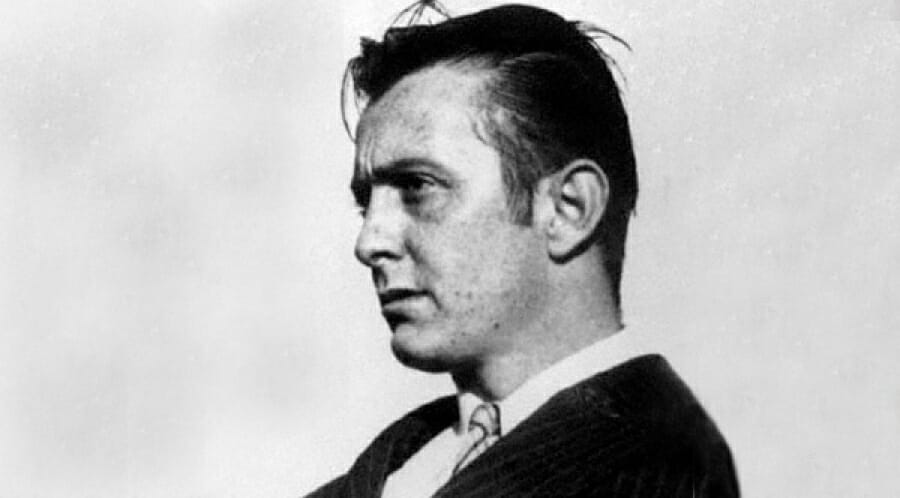
“All at once I was full of plans. Laguna Beach!” John Fante (1909-1983)

Please join us at Stanford on for a discussion of John Fante‘s 1939 novel Ask the Dust at 7 p.m. (PST) on Tuesday, Sept. 19, at Levinthal Hall in the Stanford Humanities Center, 424 Santa Teresa Street on the Stanford campus. It’s a hybrid event, so come virtually or in person. Registration here or below.

Something you may not have known about Fante. He was the son of Italian immigrants, born in 1909 (he died in 1983). Hence, Italy considers him one of its own. So we’re partnering with the Italian Cultural Institute of San Francisco for the event!

Poet Charles Bukowski (not Italian) said the book had a lifetime influence on his own writing, and that the works of Fante, a novelist, short story writer, and screenwriter, were “written of and from the gut and the heart.”

“One day I pulled Ask the Dust down from the library book shelf and stood for a moment, reading.  Then like a man who had found gold in a city dump, I carried the book to a table.  The beginning of that book was a wild and enormous miracle for me….Fante became my god.” 

The book was adapted into a 2006 film starring Colin Farrell and Salma Hayek.

Panelists will include Stanford Prof. Robert Pogue Harrison, author, director of Another Look, host of the radio talk show and podcast series Entitled Opinions, and a regular contributor to the New York Review of Books, and Stanford Prof. Tobias Wolff, one of America’s leading writers and the founding director of Another Look, as well as a recipient of the National Medal of Arts. Novelist Terry Gamble will round out the panel. Many will remember her from the Another Look discussion of Alfred Hayes‘s My Face for the World to See in 2019.

Copies are available as in Kindle and paperback. (In a pinch, the book is even available in a less user-friendly pdf format online.)

In addition to the Italian Cultural Institute of San Francisco, this event is co-sponsored by the Continuing Studies Program and the Division of Literatures, Cultures, and Languages at Stanford.

REGISTER ON THE LINK HERE

Postscript: There’s more! Read about how Fante’s Ask the Dust turned around the life of a convict: here. What happens to a civilization that grows up alongside the constant vision of dust? Read novelist Alan Rifkin’s take on that here.

“Ecstatic Pessimist”: Peter Dale Scott’s new book on poet, friend Czesław Miłosz is out!

August 2nd, 2023
Share
Peter remembers a long collaboration

Author Peter Dale Scott‘s newest book has been a long time in the making. Peter has been sharing his drafts of Ecstatic Pessimist: Czeslaw Milosz, Poet of Catastrophe and Hope with me for at least a decade, and the road to publication has been long and arduous. The volume was finally published by Rowman & Littlefield in July. So a celebration is in order.

“Book Passage,” a vast and legendary bookstore in Corte Madera, fêted the occasion with a reading and onstage conversation on the hot afternoon of Sunday, July 16.

I made the long trip from Palo Alto to Marin to hear the nonagenarian poet, translator, author, Berkeley professor, and former Canadian diplomat – spending time with Peter is always a good idea. His wisdom is formidable and his anecdotes insightful. Many of the people gathered that afternoon thought so, too: it was a gratifyingly full house, and a very friendly one, as well. (Photos by the Book Passage’s Jonathan Spencer.)

Peter was the first translator of Milosz into English, collaborating with the poet in the early 1960s. He is also the first translator for Zbigniew Herbert. For that, the Anglophone world owes him a double debt of gratitude. And so does the Polish world. The work of Milosz’s translators then and since have brought Polish literature to the fore as one of the world’s great literary treasures. (Early in his exile, Milosz referred to Polish despairingly as an “unheard-of tongue.” How times have changed!)

My two cents are included on a back cover blurb: “We are fortunate to have Scott as a guide to one of the greatest poets of our times, offering us a wise, insightful, and deeply learned journey through Milosz’s poems and life in these pages.” And so he does.

Clarifyiing a point with Norman Fischer

Peter discussed his book and read several poems and passages before he shared the onstage conversation with Norman Fischer, a poet and Buddhist priest, and psychologist Sylvia Boorstein.

The excerpt he read from his book touched on his long, sometimes conflicted, but unforgettable relationship with the poet:

“I can only say that I have tried to be true to the Milosz I knew and loved in the early 1960s, the man who cared enough about literature to devote his life to it, and yet rejected the offer of a farm where he would not have had to do anything else,” he said. [Friend Thornton Wilder offered him that pastoral possibility when the Polish poet defected.]

Here’s what he read:

A question from Sylvia Boorstein

“‘What is poetry, that does not change/Nations or people?’ That question, not yet translated into English, electrified me in Milosz’s home in 1961, when I first read it. It was my hope, then, that Milosz’s poetry might help change not just American ‘poetry of the “well-wrought urn”’ but America itself, indeed the world.”

“I believed, in short, in the efficacy and potential of Milosz’s strategy for cultural evolution (ethogeny) or what Milosz called his ‘unpolitical politics.’ When I began this book … I was thinking of the power of poetry to enhance and advance politics, as I noted in the influence of Paradise Lost, described by historians, on the American Revolution.

book photo

“Thus the doorway to my thinking … on the acknowledged contribution of Milosz’s writings, both in poetry and prose, to the success of the Polish Solidarity Movement.

“That is still my hope today. But writing this book has changed me, just as Milosz himself evolved. I now consider his role in Solidarity to be incidental, almost a footnote, to his global role in renewing shared values twoard ‘an open space ahead,’ a revitalized mindset beyond conservatism, modernism, and postmodernism.”

Copies of the book were snapped up and purchased afterward and Peter signed them – a gratifying reception for the 94-year-old poet who still has more projects to finish. Thanks and congratulations to Peter, long may he live and write!

Three cheers for the Book Haven! We’re ranked one of the top literary blogs on the planet!

July 21st, 2023
Share

We have to admit, most of the time we feel a little lonely, blogging out here on the edge of the Pacific, silently typing well into the night, tapping out these little blogposts for you, gentle reader.

Then, sometimes, we get some surprises in our inbox. Look who made the #8 spot in this ranking of the top 100 literary blogs? On Feedspot, a media/publishing database and RSS Reader, we’re jostling alongside the Paris Review, McSweeney’s, NYer Page-Turner, and World Literature Today! We’re nestled just below Lit Hub and just above the British Council! Yayyyy for The Book Haven!

From the text: “Author Cynthia Haven’s blog for the written word – from the literary world at Stanford University to the world at large. The Book Haven was founded in 2009, and over the years has been discussed and linked in The Guardian, The Atlantic, The New Yorker, and more.

We’d pop open some champagne, but we have more work to do tonight, and miles to go before we sleep…

A small stack of “unforgettable books” featured by Stanford’s Another Look book series (Photo: Clay Lambert)

Is a good novel smarter than its author? Kundera thought so…

July 15th, 2023
Share

One of the foremost writers of our times, Milan Kundera, has died, and the retrospectives and memories will be flowing for quite some time to come. The Book Haven has written about the Franco-Czech author before here and here and here. The author of The Unbearable Lightness of Being and The Book of Laughter and Forgetting, among other novels, was 94.

Is the author smarter than his novel? Non, žádný, ne, says Kundera: “Every true novelist listens for that suprapersonal wisdom, which explains why great novels are always a little more intelligent than their authors. Novelists who are more intelligent than their books should go into another line of work.”

According to his publisher Miroslav Balaštík: “For me, Milan Kundera is one of the few last great classical authors who consider writing to be more than a single novel or story but a continual process. A process that includes essays and a reflection on literary tradition, what literature means and where one fits as a writer. I think that is one of his contributions to both Czech and world literature.” 

Trevor Cribben Merrill, who met the author on several occasions, writes a retrospective in a new magazine Compact
:

“The lure of a Kundera novel for American readers, I suspect, often had to do with a kind of political voyeurism. As a college student in the late 1990s, I didn’t just identify with the protagonist of The Unbearable Lightness, Tomas, a surgeon who critiques the ruling party, loses his job, and has to wash windows for a living—I wanted to be him. Contemplated from a safe remove, his status as a victim of totalitarian oppression was positively enviable—not to mention that the window-washer job brought the doctor into regular contact with lonely housewives.

“The allure of victimhood has hardly waned in the subsequent decades, and many of the obituaries and homages to Kundera have emphasized his role as a Czech dissident (he and his wife immigrated to France in 1975), as if to suggest that the enduring value of his oeuvre consists mostly in its portrayal of life in the Stalinist trenches. One posthumous appreciation says Kundera’s novels “brought news of sophisticated Eastern-European societies trembling under the threat of Soviet repression.” The sex also gets a predictable nod (‘RIP to one of the great horny novelists of the 20th century, Milan Kundera’).”

Trevor, author of Minor Indignities, discusses the influence of his friend René GIrard on the Czech author:

“Kundera could be described as the great revealer of what the French literary critic and philosopher René Girard called mimetic desire in its late, hyperbolic stage. He was a novelist descended not just from Kafka and Solzhenitsyn, but also from Cervantes, Dostoevsky, and Proust.” (Read his 1980 interview with Philip Roth here.)

An excerpt from Trevor Merrill’s short retrospective:

“Kundera was a self-described hedonist. Yet he observed that a good novel is more intelligent than its author. His fiction is full of unhappy threesomes (“Even when she was with Eva, whom she loved very much and of whom she was not jealous, the presence of the man she loved too well weighed heavy on her, stifling the pleasure of the senses”); nude beaches characterized by a concentration camp-like uniformity; and would-be libertines who miss out on sex because they are too busy plotting revenge for a nasty comment some stranger flung at them in a hotel bar—scenarios out of Seinfeld, rather than Sade.”

“Kundera didn’t quite predict the sex recession, or go as far as Michel Houellebecq in taking stock of the ravages wrought by laissez-faire sexual economics. Then again, well-made novels don’t so much supply answers as imply them. At a time when the phenomena he was exploring were already plain to see, if less grotesquely obvious than they are today, Kundera hit on hard truths about the aftermath of the sexual revolution. He was the melancholy prophet of a world where mimetic desire increasingly outstripped the concrete pursuit of pleasure.”

Read the whole piece at Compact Magazine here.

Is Seneca staging a comeback? Maybe…

July 9th, 2023
Share

For 1,500 years, no writer except Virgil held more esteem in the classical world than Seneca. And today? “We read every major tragedian in the Western tradition, except Seneca,” says poet and author Dana Gioia, a former chairman of the National Endowment for the Arts. He’s setting out to rectify that situation.

“If Seneca’s plays survived the sack of Rome, the burning of libraries, the leaky roofs of monasteries, the appetites of beetle larvae, and the erosions of rot and mildew, they have not had a conspicuously easier time among modern critics,” he continues. “His tragedies have been dismissed both for too closely resembling Greek models and for too freely departing from them. As the classicist Frederick Ahl has noted, ‘no field of literary study rivals that of Latin poetry in so systematically belittling the quality of its works and authors.’ , “No Roman genre has suffered more consistent disparagement than tragedy.”

Seneca may be the season’s comeback kid. The former California poet laureate has just published a new verse translation of Seneca’s The Madness of Hercules (Wiseblood). Wiseblood notes that the violent and visionary play “takes the reader to the extremes of human suffering and beyond – including a descent into the Underworld, an account that echoes through the ages to Dante and Eliot.” The also book includes a rich introduction that is almost as long as the text – a good reason in itself to buy the book. After so much neglect, a thorough reintroduction is more than overdue.

The book is twenty years in the making – and every step of the way, Dana Gioia was convinced no one cared. But Seneca may be getting a major reconsideration, fueled in part by a new stoic movement taking place among the young. (Go here for a blogpost on the statesman, satirist, philosopher, and dramatist.)

Host Jaspreet Singh Boparai on Zoom

Poet/translator Gioia did another favor for Seneca: an hour-long discussion of the play and the translation that was hosted on May 30 by the Faculty of Polish and Classical Philology at Adam Mickiewicz University in Poznań. It’s on Youtube here. The conversation between Dana Gioia and Prof. Mateusz Stróżyński was hosted by classicist Jaspreet Singh Boparai – and as Dana noted, the university had the “kindness and courtesy” to host the event in English, not Polish.

Their discussion of the challenges they faced was excerpted in The Antigone Journal.

Here’s a bit of it:

DANA GIOIA: I chose Hercules Furens to translate because of its fabulous account of the Underworld. The play was the missing link between Virgil’s Aeneid and Dante’s Inferno. My interest wasn’t scholarly. Those poems were foundational to my own sense of being a poet. I particularly admired Virgil and Dante’s ability to create powerful, multi-leveled narratives that never lost their lyrical impulse. Musicality is the necessary magic of narrative poetry. It is also a quality missing from most contemporary poetry. From Seneca I learned how to present drama that alternates between regular action and sudden but sustained moments of extreme emotion. You can call these high points verbal arias or poetic oratory. In theater, they are called “show-stoppers”.  Seneca’s lyric tragedies helped me write poetic texts for opera.

Mateusz Stróżyński in convo with Dana Gioia on Zoom

MATEUSZ STRÓŻYŃSKI: I became interested in Hercules Furens during my research on EuripidesHeracles and Medea, which I began around 2010. I tried to look at the meaning of infanticide in those two plays, from a psychoanalytic perspective, trying to bring together my interest in Classical drama and psychoanalysis as well as my experience as a practising psychoanalytic psychotherapist. What struck me was that Seneca’s Hercules was much more similar to Euripides’ Medea than to his Heracles. Both seem to give an incredible insight into what has been conceptualized in psychoanalysis as pathological narcissism, especially by authors such as Herbert Rosenfeld, Heinz Kohut, and Otto Kernberg. …

How do we conceive of performing Hercules Furens for a modern audience? 

DG: I wrote the first version of The Madness of Hercules to be performed. I was fascinated by the idea of reviving verse theater. I hoped to create a faithful poetic version of Hercules Furens that worked in live theatrical performance. I wanted the audience to feel the power of both the dramatic action and the poetic speech. There was a young businessman in New York City, Richard Ryan, who told me in a bar one night that he wanted to mount the project. (He was not rich, by the way, he was just enthralled by theater and poetry.) Ryan created Verse Theater Manhattan to stage my translation.  He went on to produce many other verse plays.

We made a radical production decision – we trusted Seneca and the play. We cut the text only slightly. The staging was minimal. The actors were directed to perform the text as verse – to let the power of the language animate their characters. The long speeches were not the impediments that most scholars declared; they were the driving forces of each scene.

Dana Gioia zooming to Poznań from his home library

My translations tried to preserve Seneca’s rhetorical design and recreate the poetry. I thought of the major monologues as great operatic arias for the actors.  They need poetry to work. The Madness of Hercules was produced in a mid-sized theater in lower Manhattan. We sold out both nights, and the audience responded enthusiastically.

Seneca’s Hercules (like Medea) describes a destruction of the inner capacity to love and depend on others, through a desire to control both the self and the others. I think the horrifying sterility of the Underworld in Seneca reflects the inner emptiness and deadness of a narcissistic personality, which inevitably manifests itself in aggression and destruction. But as we can see in Seneca, this narcissistic dynamic is often masked by a narrative of saving the world from monsters in order to bring peace and harmony.

Read the whole thing at the Antigone Journal here. Watch the Youtube video here.

I have a special reason to be grateful to this edition The Madness of Hercules. Dana has kindly dedicated the volume to me:

For Cynthia Haven
Tanquam Explorator

Ben Jonson used “Tanquam Explorator,” so I am in good company!

Postscript on July 10: A note on the dedication from Latin teacher Kevin Rossiter:

The Latin from Seneca’s Moral Epistles to Lucilius, letter 2, line 5.: “Hoc ipse quoque facio; ex pluribus quae legi aliquid apprehendo. Hodiernum hoc est quod apud Epicurum nanctus sum–soleo enim et in aliena castra transire, non tamquam transfuga, sed tamquam explorator–: ‘honesta’ inquit ‘res est laeta paupertas.”

“Explorator” is a spy, an eavesdropper. “tamquam” is like “so to speak”. There’s a line in Seneca where he talks about benefitting from reading people he disagrees with, saying “I go into enemy camps not as a deserter, but so to speak as a spy.”

My own translation would be: “For I am accustomed even to cross into the enemy camp, not so much like a deserter, but so to speak as an eavesdropper/spy.”

I see now that ‘tamquam explorator’ is being applied to you in the dedication – so, ‘an eavesdropper, so to speak’ does nicely, don’t you think? Every great writer is always a great eavesdropper!”


<<< Previous Series of PostssepNext Series of Posts >>>