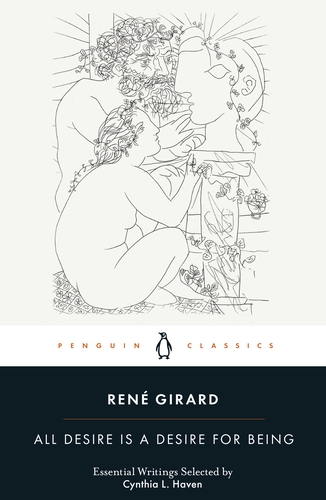
Finally! All Desire is a Desire for Being, a Penguin Classics anthology of Stanford Prof. René Girard‘s “essential writings,” is officially out this week! To my knowledge, the French theorist is the first Stanford faculty to be celebrated in the eminent series.I was honored that Penguin invited me to create this collection of Girard’s finest essays.
Prof. William Johnsen, who directs the publication of a series of books on René Girard and his mimetic theory at the Michigan State University Press, spoke about All Desire is a Desire for Beingat the Paris centenary conference for Girard’s 100th birthday, at the Institut Catholique de Paris last week. Here are Bill Johnsen’s words on that occasion:
Since All Desire is a Desire for Being is 95 percent pure Girard, it would seem that only the editor’s preface, selections and apparatus would be left to discuss. That’s all fine, I love what is in it, I am really happy to see especially the piece on Nietzsche from Paul Dumouchel‘s collection which shows the high-flying, often joyful colloques that Jean-Pierrre Dupuy and Dumouchel organized to integrate Girard with his intellectual peers in the Eighties, but I want to emphasize where Girard now appears (Penguin) and what that means: as my President says, this is a big deal.
In his interviews with Nadine Dormoy in 1988, René Girard attributes the 20,000 dependable French readers of serious books to the Écoles, and the smaller American audience to the silos of academic specialization. I have heard the same figure of 20,000 assured readers from Benoît Chantre so I assume that French readership is steady.
In 2006 I was invited by Girard and Robert Hamerton-Kelly to be Publications Chair of Imitatio, a project funded by The Thiel Foundation. One of the earliest projects was the public launch of Achever Clausewitz and Imitatio in Paris in 2007.
Imitatio had begun supporting production costs for books on mimetic theory at Michigan State University Press to find this readership. (We all should be grateful for their more than ten years of support, the slowest startup in Thiel’s stable). When Lindy Fishburne of The Thiel Foundation later assumed the directorship of Imitatio, she urged us to follow our core mission, to develop Girard’s ideas, to find them a greater recognition and circulation worldwide but also in the English-speaking world to catch up with the breadth of his readership in France and Europe.
I have spent my entire adult life in universities. As the editor of the series, I had some plans for how to spread ideas from the university to that outer world by influencing teachers who would influence their students who leave when they graduate, but I had no idea on how to approach the public directly, or whether America, despite its number of educated readers (my university alone granted 9,500 degrees this last spring), had any number approaching 20,000 dependable readers of serious books.
If Girard was besieged by reporters in Paris after Achever Clausewitz was published in 2007, nothing like that happened in America in 2009 when we published it in English as Battling to the End. In 2011, at a conference on Mimetic Theory and World Religions at Berkeley, I suggested to Cynthia Haven that she write a book about René Girard, something personal and accessible enough to help find him a wider audience in English. Girard had told me in appreciation that Haven had written specifically about the Clausewitz book in The San Francisco Chronicle, as well as other public venues in her one-person publicity campaign.
Evolution of Desire (2018) is informative both about Girard and his ideas, placing him effectively in a historical context by reference to his life and work and interviewing many people who knew him. She is both respectful and warm to her subject. It would be impossible to disentangle the circumstances that have made her book so popular: Girard himself, this century’s recognition of him with honorary degrees and awards, his election to the L’Académie Française, several organisations worldwide devoted to his work. But Haven has played a key role with her book and her reputation – she is a well-known and respected serious author for serious readers who bridges the academic and the public book world. She has her sights always on the dependable core readership of serious books in English.
My field is British Studies, I could go on and on about Penguin so I need to just summarize here. Penguin books has been the most successful venture in gaining a wide audience for serious books in English for the last one hundred years. Nothing else even comes close. So congratulations to Cynthia on publishing All Desire is a Desire for Being at Penguin, and to everyone else working in mimetic theory: this is a big deal, so buckle up.
Artist/painter J. Elliot (his Twitter handle is @j_elliot_art) is an East Coast artist working primarily in oil, as well as charcoal, watercolor, and pastels.
But he’s also one of a dying breed. A flâneur. Charles Baudelaire established the flâneur as a literary figure, referring to him as the “gentleman stroller of city streets.”
The thought started a sort of conversation on Twitter. Littérateur and pianist Koczalski’s ghost responded: “It isn’t possible to be a flâneur in America, for all of the obvious reasons.” Elliot, however, gave the concept an American spin: In the New World vernacular, flâneuring is “driving aimlessly around looking at yard sales and stuff.”
Is the day of the flâneur a thing of the past? In a 2013 article, “In Praise of the Flâneur,” in TheParis Review, Bijan Stephen writes: “The figure of the flâneur—the stroller, the passionate wanderer emblematic of nineteenth-century French literary culture—has always been essentially timeless; he removes himself from the world while he stands astride its heart. When Walter Benjamin brought Baudelaire’s conception of the flâneur into the academy, he marked the idea as an essential part of our ideas of modernism and urbanism. For Benjamin, in his critical examinations of Baudelaire’s work, the flâneur heralded an incisive analysis of modernity, perhaps because of his connotations: ‘[the flâneur] was a figure of the modern artist-poet, a figure keenly aware of the bustle of modern life, an amateur detective and investigator of the city, but also a sign of the alienation of the city and of capitalism,’ as a 2004 article in the American Historical Review put it. Since Benjamin, the academic establishment has used the flâneur as a vehicle for the examination of the conditions of modernity—urban life, alienation, class tensions, and the like. …
He goes on to assert the continued role of flâneuring in our times: “Real life hasn’t changed, and twentieth-century France was no different. Though Baron Haussmann’s avenues made flânerie more difficult, and though the rise of street traffic may have endangered those brave flâneurs who walked their turtles, the flâneur’s raison d’etre—to participate fully through observation—has always remained the same. Now that we’re comfortably into the era of the postmodern, perhaps it’s time to take a brief stroll into the past, to sample its sights and its sounds.”
Elliot took the photos below during his flâneuring excursion in Machias, Maine, where he discovered “Jim’s Books,” located in Jim’s very own garage. Elliot tweeted this a day or two ago from his East Coast digs: “Today’s flâneuring: this bookshop a guy keeps in his garage.”
Elliot’s Twitter bio includes this: “Józef Czapski frequently advised me: when you’re having a bad day, paint a still life.” For some of us, maybe. Did he actually know the legendary painter, writer, diplomat? Tell us more… (I wrote about Czapski for the Wall Street Journal. Article here.
René Girard among the bamboo outside his Stanford home in 2008. (Photo: Linda A. Cicero / Stanford News Service)
All Desire is a Desire for Beingis becoming a reality! I got my advance copies of the new Penguin Classics anthology of René Girard’s “essential writings” this week. (You can pre-order a copy here.) It was an honor to contribute to his legacy with Penguin Classics, as we near his hundredth birthday on Christmas Day. To celebrate, I am republishing an article you may not have seen before. It was published June 11, 2008, by Stanford News Service.I had met the “French polymath” (that’s how the Google “knowledge panel” identifies him nowadays)only a months before. This would become the first of many interviews, essays, and books about the French thinker.
This article and many others from the Stanford News Service are now archived and no longer publicly available. So in the centenary year of René’s birth, I thought I’d make at least this one available to all of you. Enjoy!
The story goes like this: In 2004, Jean-Pierre Dupuy, a professor of French at Stanford, is attending a conference in Berlin when he is confronted by a man in a café who asks, “Why did you become a Girardian?” Dupuy replies in a beat: “Because it’s cheaper than psychoanalysis.”
Did it really happen? Although the event was witnessed, Dupuy responds with a Gallic shrug and an Italian saying: “Si non e vero e ben trovato.” The American equivalent might be Ken Kesey‘s dictum, “It’s the truth even if it didn’t happen.”
In any case, the anecdote illustrates the kind of effect René Girard, the Andrew B. Hammond Professor of French Language, Literature and Culture, Emeritus, at Stanford and one of the immortels of the Académie Française, has had on people. Aficionados of the scholar even have a name: Girardians.
Mimesis and Theory: Essays on Literature and Criticism, 1953-2005, published this spring by Stanford University Press, explores the literary side of Girard’s thinking over his long career-a career that originally focused on literary scholarship but that has gradually embraced anthropology, religion, sociology, psychology, philosophy and theology. French Professor Michel Serres, another immortel (America has only two, and both are at Stanford), has called him “the new Darwin of the human sciences.”
Girard’s Achever Clausewitz, published last year in France by Editions Carnets Nord, will be published in English by Michigan State University Press this winter. The book, which takes as its point of departure the Prussian military historian and theorist Carl von Clausewitz (1780-1831), is considered by many to be groundbreaking. Its implications place Girard, known mostly for his studies of literature and archaic cultures, squarely in the 21st century.
“It doesn’t take much insight to realize that wars have been getting worse every time – worse from the point of view of the civilian, more and more destructive, more and more total. Well, Clausewitz is about that,” Girard explained. “Therefore my book is a very end-of-the-world sort of thing.”
Girard lives a sequestered life in the academic burrows of Stanford, but his influence abroad is seismic. Even French President Nicolas Sarkozy cites his writings. While Girard walks the Stanford campus virtually unnoticed and unrecognized, in Paris, visitors say, reporters were on his doorstep every day after the publication of last year’s book.
René and Martha Girard at their Stanford home. (Photo: L.A. Cicero)
The “Girard Effect” may become more prominent worldwide with a foundation, Imitatio, that has been established to promote his ideas. (Dupuy is its director of research.) Imitatio launched its research program with a conference at Stanford in April, with about 40 scholars from around the world attending. The Colloquium on Violence and Religion, an independent association of international scholars, also studies mimetic theory and publishes an annual journal, Contagion: Journal of Violence, Mimesis and Culture.
Although Girard will turn 85 on Dec. 25 (he was born in Avignon), he is not resting on his laurels. Achever Clausewitz signals a new development of his line of thought, and he is already working on his next book, which will focus on St. Paul. Are there any more projects envisioned?
“Thousands more!” Benoît Chantre, his French editor and interlocutor for Achever Clausewitz, said and smiled.
Scapegoats and sacrifice
Girard’s thinking, including textual analysis, is a sweeping reading of human nature, human history and human destiny. His contention is controversial: Religion is not the cause of violence, as many suppose; it was, in archaic societies, a way of solving it.
Here’s why: People are social creatures, and their behavior is based on imitation to a much greater degree than generally supposed. How else to explain why a generation decides at once to pierce their tongues, or why stocks rise and fall? How to explain how a child learns language? Even our desires are not our own; we learn them from others.
“We don’t even know what our desire is. We ask other people to tell us our desires,” he said during a lecture at Stanford’s Old Union in February. “We would like our desires to come from our deepest selves, our personal depths – but if it did, it would not be desire. Desire is always for something we feel we lack.”
Envy and resentment are the inevitable consequences of this drive toward mimesis. These emotions, in turn, fuel conflict; it occurs whenever two or more “mimetic rivals” want the same thing, which can go to only one. It might be a woman, a presidency or a research grant. Many religious prohibitions are meant to regulate and control such conflict.
“When we describe human relations, we lie,” Girard said. “We describe them as normally good, peaceful and so forth, whereas in reality they are competitive, in a war-like fashion.”
In literature, such mimetic desire can create comic masterpieces: A Midsummer Night’s Dream is a classic he frequently cites. Or it can inspire the novels of Balzac, in which the characters strive to outdo each other in snobbery and imitative social values. Such imitation can even be totally imaginary. Don Quixote wishes to be a knight errant, because he is imitating the heroes in the books he has read.
On a societal level, such conflict seeks a release, and the outlet is a scapegoat. A third party-often an outsider, a foreigner, a woman, someone who is disabled, the king or president-is blamed and demonized for having caused the conflict. Scapegoats are not seen as innocent victims; they are seen as the guilty cause of the disorder. The calls mount for the sacrificial victim, and the mob itself creates a sense of harmony.
“Joining the mob is the thing that people don’t realize. They feel the unity but don’t interpret it as joining the mob,” Girard said.
The mob prevails. The victim is killed, exiled, pilloried or otherwise dispensed with. Rivals reconcile, and peace and unity are restored to the community.
“If you scapegoat someone, it’s a third party that will be aware of it,” he said. “It won’t be you. Because you will believe you are doing the right thing. You will be either punishing someone who is guilty or fighting someone who is trying to kill you, but you are never the one who is scapegoating.”
In a sleight of hand that unsettles Girard’s critics, the fact that there is no proof is proof. It is not that the scapegoaters suppress the history of their scapegoating, he said, “scapegoating itself is the suppressing.”
For this reason, tragedy and religion in ancient Greece are inextricably entwined. Take the story of Oedipus. A plague is destroying Thebes, and whom does the mysterious oracle find at fault? The outsider, the lame newcomer king, whose expulsion brings peace to the city-state. Euripides’ The Bacchae is the same-disorder is tearing apart the society and the women are going crazy. Pentheus, the young leader, is at fault-his collective murder brings sanity and harmony to Thebes.
“The first culture which rebels against that system is the Jewish culture,” Girard said. He explains that the Bible is actually counter-mythical. Over a period of centuries, the books of the Old Testament begin to catch on to mankind’s scapegoating mechanism. While they describe and even celebrate violence, they gradually begin to question and fight it as well.
For example, many of the psalms “show a narrator who is surrounded by a crowd of good-for-nothings, who are trying to encircle him and turn him into a victim.” The story of Job also is revealing: “It’s a small community, but he’s been the dictator for years. Everybody loves him, he does no one any harm,” Girard said at the Old Union lecture. “One fine morning he wakes up, and everybody is against him. His three ‘friends’ are ready to explain how bad he is now. And everybody is ready to explain how bad he is at the same time. He has turned from the absolute hero to the scapegoat of the community. Job is like a long psalm and shows you what happens to communities. No myth will ever show you that.”
The climactic victimization is with “the announcement of what we call the Passion.”
“Jesus accepts to be the victim, and we don’t really know why,” he said. “There, what the Gospel said is that it is God himself who has allowed all this scapegoating, and says, ‘You can forgive me, since now I am ready to become your victim myself.'”
Thus, the world has arrived at a dangerous point, Girard said. The mechanism of scapegoating has been seen through; the escape valve is gone. War no longer “works” and no longer resolves mimetic rivalry among nations. While wars were once organized and carried out by states, concluding with a treaty and one side’s defeat, now individual actors can instigate acts of war in a free-for-all. Moreover, the actors may insist on their own martyrdom to aggravate the conflict, rather than resolve it.
In an interview in Le Point last year, Girard presented the dire worldview that made Achever Clausewitz controversial: “The world wars marked an important step in the rise of extremes. September 11, 2001, was the beginning of a new phase. Today’s terrorism still has to be thought through, because we haven’t yet grasped that a terrorist is ready to die in order to kill Americans, Israelis or Iraqis. What’s new here in relation to Western heroism is that suffering and death are called for, if necessary by experiencing them oneself.” We search in vain for scapegoats: “The Americans made the mistake of ‘declaring war’ on al-Qaida without knowing whether al-Qaida exists at all.
“The era of wars is over: From now on war exists everywhere. Our era is one of universal action. There’s no longer any such thing as an intelligent policy. We’ve almost reached the end.”
An existential downfall
Girard’s misgivings about war and a potential apocalypse are the extension of a long thought that has evolved over decades. The road was marked by various points of illumination: One light-bulb moment occurred during a “conversion” experience when he was a young professor at Johns Hopkins University in the late 1950s.
He explained to James Williams, in an interview included in The Girard Reader, the epiphany that was connected with the writing of his first book, Deceit, Desire and the Novel: “I started working on that book very much in the pure demystification mode: cynical, destructive, very much in the spirit of the atheistic intellectuals of the time. I was engaged in debunking, and of course recognizing mimesis is a great debunking tool because it deprives us moderns of the one thing we still have left, our individual desire.”
“The debunking that actually occurs in this first book is probably one of the reasons why my concept of mimesis is still viewed as destructive,” he said. “Yet I like to think that if you take this notion as far as you possibly can, you go through the ceiling, as it were, and discover what amounts to original sin. An experience of demystification, if radical enough, is very close to an experience of conversion.”
He described his eventual realization this way: “The author’s first draft is a self-justification.” It may either focus on a wicked hero, the writer’s scapegoat, who will be unmasked by the end of the novel; or it may have a good hero, the author’s alter ego, who will be vindicated at novel’s end.
If the writer is a good one, he will see “the trashiness of it all” by the time he finishes his first draft-that it’s a “put-up job.” The experience, said Girard, shatters the vanity and pride of the writer. “And this existential downfall is the event that makes a great work of art possible,” Girard said.
While he speaks easily of conversion, original sin and redemption, however, one visiting scholar wondered why he seemed to circumvent a related theme: the imperative topic of forgiveness. But it’s hard to beat Girard at his own game. Only a few months earlier, Girard had spoken at an informal philosophical reading group in History Corner for several dozen faculty and students.
Girard recapitulated the story of the Old Testament Joseph, son of Jacob, bound and sold into slavery by his “mob” of 10 half-brothers: “They all get together and try to kill him. The Bible knows that scapegoating is a mob affair.” Joseph reestablishes himself as one of the leaders of Egypt and then tearfully forgives his brothers in a dramatic reconciliation. It is, he said, a story “much more mature, spiritually, than the beginning of Genesis.”
The story is unlike any in archaic literature: “It’s a very beautiful story, which like many biblical stories, is a counter-mythical story,” he said, “because in myth, the lynchers are always satisfied with their lynching.”
But at the reading group, he suggested his audience might not have noticed this before. After all, they had been trained to think that the Bible was a completely backward book, superceded and preceded by better efforts, with little that was new to the world. In short, Girard dropped the cat among the pigeons.
They erupted into debate. Girard slouched back in his chair a little, smiling softly and watching the feathers fly.
Zygmunt Malinowski, who has written for us here and here and here and everywhere really, has just filed a short quick photo report from the big city on the East Coast:
Cafés are everywhere in New York City, especially around business districts, shopping areas, and entertainment districts. New Yorkers grab coffee on the go while rushing to work, or sip their morning joe while casually lingering in the café. Friends meet friends and have a bite to eat, choosing pastries and light snacks, others to meet business colleagues for brief, casual, and productive meetings. Each café has its distinctive coffee brand and various snacks so one can choose among many. Some of the more popular venues: Au Bon Pain; Prett; Zuckers, known for cream cheese and bagels; Ole & Steen, a Danish bakery chain has wholesome breads and sumptuous pastries, and Starbucks is everywhere.
These two women at Ole & Steen near Grand Central were catching up with their families and friends over Skype during a rare quiet time in the café. I grabbed a quick cup of my favorite brew, my camera, and headed out to the streets.
1. Write in longhand: when you scratch out a word, it still exists there on the page. On the computer, when you delete a word it disappears forever. This is important because usually your first instinct is the right one.
2. Minimum number of words to write every day: no “quota.” Sometimes it will be no words. Sometimes it will be 1500.
3. Use any anxiety you have about your writing — or your life — as fuel. Ambition and anxiety: that’s the writer’s life.
4. Never say “sci-fi.” You’ll enrage purists. Call it SF.
5. Don’t dumb down: always write for your top five percent of readers.
6. Never pun your title, simpler is usually better: Lolita turns out to be a great title; couldn’t be simpler.
7. At Manchester (University, where he taught creative writing) my rule is I don’t look at their work. We read great books, and we talk about them … We look at Conrad, Dostoyevsky.
8. When is an idea is worth pursuing in novel-form? It’s got to give you a kind of glimmer.
9. Watch out for words that repeat too often.
10. Don’t start a paragraph with the same word as previous one. That goes doubly for sentences.
11. Stay in the tense.
12. Inspect your “hads” and see if you really need them.
13. Never use “amongst.” Never use “whilst.” Anyone who uses ‘whilst’ is subliterate.
14. Try not to write sentences that absolutely anyone could write.
15. You write the book you want to read. That’s my rule.
16. You have to have a huge appetite for solitude.
Martin Amis: He didn’t smile for the camera … any camera… (Photo: Bryan Appleyard)
Never met Martin Amis in person, but I was a dozen feet away from him eleven years ago at Stanford’s Cemex auditorium – and wrote about it here. “As you get older – and this has to be faced – most writers go off,” said. “I lay the blame at the feet of medical science.”
He cited W.B. Yeats: “Now I may wither into the truth,” he said. But although occasionally withering, he was far from withered.I wrote about him here and here and here, among other places.
In a puzzling move, he began the evening by recounting long lists of Nazi atrocities – a return to Time’s Arrow. The subject matter is timeless, he said, and defies “that greasy little word – closure.” (Fine. About time someone took that cliché down.) “Rule Number One: Nobody gets over anything. It’s the deaths of others that kill you in the end.”
He was already thinking about death, and he died on May 19, of esophageal cancer, the same disease that claimed his friend, the author and journalist Christopher Hitchens, in 2011.
From Boyd Tonkin, writing in The Guardian, about the “writer whose acrobatic wit defied gravity and solemnity and who epitomised literary fame in an age of glitz and hype.”
“The writer Martin Amis, who has died aged 73, delighted, provoked, inspired and outraged readers of his fiction, reportage and memoirs across a literary career that set off like a rocket and went on to dazzle, streak and burn for almost 50 years. His scintillating verbal artistry, satirical audacity and sheer imaginative verve at every level from word-choice to plot-shape announced a blazing, once-in-a-generation talent.”
Read the rest here.A few words from a few who knew him. From the journalist and author Bryan Appleyard:
I saw Martin Amis in Brooklyn in 2014 and took this photo (above). I asked him to smile but he said he could not act. He had asked me to bring him a packet of rolling tobacco from London. I took him two packets. He smoked incessantly. In some interviews it looked as if his trousers were on fire. He died of esophageal cancer. He was a dazzling writer and deserves all the tributes and more. RIP
It’s oddly shocking to hear of the death of Martin Amis. A certain energy, a bullish certainty, a kind of headlong barrage of wit and Eighties street-wisdom passes with him. As a public figure he was almost more than himself. He was just a few months younger than me and he always seemed young. I met him only once when we were seated next to each other at a dinner in Manchester though I can’t remember what the occasion was. We talked a little about Thomas Hardy‘s poetry and Philip Larkin‘s too. He quoted chunks. He was friendly and mild and sad, possibly rueful. Novelists – did he say poets too? – should stop writing before they get old, he sighed. He was not joking. He had crashed out of critical adulation by then. The new wave of feminist writers had little time for him and his prestige counted against him. The £500,000 advance, the affair of the new teeth (reminds me I am back at the dentist on Monday), the book on Stalin, and the strange Booker-listing of Time’s Arrow, which – for me – was him at his brilliant but preening worst in the worst of all causes, did seem to hollow him out a little. But Money, for example, remains the work of a stunningly vivid writer. There also remains the image of the Fenton-Hitchens-Amis intellectual triumvirate with Fenton, in my view, the most princely of poets and Hitchens the most entertaining and commanding of polemicists. I imagine Clive James and John Fuller standing in the wings. And there also remains the suggestion – whose, I don’t remember – that the Eighties explosion of so-called ‘Martian’ poetry, referred to as Martianism, was so named as an anagram of Martin Amis, either that or (more likely) that it was a reference to Craig Raine‘s book of poems, A Martian Sends a Postcard Home (1979). Much remains in other words. I liked the weary, rueful man at the Manchester dinner table and I do feel a sense of shock that he is gone. A slice of historical voice is gone with him. He was not an old man but a young man grown older.
From the Polish poet, literary critic, translator, and essayist Jerzy Jarniewicz
Martin Amis, author of, among others, London Fields, The Information, and Time’s Arrow, has died; also (although he did not write poems himself) co-founder of the poetic school called the “Martian School.” There is a well-known tale about fools who wanted to see the moon, and when someone finally pointed at it, they looked at the pointing finger. I’d say that Martin Amis was looking at his finger – not because, however, like this fool, he didn’t know that it was pointing at the moon – but because he was more interested in his fingers than blue bodies suspended far away in space. Especially since the father’s generation made him look at the moon for a long time. I wrote about Amis (father and son) in the “Attendance Note,” where you can also find a conversation that we had with Peter Sommer in November 1995.