
Warsaw poet Julia Fiedorczuk and “the only solid ground for empathy”
August 15th, 2017

“The vulnerability of bodies” (Photo: Radek Kobierski)
.
Yesterday was the anniversary of Nobel poet Czesław Miłosz‘s death. What better way to celebrate his legacy than to note the influence he’s had on a younger generation?
In his later years, the Polish maestro worked on translating the Psalms into Polish – he even taught himself Hebrew for the task. The result became a classic in the Polish language. And the endeavor bore fruit in his own poetry. His last poems are redolent with the cadences of the Psalms, along with their timeless spirit of grief and hope.
 His psalms, and the effort to recreate them, have inspired others – notably the Warsaw poet Julia Fiedorczuk. “I gradually started studying the Hebrew originals with the help of a friend who knows Hebrew. I also looked at other translations into Polish – many Polish poets have translated the Psalms.”
“I’m attracted to Psalms because they express an attitude of gratitude and trust, even though some of them are written from the depth of despair,” she wrote me. “It is a desperate moment for the world right now, and in my Psalms I focus on contemporary problems. I also attempt to articulate a kind of post-religious metaphysics rooted in the experience of the vulnerability of bodies (human and non-human), which I believe to be the only solid ground for empathy.”
“My Psalms do relate to the originals, some very loosely, some a bit more closely. Sometimes they contain quotes (the Polish versions will allude to Miłosz’s versions). My Psalm 25 is a kind of ‘translation.’ Sometimes the allusion is only thematic, sometimes there is irony and distance (where Psalms of David glorify violence and anthropocentrism). It is an on-going experiment and I have no idea where it will take me.”
Psalm 31 was my favorite among the ones I’ve seen. Now it’s included in her new collection in English, Oxygen (translated by the inestimable Bill Johnston), published by Zephyr Press. The connection with its majestic prototype is indeed loose – it’s more a meditation on it. I see the homage, however, in the “mesh of branches,” which recalls the fourth verse of the psalm: “Pull me out of the net that they have laid privily for me: for thou art my strength.”
Psalm XXXI
for K.K.
a chickadee had perched on the windowsill like a message
generated by the mist, October
was turning into November in the birches oaks alders,
in the frost-resistant flowers, in the cemeteries
where our fathers wrote no memoirs,
where they would not recognize our children, our
poems, ourselves. The television was showing Poland
that had perished, and then had not perished, and then
again had perished, and then not, and then the sun
flung up a mesh of branches, all at once
the chickadee was absorbed by sky before I could say
remember, remember me –
Trans. Bill Johnston


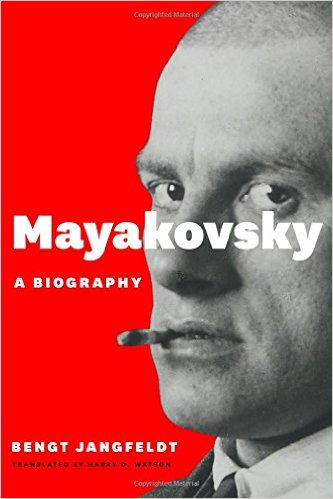 The word “love-boat” suggested romantic reasons, but also created a mystery, for Mayakovsky’s tangled love life was mostly unknown to the general public. At the time of his death he was simultaneously involved with three different women: his longtime mistress, Lili Brik, with whom he had spent most of his adult life in a bohemian ménage à trois (together with her husband, Osip Brik), but who was just then involved with a movie director; Tatyana Yakovleva, a striking young White Russian whom Mayakovsky had met in Paris and asked to marry him, but who had just married a Frenchman instead; and Veronika Polonskaya, a sultry young stage actress, also married, to whom he had also proposed marriage. Emotionally he was a wreck, and his death might have been precipitated by his relations with any one of his paramours.


 Absolutely! I thought I knew the state pretty well, but these trips have been a continuous discovery. I now realize how little I knew about the eastern half of the state, especially up in the Sierra Nevadas. Those counties are not only spectacularly beautiful, they are also central to the state’s history. There were also a lot of towns I knew only from driving through them on the way to somewhere else. How different it is to meet local people and spend a day or two there.


