The Library of Alexandria – destroyed by an angry mob with torches? Not very likely.

March 2nd, 2016

Share
agora

She was several centuries too late.

Why do little girls adore martyrs so much? Perhaps it’s preparation for marriage. In my elementary school, the book on Jeanne d’Arc was one of the most heavily worn and pawed over volumes in our small library, and my fingerprints are over every page, if the tattered book still exists at all. The imprisoned and beheaded Lady Jane Gray tended to be more popular than the triumphant Queen Elizabeth I. So did Mary Queen of Scots.

If girls persist beyond the stake and the axe, they eventually learn about … Hypatia of Alexandria, as I did.

loa2

Still picking up scrolls.

Nowadays it doesn’t take much precocity to learn the story. Rachel Weisz tells it all to us in Alejandro Amenábar’s 2009 film Agora. The Neoplatonic scholar was the most learned woman in the ancient world since Diotima, chatty girlfriend of Socrates. The mathematician, astronomer, philosopher, and presumed habituée of the Library of Alexandria, was lynched by an angry early Christian mob on March 8, 415 A.D. It was all her book larnin’ that did her in. The Library of Alexandria was destroyed by arson at about the same time.

But did it really happen that way? Many have taken on the story since the movie came out, but perhaps none better than blogger Tim O’Neill over at the blog Armarium Magnus. I write this post as a public service, to squish like a bug another myth about the big struggle between faith and science. (“I believe in philosophy,” intones Rachel Weisz-cum-Hypatia. But is philosophy a a faith to be believed, or a set of propositions to be tested in one’s life?)

Writes O’Neill: “As an atheist, I’m clearly no fan of fundamentalism – even the 1500 year old variety (though modern manifestations tend to be the ones to watch out for). And as an amateur historian of science I’m more than happy with the idea of a film that gets across the idea that, yes, there was a tradition of scientific thinking before Newton and Galileo. But Amenabar has taken the (actually, fascinating) story of what was going on in Alexandria in Hypatia’s time and turned it into a cartoon, distorting history in the process. …

loa

Angry mobs with torches, on the way.

“Not that there is anything very new or original about this – Hypatia has long been pressed into service as a martyr for science by those with agendas that have nothing to do with the accurate presentation of history. As Maria Dzielska has detailed in her study of Hypatia in history and myth, Hypatia of Alexandria, virtually every age since her death that has heard her story has appropriated it and forced it to serve some polemical purpose.”

But … but … but… what of the Library of Alexandria? My own guess is that it  probably wasn’t a patch on Google, and nobody gets all misty-eyed about that. Nevertheless…

“To begin with, the Great Library of Alexandria no longer existed in Hypatia’s time. Precisely when and how it had been destroyed is unclear, though a fire in Alexandria caused by Julius Caesar’s troops in 48 BC is the most likely main culprit. More likely this and/or other fires were part of a long process of decline and degradation of the collection. Strangely, given that we know so little about it, the Great Library has long been a focus of some highly imaginative fantasies. The idea that it contained 500,000 or even 700,000 books is often repeated uncritically by many modern writers, even though comparison with the size other ancient libraries and estimates of the size of the building needed to house such a collection makes this highly unlikely. It is rather more probable that it was around less than a tenth of these numbers, though that would still make it the largest library in the ancient world by a wide margin.

hypatia

Read the book. Please.

“The idea that the Great Library was still in existence in Hypatia’s time and that it was, like her, destroyed by a Christian mob has been popularised by Gibbon, who never let history get in the way of a good swipe at Christianity. But what Gibbon was talking about was the temple known as the Serapeum, which was not the Great Library at all. It seems the Serapeum had contained a library at some point and this was a ‘daughter library’ of the former Great Library. But the problem with Gibbon’s version is that no account of the destruction of the Serapeum by the Bishop Theophilus in AD 391 makes any mention of a library or any books, only the destruction of pagan idols and cult objects…”

“Even hostile, anti-Christian accounts of this event, like that of Eunapius of Sardis (who witnessed the demolition), do not mention any library or books being destroyed. And Ammianus Marcellinus, who seems to have visited Alexandria before 391, describes the Serapeum and mentions that it had once housed a library, indicating that by the time of its destruction it no longer did so.  The fact is that, with no less than five independent accounts detailing this event, the destruction of the Serapeum is one of the best attested events in the whole of ancient history.  Yet nothing in the evidence indicates the destruction of any library along with the temple complex.

hypatia2

65 years old? We think not.

“Still, the myth of a Christian mob destroying the ‘Great Library of Alexandria’ is too juicy for some to resist, so this myth remains a mainstay for arguments that ‘Christianity caused the Dark Ages’ despite the fact it is completely without foundation. And it seems Amenabar couldn’t resist it either – thus a scene early in the movie features an anxious Hypatia scrambling to rescue precious scrolls before a screaming mob bearing crosses bursts through a barred door to destroy what he’s dubbed ‘the second library of Alexandria’ (presumably he means the Serapeum). This seems to be at the beginning of the movie, apparently setting the stage for the conflicts between science and religion that will end in Hypatia’s murder. [Carl] Sagan, on the other hand, put the destruction of the Library after her murder. In fact, it seems no such destruction happened either in her lifetime or after it and the idea it did is simply part of the mythic parable.”

You can read all about it here. And what of Hypatia? Yes, she was gruesomely murdered by a mob. But the reasons were political, not philosophical or religious. And oh, by the way, she was probably about 65 years old. Sorry Rachel.

The weak of heart (or mind) can stick with the movie version:

Steve Wasserman is coming home! Meet the new publisher of Berkeley’s Heyday Books.

February 28th, 2016
Share
wasserman2

Welcome home, Steve!

As I write, Steve Wasserman is shoveling his stuff into boxes. At least I hope he is. Steve, who has been editor at large for Yale University Press, is coming home to California at last, and it can’t happen fast enough for us. “The call of Berkeley was very strong,” he said. “I am something of a native son. I have missed California like the amputee is said to miss the phantom limb.”

The occasion is indeed one for celebration. On July 1, he will become publisher and executive director of Heyday Books, an outfit that publishes books about … California. The publishing house is situated on University Avenue in Berkeley, and you can’t get more Berkeley than that. The cover photo for his Facebook page was quickly changed to show a panorama of Berkeley, with the university’s landmark campanile. Steve grew up and went to university in this city on the Bay.

I’ve written about Steve’s time as editor of the Los Angeles Times Book for nearly a decade, a golden age when it was the best book review section in the country, bar none. He always had an eye for the era; for what might be relevant, rather than immediate. He was always willing to take a chance, and trusted that boldness, innovation, and intelligence would find an audience. I was proud to be a part of it.

Those traits served him well as editor at large at Yale University Press, where he “brought luster and allure to the Yale list, acquiring important books by such figures as Greil Marcus, Michael Roth, Martha Hodes, David Thomson, and David Rieff, publishing them with flair and gusto,” said  John Donatich, the director of Yale University Press. “He will continue to consult with YUP, particularly editing several key authors still to be published.”

During those years also, he was a principal architect for the Los Angeles Times Festival of Books, now the largest book festival in the country.

wasserman1

A life in books.

At Heyday, he replaces Malcolm Margolin, who founded the company in 1974. Margolin seems pleased about the appointment, as is everyone else: “I can’t imagine anyone with better professional skills, more depth and variety of experience, and a more impressive record of accomplishment and public service. He knows California and its many cultures with intimacy, associates easily with the best writers and deepest thinkers everywhere, and his ample playfulness and wit have always been at the service of a humane social vision.”

According to Berkleyside:

One area he will examine is Heyday’s current distribution model. While the press publishes numerous important and beautiful books about California every year, the books are only sold in California bookstores, although they are also available online. Heyday does not have a national distributor and Wasserman does not know yet if that is because people outside the state are not interested. California as a topic is often denigrated by the East Coast, he said. Wasserman hopes to enhance Heyday’s reputation and showcase its role in interpreting California.

Steve sounds more than ready to come home and take on the new fight: “It has long been the case that California has been regarded by people who don’t live there, particularly the dyed-in-the-wool Manhattanites, who are the most provincial people in the country, as a strange backwater. Very often things California are dismissed as regional, not of national interest. Of course, all of that is rubbish. I would like to publish books that while interesting Californians, have broader resonance.”

“We couldn’t be more excited about bringing him back to California,” said Stanford alumna Emmerich Anklam (class of ’15) on the Heyday staff. “To use a favorite phrase from Steve’s predecessor Malcolm Margolin, ‘What a joy!'”

And below (pardon the blurry video quality) – this is for you, Steve.

Tobias Wolff’s advice as a mentor: “Just don’t lose the magic.”

February 25th, 2016
Share
Wolff

Toby speaking at Stanford Libraries (photo: Sonia Lee)

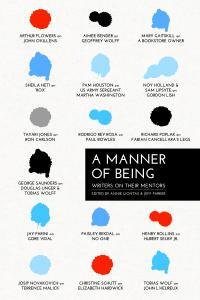
Last fall, the New Yorker ran a story about author Tobias Wolff, recent recipient of a National Medal for the Arts. The article describes Stanford’s generous and gifted writer in his less celebrated role as a mentor. George Saunders, the author, makes a great witness; he is a recipient of MacArthur and Guggenheim fellowships – Toby’s mentoring, in this case, was very successful. The New Yorker piece is taken from a new book, A Manner of Being: Writers on Their Mentors (edited by Annie Liontas and Jeff Parker, University of Massachusetts Press). 

In case there are a few others who missed the story (as I had), I humbly offer this late post, with an arrow back to Saunders’s original story, “My Writing Education: A Timeline” here. Saunders’s charming mini-memoir goes some way to explaining why Toby is one of the most beloved faculty members at Stanford. And it’s a good thing it’s charming, because, as Saunders writes later: “Writing is about charm, about finding and accessing and honing ones’ particular charms. To say that ‘a light goes on’ is not quite right—it’s more like: a fixture gets installed. Only many years later (see below) will the light go on.”

The friendship had its beginnings in February 1986, when Toby called the home of Saunders’s parents in Amarillo, Texas to tell him he had been admitted to the Syracuse Creative Writing Program, where Toby was teaching back in the 80s: “I call back, holding Back in the World in my hands. … He’s kind and patient and doesn’t make me feel like an idiot. I do that myself, once I hang up.”

Inauspicious beginnings…perhaps, but it got better:

“After the orientation meeting the program goes dancing. Afterward, Toby and I agree we are too drunk to let either him or me drive the car home, that car, which we are pretty sure is his car, if there is a sweater in the back. There is! We walk home, singing, probably, “Helplessly Hoping.” In his kitchen, we eat some chicken that his wife Catherine has prepared for something very important tomorrow, something for which there will be no time to make something else.

“I leave, happy to have made a new best friend.”

mannerofbeing Not so fast! The next day: “I wake, chagrined at my over-familiarity, and vow to thereafter keep a respectful distance from Professor Wolff and his refrigerator.”

Perhaps my favorite passage, which is very Toby, from later that semester:

At a party, I go up to Toby and assure him that I am no longer writing the silly humorous crap I applied to the program with, i.e., the stuff that had gotten me into the program in the first place. Now I am writing more seriously, more realistically, nothing made up, nothing silly, everything directly from life, no exaggeration or humor—you know: “real writing.”

Toby looks worried. But quickly recovers.

“Well, good!” he says. “Just don’t lose the magic.”

I have no idea what he’s talking about. Why would I do that? That would be dumb.

I go forward and lose all of the magic, for the rest of my time in grad school and for several years thereafter.

saunders

Gratitude. (Photo David Shankbone, Creative Commons)

Last anecdote, and you’re on your own (you’ll have to read the rest of the story here):”Toby has the grad students over to watch A Night at the Opera. Mostly I watch Toby, with his family. He clearly adores them, takes visible pleasure in them, dotes on them. I have always thought great writers had to be dysfunctional and difficult, incapable of truly loving anything, too insane and unpredictable and tortured to cherish anyone, or honor them, or find them beloved.” I’ve seen it, too. He’s a great all-round human being, and greatly adored. Perhaps he was a good role model for Saunders’s own long marriage with writer Paula Redick, a writer he met in those early days at Syracuse. They were engaged in three weeks, “a Syracuse Creative Writing Program record that, I believe, still stands.”

Oh, I know, you read all that stuff about Toby retiring last year. Yeah, I believed it, too. Read about him coming out of retirement, and much else, in a Q&A at the Stanford Daily here.

Happy 331st birthday, George Frideric Handel!

February 23rd, 2016
Share

tim120Always a pleasure to hear from our friend, the Los Angeles poet (and Stanford alum) Timothy Steele. Today he celebrates the birthday of Handel – a passion we both share, apparently. We’ve posted Tim’s birthday announcements here and here and here and here. Here’s what he had to say about the great composer:

Like many composers, George Frideric Handel (1685-1759) sometimes found himself at odds with those who performed his music. On occasion, exasperation got the better of him, as in his collaboration with the gifted but capricious soprano Francesca Cuzzoni. One day during rehearsals at the King’s Theatre, Haymarket for Handel’s opera Ottone, she announced she didn’t like the “Falsa imagine” aria and told him to write another in its place. Handel seized her around the waist and swore he’d throw her out the window unless she sang what he’d written. (She did, and the aria became one of her signature hits.)

handel

He kept his temper … usually…

Usually, however, Handel kept his temper and bore his trials with ironical wit. When, prior to the opening of “Flavio,” the tenor Alexander Gordon objected to Handel’s harpsichord accompaniment and threatened to jump up into the instrument and smash it, Handel replied that he liked that idea and that they should use it in advertising the show, since more people would come to see Gordon jump than to hear him sing. On another occasion, Handel conducted a concert in Dublin featuring the violin virtuoso Matthew Dubourg. During one number, DuBourg tore off on a wild rambling solo. When he concluded, Handel, who had been marking time with orchestra, cheerily called out, “Welcome home, Mr. DuBourg!”

Welcome home, Mr. Handel! It’s your 331st birthday!

Above, Philippe Mercier’s portrait of the composer, around age 45, at his (unsmashed) harpsichord. Below, soprano Rosa Mannion’s lovely rendition of “Falsa Imagine” in a modern context.

Remembering Umberto Eco, and a meeting of great minds in Cambridge

February 22nd, 2016
Share
apostolides

He remembers. (Photo: L.A. Cicero)

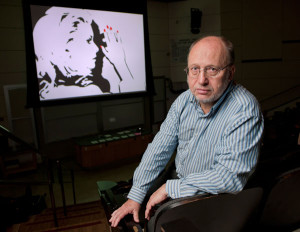
I didn’t know Umberto Eco, and I read Name of the Rose so many years ago that I had nothing to add to the news of his death on Feb. 19. One friend did, however: Stanford’s Jean-Marie Apostolidès posted his memories of the great Italian author in a short Facebook post. With his permission, I repost a translation of his single encounter with the maestro:

Remembrances of an intimate dinner party in Cambridge, Massachusetts, in 1984 (if memory serves me). Those present included the great American logician Willard Quine; Umberto Eco, wreathed in the glory of his novel The Name of the Rose, which had just appeared in English; and yours truly, the youngest of the table.

Eco

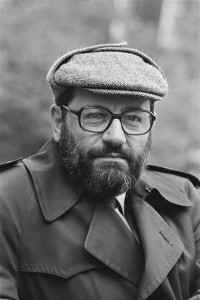
Maestro (Photo: Rob Bogaerts, Creative Commons)

All three of us were invited by Dante Della Terza, who taught Italian literature at Harvard for many years. Dante and Umberto had known each other for ages, hence the casual nature of the dinner. Dante’s wife had concocted her best Italian specialties, accompanied by a Montepulciano wine, which I will say more about. This friendly communion allowed us to reconstruct the world on a new basis, no doubt we were a little shameless.The four men were, after dining, a little tipsy, treated like pashas by the only woman in attendance that evening. Dante’s wife had indeed spent most of her time at the stove, and I do not believe in our project, changing the status of women had been on our agenda: we were too happy with the situation as it was!

To give our drinking a little intellectual cast, I proposed to my comrades that we compile a list of the ten most important philosophers in the history of thought, those that allowed us to make today’s world a little better. Each had to list their personal choices before we arrived at a common list. Mrs. Della Terza passed pen and paper to each of us. A silence of three or four minutes fell upon the table, despite the grappa that crowned the feast and redoubled our jokes. And then each in turn read his list.

Dante Della Terza

The host for the evening

But when the time came to make the collective list, we were unable to come to agreement, our choices so diverged. Umberto and I had quite a few names in common (Aristotle among the ancients, among modern Nietzsche) but Quine – who had the most clout as an authority in philosophy – brutally rejected all our proposals. A reserved man when sober, the wine had worked wickedly on him. When I advanced the name of Marx, he had a sarcastic smile, then said dismissively: “For me, he’s not even a philosopher.”

When Quine had asked Umberto to read us his own personal list, I discovered the logical basis for my ignorance: with the exception of Henri Poincaré, I did not know any of the thinkers he considered essential for the future of thought.

quine

The great logician

In short, our attempt to improve the world failed miserably. Yet were we not, all four of us, great enlightened ones? This failure did not prevent us from finishing off the evening in good spirits and, with the help of the grappa, we were all perfectly happy and pleased with ourselves when leaving the Della Terza home.

Today when I think back to that memorable evening, I regret not having taken note of names we had chosen. I particularly regret that we, the sage ones, could not come to agreement. If we had, might today’s world be in better shape?

Werner Herzog @Stanford: The Movie!

February 19th, 2016
Share
Legendary film director Werner Herzog discusses J.A. Baker's book The Peregrine at the Feb. 2 Another Look book club event.

Legendary filmmaker Werner Herzog makes a point. (Photo: L.A. Cicero/Stanford News Service)

Those of you who follow the Book Haven know that we’ve been somewhat preoccupied with legendary filmmaker Werner Herzog, who visited Stanford on February 2 to discuss J.A. BakerThe PeregrineThe discussion ranged far beyond the book, to embrace Virgil’s Georgics, the 16th century Florentine Codex (originally in Nahuatl), the Edda, his films and his views on reading and filmmaking – well, he’s a force of nature. It’s all now available on youtube, in a full-length version (here) and a quick, two-minute highlights version (here). Or see below for both: short version on top, the full hour-and-a-half below (it’s worth the time, really).

Legendary film director Werner Herzog discusses J.A. Baker's book The Peregrine with Robert Pogue Harrison, a Stanford professor of Italian literature, at the Feb. 2 Another Look book club event.

A sublime pairing. (Photo: L.A. Cicero)

The event was part of the ongoing Another Look book club series of events – Another Look’s director, Robert Pogue Harrison, a regular contributor to the New York Review of Books and host for the popular Entitled Opinions radio talk show, was the interlocutor for the discussion (we’ve written about him here and here and here, among many other places). In fact, the encounter was born in a friendship – but not with Werner, at least not initially. Robert met and interviewed Lena Herzog for the April 17, 2013 interview with Entitled Opinions about her photography (download Robert’s interviews, including that one, here).

The Another Look event was covered by columnist Caille Millner in “When Werner Herzog Came to Stanford” in the San Francisco Chronicle (here). An excerpt:

Herzog, 73, is legendary for many reasons: his passion, his punishing film sets, his contempt for personal comforts, his aversion to the contemporary gadgets that rule our lives (he grew up in a remote Bavarian village without running water or flush toilets) and, above all, for his absolute independence from Hollywood filmmaking

I was curious about how this remarkable man would fit into Silicon Valley for an evening. What’s an on-demand app to someone who didn’t make his first phone call until he was 17 years old?

It tells you something about Herzog that the reason he drove up to Stanford from Los Angeles was to talk about a little-known, long-out-of-print book about a man and a falcon: “The Peregrine,” by British author J.A. Baker (it’s been lovingly reissued by the New York Review of Books Classics imprint).

Legendary film director Werner Herzog discusses J.A. Baker's book The Peregrine at the Feb. 2 Another Look book club event.

A genial superstar. (Photo: L.A. Cicero)

She writes with style and brio, but I don’t agree with her when she dismissed the textual difficulties behind The Peregrine (as did Herzog). The issues of accuracy aren’t occasional and trivial, but pervasive and woven into the book, whose author insists on its authority as a work of direct observation. A small team of us, including an expert falconer, spent a good deal of time chewing over the magnificent text and its discrepancies – some of the issues are summarized briefly here. I even retrieved some of the letters of renowned falconer Dick Treleaven to Baker, which are now at the University of Essex (covered here), as we attempted to square Baker’s observations with reality. Robert, who wrestled even more deeply with these issues than the rest of us, had some very insightful things to say on the subject, but the onstage conversation veered off in another direction. The Peregrine is undeniably a masterpiece, but it raises questions about artistic truth, “real” truth, and what, exactly, Baker was doing. Robert’s remarks about Jimi Hendrix in the full-length video gives a hint of where his thoughts were taking him as he pondered this mysterious book. I’m convinced that these issues make the book more, not less, interesting, and raise fascinating questions about the process of creation.

One of my strongest memories of the evening, however, occurred after the conversation was over. I was the assigned person to whisk the genial superstar away to the back door and the car that was waiting for him there. He would have none of it. He wanted to shake hands and greet everyone who had come to see him. He was smiling and laughing as the crowd swarmed him. Impossible to pull him away. Who would want to?


<<< Previous Series of PostssepNext Series of Posts >>>