How the Chinese built the railroads

November 12th, 2015
Share

When I spoke to Shelley Fisher Fishkin a few days ago (we’ve written about her here and here and here), she waxed enthusiastic about the current exhibition featuring the photographs of Beijing-based photographer and computer engineer Li Ju. Shelley is one of the scholars working on the Chinese Railroad Workers in North America Project – a Chinese-American collaboration that is one of the more exciting projects afoot at Stanford. From the website: “Between 1865 and 1869, thousands of Chinese migrants toiled at a grueling pace and in perilous working conditions to help construct America’s first Transcontinental Railroad. The Chinese Railroad Workers in North America Project seeks to give a voice to the Chinese migrants whose labor on the Transcontinental Railroad helped to shape the physical and social landscape of the American West. The Project coordinates research in North America and Asia in order to create an on-line digital archive available to all, along with books, digital visualizations, conferences and public events.” And, as the poster below notes, the railroads are how Leland Stanford built the fortune that eventually created Stanford in the first place.

The exhibition started a few days ago, and continues through next Wednesday, November 18, at the Packard Electrical Engineering Building. And if you haven’t heard about the project – a short video below. Shelley is in it.

chineserr

Happy birthday to Oliver Goldsmith and William Hogarth! A few words from poet Tim Steele on the occasion.

November 10th, 2015
Share
tim120

Birthday boy.

More birthday news comes to us via our learned friend, the Los Angeles poet Timothy Steele, this time on the double birthday today of poet Oliver Goldsmith and painter William Hogarth. He enjoined us to celebrate Virgil’s 2,085 a few weeks ago. Here’s what he has to say on today’s occasion:

Other poets may have been more celebrated for their art and scope, but none was more trusted, as Samuel Johnson noted, than Oliver Goldsmith, whose birthday is today. Though Goldsmith repeatedly burned through large sums of money, friends and associates rarely failed to advance him funds whenever he requested loans. As a result, he died £2,000 in debt, a remarkable figure for somebody of his era and modest background.

hogarth

Still stooping to folly, all these years later.

Paradoxically, he wrote acutely about economics, and historians of that subject still cite the lines in “The Traveller” about income inequality (“should one order disproportion’d grow, / Its double weight must ruin all below”) and the passage in “The Deserted Village” about the effect of land enclosures on small farmers (“Ill fares the land, to hast’ning ills a prey, / Where wealth accumulates, and men decay,” etc.). Goldsmith’s lyric poems include Olivia’s song from “The Vicar of Wakefield:

When lovely woman stoops to folly,
And finds too late that men betray,
What charm can soothe her melancholy,
What art can wash her guilt away?

The only art her guilt to cover,
To hide her shame from every eye,
And give repentance to her lover,
And wring his bosom—is to die.

At right is “After the Seduction,” a painting by William Hogarth, another great eighteenth-century satirist whose birthday is today.

René Girard’s last laugh

November 9th, 2015
Share

rene-girardThe renowned French theorist René Girard, died last Wednesday. He was a personal friend and subject of my forthcoming biography with Michigan State University Press. It’s not easy to convey the pleasure of his company, and why it was so easy to spend hours talking to him, but this short video just about does it.

Many thanks to Artur Sebastian Rosman, for bringing it to my attention. And to Daniel Lance, for making the 2009 video in the first place.

René Girard – the Last laugh on Establishment / le dernier rire de René Girard from daniel lance on Vimeo.

Eminent French theorist René Girard, member of the Académie Française, dies at 91

November 5th, 2015
Share

girard4

At his home in 2008. (Photo: L.A. Cicero)

René Girard was one of the leading thinkers of our era – a provocative sage who bypassed prevailing orthodoxies and “isms” to offer a bold, sweeping vision of human nature, human history and human destiny.

French theorist René Girard was one of the leading thinkers of our era, a faculty member at Stanford since 1981 and one of the immortels of the Académie Française, died at his Stanford home on Nov. 4 at the age of 91, after long illness.

Fellow immortel and Stanford Professor Michel Serres once dubbed him “the new Darwin of the human sciences.” The author who began as a literary theorist was fascinated by everything. History, anthropology, sociology, philosophy, religion, psychology and theology all figured in his oeuvre.hollande

In particular, Girard was interested in the causes of conflict and violence and the role of imitation in human behavior. Our desires, he wrote, are not our own; we want what others want. These duplicated desires lead to rivalry and violence. He argued that human conflict was not caused by our differences, but rather by our sameness. Individuals and societies offload blame and culpability onto an outsider, a scapegoat, whose elimination reconciles antagonists and restores unity.

According to author Robert Pogue Harrison, the Rosina Pierotti Professor in Italian Literature at Stanford, Girard’s legacy was “not just to his own autonomous field – but to a continuing human truth.”

“I’ve said this for years: The best analogy for what René represents in anthropology and sociology is Heinrich Schliemann, who took Homer under his arm and discovered Troy,” said Harrison, recalling that Girard formed many of his controversial conclusions by a close reading of literary, historical and other texts. “René had the same blind faith that the literary text held the literal truth. Like Schliemann, his major discovery was excoriated for using the wrong methods. Academic disciplines are more committed to methodology than truth.”

Girard was always a striking and immediately recognizable presence on the Stanford campus, with his deep-set eyes, leonine head and shock of silver hair. His effect on others could be galvanizing. William Johnsen, editor of a series of books by and about Girard from Michigan State University Press, once described his first encounter with Girard as “a 110-volt appliance being plugged into a 220-volt outlet.”

An immortel in 2005

An immortel in 2005

Girard’s first book, Deceit, Desire and the Novel (1961 in French; 1965 in English), used Cervantes, Stendhal, Proust and Dostoevsky as case studies to develop his theory of mimesis. The Guardian recently compared the book to “putting on a pair of glasses and seeing the world come into focus. At its heart is an idea so simple, and yet so fundamental, that it seems incredible that no one had articulated it before.”

The work had an even bigger impact on Girard himself: He underwent a conversion, akin to the protagonists in the books he had cited. “People are against my theory, because it is at the same time an avant-garde and a Christian theory,” he said in 2009. “The avant-garde people are anti-Christian, and many of the Christians are anti-avant-garde. Even the Christians have been very distrustful of me.”

Girard took the criticism in stride: “Theories are expendable,” he said in 1981. “They should be criticized. When people tell me my work is too systematic, I say, ‘I make it as systematic as possible for you to be able to prove it wrong.'”

In 1972, he spurred international controversy with Violence and the Sacred (1977 in English), which explored the role of archaic religions in suppressing social violence through scapegoating and sacrifice.

rene-girardThings Hidden Since the Foundation of the World (1978 in French; 1987 in English), according to its publisher, Stanford University Press, was “the single fullest summation of Girard’s ideas to date, the book by which they will stand or fall.” He offered Christianity as a solution to mimetic rivalry, and challenged Freud’s Totem and Taboo.

He was the author of nearly 30 books, which have been widely translated, including The Scapegoat, I Saw Satan Fall Like Lightning, To Double Business Bound, Oedipus Unbound and A Theater of Envy: William Shakespeare.

His last major work was 2007’s
Achever Clausewitz (published in English as Battling to the EndPolitics, War, and Apocalypse), which created the kind of firestorm only a public intellectual in France can ignite. French President Nicolas Sarkozy cited his words, and reporters trekked to Girard’s Paris doorstep daily. The book, which takes as its point of departure the Prussian military historian and theorist Carl von Clausewitz, had implications that placed Girard firmly in the 21st century.

A French public intellectual in America

René Noël Théophile Girard was born in Avignon on Christmas Day, 1923.

His father was curator of Avignon’s Musée Calvet and later the city’s Palais des Papes, France’s biggest medieval fortress and the pontifical residence during the Avignon papacy. Girard followed in his footsteps at l’École des Chartes, a training ground for archivists and librarians, with a dissertation on marriage and private life in 15th-century Avignon. He graduated as an archiviste-paléographe in 1947.

In the summer of 1947, he and a friend organized an exhibition of paintings at the Palais des Papes, under the guidance of Paris art impresario Christian Zervos. Girard rubbed elbows with Picasso, Matisse, Braque and other luminaries. French actor and director Jean Vilar founded the theater component of the festival, which became the celebrated annual Avignon Festival.

Girard left a few weeks later for Indiana University in Bloomington, perhaps the single most important decision of his life, to launch his academic career. He received his PhD in 1950 with a dissertation on “American Opinion on France, 1940-43.”

“René would never have experienced such a career in France,” said Benoît Chantre, president of Paris’ Association Recherches Mimétiques, one of the organizations that have formed around Girard’s work. “Such a free work could indeed only appear in America. That is why René is, like Tocqueville, a great French thinker and a great French moralist who could yet nowhere exist but in the United States. René ‘discovered America’ in every sense of the word: He made the United States his second country, he made there fundamental discoveries, he is a pure ‘product’ of the Franco-American relationship, he finally revealed the face of an universal – and not an imperial – America.”

At Johns Hopkins University, Girard was one of the organizers for the 1966 conference that introduced French theory and structuralism to America. Lucien Goldmann, Roland Barthes, Jacques Lacan and Jacques Derrida also participated in the standing-room-only event. Girard quipped that he was “bringing la peste to the United States.”

Girard had also been on the faculties at Bryn Mawr, Duke and the State University of New York at Buffalo before he came to Stanford as the inaugural Andrew B. Hammond Professor in French Language, Literature and Civilization in 1981.

Girard was a fellow of the American Academy of Arts and Sciences and twice a Guggenheim Fellow. He was elected to the Académie Française in 2005, an honor previously given to Voltaire, Jean Racine and Victor Hugo. He also received a lifetime achievement award from the Modern Language Association in 2009. In 2013, King Juan Carlos of Spain awarded him the Order of Isabella the Catholic, a Spanish civil order bestowed for his “profound attachment” to “Spanish culture as a whole.” He was also a Chevalier de la Légion d’honneur and Commandeur des Arts et des Lettres.

Others were impressed, but Girard was never greatly impressed with himself, though his biting wit sometimes rankled critics. Stanford’s Hans Ulrich Gumbrecht, the Albert Guérard Professor in Literature, called him “a great, towering figure – no ostentatiousness.” He added, “It’s not that he’s living his theory – yet there is something of his personality, intellectual behavior and style that goes with his work. I find that very beautiful.

“Despite the intellectual structures built around him, he’s a solitaire. His work has a steel-like quality – strong, contoured, clear. It’s like a rock. It will be there and it will last.”

Girard is survived by his wife of 64 years, Martha, of Stanford; two sons, Daniel, of Hillsborough, California, and Martin, of Seattle; a daughter, Mary Girard Brown, of Newark, California; and nine grandchildren.

A memorial service will be held Tuesday, Jan. 19, 2016, at 2 p.m. in Stanford Memorial Church.

This article can also be read on the Stanford News website here. [My biography of René Girard will be published next year by Michigan State University Press. – C.H.]


Having trouble writing that resumé? Here’s a few tips from Leonardo da Vinci!

November 4th, 2015
Share

DaVinciResume

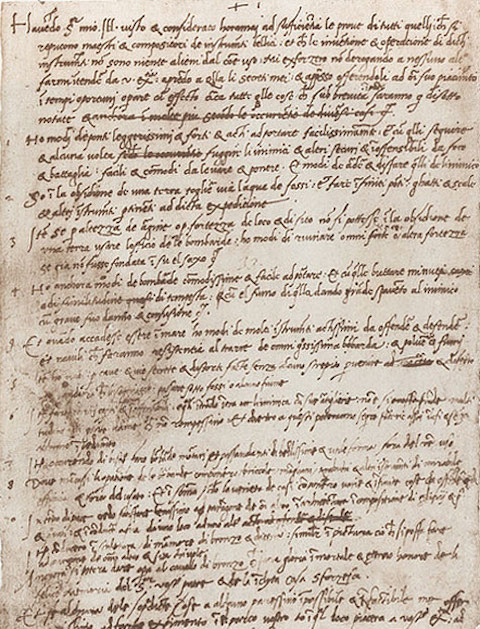
Lots of online websites have tips for writing the perfect resumé, but where better to go than to the top? Who could give better advice than polymathic genius Leonardo da Vinci, who was successful in finding free-lance gigs of various kinds throughout his life? Thanks to Open Culture, we have Leonardo’s own C.V., which he used to finagle a job in the weapons-of-war industry, a sideline between The Baptism of Christ and the Last Supper.

“Before he was famous, before he painted the Mona Lisa and the Last Supper, before he invented the helicopter, before he drew the most famous image of man, before he was all of these things, Leonardo da Vinci was an artificer, an armorer, a maker of things that go ‘boom,’” writes Marc Cendella on his blog about job-searching. “Like you, he had to put together a resumé to get his next gig. So in 1482, at the age of 30, he wrote out a letter and a list of his capabilities and sent it off to Ludovico il Moro, Duke of Milan.”

leonardo-da-vincis-machine-gun

His machine gun.

Note bene: he does not list everything he has done for the last umpteen years; he only discusses what is most relevant to the job in question. While he first describes his ability to devise weapons to burn and destroy, he also brings up, almost parenthetically, his skills in sculpture and painting in #11. You see, he thinks of the needs of his employer, and how he can solve the problems of his boss and benefit the company as a whole. He doesn’t view the resumé simply as an opportunity to brag about himself. (Although he has handwritten his resumé beautifully, we do not recommend this!)

The proof of his success is that he got the job and went off to Milan. He was so successful that a few years later he was put in charge of orchestrating Ludovico’s wedding to Beatrice d’Este, so his life wasn’t all about things that go bang. As every free-lancer knows, you can’t always do what you want to do. As a result of his relocation, his masterpiece, the Adoration of the Magi, a commission from the Monks of San Donato a Scopeto, was never finished.

Here’s what he has to say in the C.V., which doubles as a cover letter as well:

Most Illustrious Lord, Having now sufficiently considered the specimens of all those who proclaim themselves skilled contrivers of instruments of war, and that the invention and operation of the said instruments are nothing different from those in common use: I shall endeavor, without prejudice to any one else, to explain myself to your Excellency, showing your Lordship my secret, and then offering them to your best pleasure and approbation to work with effect at opportune moments on all those things which, in part, shall be briefly noted below.

leonardo-da-vincis-crossbow

His cross-bow.

1. I have a sort of extremely light and strong bridges, adapted to be most easily carried, and with them you may pursue, and at any time flee from the enemy; and others, secure and indestructible by fire and battle, easy and convenient to lift and place. Also methods of burning and destroying those of the enemy.

2. I know how, when a place is besieged, to take the water out of the trenches, and make endless variety of bridges, and covered ways and ladders, and other machines pertaining to such expeditions.

3. If, by reason of the height of the banks, or the strength of the place and its position, it is impossible, when besieging a place, to avail oneself of the plan of bombardment, I have methods for destroying every rock or other fortress, even if it were founded on a rock, etc.

4. Again, I have kinds of mortars; most convenient and easy to carry; and with these I can fling small stones almost resembling a storm; and with the smoke of these cause great terror to the enemy, to his great detriment and confusion.

5. And if the fight should be at sea I have kinds of many machines most efficient for offense and defense; and vessels which will resist the attack of the largest guns and powder and fumes.

6. I have means by secret and tortuous mines and ways, made without noise, to reach a designated spot, even if it were needed to pass under a trench or a river.

Adorazione_dei_Magi_-_Google_Art_Project

I’d rather have this, ta very much.

7. I will make covered chariots, safe and unattackable, which, entering among the enemy with their artillery, there is no body of men so great but they would break them. And behind these, infantry could follow quite unhurt and without any hindrance.

8. In case of need I will make big guns, mortars, and light ordnance of fine and useful forms, out of the common type.

9. Where the operation of bombardment might fail, I would contrive catapults, mangonels, trabocchi, and other machines of marvelous efficacy and not in common use. And in short, according to the variety of cases, I can contrive various and endless means of offense and defense.

10. In times of peace I believe I can give perfect satisfaction and to the equal of any other in architecture and the composition of buildings public and private; and in guiding water from one place to another.

11. I can carry out sculpture in marble, bronze, or clay, and also I can do in painting whatever may be done, as well as any other, be he who he may.

Again, the bronze horse may be taken in hand, which is to be to the immortal glory and eternal honor of the prince your father of happy memory, and of the illustrious house of Sforza.

And if any of the above-named things seem to anyone to be impossible or not feasible, I am most ready to make the experiment in your park, or in whatever place may please your Excellency – to whom I comment myself with the utmost humility, etc.

“Mark, learn, and inwardly digest,” as another genius once said.

Farewell to Stanford’s “How I Write” – and hello to Hilton’s new book!

November 1st, 2015
Share

hilt&charlie

Teamwork: Charlie Junkerman and Hilton Obenzinger

It’s a cliché that all good things come to an end, but stoicism was little consolation for the 40 or 50 of us who came to bid farewell to the “How I Write” series that has been part of Stanford life for more than a dozen years. The series of public conversations has been ably and amiably hosted by Hilton Obenzinger, under the aegis of Continuing Studies.

Here’s a few things that were consolations: the send-off party at the Stanford Faculty Club was celebrated with good food and good company. And here’s the best part: Hilton has made the 13-year series into a 262-page book, How We Write: The Varieties of Writing Experienceavailable on Amazon here. The book is dedicated to the late Diane Middlebrook. Hence, last week’s event was a fête for the new book, though tinged with a little sadness, too.

Charlie Junkerman, the dean of Continuing Studies, called the book “a portable condensation of all those conversations” and “the right capstone to this project of many many years.” Noting Hilton’s ventures in fiction, poetry, history, and criticism, he added that “he hasn’t written a cookbook so far, but that may be coming.”

What did Hilton learn from this long venture? “People are weird and they work in all kinds of strange ways.” He remembered the author who required his “writing sweater” to write. He spoke with award-winning Irish poet and essayist Eavan Boland, who likes writing code and reading tech magazines, while engineer Eric Roberts, author of Programming Abstractions in C, has no TV and surrounds himself with books, not tech toys.

As Tom Winterbottom writes in his discussion of the book here:

Who knew that the renowned Stanford literary critic Terry Castle wrote the entire first draft of her dissertation in tiny handwriting on just seven sheets of legal-sized paper?

Or that the acclaimed author and Stanford professor Adam Johnson learned the craft of storytelling at a young age in part by rifling through his neighbors’ garbage cans for inspiration?

Amusing, yes, but anecdotes give little sense of the grueling process of writing itself, or the perils of publication. The longed-for moment when you see your book in publication can bring as much rue as reward:

When you read your own work as something fresh, something strange, it can be very exciting – especially if there’s time to make revisions. But then, once published, you almost inevitably discover typos, mistakes, and causes for regret and even remorse. As in a lover’s quarrel, sometimes we wish we could take the words back. But it’s almost never possible. …

obenzingerMost of the time the ill-chosen words hang there; if you’re lucky, no one reads them and they turn to dust. But sometimes the words act and cause actions, as words do, and some readers may be led down the wrong path or may have terrible thoughts planted in their brains. So far I haven’t disowned any of my own writing, although I often cringe at how infantile, wrong-headed, or tone-deaf some passage may be.

I certainly can’t disavow my typos. No matter how much the copy editor and I comb the text, at least one goof will slip right through the galleys. For some reason there’s an article repeated or a word misspelled or worse. Yet I’ve come to terms with the stray typo, because the error demonstrates that the work is not perfect, the text is always contingent, always transient, a ‘draft of a draft,’ as Herman Melville‘s Ishmael describes Moby-Dick. …

But shame, failure, despair, utter horror, these are all stations on the journey, even after completing a ‘draft of a draft.’ …

“Where’s the quote from?” several of the guests called out when he was finished reading. “Me!” beamed Hilton. It was his own. It’s in his book. You can buy it here. (And you can read a little more about it here.)


<<< Previous Series of PostssepNext Series of Posts >>>