Have a scapegoat for Thanksgiving! “It’s a ritual sacrifice, with pie.”

November 25th, 2015

Share
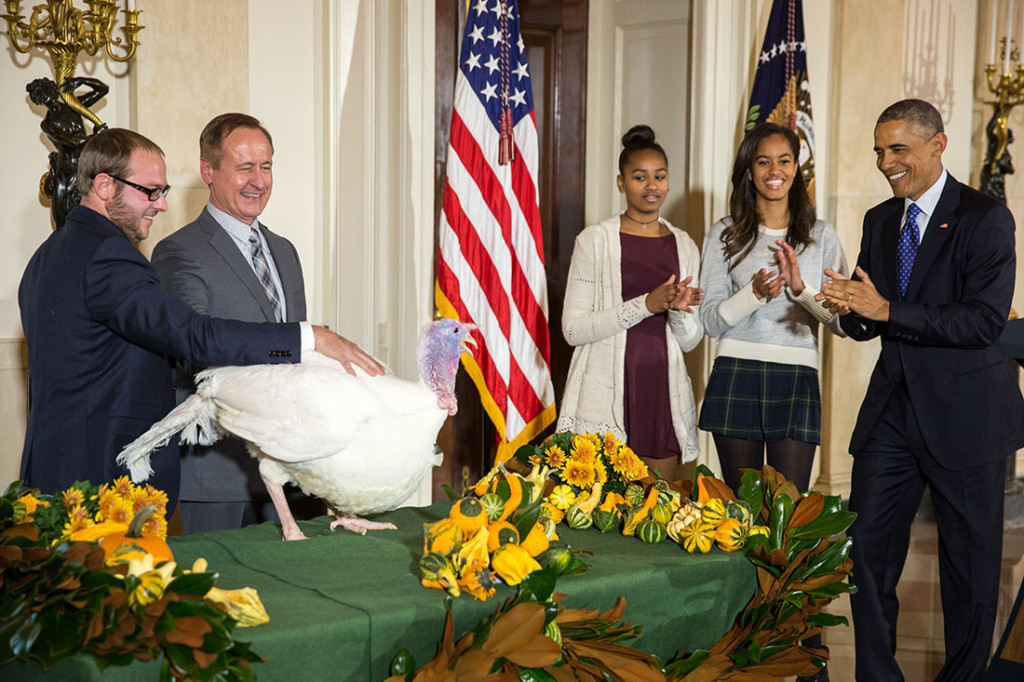
President Barack Obama, National Turkey Federation Chairman Gary Cooper; and son Cole Cooper participate in the annual National Thanksgiving Turkey pardon ceremony in the Grand Foyer of the White House, Nov. 26, 2014. (Official White House Photo by Chuck Kennedy)

President Obama, National Turkey Federation’s Gary Cooper, and Cole Cooper in last year’s “pardon” at the White House. (Official White House Photo by Chuck Kennedy)

I’ve always been ashamed of the annual White House ritual: the turkey pardoned for a crime it did not commit. Mock laughter accompanies the mock crime. Meanwhile, while thousands upon thousands of other helpless animals are slaughtered across the nation. 

All across America, fractious families unite for the day over the real carcass of a dead bird – it is the very symbol of a national and familial unity. Is the Thanksgiving turkey a classic scapegoat? I figured I couldn’t be alone in my hunch, and I wasn’t. René Girard, who died earlier this month, is much on my mind this Thanksgiving, and he helps us get a handle on the strange ceremony, with a little help from his friends:

truman-turkey

Harry Truman started it in 1947.

Karen Davis writes in More Than a Meal: The Turkey in History, Myth, Ritual, and Reality (Lantern Books, 2001):

“The idea of a Thanksgiving turkey as a scapegoat may seem like a parody of scapegoating, but what is the scapegoat phenomenon but a parody of reason and justice? The scapegoat, after all, is a goat. Animals have been scapegoats in storytelling, myth, and history every bit as much as humans and probably more, as the scholar of myth and ritual, René Girard observes in Violent Origins: Ritual Killing and Cultural Formation (Stanford University Press, 1988). Social animals especially have been scapegoated since time immemorial. ‘[I]n all parts of the world,’ Girard says, ‘animals living in herds, schools, packs – all animals with gregarious habits, even if completely harmless to each other and to man,’ have been vilified.

“This is not simply a matter of other cultures and ancient history. Evans shows how the belief that ‘everything must be “well-thought, well-said and well-done,” not ethically, but ritually, contributed to the fact that until quite recently, European societies hauled birds and other creatures before the bar in legal ceremonies as absurd as any scene in Dickens. ‘[E]xtending from the beginning of the twelfth to the middle of the eighteenth century,’ he tells us, the culprits were ‘a miscellaneous crew, consisting chiefly of caterpillars, flies, locusts, leeches, snails, slugs, worms, weevils, rats, mice, moles, turtle-doves, pigs, bulls, cows, cocks, dogs, asses, mules, mares and goats.”

Jared Christman explores another angle of the ritual, writing in Grave Pawns: Civilization’s Animal Victims: “The pardon therefore performs the same basic function as the scapegoating sacrifice theorized by Girard in Violence and the Sacred, although instead of one special victim being scapegoated, every animal except for one special non-victim is scapegoated.”
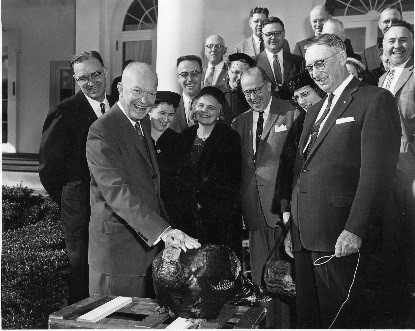
eisenhower-turkey

Eisenhower kept it up.

“Around the Thanksgiving table, the cultural relations of the nation merge with the blood relations of the family. Through the carcass of the sacrificial victim, the family becomes a microcosm of the nation and the nation becomes a macrocosm of the family. The size of the culinary victim is key: the entire turkey can be dismembered and consumed at a household gathering. This creates a ritual symmetry between the dimensions of the victim’s body and the dimensions of the cultural building block of the family. …

“This sovereign ‘pardon’ of a token animal has become ritually necessary because the industrialized scale of Thanksgiving creates a pressing need for expiation and the shifting of blame from the victimizers to the victims. Against the holiday’s backdrop of rampant factory farming, the pardon of the “innocent” bird scapegoats every other “criminal” turkey for advanced civilization’s sins against nature. …

“With each passing year, the comforting illusions of the Thanksgiving feast, its New World mythology, conceal less and less the industrialized context of the sacrament. Any serious pretense of the new Eden is long gone. The bird upon today’s Thanksgiving table is a bloated, assembly-line caricature of the wild turkey of the 17th-century American woods. Of soupcourse, even the mythology of the original Thanksgiving of the Plymouth pilgrims was a bright shining lie. The cagier fowl of yesteryear’s table was the victim of a ritual protocol of nation-building about as new as the Old World hills.”

Well, there you have it. History has it that the real Thanksgiving was celebrated in St. Augustine, Florida, some years earlier in 1565, when the Spaniards shared a communal meal with the local Timucuans. What was on the menu? Bean soup. Read about it here.

Update: NPR is onto the story here.

Update on 11/20/18: A comment from George Dunn: “It’s a ritual sacrifice, with pie.” ~ Anya on Buffy the Vampire Slayer

The Holocaust: what was it like for the kids in hiding?

November 23rd, 2015
Share

safest-lieA promise is a promise. We don’t usually do “young adult” fiction here at the Book Haven, but in this case I make an exception – a duty as well as a pleasure. Seven years ago, over bronowicka wegetariań„ska and some very good wine and vodka at Pod Baranem in Kraków (I later learned it was one of Czesław Miłosz‘s favorite restaurants in that wondrous city),  I heard the story of Irena Sendler, who had died a few months before in 2008. It was an extraordinary tale told late in the evening by her friend and Holocaust survivor Lili Pohlmann of the city’s Judaica Foundation.
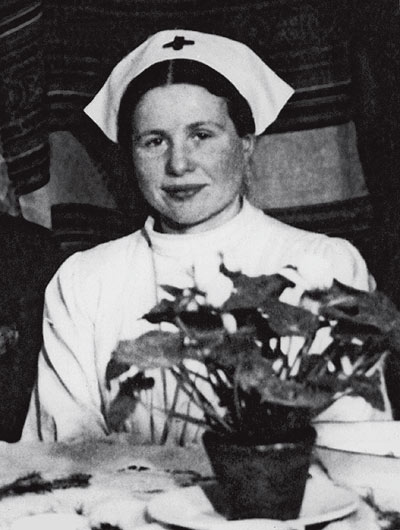
Now the story is well known, but back then it wasn’t. I was skeptical of Lili’s claims of her close friend who had saved thousands of Jewish children from the Warsaw Ghetto. Why had I never heard of her? I went back to my Kraków apartment and googled, and confirmed Lili’s account – since Sendler was a Polish patriot, the Soviet authorities had had an interest in suppressing the story, which became known only after 1989. I resolved pretty much then and there to do what I could to share the history, as I have done here and here and here and here and here, and a few other places as well. So how could a not cover Angela Cerrito‘s well-researched The Safest Lie when the publisher, New York’s Holiday House, sent it to me?

The fictional story is told from the point of view of one of Sendler’s hidden children, nine-year-old Anna Bauman. When she hears her new, assigned name, Anna Karlowska, she says, “The words are heavy and far away, like a stone thrown so far out into the lake that it is impossible to hear the splash.”

Sendler herself makes two brief appearances in the book under the code name she used, “Jolanta.” Her first when she makes arrangements to rescue Anna from the Warsaw Ghetto. Sendler said that, for each child saved, she needed a team of 25: 10 to smuggle children out, 10 to find families to take the children, and 5 to get false documents.The second encounter occurs when Anna is in hiding at a convent school – Sendler said not a single convent had refused to shelter a child.

In The Safest Lie, the fictional Anna overhears a conversation of an unknown woman with Sister Maria:

As I dust the first windowsill, I hear Sister Maria’s conversation through her open door.

“We heard of your capture. We even received news of your death.”

irena-sendler1

To honor her.

“In these times, one doesn’t know what to believe,” answers a woman. The voice is decisive, but so low. Someone used to talking in whispers. It’s low and rumbly, but strong. I try to slow my breathing and quiet my heart so I can hear properly. I know that voice! Jolanta? My heart drums in my ears. Could it be? 

“Perhaps the news you heard was true. Today I am Mrs. Dabrowska. Tomorrow perhaps another name. We try to be safe, though we know safety isn’t always possible.”

Oh how I wish I could run into Sister Maria’s office. I want to ask Jolanta a million questions. … Outside the door, I hear Sister Maria say, “Fifteen will help a great deal.”

“Tomorrow then,” says Mrs. Dabrowska, who sounds just like Jolanta.

I walk into the office and set my cloth on Sister Maria’s desk. I study the woman. Her hair is not like Jolanta’s, and something is different about the face. Could it really be her? The woman smiles at me. I’ve never seen Jolanta smile. “And how are you today?” She places a hand on my arm.

“Very well, thank you,” I say. The hand doesn’t feel familiar, but the woman’s yes do. Does she know me?

“Anna, please excuse us,” says Sister Maria.

I leave the room and wait at the end of the hall by the statue of Mother Maria. I pray again. Should I speak with her? Should I ask if she’s Jolanta? I wait until the lady leaves Sister Maria’s office. When I see her walking away, I decide it can’t be Jolanta. The woman drags her left leg. It looks like every step causes her pain. Not at all like Jolanta, who took short, speedy steps.

Irena Sendler had been captured, tortured, and sentenced to a firing squad by the Germans in 1943. Although they had broken her feet and legs, she escaped. She lived until April 2008.

Anyway, it’s a gift idea for the coming month. It’s a fast-paced, moving 181 pages. I had trouble putting it down.

Adam Johnson gets National Book Award – and boy, was he surprised!

November 19th, 2015
Share
adamjohn

He told his family to stay home.

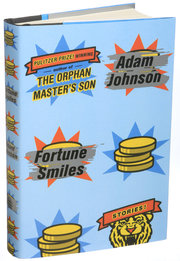
Short story collections don’t often win a National Book Award, but one did last night – and we couldn’t be more delighted that it did. Pulitzer prizewinning Adam Johnson‘s Fortune Smiles was awarded the fiction prize. No one was more surprised that Adam himself. He was clearly not expecting to be on the stage Wednesday night.

“I told my wife and my kids, ‘Don’t come across America because this is not going to happen,’” he told the Los Angeles Times.

A short story collection won last year (Phil Klay’s Redeployment) and lightning doesn’t often strike the same place twice with the big-ticket literary award.

Adam won a Pulitzer for his Orphan Master’s Son, but he first came to critical notice with in the short story genre, one that he missed after working on his long novel about life in North Korea, which he called a drama with “one central character, and a supporting cast of 23 million” (read it here).

“I think the short story is a machine, and it has lots of gears that turn: Voice, style, architecture, chronology, scene selection,” Johnson said in a recent NPR interview. “I think they’re difficult, but they can be very perfect and powerful — I missed them, working on a novel for many years.”

When I first wrote about Adam six years ago here, he thought he would always be a niche artist:

fortune-smilesHe admitted that not everyone will be a fan of his “off-kilter, quirky humor.” When he sees furrowed brows and incomprehension at his readings, he thinks, “Don’t buy it! It’s not for you!”

He sees writers occupying more of a niche market, like magazines. No one insists, he pointed out, “You have to read the latest Cat Fancy – you’ll die if you don’t!”

Hence, while most authors dream of immortality, Johnson anticipates obscurity: “There will be no statues of Adam Johnson – I don’t think so,” he said, smiling slyly and sipping his iced coffee.

We’ll wait and see, Adam. We’ll wait and see.

Meanwhile, Ta-Nehisi Coates won the National Book Award for nonfiction for Between the World and Me, a visceral exploration about the experience of black men in America.

“Every day you turn on the TV and see some kind of violence being directed at black people,” Mr. Coates said in an emotional acceptance speech. “Over and over and over again. And it keeps happening.”

Read more about this year’s awards at the New York Times here.

Marcel Proust and “a world based on kindness, scrupulousness, self-sacrifice”

November 18th, 2015
Share
Vermeer

Vermeer’s “View of Delft”: “He took a turbulent reality, and made it look like Heaven on earth,” according to one art critic.

Los Angeles poet Timothy Steele offers a few words on one of the preeminent writers of France, ever:

tim120

Tim Steele

One of the literary greats of Paris and of the world, Marcel Proust died ninety-three years ago today. The many subjects he treats in In Search of Lost Time include mortality and the work of Johannes Vermeer, and the two come together in the scene of the novelist Bergotte’s death. Readers will remember that Bergotte, though gravely ill, goes to an art exhibition to see Vermeer’s “View of Delft,” which is on loan in Paris from the Maruitshuis museum in The Hague. Bergotte finds his way to the gallery in which the masterpiece hangs and focuses his admiration on “a little patch of yellow wall” in the painting. (Proust is perhaps referring to the wall on the far right side, or to the roof and wall just to the left of the double-turreted Rotterdam gate.) After reflecting that he should have written as Vermeer painted, layering his stories with color to give them greater warmth and depth, Bergotte sinks to a circular settee and suffers his fatal heart attack. Proust writes:

proust

Au revoir, Marcel.

“He was dead. Dead forever? Who can say? . . . All that we can say is that everything is arranged in this life as though we entered it carrying a burden of obligations contracted in a former life; there is no reason inherent in the conditions of life on this earth that can make us consider ourselves obliged to do good, to be kind and thoughtful, even to be polite, nor for an atheist artist to consider himself obliged to begin over again a score of times a piece of work the admiration aroused by which will matter little to his worm-eaten body, like the patch of yellow wall painted with so much skill and refinement by an artist destined to be forever unknown and barely identified under the name Vermeer. All these obligations, which have no sanction in our present life, seem to belong to a different world, a world based on kindness, scrupulousness, self-sacrifice, a world entirely different from this one and which we leave in order to be born on this earth, before perhaps returning there to live once again beneath the sway of those unknown laws which we obeyed because we bore their precepts in our hearts, not knowing whose hand had traced them there.”

– In Search of Lost Time, trans. C. K. Scott Moncrieff & Terence Kilmartin, vol. 5 (New York: Random House, 1993): 245-46.

Mozart and the intelligence of love

November 16th, 2015
Share
figaro

Opening night at the opera. (Photo: Elena Danielson)

Before I made the trek to Opera San Jose yesterday, a friend tipped me off that a line from Dante Alighieri opens one of the scenes in Wolfgang Amadeus Mozart‘s Marriage of Figaro (read about the production here). This perfectly cut diamond of an opera has sometimes been compared to the Italian poet’s masterpiece, The Divine Comedy; both oscillate between the highest and the lowest that the human species has to offer – from the supercelestial to the depraved. But did Mozart crib a line from Dante? Where?

He didn't mean to do it.

Did he crib from Dante?

Larry Hancock, the learned and amiable general director of the San Jose Opera, was equally mystified when I asked him at the Q&A session following his pre-show presentation. He told me to keep my ears open.

Well, an easy thing to do at an opera from one angle – but in the San Jose Opera’s excellent production, it was also easy to lose track of scholarship in the beauty of the music and the magic of this very well-matched cast of singers. There wasn’t a weak link in the long chain. So I forgot all about Dante.

By Act II, I was swept up in the Countess’s great self-pity aria (there’s always one in a Mozart opera), Susannah’s banter, and the smitten Cherubino as he began to sing the song he wrote for his Countess, Voi che sapete che cosa è amor. The supertitles rolled on the screen – “Ladies, you who know the intellect of love…,” or words to that effect. The text suddenly seemed very un-Mozartlike, and a frisson ran through me. I raised my pointed finger to the overhead screen in slow recognition, and it froze there in mid-air, till my discomfited companion jerked my hand down again.

Lorenzo_da_Ponte

Scandalous priest

I had been expecting a line from The Divine Comedy. Instead, of course, this is one of the most famous passages of La Vita Nuova, the work in which Dante describes his love for Beatrice Portinari, and his anguish at her death – as well a meditation on love as a transcendent force in our lives and as a poetic theme. “Ladies who have the intelligence of love,/I wish to speak to you about my lady…” (Donne ch’avete intelletto d’amore, i’ vo’ con voi de la mia donna dire…)

Not dead on, but close enough, and certainly an Italian audience would recognize the homage even faster than I did.

I found Larry in a hallway during the intermission. How did this Viennese composer come to utter the words of Dante? He probably didn’t, he said. He suggested I look instead to the famous librettist Lorenzo da Ponte, a dissolute priest banished from Venice who eventually took to the pen for his living. And aren’t we grateful he did? He was the most celebrated librettist of his time – and he certainly would have known his Dante well, even if he didn’t take the poet’s sterner admonitions to heart.

rene-girard

He got it right.

I highly recommend this Marriage of Figaro, which continues through November 29, so you can pay a visit over the Thanksgiving over the weekend.

It was my first time attending an opera in about a decade. What inspired me to accept an invitation several weeks ago, during a time of very intense deadlines? It was the first opera I had ever attended way back in 1978 London, at the English National Opera, so it strikes a deep chord in me. More importantly, however, I recalled that René Girard said, “The Marriage of Figaro is, for me, the most mystical of all music.” No doubt he was moved by its recurring themes of escalating vengeance, sublime forgiveness, and finally, peace and reconciliation.

Little did I know I would be attending it the day after his funeral, and two days after a massacre in France. Elijah Ho noted in the San Jose Mercury:

On Opera San Jose’s Saturday night opening performance of Mozart’s The Marriage of Figaro, French police stormed the Boulevard Beaumarchais of the 11th arrondissement in Paris, where but a few feet away, the Bataclan theater had become the site of unspeakable horrors. The boulevard, which leads directly to the Place de la Bastille, is named for the playwright on whose revolutionary work Mozart’s opera is based, one which prefigured the most famous storming in history. … In November 1963, Leonard Bernstein famously remarked after the assassination of President Kennedy: “This will be our reply to violence: to make music more intensely, more beautifully, more devotedly than ever before.”

René Girard on terrorism: “We have to radically change the way we think.” Have we?

November 14th, 2015
Share

parisToday is the funeral of René Girard, the renowned French theorist who taught us so much about violence (a larger memorial service will also be held in January at Stanford Memorial Church). It is also a day of national mourning in France, which yesterday suffered a terrorist attack of an unprecedented scale, the biggest attack on the nation since World War II. On the occasion of this atrocity, I am reprinting René’s prescient words from Battling to the End, which I had published on this blog after the Charlie Hebdo massacres of last January – the two events seem to be bookends of a very violent year.

Battling to the End was first published in Paris in 2007, long before the current cycle of events. Hence, he reflected on the devastation of September 11, 2001, but his suggestions are even more pertinent today, “as history has accelerated and politics has lost importance.” He called for a deeper understanding and a radical rethinking of our current assumptions, understandings, and strategies. “The work to be done is immense,” he wrote. Has that happened? I don’t think so. I reviewed this book for the San Francisco Chronicle here, and wrote an article about him here – which included part of the excerpt below. Requiescat in pace, René. We love you.

Atta, the leader of the September 11 group who piloted one of the two airplanes, was the son of a middle class Egyptian family. It is staggering to think that during the three last days before the attack, he spent his nights in bars with his accomplices. There is something mysterious and intriguing in this. Who asks about the souls of those men? Who were they and what were their motivations? What did Islam mean to them? What does it mean to kill themselves for the cause? The growing number of attacks in Iraq is impressive. I think it is strange that there is so little interest in the logic of these events, which dominate the world just as the Cold War once did. Since when? We are not really sure. No one could have imagined that we would be in this situation barely 20 years after the Berlin Wall fell. This disturbs our vision of history as it has been written since the American and French revolutions. Our vision of history does not take into account the fact that the entire West is challenged and threatened by this. We have to say “this” because we do not know what it is. …

girard4On September 11, people were shaken, but they quickly calmed down. There was a flash of awareness, which lasted a few fractions of a second. People could feel that something was happening. Then a blanket of silence covered up the crack in our certainty of safety. Western rationalism operates like a myth: we always work harder to avoid seeing the catastrophe. We neither can nor want to see violence as it is. The only way we will be able to meet the terrorist challenge is by radically changing the way we think. Yet the clearer it is what is happening, the stronger our refusal to acknowledge it. This historical configuration is so new that we do not know how to deal with it. It is precisely a modality of what Pascal saw: the war between violence and truth. Think about the inadequacy of our recent avant-gardes that preached the non-existence of the real. …

If we had said in the 1980s that Islamism would play the role it plays today, people would have thought we were crazy. Yet the ideology promoted by  already contained para-religious components that foreshadowed the increasingly radical contamination that has occurred over time. Europe was less malleable in Napoleons time. After Communism, its vulnerability has returned to that of a medieval village facing the Vikings. The Arab conquest was a shock, while the French Revolution was slowed by the nationalism that it provoked across Europe. In its first historical deployment, Islam conquered religiously. This was its strength and it also explains the solidity of its roots. The revolutionary impetus accelerated by the Napoleonic era was checked by the equilibrium among nations. However, nations became inflamed in turn, and destroyed the only possible means of stopping revolutions from happening.

We therefore have to radically change the way we think, and try to understand the situation without any presuppositions and using all the resources available from the study of Islam. The work to be done is immense. …

battling to end_webOf course, there is resentment in its attitude to Judeo-Christianity and the West, but it is also a new religion. This cannot be denied. Historians of religion, and even anthropologists, have to show how and why it emerged. Indeed, some aspects of this religion contain a relationship to violence that we do not understand and that are all the more worrying for that reason. For us, it makes no sense to be ready to pay with one’s life for the pleasure of seeing the other die. We do not know whether such phenomena belong to a special psychology or not. We are thus facing complete failure; we cannot talk about it and also we cannot document the situation because terrorism is something new that exploits Islamic codes, but does not at all belong to classical Islamic theory. Today’s terrorism is new, even from an Islamic point of view. It is a modern effort to counter the most powerful and refined tool of the Western world: technology. It counters technology in a way that we do not understand, and that classical Islam may not understand either.

Thus, it is not enough to simply condemn the attacks. The defensive thought by which we oppose the phenomenon does not necessarily embody a desire to understand. Often it even reveals a desire to not understand, or an intention to comfort oneself. Clausewitz is easier to integrate into a historical development. He gives us the intellectual tools to understand the violent escalation. However, where do we find such ideas in Islam? Modern resentment never leads all the way to suicide. Thus we do not have the analogical structures that could help us to understand. I am not saying that they are not possible, that they will not appear, but I admit my inability to grasp them. This is why our explanations often belong to the province of fraudulent propaganda against Muslims.


<<< Previous Series of PostssepNext Series of Posts >>>