Cracking the books with Wystan

September 5th, 2013
Share

auden-syllabus2

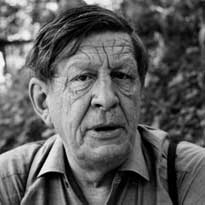
“What is this tattered sheet of paper?” you may ask.  It is reproof.  For somewhere in my garage, I have my very own copy of this syllabus, issued by W.H. Auden to his semester class on “Fate and the Individual in European Literature,” when he taught at my own alma mater, the University of Michigan, way back in 1941-42.  I asked for it a decade or two ago, and would have been the first to put it online had I not misplaced it.  Now it’s all over the internet – I knew the game was up when The Atlantic put it on tumblr a year ago.  In any case, it has influenced my life in strange ways.  For example, it’s the reason why Shakespeare‘s Henry V, Part 2, is the only work of literature on my Droid, besides the King James Bible.  I still have some catching up to do to finish the list.

auden

Cherce.

“What I find fascinating about the syllabus is how much it reflects Auden’s own overlapping interests in literature across genres – drama, lyric poetry, fiction – philosophy, and music,” Lisa Goldfarb, Associate Professor and Associate Dean at NYU’s Gallatin School, told the New York Daily News earlier this year. “He also includes so many of the figures he wrote about in his own prose and those to whom he refers in his poetry: especially “The Tempest” of Shakespeare; Kierkegaard, Baudelaire, Rimbaud, Melville, Rilke, as well as the opera libretti on the syllabus.

“By including such texts across disciplines – classical and moderliterature, philosophy, music,anthropology, criticism – Auden seems to have aimed to educate his students deeply and broadly.He probably would have enjoyed working with students on the texts he so dearly loved.”

Now it’s over at Flavorwire, along with the course instructions and syllabi for David Foster WallaceKatie Roiphe, Lynda Barry, Lily Hoang, Susan Howe, Zadie Smith, Donald Barthelme.  Check them out here.

But for me?  I’ll still take Wystan’s list.  It’s cherce.

(P.S.  I have a hidden motive for posting this syllabus. Now I can’t lose it.)

Brodsky@Stanford

September 3rd, 2013
Share
romas

Happy days: Katilius, Brodsky, Venclova in Lithuania (Archives of Ramūnas and Elė Katilius)

It won’t be news to the readers of the Book Haven that the late Nobel poet Joseph Brodsky was a friend to Lithuania – I’ve written about it here and elsewhere. Now visitors to Stanford Libraries will have primary evidence of the affinity, thanks to the Ramūnas and Elė Katilius archive. I’m mightily chuffed to have had a role in bringing this treasure to Stanford – so yes, I’m bragging a bit.  It’s been one of the best adventures I’ve ever had at the university that has been my off-and-on home for years – and I owe it all to Lithuanian poet Tomas Venclova.  And we all owe thanks to Romas Katilius.

Here’s how my story begins:

At the end of August 1966, the young Russian poet Joseph Brodsky was in low spirits. He was having trouble readjusting to Leningrad life on his return from 18 months of exile doing hard labor near the Arctic Circle. Brodsky’s crime was “having a worldview damaging to the state” and “social parasitism . . . except for the writing of awful poems.” There were romantic troubles besides.

A colleague was worried, and kept in touch with him while traveling. One night he telephoned Brodsky from Lithuania, where he was staying with friends in Vilnius.

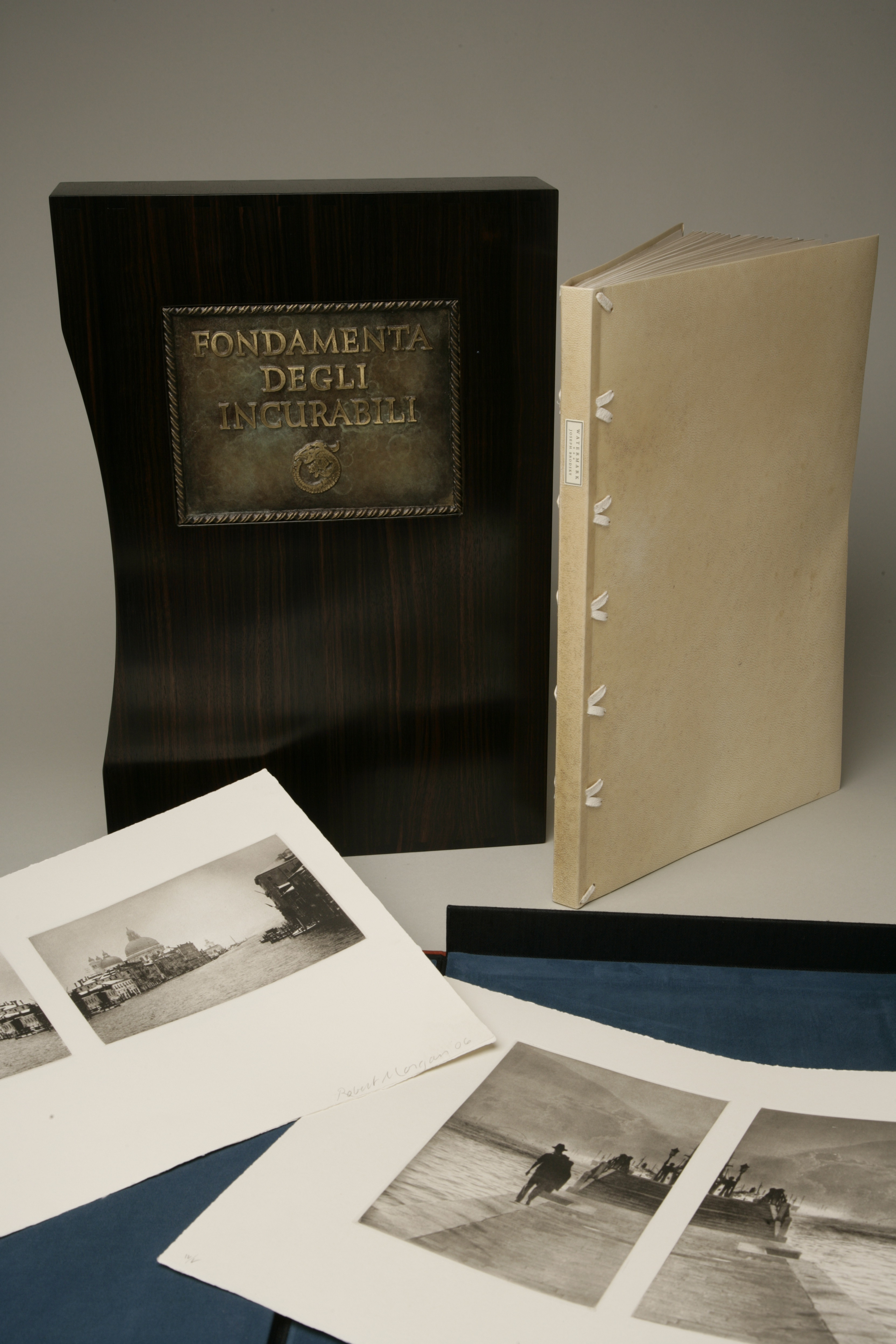
Peter Koch’s magnificent “Watermark” (Courtesy Peter Koch Printers)

“Let him come over here. We are all in a good mood here,” urged the Lithuanian host, Ramūnas Katilius. Brodsky arrived before noon the next day, and even held two readings at the apartment during his stay.

Thus began a lifelong friendship with the Katilius family and a long romance with Lithuania, a comparative refuge during the dying years of the Soviet empire. Eventually, Brodsky gained recognition as Russia’s greatest postwar poet and, in exile, a controversial titan on the New York literary scene who taught at several U.S. universities. He belonged to the world, becoming, in his words, “a Russian poet, an English essayist, and of course, an American citizen.” He won the Nobel Prize in Literature in 1987 and died at his desk at age 55 in 1996.

Read the rest here.  Please.

Oh! Oh! Oh!  Don’t forget to read about the Berkeley printer Peter Rutledge Koch‘s special edition of Watermark, also at the Libraries:

Venice has entranced poets through the centuries, perhaps none more so than Russian Nobel laureate Joseph Brodsky. “I always adhered to the idea that God is time, or at least that His spirit is,” Brodsky wrote. “I always thought that if the Spirit of God moved upon the face of the water, the water was bound to reflect it.” So it was that every New Year’s Eve, the poet tried to be near water, “to watch the emergence of a new helping, a new cupful of time from it.” He particularly tried to journey to Venice, a favored destination captured inWatermark, his book-length meditation on the city.

The rest is here.

Seamus Heaney: “rhymes as important as revolution”

September 1st, 2013
Share

heaney2I’ll be speaking at a private book club event next week.  On what?  The role of the reader.  So many write and write and write about the process of writing, the burdens of the writer, the writer’s obligations to society, and so on and so on and so on.  Who thinks about the reader?  I do, sometimes.  And I’m not alone.  Here’s what Seamus Heaney, who died a last week (see posts here and here) had to say on the subject … well, he starts out on the right horse, but quickly falls off.

From Stepping Stones, a 500-page Q&A with Dennis O’Driscoll:

How do you respond to Joseph Brodskys contention that ‘a reader who has a great experience of poetry is less likely to fall prey to demagoguery on the part of the politician’? There is also Yves Bonnefoy‘s somewhat similar view that ‘poetry is a cure for ideology’.

Joseph was right to contend that a person sensitized to language by poetry is less likely to sway in the mass-media breeze; and I agree with Bonnefoy if he means that successful poetry will launch itself beyond the pull of the contingent and get into its own self-sustaining linguistic and imaginative orbit. Take a poem like ‘Leda and the Swan’.  It begins with what Bonnefoy might call ideology: Yeats starts thinking of the Russian Revolution, which represents the rule of the many, the arrival of power from below, from down to up, and that he opposes the rule of the few, the rule from above, from up to down, so the violent descent of Zeus upon Leda comes to mind as analogous to all this – but then, as Yeats himself has told us, bird and girl took over his imagining, and the poem, powerful and problematical as it is, took off.  Thinking about rhymes becomes as important as thinking about revolution.

But poems can be political insofar as they discover the paradigmatic. Think of Cavafy. Cavafy’s cameos of the ambitions and victories and defeats among various tyrannies and dynasties and satrapies during the Hellenistic age have a wonderful, clarified political wisdom, but they’re free – or, if you prefer, cured – of ideology. It’s hard to talk about this without citing examples, probably because examples tell us that the only real answers to the general problem are specific poems in specific situations. Whitman‘s hospital poems during the American civil war. Poems by Auden and MacNeice in the 1930s – ‘Look, Stranger’, ‘The Sunlight on the Garden’.  Derek Mahon‘s ‘Lives’.

How should we regard a question like Czeslaw Miloszs ‘What is poetry that does not save/Nations or people?’

hartley's jamIt’s a cry wrung from him in extremis, de profundis, the cry of the responsible human. But it’s one he answers in different ways in his work – in the witness of poems like ‘Campo dei Fiori’ and ‘Song on Porcelain’, and in the obstinate espousal of beauty and order – the calligraphy, as he once called it – of poems like ‘The World’, or ‘Encounter’, or ‘Gift’.  These latter ones, incidentally, could have as their motto Brodsky’s equally challenging declaration that ‘if art teaches anything, it’s that the human condition is private’.

Where do you stand between those two positions?

Betwixt and between them – which is, in effect, where Czeslaw Milosz and Joseph Brodsky also stood. Joseph was out to save people when he suggested during his time as Poet Laureate of the United States that poetry should, like the Gideon Bible, be available in hotel rooms and should be distributed like handouts at supermarket checkouts. And Czeslaw writes about loving herring and strawberry jam as well as beauty and truth.

Seamus Heaney at Stanford

August 31st, 2013
Share
Seamus Heaney

Portrait of the poet as a young man.

Seamus Heaney, who died yesterday at 74, never taught at Stanford, but he did visit here at least once.  I was thumbing through Stepping Stones, the book-length Q&A with the late Dennis O’Driscoll, which I purchased after he mentioned it in his second letter to me (see yesterday’s post about that brief encounter here).  As with my usual impulsive book purchases, I had more money than time, so I never did more than crack the spine.  I did today though, and ran across this:

O’Driscoll:  Did you meet Thom Gunn?

Heaney:  During my later visit, yes, a couple of times. I don’t think we encountered in 1971/2. But when I was Beckman Professor [at the University of California] in 1976, Donald Davie organized a dinner in his house in Stanford and sent Alan Shapiro to collect me and drive me down. Alan was his graduate student at the time and had a car.  Thom Gunn was a guest that evening also and the whole event went off with great brio; but what I remember most was the fact that Thom had hitch-hiked down from San Francisco.  No pampering there – even the bus was too much for him.  I think, by the way, that I stilll like the iambic, English side of Gunn better.  Fighting Terms is a terrific first book; and there are poems like “The Discovery of the Pacific” and those late Dantesque treatments of the pre-AIDS gay scene in San Francisco.  He can really build the pressure when his stanzas are working for him.

thom-gunn

Gunn: he packed a punch

It wasn’t courage only that led Gunn to thumb his way down to Palo Alto from his Upper Haight apartment. He doesn’t drive, at all.  Who needs to in San Francisco, he told me.  (I suppose he still could have taken some sort of bus, if there was was one … which I doubt.)

To my knowledge, I was the last person to interview Thom Gunn. The Q&A  ran posthumously in the Georgia Review in Spring 2005 – alas, it’s not online.  Now Gunn did teach at Stanford, briefly, for one quarter.  I wrote about that here.

Au revoir, Seamus Heaney! My two letters from the Nobel laureate

August 30th, 2013
Share
Heaney

Generous, humble, and glowing from the inside

“You of all people!”  That’s how my first letter from Nobel poet Seamus Heaney began.  It’s not hard to keep track of them; there were only two.  This, the first one, was in a large envelope,  addressed in his loose, open handwriting in December 2007.  His Strand Street address was in one corner, and some attractive, carefully chosen stamps with foxgloves, dandelions, and black bog rush.  (You see how carefully I still treasure this missive?)  I had written half a year before to ask that the Irish poet contribute his memories to An Invisible Rope: Portraits of Czeslaw Milosz, and hadn’t received an answer.  When I heard today that he’d died, at 74, I went and pulled the letter out of a storage chest.

“You of all people! I’m very sorry to have overlooked your letter of last July: your book of Conversations with Czeslaw is one of the most helpful and constantly readable, and I’ve admired several reviews,” he wrote. He wanted to contribute, but warned that his memoir would be brief, and asked if I thought this would look “niggardly.” He kindly enclosed another piece on Joseph Brodsky, which he’d written for our mutual friend Valentina Polukhina. He neglected to remind me that he was still recovering from his 2006 stroke when I first wrote him, and had cancelled work for a year afterward.

heaney2Well, this was the man.  He was being humble to me.  It’s a powerful lesson in noblesse oblige, whether in poetry or some other field.  But one has to admit in the literary arena, it’s somewhat rare.  As an editor or journalist, one is more likely to be treated like an annoying tick than a respected colleague.  I pinned the letter to my wall for several years, to look at it in the bad times.

So I even treasured the second letter from Dublin, nine months later, signed simply “Seamus” with handwritten insertions (this one with a stamp featuring sea asters).  He wouldn’t be able to contribute after all.  He was about to set out on a road show with Dennis O’Driscoll (who died before him, I wrote about Seamus’s generous tribute hailing him as “my hero” here) – they’d just published a book-length Q&A called Stepping Stones – plus a TV documentary for his 70th birthday.  Given his schedule, and he was “naturally very sorry not to have been able to deliver a piece that would do credit to Czeslaw and indeed to myself before now.”  Henceforth we communicated back-and-forth through a flurry of emails via the mysterious cyberspace intermediary “Susie,” since she had an email address and he didn’t – he admitted “I’m still at the scriptorium stage of development.” We wound up reprinting his earlier memoir, “In Gratitude for All the Gifts” for the book, written when his fellow Nobelist had died in 2004. And no, it wasn’t “niggardly” at all.  It was, like him, generous and humble and glowing from the inside, like a peat fire in a cold Irish winter.

Postscript from Jane Hirshfield, as always eloquent. Jane joins the world in mourning the loss of Seamus Heaney, one of its greatest, most eloquent, and most generous poets. She writes: “In his presence and in his words, you felt always the embrace of being. His words brought the burnish of original seeing. You were made, quite simply, more alive by his aliveness, in life and on the page – as in the opening poem from his 2010 collection, Human Chain:

Had I Not Been Awake

Had I not been awake I would have missed it,
A wind that rose and whirled until the roof
Pattered with quick leaves off the sycamore

And got me up, the whole of me a-patter,
Alive and ticking like an electric fence:
Had I not been awake I would have missed it

It came and went too unexpectedly
And almost it seemed dangerously,
Hurtling like an animal at the house,

A courier blast that there and then
Lapsed ordinary. But not ever
Afterwards. And not now.

Jane&seamus

Two poets, held in memory…

Robertson Davies goes postal on his 100th birthday!

August 28th, 2013
Share

birthday cakeOh dear, oh dear, oh dear!  How could we have almost overlooked that today is the centenary of Robertson Davies, an author who has given us so much wisdom and laughter?

Whew!  Fortunately we’re just in time for the day.  Happy birthday, Robertson!  And we’ve baked you a little cake to celebrate!

How could we forget the man who said:

“A happy childhood has spoiled many a promising life.”

“I do not ‘get’ ideas; ideas get me.”

“The dog is a yes-animal. Very popular with people who can’t afford a yes man.”

“Authors like cats because they are such quiet, lovable, wise creatures, and cats like authors for the same reasons.”

robertson2“Do not suppose, however, that I intend to urge a diet of classics on anybody. I have seen such diets at work. I have known people who have actually read all, or almost all, the guaranteed Hundred Best Books. God save us from reading nothing but the best.”

“Extraordinary people survive under the most terrible circumstances and they become more extraordinary because of it.”

“Inactivity and deprivation of all accustomed stimulus is not rest; it is a preparation for the tomb”

“Fanaticism is overcompensation for doubt.”

Fortunately, fortunately, the Canadian post is on top of things, which makes a nice change.  They’re issuing a commemorative stamp.  (Canadian readers, can you send me one?)

Here’s how Canada’s National Post summarized his career:

Born in 1913 in Thamesville, Ontario, Davies had a long and distinguished literary career, not only as a novelist, but also as a playwright, journalist, and critic.

Davies’ career spanned six decades and numerous genres. In 1940, he became the literary editor of Saturday Night magazine. He was also a longtime editor for the Peterborough Examiner.

davies3A lover of theatre, Davies wrote more than dozen plays during his lengthy career, and would help launch Canada’s Stratford Festival in 1953, where he served on its board of governors.

Davies was also the founding master of the University of Toronto’s Massey College, in 1963, where students jumped at the chance to hear him tell ghost stories each Christmas.

The author’s greatest success came from the 11 novels he published during his lifetime. The most famous of those, The Fifth Business (1970), was on the Toronto Star bestseller list for 42 weeks, and would form one part of The Deptford Trilogy.

Davies won many awards, including a Booker Prize, a Governor General’s Literary Award (for The Manticore), and the Stephen Leacock Award for Humour (for Leaven of Malice).

Towards the end of his life, Davies himself responded to such introductions this way: “The introducer has approached me by what may be called the biographical path. He begins by telling that I was born, and when, and where. As soon as he mentions the date of my birth I can see the audience doing a little sum in their heads, after which they look at me with renewed interest to see how I am carrying the burden of my years. He is all kindness; he romps through the public details of my life, but under the circumstances I cannot laugh or weep.”

RobertsonDaviesThat’s from the 1989 Paris Review interview with Elisabeth Sifton.  I was happy to read that Davies confirms my own prejudice about writing by hand.  No surprise, perhaps.  Like me, he began in the daily wipes:

INTERVIEWER:

Now, the requisite Paris Review question: How do you write your novels? In your instance, this is a more interesting question than usual because you have an extraordinarily beautiful italic hand. Do you write the first draft of your novel longhand or do you type?

DAVIES:

daviesI type because writing by hand I find to be a very great betrayer. If you write carefully and try to write legibly, as I do, you finish a page and think, That’s a handsome page. This is absolutely wrong. Also, you can only write so long with a pen before your hand becomes tired, and then your invention begins to tire. If you type, which I do because I had my earliest training as a newspaperman and learned to use the typewriter readily, you have what you’ve written there before you cold and bare. Then you can go over it, and it is as though someone else had written it and you can edit it with great severity. I am a terrible fidget about form, and the first typed draft is often pitifully ragged and messy. But then after it goes to my secretary, who makes a clean copy, I revise extensively. The heavy work is done, but I like revising. As for editing, though I try to be stringent, you will recall that I resist your editorlike zeal for total clarity—all the lights blazing and not a dark corner to be found. I am a writer much given to light and shade, and I firmly believe that to know all is to despise all.

Read the rest here, and pop open a bottle of champers for “The Man.”


<<< Previous Series of PostssepNext Series of Posts >>>