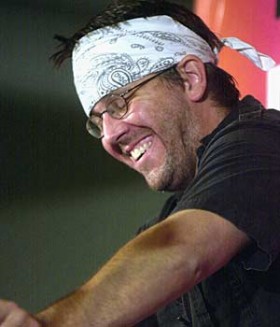
Congratulations! Tomas Venclova responds to his newest honor

April 6th, 2013


Share
"Above all, love language" (Photo: Dylan Vaughan)

“Above all, love language” (Photo: Dylan Vaughan)

Preeminent Lithuanian poet Tomas Venclova has been named an honorary citizen of Vilnius … but wait!  Why does he need honorary citizenship?  His family moved to Vilnius from Klaipėda when he was quite young, and he attended Stefan Batory University (now Vilnius University) in the city, as did his friend Czesław Miłosz.

Oh, that’s right.  He was more or less kicked out.  He was active the dissident movement, hence,  he was “deprived of Soviet citizenship,” which means he had to leg it out of his native land in 1977.  I believe he spends part of the year in Vilnius,  as well as in Kraków and New Haven, Conn., where he is now an emeritus professor at Yale.  Well, he gets around a lot.

From a Lithuanian news site:

Vilnius City Council unanimously decided to name Tomas Venclova, a Lithuanian poet, publicist and translator, an honorary citizen of Vilnius.

“Vilnius deserves to have the right and reason to be proud of the fact that such an outstanding figure came of age in the city; by naming Tomas Venclova an honorary citizen of Vilnius, the ties between the poet and his beloved city will be strengthened forever,” the Directorate of Vilnius Memorial Museums said in its nomination letter.

35 years ago, Venclova published his correspondence with Czeslaw Milosz, another celebrated writer born in Vilnius [not true, he was born in Szetejnie – ED], in an essay titled “On Vilnius as a Form of Spiritual Life.” Thanks to this publication, the world learned more about problems of Soviet-occupied Lithuania and Vilnius.

His alma mater, Vilnius University (Photo: C.L. Haven)

His alma mater, Vilnius University (Photo: C.L. Haven)

Venclova will become the 11th honorary citizen of Vilnius.

Wait.  Publicist???  I suppose they’re referring to his top-notch guide to Vilnius, which exists in English.  From his introduction:

…Vilnius has always remained many-faceted and multi-lingual.  It has been and will always be a dialogue city. … The Lithuanian capital reminds one of a palimpsest – an ancient manuscript in which the text reveals traces of an earlier text or even several of them underneath it.  The city is surrounded by a hilly northern landscape: because of abundant forests and lakes it has always appeared somewhat untamed. Throughout the city, up to its very centre, islands of untamed nature can be found.

So what does it mean to be a citizen of the city you have lived in so many years?  I sought quick clarification from the poet himself.  He wrote back yesterday from Berlin:

Dear Cynthia,

There are eleven honorary citizens of Vilnius, including Milosz (for whom the  city was also home for decades). The list includes Reagan and Brzezinski; that may look a bit awkward (they helped Lithuanians in the fight for independence).

Winner takes nothing, except the right to participate in the meetings of the city council (nobody ever insisted on that privilege). City also provides for the upkeep of his/her grave. In case of Reagan, the last provision is obviously void.

Love,
Tomas.

Well, there you have it.  From the horse’s mouth.

Van Gogh and “celestial means of locomotion”

April 4th, 2013
Share

starrynightMovie critic Roger Ebert has died, after a long and disfiguring journey with cancer.  Some pundits are calling him the greatest movie critic ever … have they forgotten Pauline Kael so soon?

Also making the rounds is this essay about death from Ebert in Salon.  I don’t know much about Vincent Van Gogh‘s life, except for the famous bits.  Since childhood, I adored his 1889 painting “Starry Night,” with its turbulent movement of the heavens, until I saw it on too many placemats and tea towels.

Van Gogh’s words in his last months, to his brother Theo:

“Looking at the stars always makes me dream, as simply as I dream over the black dots representing towns and villages on a map.

Why, I ask myself, shouldn’t the shining dots of the sky be as accessible as the black dots on the map of France?

Just as we take a train to get to Tarascon or Rouen, we take death to reach a star. We cannot get to a star while we are alive any more than we can take the train when we are dead. So to me it seems possible that cholera, tuberculosis and cancer are the celestial means of locomotion. Just as steamboats, buses and railways are the terrestrial means.

To die quietly of old age would be to go there on foot.”

tintin3Van Gogh wrote words from an asylum in Saint-Rémy-de-Provence – he painted “Starry Night” about that time; it was the view outside his window.  I hadn’t realized that his later years were so deeply associated with Provence, where I visited last December, nor did I know his 1888 painting in Arles, “Starry Night Over the Rhône,” reminding me of the river that runs through Avignon, as turbulent as the stars above Saint-Rémy-de-Provence.

Ebert’s comment on Van Gogh’s letter, which he found cheering in his final months:  “That is a lovely thing to read, and a relief to find I will probably take the celestial locomotive. Or, as his little dog, Milou, says whenever Tintin proposes a journey, ‘Not by foot, I hope!’”

Bookplate mania, forever and ever

April 3rd, 2013
Share

Over at Buzzfeed … bookplates of famous people.  Hard to make a choice among the cosmic, the tasteful, the vulgar, the odd, the obvious, the outré – but here goes.

The cosmic… Albert Einstein

bookplate1

The unexpected … Bette Davis

bookplate2

The self-aggrandizing… Greta Garbo

bookplate-garbo

The elegant (with such a name, how could it be otherwise?) … Oliver Wendell Holmes

bookplate-holmes

Because she’s the Queen … Victoria

bookplate-victoria

Because we love lions… Charles Dickens

bookplate3-dickens

Check out the bookplates of Benito Mussolini, Woodrow Wilson, H.G. Wells, William Butler Yeats, Maurice Sendak, and many others here.

David Foster Wallace: “Dostoevsky wasn’t just a genius – he was, finally, brave.”

April 1st, 2013
Share
Joseph and Marguerite Frank

Joseph and Marguerite Frank

I drove over to visit Marguerite Frank at her Stanford apartment one night last week.  She was sorting through mountains of photos and papers of her husband, the late and wonderful Dostoevsky scholar Joseph Frank.

Among the pile, she handed me this, from the Village Voice Literary Supplement: a 1996 review of the first four volumes of Joe’s mammoth Dostoevsky biography.  Here’s the kicker:  they were reviewed by David Foster Wallace, the late great writer who killed himself in 2008.

I hadn’t had the chance to read the edgy author before.  I have to say it was, initially, a bit of a slog.  Wallace intersperses his review with italicized,  existential questions between asterisks (sample:  “What does ‘faith’ mean?” “Is it possible really to love somebody?”), and the determinedly rambling and offhand style began to grate early on.  Wallace’s long, digressive footnotes are a precursor to Junot Diaz’s running, footnoted commentary on the history of the Dominican Republic in The Brief Wondrous Life of Oscar Wao, but Diaz is compelling; Wallace just goes on a bit.

It gets better: Wallace picks up considerable steam – both on Fyodor Dostoevsky (a.k.a. FMD) and Joe Frank.  It’s well worth the wait.  Here’s a long excerpt:

“The thing about Dostoevsky’s characters is that they live.  And by this I don’t mean just that they’re successfully realized and believable and ’round.’ The best of them live inside us, forever, once we’ve met them. …

wallace

Are we “under a nihilistic spell”?

FMD’s concern was always what it is to be a human being – i.e., how a person, in the particular social and philosophical circumstances of 19th-century Russia, could be a real human being, a person whose life was informed by love and values and principles, instead of being just a very shrewd species of self-preserving animal. …

So, for me anyway, what makes Dostoevsky invaluable is that he possessed a passion, conviction, and engagement with deep moral issues that we, here, today, cannot or do not allow ourselves. And on finishing Frank’s books, I think any serious American reader/writer will find himself driven to think hard about what exactly it is that makes so many of the novelists of our own time look so thematically shallow and lightweight, so impoverished in comparison to Gogol, Dostoevsky, even lesser lights like Lermontov and Turgenev. To inquire of ourselves why we – under our own nihilistic spell – seem to require of our writers an ironic distance from deep convictions or desperate questions, so that contemporary writers have to either make jokes of profound issues or else try somehow to work them in under cover of some formal trick like intertextual quotation or juxtaposition, sticking them inside asterisks as part of some surreal, defamiliarization-of-the-reading-experience flourish.

frank_book_newsPart of the answer to questions about our own art’s thematic poverty obviously involves our own era’s postindustrial condition and postmodern culture.  The Modernists, among other accomplishments, elevated aesthetics to the level of metaphysics, and ‘Great Novels’ since Joyce tend to be judged largely on their formal ingenuity; we presume as a matter of course that serious literature will be aesthetically distanced from real lived life.  Add to this the requirement of textual self-consciousness imposed by postmodernism, and it’s fair to say that Dostoevsky et al. were free from certain cultural expectations that constrain our own novelists’ freedom to be ‘serious.’

But it’s just as fair to observe that Dostoevsky operated under some serious cultural constraints of his own: a repressive government, state censorship, and above all the popularity of post-Enlightenment European thought, much of which went directly against beliefs he held dear and wanted to write about.  The thing is that Dostoevsky wasn’t just a genius – he was, finally, brave.  … who is to blame for the philosophical passionlessness of our own Dostoevskys? The culture, the laughers? But they wouldn’t – could not – laugh if a piece of passionately serious ideological contemporary fiction was also ingenious and radiantly transcendent fiction.  But how to do that – how even, for a writer, even a very talented writer, to get up the guts to even try?  There are no formulae or guarantees. But there are models. Frank’s books present a hologram of one of them.”

Are they overrated? Anis Shivani knocks the famous 15.

March 30th, 2013
Share
shivani

Here comes da judge.

“Are the writers receiving the major awards and official recognition really the best writers today? Or are they overrated mediocrities with little claim to recognition by posterity? The question is harder than ever to answer today” – yet the fearless Anis Shivani takes a shot at it in the Huffington Post here.  A few days we wrote about the outspoken literary critic. Did you catch his post on “The 15 Most Overrated Contemporary American Writers”?  Shivani roams freely among genres, condemning essayists, poets, novelists, journalists, you name it.

He writes:

“The ascent of creative writing programs means that few with critical ability have any incentive to rock the boat – awards and jobs may be held back in retaliation. The writing programs embody a philosophy of neutered multiculturalism/political correctness; as long as writers play by the rules (no threatening history or politics), there’s no incentive to call them out. (A politically fecund multiculturalism – very desirable in this time of xenophobia – is the farthest thing from the minds of the official arbiters: such writing would be deemed ‘dangerous,’ and never have a chance against the mediocrities.)

The MFA writing system, with its mechanisms of circulating popularity and fashionableness, leans heavily on the easily imitable. Cloying writers like Denis Johnson, Amy Hempel, Lydia Davis, Aimee Bender, and Charles D’Ambrosio are held up as models of good writing, because they’re easy enough to copy. And copied they are, in tens of thousands of stories manufactured in workshops. Others hide behind a smokescreen of unreadable inimitability – Marilynne Robinson, for example – to maintain a necessary barrier between the masses and the overlords. Since grants, awards, and residencies are controlled by the same inbreeding group, it’s difficult to see how the designated heavies can be displaced.

450px-BillyCollinsbySuzannahJamaica2010

Collins – resting on his laurels? (Photo: Suzannah Gilman)

As for conglomerate publishing, the decision-makers wouldn’t know great literature if it hit them in the face. Their new alliance with the MFA writing system is bringing at least a minimum of readership for mediocre books, and they’re happy with that. And the mainstream reviewing establishment (which is crumbling by the minute) validates their choices with fatuous accolades, recruiting mediocre writers to blurb (review) them.”

Sounds a lot like what Dana Gioia was saying a couple decades ago in “Can Poetry Matter?”  (The controversial Atlantic article was eventually published in his book of that title in 1992.)  And Dana spared us the tedious little click-through of the line-up of the condemned writers and their photographs.  But still …

Shivani concludes:

“If we don’t understand bad writing, we can’t understand good writing. Bad writing is characterized by obfuscation, showboating, narcissism, lack of a moral core, and style over substance. Good writing is exactly the opposite. Bad writing draws attention to the writer himself. These writers have betrayed the legacy of modernism, not to mention postmodernism.”

The list of the condemned includes: Amy Tan, Billy Collins, Antonya Nelson, Jhumpa Lahiri, Michael Cunningham, John Ashbery, Mary Oliver, Sharon Olds, Jorie Graham, Louise Gluck, Junot Diaz, Jonathan Safran Foer, Jorie Graham, Michiko Kakutani, William T. Vollmann, and Helen Vendler.  Something for everyone.

Read it here.

You may not agree, but feel free to mount your defense in the comment section below.  We’ll be curious to know what you think. Truly.

Meanwhile, it’s proving an exceptionally busy weekend, what with editing interview transcripts, answering a backlog of letters, proofs to review, a visit to the East Coast to organize, and weekend engagements.  See you on Monday.

He got an “A” from Nabokov

March 26th, 2013
Share
nabokov

Six feet tall and balding.

Delightful piece over at the New York Review of Books by Edward Jay Epstein, recalling his 1954 class with Vladimir Nabokov at Cornell.  We’ve written about Nabokov’s time at Stanford in 1941 here, but that was before he was quite the big-shot.

Here’s an excerpt:

The professor was Vladimir Nabokov, an émigré from tsarist Russia. About six feet tall and balding, he stood, with what I took to be an aristocratic bearing, on the stage of the two-hundred-fifty-seat lecture hall in Goldwin Smith. Facing him on the stage was his white-haired wife Vera, whom he identified only as “my course assistant.” He made it clear from the first lecture that he had little interest in fraternizing with students, who would be known not by their name but by their seat number. Mine was 121. He said his only rule was that we could not leave his lecture, even to use the bathroom, without a doctor’s note.

He then described his requisites for reading the assigned books. He said we did not need to know anything about their historical context, and that we should under no circumstance identify with any of the characters in them, since novels are works of pure invention. The authors, he continued, had one and only one purpose: to enchant the reader. So all we needed to appreciate them, aside from a pocket dictionary and a good memory, was our own spines. He assured us that the authors he had selected—Leo Tolstoy, Nikolai Gogol, Marcel Proust, James Joyce, Jane Austen, Franz Kafka, Gustave Flaubert, and Robert Louis Stevenson—would produce tingling we could detect in our spines.

Read the rest here.  It’s very short and a lot of fun.


<<< Previous Series of PostssepNext Series of Posts >>>