What do Truman Capote, Ernest Hemingway, Philip K. Dick, and Jean-Paul Sartre have in common?

September 13th, 2012
Share

Hermann Hesse finds true love

I have a lot of writing to finish between now and Sunday night – I’ll be going at it 24/7.  Meanwhile, you might want to check out Buzzfeed’s “30 Renowned Authors Inspired by Cats.”  There’s also more at Writers and Kitties.

Mark Twain was an obvious choice.  But I combed through to see if they were going to remember some of the world’s most famous cat-lovers.  Colette, for example, who famously said, “Plus je connais les hommes, plus j’aime mes chats.”

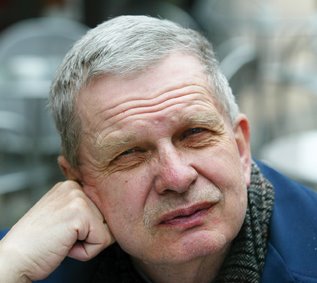
Mississippi and J.B. (Photo: Bengt Jangfeldt)

She’s there, along with Truman Capote, Ernest Hemingway, Edgar Allan Poe, Philip K. Dick, Hermann Hesse, Edward Gorey, George Plimpton, Jacques Derrida, W.H. Auden, and Jean-Paul Sartre make the cut.  But where’s T.S. Eliot, for goodness sake?

A few other notables were missed.  Where is Joseph Brodsky and his famous cat Mississippi?

I’m not entirely sure Vikram Seth is a cat-lover, but I think he must be.  The gnarly old tomcat Charlemagne, in The Golden Gate, is one of the great literary cats. I could find no photo of him with cats – only this from Delhi Walla, which is as close as I’m going to get tonight.  And since my own copy of Golden Gate is loaned out to a good cause, I found this sole sonnet (the novel is composed of Pushkin tetrameter sonnets), in which the lawyer John is warned of his romantic competition for the heart of fellow attorney Liz.  I like the way these fleet, four-footed sonnets fit onto wordpress better, next to a photograph, without awful line breaks:

Vikram Seth and fan

Ah, John, don’t take it all for granted.
Perhaps you think Liz loves you best.
The snooker table has been slanted.
A cuckoo’s bomb lies in the nest.
Be warned. Be warned. Just as in poker
The wildness of that card, the joker
Disturbs the best-laid plans of men,
So too it happens, now and then,
That a furred beast with feral features
(Little imagined in the days
When, cute and twee, the kitten plays),
Of that familiar brood of creatures
The world denominates a cat,
Enters the game, and knocks it flat.

Charles Bukowski and friend

Speaking of Vikram Seth, let’s take a moment to give equal time to dogs.  I have in mind one that played prominently in Seth’s novel, An Equal Music. It’s St. Augustine’s small white Maltese dog in Vittore Carpaccio‘s Saint Augustine in His Study, in Venice’s Scuola di San Giorgio degli Schiavoni. It’s from Carpaccio’s mature period – he began it in 1502 and completed it in 1507. It’s one of seven panels he made, still in the Schola, depicting the guild’s patron saints.

On Vikram Seth’s authority, I shlepped to the Schola a decade or so ago. It’s tucked away on one of Venice’s sidestreets and not easy to find.  It was worth it. The schola is dark and mysterious and pure magic. The painting everything he said it would be.

Highly recommended.

.

A saint's best friend...Carpaccio's Augustine in his study

.

Joshua Landy: “Literary texts are not cudgels but weight machines.”

September 11th, 2012
Share

"Literature as Rorschach test, simulation space, participatory wrestling match" (Photo: L.A. Cicero)

Why read hard books? the Guardian‘s Stephen Abell asks.

Joshua Landy rushes to the rescue with equally hard answers in his new book, How to Do Things with Fictions.  Josh is nothing if not a lively thinker.  Abell writes:  “His answer, when shorn of its sometimes uncomfortably scratchy fleece of critical theory, is simple: complicated literature (like green vegetables) is good for you. Landy believes that certain texts provide training for our minds, by actively working on the reader to expand their mental capacity: ‘each work, in other words, contains within itself a manual for reading, a set of implicit instructions on how it may best be used.'”

Frankly, I like the even more simple answer he gave me in his Stanford office, nearly two years ago: “Spending time in the presence of works of great beauty can powerfully change your life.”  In fact, I think the article I wrote goes some way towards answering the questions I posed last week about defending the humanities:  “The Cambridge-educated Landy rejected the notion that literature is morally improving. Instead, great works ‘enable us to clarify ourselves to ourselves.’ He offered ‘literature as Rorschach test, literature as simulation space, literature as participatory wrestling match.’ He advocated moving away from the ‘stranglehold of narrativity,’ which literature shares with biography and history, and turning to ‘a more lyrical mode of thinking.'”

The case studies from his new book range across five countries and 2,500 years: Plato‘s Gorgias and Symposium, St. Mark‘s gospel, Chaucer‘s Canterbury Tales, a sonnet by Stéphane Mallarmé, and Samuel Beckett’s trilogy Molloy, Malone Dies and The Unnamable.  Abell writes:

Before we get to the evidence, we receive a breathless summary of various other literary theories that seek to explain the purpose of fiction. Landy is fond of lists and numbers, and posits “13 ways of looking at fiction”, which include three main schools of thought: the “exemplary” (novels as morals; read Clarissa and become a better person); the “affective” (freeing our emotions; see Kafka‘s wonderful observation that “a book must be the axe for the frozen sea within us”); and the “cognitive”. Landy spends most time on the “cognitive”, subdividing it – I think – into four other sections, but basically categorising it as the view that novels are “directly educational”.

Landy’s own theory, of fiction as a thought-trainer, comes close to this notion, but he exerts himself considerably to condemn those “meaning-mongers” who insist that fictions provide the key to straightforward verities. He is also dismissive of those of us who only want to dwell on the enjoyment of being told a story, or what he calls “the glorious uselessness of fiction, its ostensible inability to yield anything beyond pleasure”.

Abell hints strongly at the end of the piece that he reads books for the plots.  But Josh Landy’s description of one case study, the Gospel of St. Mark, during a colloquium two years ago, was downright spellbinding:

Landy offered an example from his forthcoming book, focusing on Jesus’ parables, as told in the Gospel according to Mark: “The big mistake that people have made across the centuries is to think that what’s on offer in the parables is some kind of message. But the parables do not seek to teach; they seek to train.”

The parables, often obscure, were meant to move readers of Mark’s texts from the literal to the metaphoric, Landy said, a shift that “implies that nothing we see is inherently significant, since the entire visible realm is merely a symbol for a higher plane of experience.”

“To move away from literal language to figurative language is to move away from the body and to the spirit,” Landy said.

“Literary texts do not bludgeon us into submission,” Landy said. “They are not obligations but offers. They are not cudgels but weight machines. Their effects are neither automatic nor inevitable.”

Read the rest of Abell’s interesting article here.  Or read my story here.

Happy 75th birthday, Tomas Venclova! Plus a note on the feldspar of languages…

September 10th, 2012
Share

His alma mater, Vilnius University (Photo: C.L. Haven)

I toast a special anniversary at midnight, though not, perhaps, the one you’re thinking of.  The poet Tomas Venclova turns 75, and a few days ago returned to Vilnius in his native Lithuania to celebrate the occasion. (Frankly, I prefer honoring this anniversary – it’s a refusal to let killers own this day.)

I think the Lithuanian writer would agree that poets are the means by which language lives.  So what better way to honor him than to celebrate his native tongue, spoken by a few million people?  In his own words:

“Matters get more tangled when we speak about the poetry of a small country, a country that is – or was, just until a few months ago [this was written in 1990 – ED] – under the rule of a foreign-speaking, totalitarian empire. Lithuania is one of those small countries. Besides, the Lithuanian language differs from its friends in misfortune. It is one of the classical Indo-European languages, like Latin, Ancient Greek, Gothic, or Old Slavonic; but it is the only one of them that is still alive and is by no means near to being dead, regardless of sufficiently adverse conditions …

“On the whole, the Lithuanian language is by no means delicate or weak. In an odd way, a poet’s direct feeling also confirms this. The Lithuanian language is harsh, jagged, not especially musical, with consistency and texture that bring a feldspar to mind. Its verb is sculptural in catching a hundred nuances of evolution and change. It is especially because our language is palpable and graspable that writing in Lithuanian is a happy and gratifying preoccupation.”

It seems to have been a happy and gratifying preoccupation for him, though often a lonely one.  I cannot say this is now my favorite poem by him, but it’s my first favorite, and serves as a sort of ars poetica:

Above all, though it’s hard, love language –
humbled in newspapers, obituaries saturated with lies,
in the bedroom’s close darkness, the informer’s confession,
in the cry at the bazaar, trenches, the stench of hospital wards,

Birthday Boy (Photo: Dylan Vaughan)

in third-rate theatres, secret police offices, on lavatory walls.
In grey buildings where the stairwell’s shaft is guarded
by steel nets, so that it is not a man, but the century,
which selects the instant of his death;

this language, almost collapsed, littered with sound
and fury. That’s it, love language –
banished to earth beside us,
Though carrying with it the primordial Word …

Happy birthday, Tomas.

Postscript on 9/12:  The U.S. ambassador to Libya, J. Christopher Stevens, was murdered in a rocket attack yesterday. The killers got the day after all.


The last days of Tolstoy – a defense brief, a video, and a murder mystery

September 9th, 2012
Share

The family circle at Yasnaya Polyana, about 1905, before the nutters took over.

We’re rather on a Leo Tolstoy kick over here, aren’t we? But how can we help ourselves? We just found these two film clips of the author’s last days.  Lots of snow and horses, as you’d expect – then Tolstoy in death, laid out on a bed with flowers, and the funeral procession, with what looks like thousands of peasants.

Sophia and daughter Alexandra in a portrait by Nikolai Gay

The first clip is taken from 1969 BBC series Civilisation: A Personal View by Kenneth Clark, and the longer, Russian clip is second (it includes earlier footage from 1908).  The 82-year-old writer died at the out-of-the-way rural train station in Astapova, weakened by his sudden decision to renounce everything and hit the road.  According to Sir Kenneth Clark in the video, “He left his wife, his comfortable estate and his wealth and traveled 26 hours to Sharmardino, where Tolstoy’s sister Marya lived, and where he planned to live the remainder of his life in a small, rented hut.”  (Thanks, Open Culture, for bringing the clip to our attention.)

Comfortable?  We think not.

Of particular note is the first clip’s comments on Tolstoy’s “demented” wife Sophia.  She’s taken a lot of bad press over the years, but she finally has a champion:  Alexandra Popoff, author of 2010’s Sophia Tolstoy: A Biography, writes on her Sophia Tolstoy website: “She was central to his creativity and it is impossible to imagine his life and works without her.”  According to the biographer:

Sophia was judged by her final year with Tolstoy and by people hostile to her — the great man’s disciples, particularly Vladimir Chertkov, a vain man who wanted to establish himself as the person closest to Tolstoy. He led a smear campaign against Sophia and described Tolstoy’s marriage as martyrdom.

To understand why there are still many misconceptions about Sophia and her role we need to know that for most of the twentieth century it was impossible to publish essential documents in her favor. …

The character of this remarkable woman was unlike the portrayals. She handled Tolstoy’s publishing affairs and their family’s business affairs, while also raising a large family. I was impressed with her capacity for hard work: a mother of 13, who herself nursed and educated their children, she was also a successful publisher, translator, and photographer. A lot of her labor went into Tolstoy’s novels, which she copied and produced. She also worked alongside Tolstoy during the famine relief.

The comment rather puts the lie to this one, by James Meek in a Guardian article giving Anna Karenina another reading: “I’m not sure Tolstoy ever worked out how he actually felt about love and desire, or how he should feel about it. He was torn between compassion and moral rigour, between lust and self-denial, between loving his wife and being bored by her. His uncertainty is reflected in the dual portrayal of his wife in Anna Karenina – as the virtuous, somewhat frumpy Dolly, worn out by childbearing, like the woman his wife was when he was writing the book, and as the feisty, pretty teenager Kitty, like the woman his wife was when he married her. They must have seemed to contradict each other, yet each was true to her time; and Tolstoy, for all that he was a master of time, was only a slave to truth.”

Surely if he were a slave to truth he would have noted that frumpy older wives hadn’t necessarily bargained for paunchiness, baldness, flatulence, snoring, and flourishing mid-life nose hair.

Meanwhile, way back in 2009, Elif Batuman wrote a riveting piece for Harper’s about the murder of Leo Tolstoy:

A literary Sherlock

As is often the case, Tolstoy’s enemies were no more alarming than his so-called friends, for instance, the pilgrims who swarmed Yasnaya Polyana: a shifting mass of philosophers, drifters, and desperados, collectively referred to by the domestic staff as “the Dark Ones.” These volatile characters included a morphine addict who had written a mathematical proof of Christianity; a barefoot Swedish septuagenarian who preached sartorial “simplicity” and who eventually had to be driven away “because he was beginning to be indecent”; and a blind Old Believer who pursued the sound of Tolstoy’s footsteps, shouting, “Liar! Hypocrite!”

Meanwhile, within the family circle, Tolstoy’s will was the subject of bitter contention…

“You are certainly my most entertaining student,” said my adviser when I told her my theory. “Tolstoy— murdered! Ha! Ha! Ha! The man was eighty-two years old, with a history of stroke!”

“That’s exactly what would make it the perfect crime,” I explained patiently.

Read the rest here. It’s marvelous, of course.


“Why do I need to know that?” Defending the humanities, social sciences in a techno world

September 7th, 2012
Share

John Hennessy, Leslie Berlowitz, Steven Denning, Condi Rice (Courtesy American Academy of Arts & Sciences)

What’s a degree in the humanities or social sciences “good for”?  Can you get a job with a B.A. in German studies or history?  Should students finally do what their parents have been begging them to do all along, and go for physics or computer science instead?

William Perry (Photo: L.A. Cicero)

In the face of hard times and declining interest and enrollment, the humanities and even the social sciences are often seen as the “uncool” poor relations of the sciences and technologies.  Increasingly, they’re being asked to justify their presence at the academic table.

The American Academy of Arts & Sciences Commission on the Humanities and Social Sciences has been working on the defense.

It’s preparing a report for Congress, to be delivered in early 2013.  As part of that process, it is holding several forums around the country that focus on various aspects of the humanities and social sciences.  The first, Humanities and Civil Society, was held in Cambridge, Mass., in July; the second was at Stanford on Tuesday.

The Stanford event, The Humanities & Social Sciences for International Relations, National Security, and Global Competitiveness, was  hosted by Stanford President John Hennessy, a member of the commission. Former Secretaries of State Condoleezza Rice and George Schultz, former Defense Secretary William Perry, and former Ambassador to Afghanistan Karl Eikenberry were among the 22 participants.

Leslie Berlowitz, president of the academy, asked all the participants to pool their thinking “so that we can talk cogently and with authority on why the humanities matter,” from kindergarten to graduate school.  She stressed the need “critical thinking, understanding other languages and culture … for public life, for our security, and for global competitiveness.”

I know what you’re thinking: that’s not what the humanities are for.  Learning how to write a smashing sonnet will not make you richer or  the nation more secure or more globally competitive.

However, even with that proviso, the discussion evoked some powerful anecdotes about serving in foreign wars or the diplomatic service, and the need for cross-cultural understanding and foreign language study.

“Why do I need to know that?”

Perry recalled his experience in “diplomacy that dealt with incredible danger” over 65 years of his life, first as an 18-year-old army soldier sent to occupied Japan.  “The glamor of war turned into the horror of war,” he said.

David Kennedy (Photo: L.A. Cicero)

The firebombing of Tokyo left more dead than Hiroshima and Nagasaki combined.  When he went to Okinawa, a city the size of San Jose, “I was not prepared for what I saw there.  Not a building was left standing.”  Working with Hungarians after the brutal Soviet suppression of 1956, “I came to know some of them and know their personal stories.”  The Cuban Missile Crisis “was a very moving experience for a 32-year-old.  I truly believed it would be the last day on earth.”

“Deterrence, as important as it was, is very, very dangerous and can easily spin out of control, leading to nuclear holocaust,” he said.

Facing the enormous Red Army, America chose to “offset numerical superiority with technical superiority” – with smart intelligence systems, stealth weapons, the internet, he said.

Whoops, we’re back to technology again, aren’t we?  Perry voiced hope for a world without nuclear weapons – maybe we’ll go back to our ploughshares and poems then.

Condoleezza Rice made a polished presentation that cut to the chase: “I think we’re a bit on the defensive about the humanities and social sciences,” said Rice.  “I myself am a social scientist and a musician. I can’t understand why we are on the defensive.”

“Our world has become quite instrumental,” she said, noting the rise of the social media and the transformations in the traditional media.  “The attention span is a minute and a half, if that.”

Condi Rice (Photo: L.A. Cicero)

“The question is: ‘Why do I need to know that?’ If you try to defend the humanities and social sciences in terms of its usefulness in the next week, it’s hard to make a connection.”

Instead, she said we must help students “to understand that we have a past, are living in the present, and hope for a better future.  One has to know something about how human beings have addressed important issues in the past.”

“We also need to understand us.  We are, as Americans, losing the sense of us,” she said. “One way not to fear they is to have a strong sense of us.”

In the era of texting and twitter, many students have a reduced capacity to “use evidence to support and make an argument.”  She asks students if they knew the case they are trying to make, or whether they simply “expect to meander towards the end and hope for the best?”  (Why did my mind drift immediately towards Montaigne?)

She argued for a more rigorous training in writing, pushing students to go beyond what they feel and believe to articulate what they know and have learned.  “The well-argued, well-written two-pagers can make a difference,” she said – even with a U.S. president.

“You can’t defend what you don’t know.”

Eikenberry, who is also a Chinese specialist, continued some of the same themes: “In my many talks with the People’s Liberation Army, they never asked me a question about Tang Dynasty poetry.  They never asked me questions about Napoleonic history.  They asked questions about American history, American economy.”

“If we don’t understand ourselves, we can’t do it well,” he said. “You can’t preserve something you don’t understand.  You can’t defend what you don’t know.  If you aspire to be a transnational bridge, you have to be grounded on both sides of the river.”

Get to the point, Michel.

Lt. Col. Joel Vowell described 21 years as an active duty infantry officer and recent work with tribal organizations in Afghanistan.  He recalled one incident in which choosing a site for a well meant that the American troops had inadvertently taken sides in a 400-year conflict.  “I had to educate myself in linguistics, political science, sociology, geography, media studies …” well, I lost track at that point of the various fields he self-educated himself in. Lots.

Pulitzer prizewinning historian David Kennedy said the humanities give us “the ability to operate in an ambiguous environment.”

“Dealing with ambiguity is the essence of the humanities,” he said.  “Interpretation, reconciliation, appreciating the points of origins of different positions – humanities are at home with ambiguity. It is our stock and trade.”

But I return to my earlier point:  I think that’s confusing an effect with the raison d’etre. It’s not what the humanities are for, or rather, it’s only a small part of what the humanities are for.  The humanities … well, make us more deeply human, but even that description is way too reductive to be much use.

Given the session’s title, it’s not surprising that there was a tendency to boil down the humanities and social sciences to foreign language learning and cultural understanding – rather than, say, the worthiness of efforts to make an immortal sculpture or ponder the mysteries of   epistemology.

But it would appear that apples and oranges were on the table. I’m not so sure social sciences are in quite the same pickle (to continue my jostling, gustatory metaphors) as the humanities.  Psychology, for example, might be a suitable entry point for med school, political science for law school – more than, say, East Asian art leads to anything obvious, other than a PhD in the subject.  Of course, there are gray areas: I’ve had quarrels with people about whether history is a humanities or a social science.  But social sciences are by definition social, and the humanities?  At their finest, they lead us on an interior journey, guiding to individual, unique understandings, and inoculating us along the way (with varying degrees of success) against groupthink.

However, if both are hot in the pot, it may not matter which one has hit the boiling point first.


 

Tom Stoppard: “What Tolstoy is on about is that carnal love is not a good idea.”

September 5th, 2012
Share

Do not, repeat, do not try this at home...

The incomparable patron saint of bloggers, Dave Lull, alerted me to a Guardian interview with one of Britain’s foremost playwrights, Tom Stoppard, who created the screenplay for the latest film version of Anna Karenina, which we wrote about yesterday.

I don’t think Tom Stoppard quite gets it.  “What Tolstoy is on about is that carnal love is not a good idea,” he says, although Tolstoy seemed to have a pretty good idea what it was about in Anna Karenina and War and Peace (before marrying the vivacious Natasha off to the rather inept Pierre, with whom she’s rather happy by the end).  Stoppard seems to miss the point that almost all societies except our own regarded unregulated passion as a kind of madness, and a destructive force in society.  After all, Anna’s young son is left motherless at the end of the novel, and a good many other lives are disfigured.  Tolstoy might have argued that there is no such thing as a personal life, and personal choice.  That’s why he has the Levin chapters.

There’s the additional problem that the Levin chapters of the novel contain many long discussions about local government, and estate management. “It’s as though,” Stoppard jokes, “Tolstoy took the big essay at the end of War and Peace and said to himself, ‘I’d better spread this through the whole story next time.'”

But Levin (modelled on Tolstoy himself) is important. The parallel, shy relationship between Levin and Kitty (superbly played by Domhnall Gleeson and Alicia Vikander) is used by Tolstoy to counterpoint Anna’s affair. “For a while,” Stoppard continues, “I thought we should ignore everything and just go hell for leather, and into, and through, and out of, this relentless love affair. I was going to make it like a very fast modern movie, which was all about being in lust.” In the end, he says, “wiser counsels prevailed, including my own”.

Apparently, the proscenium arch, stage device the film uses was not Stoppard’s idea at all, but rather director Joe Wright‘s, which comes rather as a relief.

“He called me up, and said, ‘Can I see you urgently?’ He came round with a big file and exhibited his idea – essentially that the Moscow and St Petersburg scenes should take place in a 19th-century theatre – on my kitchen table.”

Was this to do with budget problems? Stoppard shakes his head. “Joe needed a concept to get excited about doing the novel as a movie. I think he talked to Keira about it – Pride and Prejudice had worked out really well for them – and this was what he came up with.”

Once again the proscenium arch is hot news.  It sounds a lot like Ingmar Bergman‘s Magic Flute of 1975.  It was hot news way back then, too, and made for a charming production of Mozart.  Since we are speaking of happy marriages … Levin’s, anyway … I include a clip below of the sweet and magical reunion of Papageno and Papagena at the end of the opera. Hard to top that one for marital bliss.  Meanwhile … Jude Law. I’m now convinced he’d be a dynamite Alyosha (moving from Tolstoy to Dostoevsky). I don’t think his Karenin is “pinched and prim” at all (according to Peter Bradshaw in the Guardian review), given the total destruction of his life Karenin is facing – see what you think in the clip below, which includes a typically Tolstovian lecture on fidelity and love, although I don’t see why cattle have to be insulted.


<<< Previous Series of PostssepNext Series of Posts >>>