“The most selfless guardian of Brodsky’s heritage”: Valentina Polukhina (1936-2022), requiescat in pace

February 8th, 2022

Share
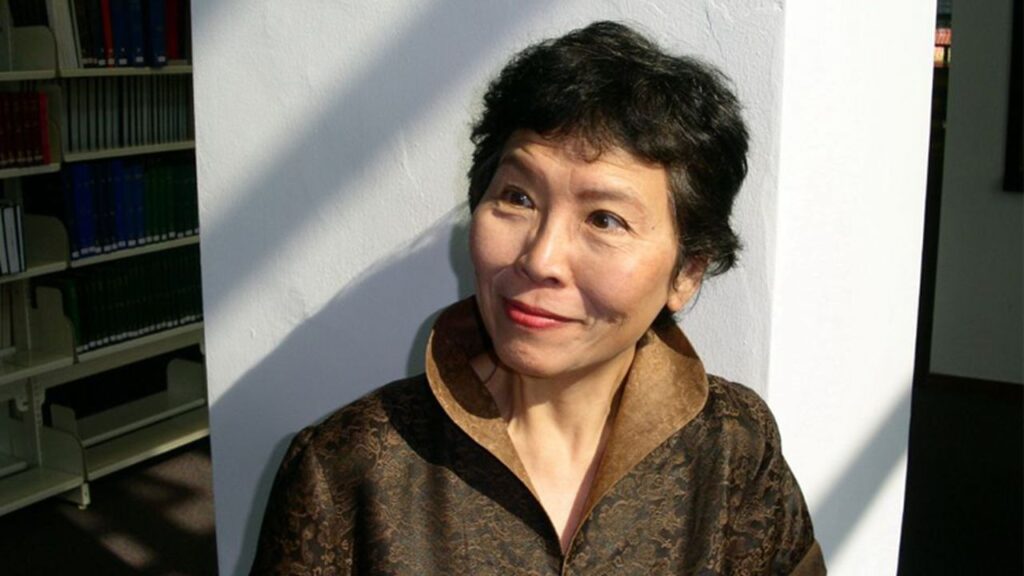
Valentina Polukhina in 2010 (Photo: Yuri Leving)

She was a woman from another era, in the finest sense of the word. The up-to-date term “networker” would trivialize Valentina Polukhina‘s indefatigable labors – yet never was it more apparent since her death in the early hours this morning how wide her network was. The Keele University professor who was one of the world’s leading scholars on Nobel poet Joseph Brodsky seemed to know everyone, and kept up a wide circle of correspondence. Her Facebook page was flooded with reminiscences and condolences.

Joseph Brodsky and Valentina Polukhina

She died quietly at her home in Golders Green, London, in the early morning hours of February 8, at age 85. There is no one like her, and no one to take her place. She will be very much missed – and not only in the world of Brodsky scholarship. She was a generous scholar, a kind and wise human being, and a dear friend. She was the recipient of the A. C. Benson Medal and the Medal of Pushkin. Valentina, the widow of translator Daniel Weissbort, will be remembered most of all, I think, for her tireless work on the multi-volume Brodsky Through the Eyes of His Contemporaries. That unique masterwork will grow in importance and meaning with time.

And what a fascinating effort it was: a massive collection of in-depth interviews with those who knew the Russian Nobel poet – including friends from his Leningrad days before his 1972 expulsion from the USSR, which brought him to Ann Arbor and the University of Michigan, and the new friends he made in exile. The volumes include interviews with fellow Nobelists Seamus Heaney, Czesław Miłosz and Derek Walcott, Swedish author Bengt Jangfeldt, Lithuanian poet Tomas Venclova, British author John le Carré, Susan Sontag, and dozens and dozens of others, some famous, others relatively unknown colleagues from Russia. Think of it: a firsthand record of what it was like to live, love, and work with one of the great geniuses of our time. She took flak for this effort – not least of all from Brodsky himself – but I have no doubt these volumes (two in English, three in Russian) will stand the test of time, and be an endless literary and cultural goldmine for generations to come.

Yuri Leving of Dalhousie University, who has written about Brodsky’s artwork, agrees: “While reading obituaries and sketches today about the main and, without exaggeration, the most selfless guardian of Brodsky’s heritage, I involuntarily caught myself thinking of the bright portraits in Brodsky Through the Eyes of his Contemporaries. I took this photograph (above) at her home in Golders Green in August 2010 when her husband, the remarkable poet and translator Daniel Weissbort, was still alive. The following ten years included a few more meetings and regular correspondence – everything about Brodsky was sacred to her, and it could not help but attract her. In 2021, when I was preparing to go to London again, Valentina wrote: ‘Alas, I can no longer cook dumplings. Instead, I will invite you to lunch at my club Athenaeum, where Joseph appeared in jeans at the invitation of Sir Isaiah Berlin. You really need to be in a suit and tie for this.’ My trip was exactly a week after Valentina was discharged from the hospital (she had been injured in a fall) so we agreed to postpone the appointment. Now is forever and ever.”

She was a 21st century networker, but also something from a much older tradition: one of those Russian women (some scholars, some not) who dedicate their lives to a timeless literary figure, one such as Joseph Brodsky. Among her many books: Joseph Brodsky: A Poet for Our Time (Cambridge University Press, 1989, 2009), Brodsky’s Poetics and Aesthetics (Macmillan Press, 1990), Joseph Brodsky: The Art of a Poem (Macmillan Press, St. Martin’s Press, 1999), and others. That’s in addition to the two thick volumes of Brodsky Through the Eyes of His Contemporaries, which I reviewed for The Kenyon Review a decade ago.
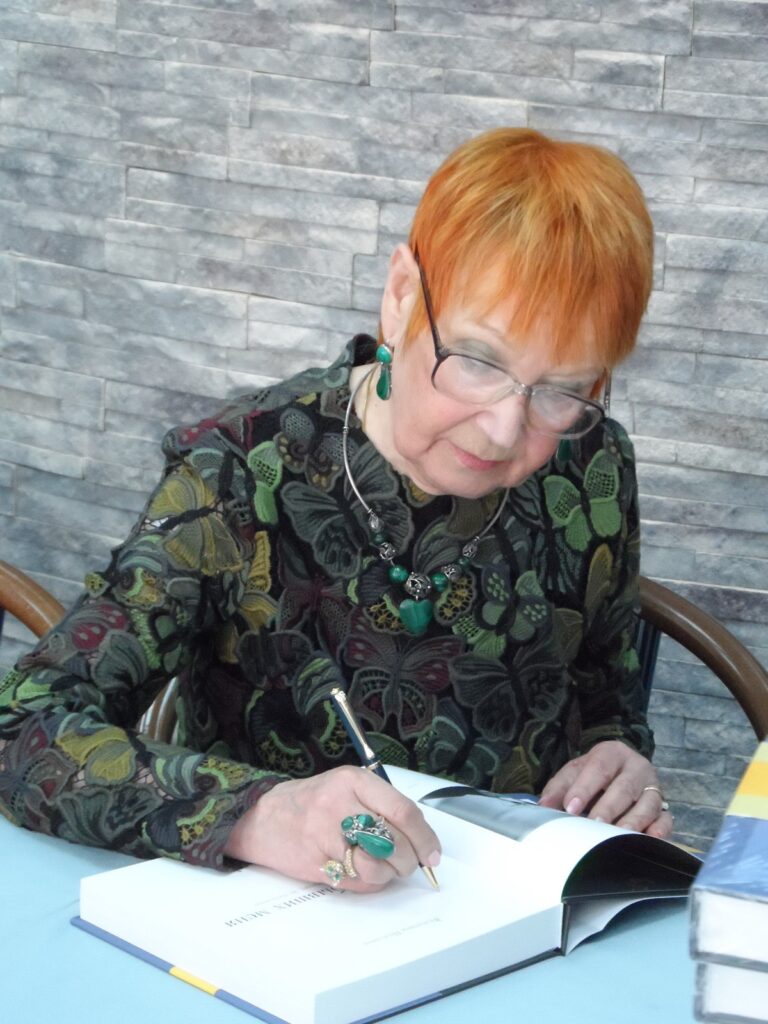
Book signing

From author Maxim D. Shrayer of Boston College: “The passing of Valentina Polukhina, literary scholar best known for her writings about Joseph Brodsky, is a terrible loss. Our family and Valentina have been friends for over twenty-five years. She was endowed with a remarkable and rare talent—to love and cherish poetry and poets, and to do so outside the grid of literary politics. How bitter it is to realize that Valentina Polukhina is gone. Memory eternal.”

I was a recipient of her generosity during our work with The Man Who Brought Brodsky Into English: Conversations with George L. Kline. She was an invaluable firsthand source. I will always treasure the time we spent together in London back in 2018. The advice she gave, the additional material she supplied from her own rich archive, all enriched the small volume.

She was a matchless hostess as we worked, for she generously invited me to stay in her charming Golders Green home for a week. And that was an unforgttable event, too – a place infused with her history and memories, her Russian taste, her vivid colors, her rich Orthodox heritage, made an indelible impression.

We were going to get together in London to celebrate with champagne the publication of The Man Who Brought Brodsky into English … when the coronavirus epidemic subsided, when travel resumed. Now I will have to lift a glass of bubbly to her memory by myself – here, far away, on the shores of the Pacific.

Postscript on February 11: Over at her blog The Stone and the Star, poet and publisher Clarissa Aykroyd remembers meeting Valentina at a reading: “I asked her about her writing and work and she told me that she had written many books about Brodsky. She then mentioned that her husband was the late Daniel Weissbort. I was a bit dumbfounded – Daniel Weissbort died only a few months ago and I had read many tribute articles and obituaries. He was the founder of Modern Poetry in Translation, along with Ted Hughes. She herself was Valentina Polukhina, not only a Brodsky expert but a major scholar and advocate of Russian literature for English speaking audiences. I told her that I didn’t know a lot about Brodsky but that I adored Mandelstam, and she said “The advantage of Mandelstam is that he has been translated by many different people, so you have a lot of choice.” I also told her, quite sincerely, that I would rather read Modern Poetry in Translation than most journals dedicated to contemporary English-language poetry, and she seemed happy about that. When we introduced ourselves, she said to me that the name Clarissa was also found in Russia, but that it was considered quite aristocratic. It was a lovely, striking encounter.” Read the whole thing here.

Also, Britain’s premier publisher of poetry, Bloodaxe Books, has a summary of her career here.

Postscript: A small example of her cultural efforts on behalf of the Brodsky legacy in 2018, in The Guardian here.

At the Russian Cultural Center in Kensington, 2018. Valentina at lower left, and me in the Harris tweed.

“Delicious…[it] evokes so much so vividly and so intelligently”: Leon Wieseltier, Ilya Kaminsky weigh in on “Czeslaw Miłosz: A California Life”

February 6th, 2022
Share

The Book Haven has been pretty mum on our our newest offering, Czesław Miłosz: A California Life, just out with Berkeley’s Heyday Books (we wrote about its origins here). But we’ve been speaking about it – in Berkeley, in Chicago, in San Francisco, and on podcasts (listen to us at the Athenaeum here). Let’s end our blog silence now with the words from one of America’s most eminent literary critics, Leon Wieseltier:

“Cynthia Haven’s book is delicious. She evokes so much so vividly and so intelligently; for me her pages were a restoration of a richer and less lonely time. And her intuition is right: Czeslaw Milosz and California are indeed a chapter in each other’s history.” 

We’ve written about Ilya Kaminsky, author of Deaf Republic here and here. We’re honored that he chimed in, too: “Czesław Miłosz: A California Life asks about the meaning of exile, about the possibilities of a new home, about the transformation of a poetic perspective, about alienation and the building of literary bridges. But in the end, the book asks one big, nearly impossible question: How did the great Polish exile Miłosz change his newfound home—and how did California, after so many years, transform Miłosz’s own metaphysics? For it is a metaphysical question, after all: How does a place change the poet, and what does a poet do to shift our perspective on the place? On this unending journey, Cynthia L. Haven is an illuminating guide, one who brings knowledge, precision, and grace. There is much to learn from this book about Miłosz and California, yes, but also about poetry and the world.”

Kaminsky: “Knowledge, precision, and grace”

From Publishers Weekly:

“The irony is that the greatest Californian poet… could well be a Pole who wrote a single poem in English,” suggests journalist Haven (Evolution of Desire) in this detailed biography of Czesław Miłosz (1911–2004). California was crucial to Miłosz’s life and work, Haven argues, and notes that the Polish poet had a complicated relationship with the U.S.: “He longed for America yet loathed it, too.” The narrative follows Miłosz as he worked in U.C. Berkeley’s Slavic department starting in 1960 and taught Polish literature, during which he found American students “unreliable and undisciplined.” Haven also traces the poet’s relationship to his home country: when he returned for the first time in 30 years after he won the Nobel Prize in 1980, he had questioned “whether he still had any audience in his native land—after the censorship, after the years in exile—and so the crowds stunned him.” Much has been written about the poet, and Haven finds new ways into his life by inserting herself into the narrative—discovering Miłosz’s Bells in Winter in a Palo Alto Bookstore, visiting him in his Grizzly Peak home, attending his packed last public reading at Berkeley—and her examinations of the influence of place on his poetry are insightful. Fans of Miłosz’s work should give this a look.

More on Amazon here.

A UCLA prof, a Pakistani writer, a Stanford radio host: making bridges across the world

February 1st, 2022
Share
Nizami Ganjavi’s her thing.

Thomas Harrison grew up next to the oldest bridge in the world, on the Aegean in İzmir, Turkey – a city known as Smyrna in the ancient world. The bridge marked the western endpoint of the “Assyrian Route,” the 1500-mile stretch that was the most important trade route in the ancient world. (Legend has it that Homer crossed it as a boy.) The UCLA professor has just written a book about bridges:  Of Bridges: A Poetic and Philosophical Account, (University of Chicago Press). We wrote about that endeavor here.

Which brings to mind another “Harrison” who also grew up in İzmir, next to the same bridge: Stanford’s Robert Pogue Harrison, who is his brother. Thanks to the Robert’s celebrated radio/podcast series, Entitled Opinions, they found a spiritual ally half a world away. Aqsa Ijaz was teaching literature in Pakistan when she discovered the show in 2012. “The show was a strange expansion of my world,” she said. So much so that she’s now a doctoral candidate at the Institute of Islamic Studies, McGill University, where she teaches all levels of Urdu. The writer and translator’s academic focus is the North Indian reception of a 12th-century Persian poet, Nizami Ganjavi and his love stories. She’s also featured in an Entitled Opinions interview on Rumi here.

She’s written a review of the Thomas Harrison’s book. It’s over at Marginalia and begins:

“Bridges, of all kinds, have traditionally represented our desire to know and connect with what’s on the other side. They symbolize our hopes to traverse vast and sometimes impossible distances across time and space. As I finished reading Thomas Harrison’s fascinating new book, entitled Of Bridges: A Poetic and Philosophical Account, I remembered that it was the image of the bridge that my grandfather gave me when, as a young girl, I asked him about the nature of our existence and the life hereafter.

“Fond as he was of metaphors, he explained to me that our journey here is like walking on a bridge (pul) a kind of crossing over to the other side. He wanted me to understand the transitory nature of life, which like a bridge allows us only a passage to the other side–not a home. Reading Harrison’s meditations on ‘word bridges’, it struck me that my grandfather used the ultimate bridging capacity of language, i.e., the metaphor to make me comprehend what was essentially incomprehensible. Through the inherent paradox of a bridge; he connected me to the other side in a figure of speech but essentially kept me separate from it. In language, he joined for me what was essentially apart.”

She points out that the Urdu word for death (inteqāl) actually means “crossing over to the other side”, or more accurately, “to transfer.”

Which is in a sense what all three of them have been doing all along. Making bridges of all kinds, whether via books, podcasts, radio shows, or teaching – across continents, linking minds.

Read Aqsa’s article over at Marginalia here.

“The genius of place”: Boris Dralyuk’s debut poetry collection “My Hollywood” sings of an émigré’s adopted land

January 30th, 2022
Share

Hollywood and “high lit” wouldn’t seem to be natural buddies, but they form a piquant alliance in the poetic sensibility of Soviet-era Jewish immigrant and Angeleno Boris Dralyuk, the brilliant and multi-faceted editor-in-chief of The Los Angeles Review of Books. His poetry has appeared in The New York Review of Books – and check out two great poems over in the current The Hudson Review here. He is a gifted translator from the Russian, too – see his renderings of Isaac Babel, Mikhail Zoshchenko, and others.

We have written about his poems here, and also here and here. And we’ve collaborated with him on a number of LARB ventures – a Q&A with Russian author and poet Maria Stepanova among them.

But here’s a new reason to celebrate him: his debut poetry collection, My Hollywood and Other Poems, will be out with Paul Dry Books this spring. (Paul Dry also published Dana Gioia‘s Studying with Miss Bishop recently; it’s gone into multiple printings. We wrote about that venture here.) Boris’s brand new collection My Hollywood is dedicated to Dana Gioia, another Angelino.

My Hollywood features appearances by such cultural heavyweights as Thomas Mann, Laura and Aldous Huxley, and Arnold Schoenberg,” says L.A. poet Timothy Steele. “But Dralyuk also treats us to tours of now vanished landmarks of L.A. like the Garden of Allah hotel and the Bargain Circus discount barn; and he chronicles the careers of some of the many entertaining misfits, including a ne’er-do-well uncle of Isaac Babel, who have passed through Southern California on their earthly pilgrimage. Dralyuk is as well a lively technician—a clever rhymer who is particularly deft at sonnets. Anyone interested in fine verse and Los Angeles will relish this book.”

The collection describes, in formal verse, the experiences of migrants in Los Angeles, as well as the seedy bars, the visiting luminaries, the fading stars – in ballades, in villanelles, in Pushkin’s swift iambic tetrameter sonnets, and more. According to the dust jacket: “… the poems pursue the sublime in a tarnished landscape, seek continuity and mourn its loss in a town where change is the only constant. … honors the vanishing traces of the city’s past, and, in crisp and evocative translations, summons the voices of five Russian poets who spent their final years in LA, including the composer Vernon Duke.”

This, from llya Kaminsky, author of Deaf Republic and Dancing in Odessa: “There is that old concept of the ‘genius of a place,’ which, as it enters literature, makes an atmosphere all its own—impossible to forget. I keep thinking of this as I read My Hollywood and Other Poems, in which Boris Dralyuk, the brilliant translator of Isaac Babel’s Odessa Stories, now gives us Los Angeles: a theater of being, captured in beautifully crafted sonnets, pantoums, and hymns full of longing and character and verve. Anyone who has ever visited the Russian immigrant shops and restaurants of Los Angeles, or stopped in parks where old men play cards and grandmas watch kids while spreading gossip, will instantly recognize the music of memory in Dralyuk’s virtuoso performance. The wit and daring of his rhymes and phrasing remind me of that old master, Donald Justice, who dazzled us with the elegance of his forms. Dralyuk carries this high style into the twenty-first century, and I, for one, am thrilled to be in the presence of his marvelous verbal art.”

My memories of Los Angeles are scattershot and brief, but my beloved in-laws lived in Glendale for at least a half a century; it is perhaps the biggest Armenian stronghold west of Asia. So I appreciated Boris’s lovely translation of a poem by Peter Vegin (1939-2007), a half-Armenian poet I didn’t know (Boris has brought so many poets and writers to our attention). Boris describes Vegin on his personal website this way: “a poet and painter who had rubbed elbows with Andrei Voznesensky and other leading figures of Thaw-era Soviet culture in the 1960s. He emigrated to the United States in 1989 and soon settled in Los Angeles, where, throughout the 1990s, he was a major contributor to the Russian-language press. But a series of setbacks in the 2000s — including a fire that destroyed a number of his manuscripts and canvases — plunged him into depression. He passed away on August 10, 2007, at the age of 68.”

He adds: “One of the things my friends (and especially their émigré families) had in common was a reverence for Mount Ararat, whose breathtaking snow-capped peaks rise to roughly 13,000 and 17,000 feet near the intersection of Turkey, Armenia, Iran, and Azerbaijan. Very recently I came across a Russian poem that expressed this reverence with such witty candor, such sweet music that I just had to translate it.” And so he did. See below. And below that, two more original poems of his own from the volume.

“She has put a planet on the table”: Dana Gioia on poet Shirley Lim

January 24th, 2022
Share
“An unusual economy and panache”

Over at The Los Angeles Review of Books, poet Dana Gioia praises Shirley Geok-lin Lim as “a poet of exile and assimilation, loss and recovery, journeys and explorations.” His friendship with the Malaysian-born poet goes back four decades, when they first met in Katonah, NY. During an awkward conversation, he recalls, “Finally, I asked a polite but banal question about her graduate studies in English. Shirley replied that she had worked at Brandeis with J. V. Cunningham. His was not a name to impress most people, but to me, Cunningham was a gold standard. He was the greatest American epigrammatic poet — ever. He was also a formidable scholar, mordant curmudgeon, and semi-recluse. Tell me more, I said. And she did.”

“A year later Shirley sent me her first book, Crossing the Peninsula & Other Poems (1980). Published in Kuala Lumpur by Heinemann Asia in a tiny format, the book gave the impression of slightness. I always worry when reading a book of poems by an acquaintance, Will I like it? Will it be interesting or awful? In Shirley’s case, I was immediately engaged, though I recognized her debut volume was a very unusual collection.”

“A gold standard”

Why? He explains: “Most first books have a grab bag quality. Young poets want to show all their steps toward creative maturity — different styles, subjects, and stances. Lim’s book did that, too, but with an unusual economy and panache. The poems had ambitious subjects — Adam and Eve, Christ, shopping, divorce, Cezanne — but they were mostly short. They didn’t waste a word. (Surely the terse Prof. Cunningham’s influence at work.) Few young poets show such control, especially mixed with such an appetite for ideas and experience.”

He soon added her poem, “To Li Po,” to a new edition of An Introduction to Poetry, which he co-edited with X. J. Kennedy. “Since then I have hardly published an anthology which did not include one or more of her poems.”

Dana Gioia recalled the words of literary critic Hugh Kenner, who once described American Modernist innovation as a “homemade world” — “unorthodox creativity free from pomp, precedent, and pretension.” Then he added “Shirley’s best poetry has that ‘homemade’ quality. Like Wallace Stevens, she has put a planet on the table, a ‘homemade world’ of her own experience.”

Lim’s In Praise of Limes, will appear in March from Sungold Editions. Meanwhile, read more about her in The Los Angeles Review of Books here.

A legendary library goes viral!

January 18th, 2022
Share
`
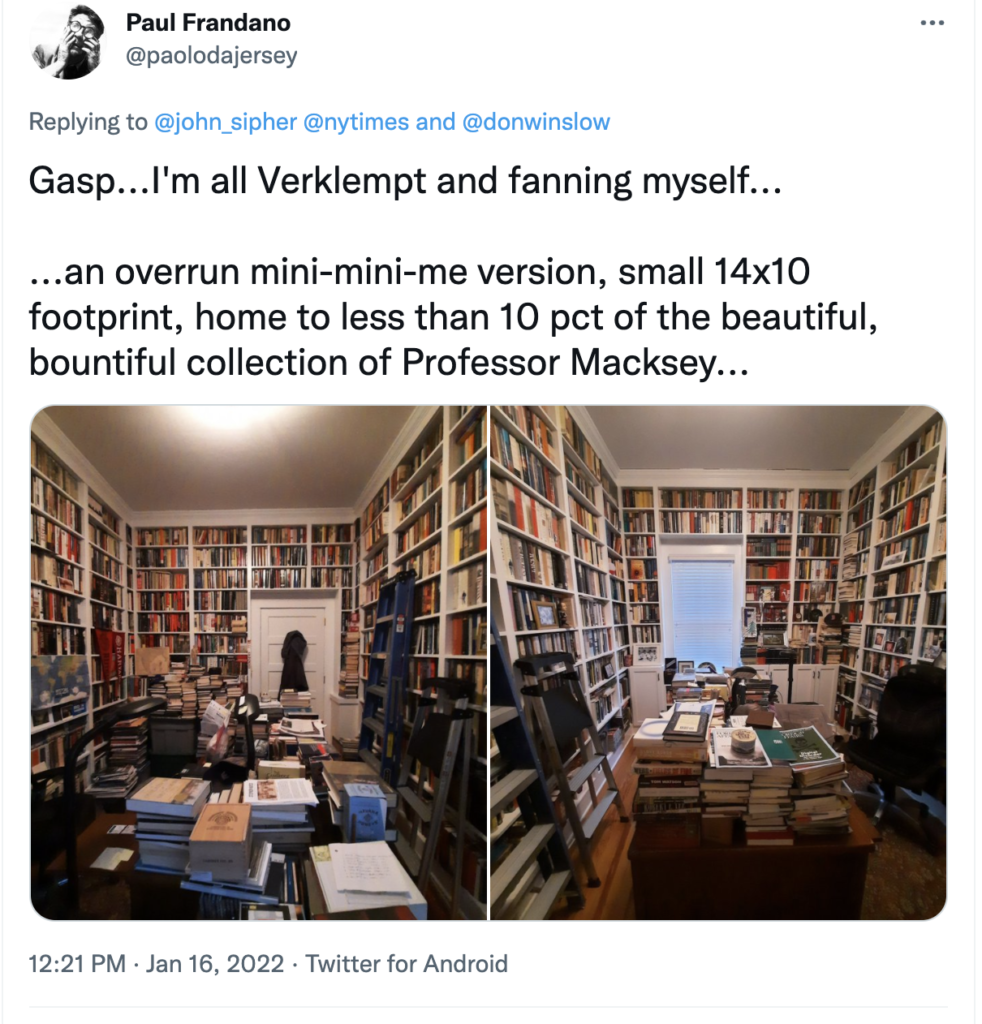
The legendary library that went viral – and deserves to.

It no longer exists in the real world – like Shangri-La, or Valhalla. But now it has a reality all its own. We’ve posted this photo before, in our stories about the notable booklover here and here and here. But now this room – and the book-crammed mansion around it – belongs to the universe.

The polymathic professor who called this place home didn’t achieve Twitter fame in his lifetime. Now he has it. This month, bestselling author Don Winslow tweeted a photograph and, since he has 761.6K followers, it’s gone viral. Kate Dwyer has penned a New York Times article about the twitterstorm, titled “A Library the Internet Can’t Get Enough of,” here.

Other rooms to explore, it’s endless…

A few excerpts:

Bathed in the buttery glow of three table lamps, almost every surface of the room is covered with books. There are books on the tables, books stacked on mahogany ladders, and books atop still more books lining the shelves of the room. “I hope you see the beauty in this that I do,” Mr. Winslow wrote in the tweet, which has been acknowledged with 32,800 hearts.

If you spend enough time in the literary corners of Twitter, this image may look familiar. It rises again just about annually, and the library has been attributed over the years to authors including Umberto Eco and buildings in Italy and Prague. As with other images featuring beautiful bookshelves, people go absolutely bananas for it. Mr. Winslow’s post received 1,700 comments, including one from a professor at Pace University who has been using the photo as his Zoom background. … He noted that there’s something comforting about the image, since “it’s a room you could happily get lost in.”

***

The library, it should be known, is not in Europe. It doesn’t even exist anymore. But when it did, it was the home library of Johns Hopkins professor Dr. Richard Macksey in Baltimore. (I was his student in 2015 and interviewed him for Literary Hub in 2018.) Dr. Macksey, who passed away in 2019, was a book collector, polyglot and scholar of comparative literature. At Hopkins, he founded one of the country’s first interdisciplinary academic departments and organized the 1966 conference “The Languages of Criticism and the Sciences of Man,” which included seminal lectures by the theorists Jacques Derrida, Roland Barthes, Jacques Lacan and Paul de Man.

Dr. Macksey’s book collection clocked in at 51,000 titles, according to his son, Alan, excluding magazines and other ephemera. A decade ago, the most valuable pieces — including first editions of Moby Dick, T.S. Eliot’s Prufrock and Other Observations, and works by Wordsworth, Keats and Shelley — were moved to a “special collections” room on the Hopkins campus. After Dr. Macksey’s death, a S.W.A.T. team-like group of librarians and conservators spent three weeks combing through his book-filled, 7,400-square-foot house to select 35,000 volumes to add to the university’s libraries.

Polymathic Professor Macksey

Surprise discoveries included an 18th-century Rousseau text with charred covers (found in the kitchen), a “pristine” copy of a rare 1950s exhibition catalog showing Wassily Kandinsky’s paintings, posters from the May 1968 protests when students in Paris occupied the Sorbonne, a hand-drawn Christmas card from the filmmaker John Waters, and the original recordings of the theorists at that 1966 structuralism conference. [Note: The story of that conference is included in The Evolution of Desire: A Life of René Girard – we wrote about that here.]

“For years, everyone had said ‘there’s got to be recordings of those lectures.’ Well, we finally found the recordings of those lectures. They were hidden in a cabinet behind a bookshelf behind a couch,” said Liz Mengel, associate director of collections and academic services for the Sheridan Libraries at Johns Hopkins. Several first editions by 20th-century poets and novelists sat on a shelf in the laundry room.

***

What would Dr. Macksey think if he knew his library had taken on a life of its own? “My dad liked nothing better than sharing his love of books and literature with others,” Alan Macksey said. “He’d be delighted that his library lives on through this photo.”


<<< Previous Series of PostssepNext Series of Posts >>>