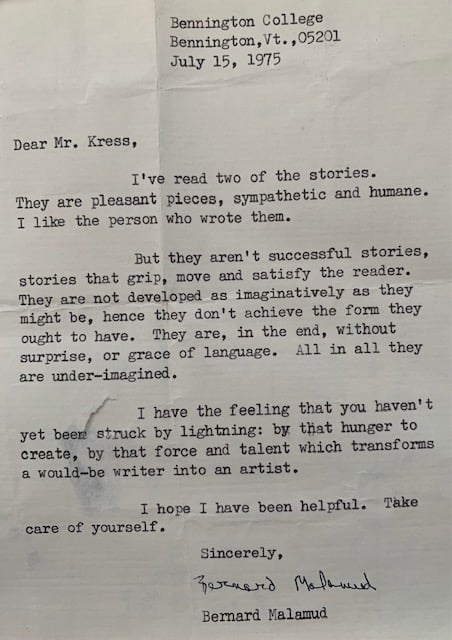
A few weeks ago, we featured a mind-blowing letter from Czesław Miłosz to Irish writer Adrian Rice. Here’s another great letter, from an older poet to a younger one – the recipient, Leonard Kress, was willing to share it with us. The letter was written by the eminent American novelist Bernard Malamud. And what a letter it is! Some of us are made by praise, and some of us are broken by it. And the same can be said of criticism.
So don’t cry. As you will note in the letter below, the crucial word is “yet.” Kress went on to publish several full-length poetry collections, fiction, non-fiction, reviews, and chapbooks. Here’s how I know him: he has also completed a new verse translation of the 19th century, Polish Romantic epic, Pan Tadeusz, by Adam Mickiewicz.
Some good news on my just-out book, Czesław Miłosz: A California Life, published by Heyday Books in Berkeley: a smashing review and an interview are just out:
Peter Schlachtewrites in Zzyzyva that “the biography makes the strong case that Miłosz’s poetry was irrevocably influenced by his experiences in California, from witnessing the social upheaval at Berkeley in the 1960s to spotting deer on his morning walks around Grizzly Peak.” Well, yes. How could he not be?
The publication of the book marks a curious coincidence: both of us had been in California for forty years. The poet died in 2004, but I continue totting up the years I have spent in California. It now stands at 42.
From the beginning of Schlachte’s review:
Czesław Miłosz: A California Life (256 pages; Heyday) is as much as portrait of a place as it is of a person. Cynthia L. Haven’s biography of the 1980 Nobel winner and towering voice in 20th century literature explores Miłosz’s work not distilled through the lens of his upbringing in Lithuania nor his formative years in Poland, but through his later life, residing on Grizzly Peak in Berkeley and teaching Slavic languages and literatures at UC Berkeley. From the opening pages, Haven writes beautifully of California’s history and landscape. Here she is describing California’s famously balmy weather: “At first, the unrelieved azure sky, the high-noon sun, is oppressive. The newcomer longs for shade, for dusk, for shadow, for stars. But one soon learns to sense the change of seasons not by snow or rain but rather by the difference between the radiant sunlight of summer that gives clarity and sharp relief to everything in its realm, and the lower slant of golden light in autumn, and then our haze-filled days of winter with lingering sunsets that diffuse light and scatter shadows.”
This is emblematic of Haven’s prose throughout the biography—her descriptions, regardless of topic, are not a means to an end. When she writes about California, it’s not merely to draw the connection between the land and Miłosz. Rather, Haven takes space to revel in the “hypnotic monotony” of the weather and the “alien, hyperreal” rocks along Highway 1. Her language is a place of energy, richness, and—fittingly—poetry.
Also this week, over at the Nob Hill Gazette, Paul Wilner interviews me on “The Americanization of Czesław Miłosz.” An excerpt:
“His formidable wisdom would leave anyone in the dust, but he wore it lightly,” she recalls. “Yet his lifetime of suffering lent him gravity, too. His home life was agonizing, with his first wife, Janina, dying by inches, and a son who went mad. But the suffering kept him searching. He was a restless, relentless learner. He never stopped.’’
Miłosz returned to Poland in 2000, by then an American citizen with a “second, very American wife, Carol,” Haven says. “His Polish friends could see the Americanization — he got more from California than he knew. He must have been haunted by California in his dreams.”
Read the whole thingover at the Nob Hill Gazette here.
Portrait of the artist (Ave Maria Möistlik/Creative Commons)
Today is the 86th birthday of Yevgeny Rein, one of Russia’s leading poets and winner of the prestigious Pushkin Prize. Fortunately, Los Angeles Review of Books editor Boris Dralyuk reminded me of the occasion on Twitter. What better way to celebrate than cite the comments of his friend, the Nobel poet Joseph Brodsky?
Both were in the quartet of “Akhmatova’s orphans,” the group of young poets who were protégés of Anna Akhmatovain the years before her death in 1966. The quartet also included Dmitri Bobyshevand Anatoly Naiman.
Brodsky called Rein “metrically the most gifted Russian poet of the second half of the 20th century.” He continues in a 1994 Commentary introduction:
“… the death of the world order for Rein is not a singular event but a gradual process. Rein is a poet of erosion, of disintegration—of human relationships, moral categories, historical connections, and dependencies of any nature binomial or multipolar. And his verse, like a spinning black record, is the only form of mutation accessible to him, a fact testified to above all by his assonant rhymes. To top it all, this poet is extraordinarily concrete, substantive. Eighty percent of a Rein poem commonly consists of nouns and proper names. The remaining 20 percent is verbs, adverbs, and, least, adjectives. As a result, the reader often has the impression that the subject of the elegy is language itself, parts of speech illuminated by the sunset of the past tense, which casts its long shadow into the present and even touches the future.
Brodsky teaching students in Ann Arbor, 1974
“But what might seem to the reader a conscious artifice, or at the very least a product of retrospection, is not. For the surplus materiality, the oversaturation with nouns, was present in Rein’s poetry from the beginning. In his earliest poems, at the end of the 1950s—in particular in his first poem, “Arthur Rimbaud”—one notes a kind of “Adamism,” a tendency to name things, to enumerate the objects of this world, an almost infantlike thirst for words. For this poet, the discovery of the world accompanied the development of diction. Ahead of him there was, if not life, then at least a huge dictionary.”
He concludes: “Russian poetry has never had enough time (or space, for that matter). This explains its intensity and wrenching quality—not to say hysteria. What has been created in the existent parameters over the last hundred years—under Damocles’ sword—is extraordinary, but too often colored by a sense of ‘now or never!'”
Well, read the whole thing here, along with Brodsky’s selection of his poems.
The Book Haven’s roving photographer Zygmunt Malinowski has photographed a New York City Covid Christmas for us – since we can’t be there in person during a time of plague. He shares his observations below, as well as his photographs.
On the Sunday before Christmas, Rockefeller Center as well as the surrounding streets were crowded, despite repeated dire news reports that Omicron was rapidly spreading in New York. Locals and visitors – mostly masked, with children in tow – came to see the lit-up Christmas tree and holiday window displays on 5th Avenue, yet the usual high energy of the event this year was subdued.
Bonwit Teller window display of “The Present Moment.”
“Rockettes Christmas Spectacular” closed after a short run. Other Broadway shows cancelled performances and several sports events shut down. This year the giant snowflake overhanging 57th Street and 5th Avenue was missing, instead the image of a Christmas tree, several stories high, stood out on a nearby Vuitton building corner. On several 5th Avenue sidewalks several holiday trees glistening with gold, were placed alongside a large yellow toy taxi and oversized gift wrapped boxes.
The promenade of Rockefeller Center, a pedestrian favorite because of its spectacular view of the tree and ice rink, was unusually crowded considering pandemic warnings, while the back area closest to the standing tree was completely closed off for security reasons after a decorated tree a few blocks away was set aflame by a vandal. Opposite the plaza across the street by Saks Fifth Avenue holiday windows, children were happy to meet visiting Mini-Mouse and Grinch (who normally roam Times Square), as they viewed “city children-inspired theme” featuring their dreams of games, getaway and carnival.
A few blocks up, the theme for the extravagant Bonwit Teller windows was “The Present Moment.” Around the corner at “Playfulness Moment” window, life-like cats and a few mice (some on fire escapes), seemed to be exploring a colorful city wonderland as amused passers-by watched, while several others bought hats and scarves from a street vendor to ward off the chilly breeze.
Among the hustle and bustle, there was a missing holiday presence – not so obvious to all but noticed by some New Yorkers: the absence of Salvation Army next to their red kettles, ringing bells for donations to the needy. The city Santas spreading holiday cheer were also missing, reportedly due to a Santa shortage.
According to the experts the pandemic won’t be over anytime soon. It will stay with us for several years, and we must learn to live with it. A short distance away, a “Rapid Covid Test” van was standing trailed by a long line as a reminder.
Bonwit Teller window display “Playfulness: The Present Moment.”
Christmas trees on the sidewalk. 5th Avenue
Christmas tree image on Louis Vuitton building, 5th Avenue and 57th Street
Children meet Minnie Mouse and Grinch at Saks Fifth Avenue.
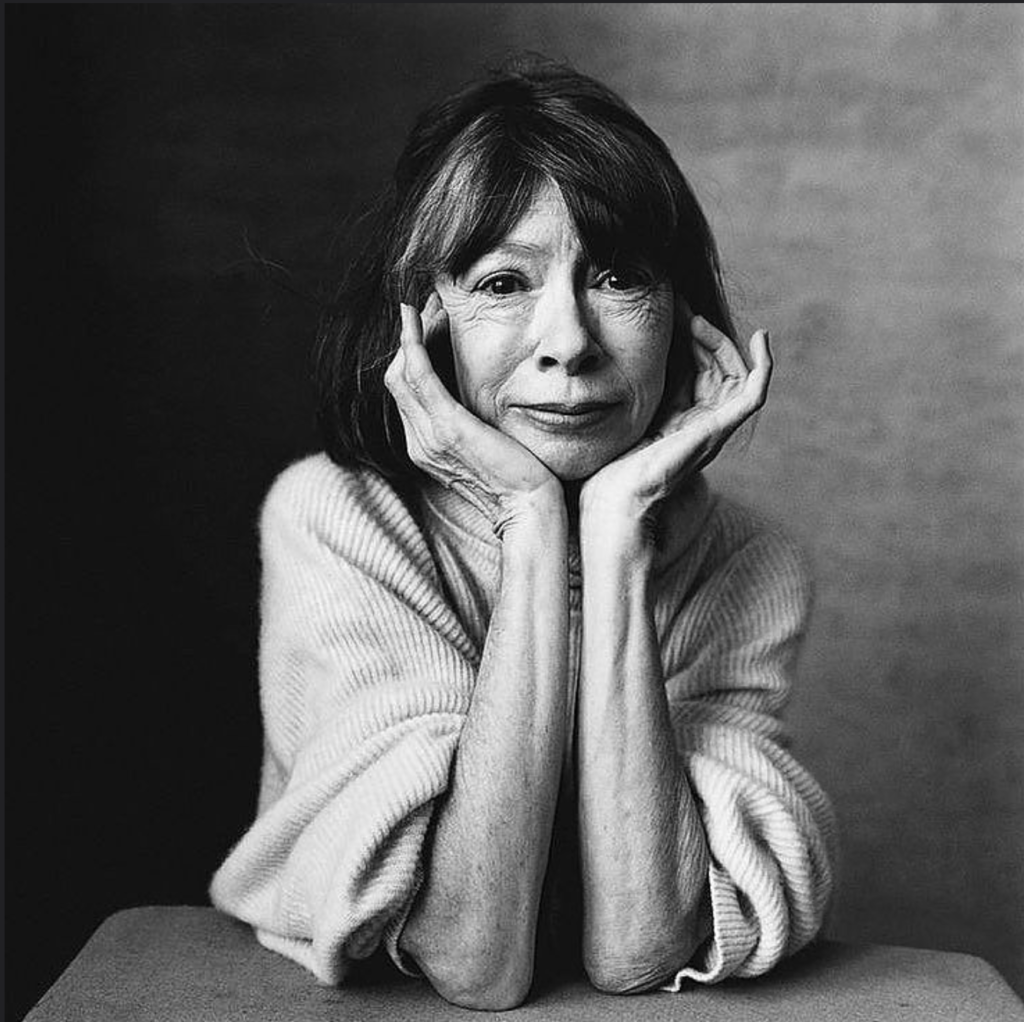
When Steve Wasserman, who now heads Heyday Books in Berkeley, left New York City to head the Los Angeles Times Book Review, author Joan Didion gave him some advice. Over a dinner at Elio’s on the Upper East Side, he recalls, “Joan gripped my forearm with steel in her fingers, and said: ‘Just review the good books.’ I laughed, and she said, ‘No, I mean something quite specific: Just because a writer lives in zip code 90210 doesn’t mean you have to pay attention. If the work is good, of course, but if it’s second-rate, or worse, don’t give it the time of day. To do otherwise is a formula for mediocrity, for the provincialization of the Review.‘”
Joan Didion died today of Parkinson’s Disease. She was the author of a score of books, including Slouching Towards Bethelehem in 1968. She won the 2005 National Book Award for Nonfiction and was a finalist for both the National Book Critics Circle Award and the Pulitzer Prize for The Year of Magical Thinking. Steve wrote an appreciation of her at the San Francisco Examiner here. An excerpt:
“Joan’s death at age 87 leaves a gaping hole in the landscape of California letters. There really was no one like her. She was, in a way, the least Californian of our state’s writers, if by ‘Californian’ we mean ever-sunny, full of optimism, wed to the conceit that history is weightless. Didion cast an unsparing eye on everything she examined. Her aesthetic, perhaps shaped as much by her early stint as a writer for William F. Buckley Jr.’s conservative National Review as it was by the dessiccated temperament of her Yankee forebears, was chilly, unforgiving, hard. She reminded one nothing so much as Chauncey Gardiner, the protagonist of Jerzy Kosiński’s Being There, who liked ‘to watch.’”
He followed her advice, and never reviewed bad books.
“She was always the consummate spectator, refusing to taint her stories with any personal intervention,” he wrote. “And yet, and yet. For all her enviable craftsmanship and her gimlet eye, Joan’s work often risked ethical failure. She was so good that often her readers didn’t tumble to the sleight-of-hand that was baked into the DNA of her peerless sentences. The pixie dust she cast on the subjects she covered was dazzling, so much so that you often found yourself succumbing to the spell of her style, much as a genius cinematographer stacks the deck by shooting wonderfully and compellingly composed pictures. When the movie ends, you find yourself unable to look at the world — at least for a time — in any other way. Joan’s style was pitch-perfect. The framing was always impeccable and her skill so good that you tended not even to notice that she’d had her thumb on the scale. She often mistook her own sensibility for a general condition. The Wall Street Journal got it right when a review of her book on the atrocities of El Salvador was headlined: ‘A Migraine in Search of a Revolution.”
“Joan was something of a forensic writer, looking askance at the foibles of people, unrivaled in her understanding of the use and abuse of the English language. No one was better at deconstructing the syntax of power inherent in bureaucratic idiom. She understood with exemplary acuity how entire ideologies are concealed in the warp and woof of everyday language. She knew the devil was in the details. Almost every piece she wrote is an autopsy of the mentalities that have shaped American culture. Unusual for a writer who started out as a supporter of Barry Goldwater, Didion drifted leftward, always wanting, as she once remarked admiringly of former Ramparts editor Robert Scheer’s journalism, to know who does the screwing and who gets screwed.”
I had met Poland’s greatest living poet, Adam Zagajewski, during my first visit to Kraków in 2008; he became an important reason to return to that jewel-box city. But I didn’t know of the connection between the two poets until The Los Angeles Review of Books‘ quarterly review (that’s right, the LARB has a print edition) published this marvelous homage: “Dark Coat: On Adam Zagajewski,” remembering the poet’s life and work before his shocking and unexpected death on March 21. The artistic reason for the tribute: the younger poet writes that “poetry is, finally, a mourning of each death, of every vanishing, witness to the ‘fury of disappearance.'” In this case prose will serve the cause as well.
According to Tomasz Różycki: “He followed his own path, and at times it seemed that he had been abandoned there, alone.” In writing a retrospective, he has written the best introduction to Adam Zagajewski and his work I know. (The translation of the essay, by the way, is by the poet Mira Rosenthal, a former Stegner Fellow at Stanford.)
A couple excerpts, the first one discussing Adam Zagajewski’s renowned poem, “To Go to Lvov”:
It was a very concrete and Polish kind of poetry, as much as Polish recollections of a lost Lwów can be — and, at the same time, it was detached from our cursed Polish problems. It was different, worldly, free. Not because the poems were detached from reality, as Polish critics often accused them of being, no — they were about reality itself, since our reality is twofold, if only because of the fact that it’s made up of the visible and the invisible and, in addition, to quote Hegel, it is threatened by the “fury of disappearance” and, therefore, only accessible to us within the blink of an eye. Moreover, poetry is the awareness of this vanishing, an elegy, a farewell to reality, a moment of mourning, necessary for us to be able to cope with the loss and to deal with the overabundance of memory.
I’m writing this because some things only happen once in a lifetime; we can pass them over in silence, but sooner or later that silence will overwhelm and engulf us. We can try to be thankful for them, however ineptly, but that gratitude by its very nature will be less than the gift we received. It’s helpful to gain distance from something in order to describe it. It’s even better if the object of description has been frozen, though that’s not possible in this case, even with the help of such a fixative as death.
***
“I’m writing this because some things only happen once in a lifetime.”
His poetry seemed different from anything I had read before, especially from contemporary poetry, which was marked by some king of gloomy heaviness, some kind of dry, wooden palpitation of language. Within Adam’s poetry, there was breath, space; it was not cramped, but exploding with light. Within it, there was no confusion or great toil; it was exactly as he had written — “a search for radiance.” And it was a poetry of joy — the pure joy of being, of admiration for beauty and the world, of being a child in the world. Joy like the joy of swimming in the warm Mediterranean Sea. He understood and wrote about the fact that, in the same sea, refugees were drowning, just as he understood and wrote about the fact that Lwów, a city that he loved dearly, was the site of so much death just before his birth. “A poem grows on contradictions, but it can’t grow over them,” as he wrote in “Ode to Plurality.” His poetry did not absolve him of anything, but it took on what poetry has taken on from the beginning: a celebration of human existence, of human life. The world is sometimes difficult and unbearable, but it also deserves to be praised, life deserves our gratitude and good that is more powerful than evil. Czesław Miłosz adored how Adam’s poems were so “intoxicated with the world.” His poems are often ecstatic, orgasmic, starting with the concrete and transforming into a hymn — as in, among many others, the poem “Lava,” which could be seen as an attempt to answer Adorno’s famous assertion that writing poetry after Auschwitz is barbaric. So many poems tell of flashes of happiness — of those times, as Schopenhauer says, when “we are, for that moment, unburdened of the base press of the will, we celebrate the Sabbath of the workhouse of willing, the wheel of Ixion stands still,” and which Nietzsche described with the phrase “eternal return.” Adam’s poetry is slight and piercing at the same time, and when I read it, I get the sensation that the calendar has made some kind of mistake again and forgot to note the holiday that the poem announces.