
For World Poetry Day: Tomas Venclova on Anna Akhmatova, Joseph Brodsky, and Czesław Miłosz

March 20th, 2012

Share

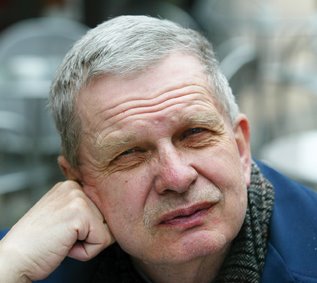
"Above all, love language" (Photo: Dylan Vaughan)

I met Tomas Venclova in Kraków last May, at the festival celebrating the Czesław Miłosz centenary.  After the grand fête closing the week-long events – an awards ceremony and concert at the Kraków Opera House – a few exhausted party-goers had had enough and were ready for bed.  Those of us who were weary of wine and hors d’oeuvres looked for a way to head back to the hotel in the rain. I was shoveled into a taxi with two men.  One of them was Tomas Venclova, Lithuania’s leading poet, and a writer who is sometimes mentioned as a Nobel candidate.

We had corresponded before, as he was one of the contributors to my book, An Invisible Rope: Portraits of Czesław Miłosz, and I had also heard him reading and reminiscing in the days before – the voice not quite what I had expected, the pitch slightly higher, the timber a little quirky, almost birdlike.

And here he was … or had I introduced myself in the crowded, jostling days before that night?  I must have. I honestly can’t remember.  But this is the first time I do remember, clearly:  he was in the front seat – silent … as tired as I was, perhaps? I could see his silhouette, with his trademark cap, against the rainy windows. I spent most of the time chatting with the fellow with whom I shared the back seat, someone who knew us both – and such are the tricks of memory that I cannot remember who, exactly, that third companion was. He has become a mysterious stranger, though the Lithuanian poet and I have struck up a correspondence since. A penpal by email or letter, from Yale, or Vilnius, or Paris – but  I haven’t seen him face-to-face since May.

Except on these newly released videos of interviews conducted last year in Paris.  I was greatly chuffed that Web of Stories has put them online to celebrate World Poetry Day on Wednesday, March 20.  It’s a good excuse to talk about this quietly marvelous poet – we aren’t likely to do anything later, on his birthday; it falls on September 11.

Here’s your chance to meet the poet and his poems.  Too few know the Vilnius-born poet and his work. Consider it a gift on the first day of spring.

From the email Web of Stories sent me:

In these absorbing clips, Venclova recounts his upbringing in Lithuania, including how he and his father had staunchly opposing political views. He also depicts how his first poems were dedicated to the Hungarian Revolution and despite not being published, they were circulated among groups of people: “I can say with pride that many, many years later when Hungary and Lithuania were free, I received a Hungarian medal for supporting the Hungarian Revolution then through my poems.

He also reminisces about his decision to emigrate to America, losing his Soviet citizenship, being offered a job at Yale and looks back over his career as a writer since leaving Lithuania: “When I left, I thought that it was possible that I’d end up as a lorry driver, for example, or a cleaner or a road layer. But that didn’t happen, I’d been a philologist and a writer and I remained a philologist and a writer.”

Alas, I was not able to embed the story of his meeting with Anna Akhmatova, and her interactions with Alexander Solzhenitsyn – you’ll find that here.

This clip describe Tomas’s meeting with Joseph Brodsky at Akhmatova’s funeral. My friend, the Lithuanian physicist Ramūnas Katilius, translated Tomas’s poems into Russian for the Nobel poet. “This was our triumvirate, our group.”

I didn’t realize that, in fact, that Tomas Venclova first brought Czesław Miłosz (or Česlovas Milašius, in the native Lithuanian) to Joseph Brodsky‘s attention. Here’s the story in the clip below.


Part Deux, with video clips discussing his help from Arthur Miller, his friendship with Timothy Snyder, and his unsuccessful attempt to save an imprisoned dissident, Viktoras Petkus, is here.

Part Deux: Tomas Venclova on Arthur Miller, Timothy Snyder, and an imprisoned friend

March 20th, 2012
Share

More on Tomas Venclova.  I can’t get enough.

Below, a few more clips from the celebration of World Poetry Day at the Web of Stories, continuing my post here.

I certainly didn’t know the playwright Arthur Miller had championed the Lithuanian poet and written a letter to the Communist authorities to protect him. Here’s the story:

I’ve written a lot about Timothy Snyder in these pages – but I didn’t know till now he is friends with Tomas (who is a great fan of Bloodlands). “A relationship with him is something you can be proud of,” he says of the acclaimed author.

A reading of his poem “Before the middle of July, Paris.” The poem is dedicated to the imprisoned Lithuanian dissident Viktoras Petkus. “Well, this is about how a person attempts to reach public opinion in the West, and doesn’t succeed.”

Ever wonder how cigarettes got that “glamorous” image? Hint: It wasn’t an accident.

March 18th, 2012
Share

Accidents happen (Photo: L.A. Cicero)

I ran into historian Robert Proctor at the Stanford Humanities Center Book Celebration earlier this month – or rather he ran into me.  I was drinking a glass of red wine to celebrate the fête honoring, among other tomes, An Invisible Rope: Portraits of Czesław Miłosz when … whoops!

That’s one reason I wear black – I like red wine, and yet tend to be both the perp and target of clumsiness … well, usually the perp.  (In photo at right: that’s moi at the back of the room in the tan jacket – but the blouse was black silk, whew!)  Once I had sopped the wine from my cleavage and neck, I recognized the author of Golden Holocaust: Origins of the Cigarette Catastrophe and the Case for Abolition, a book the tobacco industry tried to stop with subpoenas and hundreds of thousands of dollars in legal fees – I wrote about it here.

In an exchange of emails afterward, I learned that his book got a very big spread in Le Monde.  Author Proctor, who was the first historian to testify in court against the tobacco industry (in 1998), deserves it.  The link for 25 February article by Stéphane Foucart is here. It’s blogged at Le Monde here.

But I didn’t see a link anywhere for the fascinating sidebar, “Smoking Onscreen Pays Big Dividends.” An excerpt from the French article – my translation is all-too-fallible, but the dollar figures speaks an international language:

You can’t ignore it.  If you saw David Fincher’s screen adaptation of the first part of the Millenium – the trilogy of books by the writer Stieg Larsson – you know that Mikael Blomkvist smokes Marlboro reds. The journalist of integrity, a somber and solitary hero, orders his pack of cigarettes in a bar at the beginning of the film.  How many scenes are like this?  This type of investment is expensive.

In the secret documents from the industry – the “tobacco documents” – we find the agreement struck between Sylvester Stallone and Brown & Williamson in 1983: the actor took $500,000 for smoking several cigarette brands (Pall Mall, Kool, etc.) in his five films. It’s hardly rare.

This will break a few icons:  Paul Newman gets a car worth $42,307 for smoking such mark in The Last Stand (1984). Sean Connery gets $12,175 worth of jewelry to smoke in the James Bond film, Never Say Never (1983), Clint Eastwood gets a $22,000 car to show a particular cigarette in Sudden Impact (1983) … The examples are legion. Often, a studio makes the agreement directly with a brand – $350,000  for that Lark smoked in Licence to Kill (1989). In his book Golden Holocaust, Robert Proctor shows that the film was invaded by the cigarette almost from its inception.

In other words, it’s not an accident that cigarettes acquired a “glamorous” image – and to some extent maintained it decades after the bad news was out.

Glad France is getting the dismal news at last.  I saw a lot of people lighting up in Paris last month.  Those cigarettes cost a lot more than a wad of euros.

Hurry hurry hurry! Get your Simone Weil t-shirt! 10 hours to go!

March 17th, 2012
Share

Okay, Okay, I know. What on earth would Simone Weil, the brilliant philosopher and mystic who worked tirelessly on behalf of the poor and the disenfranchised, have thought of a t-shirt in her honor?  Nevertheless, I’m going to go for it. You should, too.

Here’s why: the funds go to her new movie, An Encounter with Simone Weil. Anything that promotes the work and writing of the woman Albert Camus described as “the only great spirit of our time” is a worthwhile endeavor, but this one especially so.  Here’s what filmmaker Michael Moore said of the film:

Julia Haslett has made a profound and moving film on a woman who continues to speak to all of us. Few Americans know of Simone Weil, but this deeply affecting documentary will make you want to know more. An Encounter with Simone Weil challenges all of us not to look the other way when we see the suffering of others. Julia’s personal journey through the film is both heartbreaking and inspiring.”

New York Magazine made it a “critic’s pick” with these words:

Haslett’s intensely personal and touching film about the twentieth-century French philosopher and activist uses Weil’s writings, spiritual journey, and short, sad life as a way to explore her own personal emotional landscape—from her relationship with postmodern capitalism to her relationship with her troubled family.

The event on Kickstarter is here, with 10 short hours to go.  A $75 pledge gets you a signed copy of Sylvie Weil‘s new book, At Home with André and Simone Weil.

Postscript:  So here’s the final tally: 247 backers signed in, pledging $20,077 on a $15,000 goal.  Good news!

Nelly Sachs. Ever hear of her? Nobel poet finds new recognition.

March 16th, 2012
Share

Ever hear of Nelly Sachs? I hadn’t, either.

Sachs is one of the more neglected Nobel prizewinners (she was awarded in 1966), so I was glad for the opportunity to familiarize myself with her life and work at an event last week in the Stanford Libraries’ elegant Bender Room.  That, and a few new books (including the collection at left, published last year by Green Integer), should spur at least a small revival of her name. But perhaps, as is so often the case, the revival is already underway and I am confusing cause with effect.

The Berlin-born Jewish poet (1891-1970) fled with her mother after the Nazis took power, and sought refuge in Sweden, with the help of her friend (and eventually fellow Nobelist) Selma Lagerlöf.  Always of fragile health, her life was marked by breakdown, paranoia, hallucinations.  Her name as a poet pretty much began at 50, with her emigration. She supported herself and her mother with her translations.

Her biographer

The Bender Room event with champagne celebrated the publication of Aris Fioretos‘s Nelly Sachs, Flight and Metamorphosis: An Illustrated Biography. The Swedish writer Fioretos described Nelly Sachs, in the postwar years, looking up at the crossing vapor trails in the sky and seeing first scissors, then a swastika; she was sure the airplanes were spying on her.  He suggested a bit of aural wordplay – “Sachs,” or “sax,” is Swedish for scissors.  She continued to write even while in a mental institution.

Axel Englund of Stockholm University said she revered Friedrich Hölderlin. He quoted her line “our bodies still sound with their mutilated music” – presaging  Adam Zagajewskis “Let Us Praise the Mutilated World,” no?

Someone read these lines of hers:

We stars, we stars
We wandering, glistening, singing dust –
Earth, our sister, has gone blind
Among the constellations of heaven –

He read excerpts from the letters.

The actor/director Andrew Utter, founder of L.A.’s Uranium Madhouse Theater read from her letters.  After his reading, he kindly gave me the xeroxed pages he had read. But several days later he faxed me this one, somehow overlooked in the handful he had given me.  On the page was this 1958 letter to her “Dear poet and dear person Paul Celan“:

For me it is joy enough to have a few friends, but you understand me, dear poet – I still wanted something else. I still have to accustom myself to joy, too, after so much suffering, and when the Swedish poets awarded me their newly endowed poetry prize, I couldn’t take anything in and became quite confused, that I, a foreign-language refugee, should be given so much honor.

There is and was in me, and it’s there with every breath I draw, the belief in transcendence through suffusion with pain, in the inspiritment of dust, as a vocation to which we are called. I believe in an invisible universe in which we mark out our dark accomplishment. …”

There the fading text on the faxed page disappeared in to the following, unsent page. I wonder what the rest of the letter said.

Celan replied to her of course, with his own poem, “Zürich, Zum Storchen” [Zurich, at the Stork Inn]. Here is a bit of it, in John Felstiner‘s translation:

Our talk was of your God, I spoke
against him, I let the heart
I had
hope:
for
his highest, death-rattled, his
wrangling word –

Your eye looked at me, looked away,
your mouth
spoke toward the eye, I heard:

We
really don’t know, you know,
we
really don’t know
what
counts.

Another souvenir from Paris…

March 15th, 2012
Share

My charming host

I’ve received another souvenir from Paris, following last month’s talk at the American University on “Old Wine in New Bottles: Literary Journalism as Cultural Translation.” This time the ever-gracious Center for Writers and Translators has added a few sound clips from the workshop session.

They described them this way:

She joined us to discuss the changing face of cultural and literary journalism, touching on Twitter, Polish poets Czesław Miłosz and Adam Zagajewski, her memories of studying with Joseph Brodsky at the University of Michigan, the unexpected heroism of Marina Tsvetayeva‘s husband, and how to review books that don’t exist.

The sound clips are on the CWT website here. I share the new site with translators Richard Pevear and Larissa Volokhonsky discussing Nikolai Leskov. (I’ve written about the translating duo here.)

Dynamic duo

Meanwhile, my correspondence with my charming host for the visit, Daniel Medin, yielded this photo, more flattering (and more true-to-life) than the one I’ve used in earlier posts.

Daniel, by the way, is associate professor of comparative literature at the American University, associate editor of the Cahiers Series (we’ve written about that here), and the European editor of Quarterly Conversation (which I discussed here).

(Special thanks to Madeleine LaRue for coordinating the website effort!)


<<< Previous Series of PostssepNext Series of Posts >>>