
Huckleberry Fi (n’s removed) — continued

January 5th, 2011

Share

Actually, this headline came from Brandwine Books here, but we liked and so we stole it.  Commenting on the Entertainment Weekly article (not our first article which we posted on Dec. 31 here) about Alan Gribben‘s forthcoming NewSouth edition of Mark Twain‘s Huckleberry Finn, Mr. Brandywine  notes:

Every instance of the ‘n’ word (you know the word I mean) has been changed to ‘slave.’ And every instance of ‘Injun’ has been changed to… something. They don’t say what.

‘Is this really a big deal?’ the columnist asks.

Yeah, I kind of think it is.  …

My opinion (I could, of course, be wrong), is that if a student is old enough to understand the extremely sophisticated themes of Huckleberry Finn, he or she is old enough to understand that the “n” word, while always offensive, was in very common use in Mark Twain’s time, even by black people themselves. I think that’s a fact worth knowing. Educational, even.

‘Ah ha!’ says someone. ‘But you’re saying “n word” yourself! You’re a hypocrite!’

‘Silence, Imaginary Interlocutor!’ say I (I might as well. Anthony Sacramone isn’t using the phrase much these days [I just tried to link to his dormant blog, but now it won’t let you in without a Google account]). The truth of the age I live in is that the ‘n’ word is no longer in common use, except as an insult (and in rap lyrics). If I tried to use it in Mark Twain’s way, I’d be as false to my own world as it’s false to his to clean it up in Huckleberry Finn.

I hold (again, I could be wrong) that when it comes to speech, the Victorians were able to express themselves with far greater freedom than we enjoy today.”

I’m not so sure.  Didn’t the Victorians find it to risqué to mention piano legs, and isn’t that why they put those silly little doilies on them?  Be that as it may, I think the 19th century has taken a bum wrap for prudery, which was heavily localized in the upper middle classes.  The lower classes recruited for the workhouses and brothels knew little about it.
Among the blog’s commenters is “Phil,” who says:  “This is ridiculous, and I hope the book does not sell.”

Not a chance, sport.  I have only two words to say to Phil:  Textbook Sales.

The New York Times weighed in yesterday, contributing this to the discussion:

“I’m not offended by anything in ‘Huck Finn,’ ” said Elizabeth Absher, an English teacher at South Mountain High School in Arizona. “I am a big fan of Mark Twain, and I hear a lot worse in the hallway in front of my class.”

Ms. Absher teaches Twain short stories and makes “Huck Finn” available but does not teach it because it is too long — not because of the language.

“I think authors’ language should be left alone,” she said. “If it’s too offensive, it doesn’t belong in school, but if it expresses the way people felt about race or slavery in the context of their time, that’s something I’d talk about in teaching it.”

Doug Mataconis at Outside the Beltway notes that “it’s fairly obvious that Twain is condemning racial prejudice and that one of the central themes of the book is the process by which Huck discovers that the things he’d been taught by society by blacks were wrong, and that his companion him was, in fact, an heroic figure. Twain’s use of a word that, even in his time, was meant to be insulting and demeaning, was deliberate and removing it because of ‘sensitivities’ seems to me to detract significantly from the overall power of the novel.”

Kevin Drum at Mother Jones reads this and comes up with a different conclusion:

But the problem with Huckleberry Finn is that, like it or not, most high school teachers only have two choices these days: teach a bowdlerized version or don’t teach it at all. It’s simply no longer possible to assign a book to American high school kids that assaults them with the word nigger so relentlessly. As Twain scholar Alan Gribben, who led the bowdlerization effort, explained, “After a number of talks, I was sought out by local teachers, and to a person they said we would love to teach [Tom Sawyer] and Huckleberry Finn, but we feel we can’t do it anymore. In the new classroom, it’s really not acceptable.”

Given that choice, I guess I’d bowdlerize.

First the Book Haven — then the world. The Huck Finn “n-word” ignites the nation.

January 4th, 2011
Share

A classic: "a book which people praise and don't read."

Well, well, well.  We don’t like to brag … not much, anyway … but the whole world seems to have picked up on the Huck Finn and the n-word story, which started here a few day ago, thanks to a reader tip.  (If you find a story prior to our Dec. 31 post, let us know. We’re curious.)  Another case of the power of the blog, even a relatively obscure one.  We’re not Huffington Post, after all.

We started it, Books Inq picked it up Jan. 2, Bookshelves of Doom carried it later in the same day … then Publisher’s Weekly ran a story yesterday, the Entertainment Weekly published an article here, which was deluged with over 1,000 comments.

Unsurprisingly, EW writes:

Unsurprisingly, there are already those who are yelling “Censorship!” as well as others with thesauruses yelling “Bowdlerization!” and “Comstockery!”

Actually, we used the word “Bowdlerization,” and think people are smart enough to know the origins of the word and the 19th century editor Thomas Bowdler who made Shakespeare “respectable” for the fainting couch crowd.

EW continues:

The original product is changed for the benefit of those who, for one reason or another, are not mature enough to handle it, but as long as it doesn’t affect the original, is there a problem?

Frank Wilson at Books Inq exploded at that one in a post titled “Dumb Reaction“:   “Well, the point is that it does affect the original. Something else from Wittgenstein: ‘One age misunderstands another; and a petty age misunderstands all others in its own nasty way.'”

CNN picked up the EW story — and from there, the world.  From CNN:

Quote of the day: “What’s next? We take out the sexual innuendo from Shakespeare? Or make Lenny Small “normal”? How about cut all the violence out of Clockwork Orange? ” –AA

A pretty close paraphrase of what we said.

A couple more comments:

jujube said, “So it’s a children’s edition of ‘Huckleberry Finn.’ Adults can and should still read the original. I don’t get the outrage.”

Bobby said, “So we take the ‘n’ word out of Huck Finn, but all of these rappers and hip hop stars still say it every other word, and that’s fine?”

Publishers Weekly actually went so far as to write the n-word, which occurs in Twain’s book 219 times.  It also noted that Twain himself defined a “classic” as “a book which people praise and don’t read.” This one may be different.  Its article also notes that the new edition dispenses with the “in-word” — that is to say, “Injun.”

Dr. Gribben recognizes that he’s putting his reputation at stake as a Twain scholar,” said [NewSouth cofounder Suzanne] La Rosa. “But he’s so compassionate, and so believes in the value of teaching Twain, that he’s committed to this major departure. I almost don’t want to acknowledge this, but it feels like he’s saving the books. His willingness to take this chance—I was very touched.”

We posted a reply from NewSouth this morning as a postscript on our original post.

By the way, Garrison Keillor wrote a reaction to the newly published Autobiography of Mark Twain in the New York Times a few weeks ago here: “Samuel L. Clemens was a cheerful promoter of himself, and even after he’d retired from the lecture circuit, the old man liked to dress up as Mark Twain…”  Spoiler:  He didn’t like it much.

The year in review, 2010: Cheer up! Things could be worse!

January 2nd, 2011
Share

Cheer up! Things could be worse!

There’s lots to post, but little time.  I feel obligated to write something to acknowledge the new year and wrap up the old, but I’m still recovering, and my therapist says Dave Barry has done it so much better than I ever could, in the Miami Herald here.

I don’t usually like his stuff, but I liked this.

Barry reassures us it is not the worst year ever: “There have been MUCH worse years. For example, toward the end of the Cretaceous Period, the Earth was struck by an asteroid that wiped out 75 percent of all the species on the planet. Can we honestly say that we had a worse year than those species did? Yes we can, because they were not exposed to Jersey Shore.”

So here are a few of his highlights for 2010:
  • January: The runaway movie hit is Avatar, a futuristic epic about humans who travel to an alien planet to mine a precious mineral that they believe will give them the power to emit believable dialogue. This being a James Cameron movie, they fail.
  • April: when the Deepwater Horizon rig explodes in the Gulf of Mexico after being struck by a runaway Toyota Camry. BP initially downplays the magnitude of the problem, claiming that the resulting oil leak is smallish and might go away on its own or even prove to be, quote, “nutritious for oysters.” Soon, however, large patches of crude oil are drifting toward land, and it becomes clear that this is a major disaster — a challenge that we, as a nation, will have to meet, as we have met other challenges, with a combination of photo opportunities, lawsuits and tweeting.

    And kitschy, too

  • April: President Obama outlines his bold vision for the U.S. space program, calling for a manned mission to establish comprehensive health-care reform on Mars by 2030. The president also signs a historic arms-reduction treaty with Russian President Dmitry Medvedev under which both countries will destroy one-third of their older nuclear missiles by upgrading them to Windows Vista. In a related development, Iran purchases $78 million worth of used nuclear-missile parts on Craigslist.
  • May:  The pesky Deepwater Horizon oil spill dominates the news as BP tries a series of increasingly desperate measures to plug the leak, including, at one point, a 167,000-pound wad of pre-chewed Juicy Fruit. President Obama, eager to show that he is on top of the situation, develops severe forehead cramps from standing on the shore and frowning with concern at the water.
  • July: The month ends on a troubling note as the United Nations Security Council votes unanimously to send a peacekeeping force to quell Mel Gibson.

    Peacekeeping force en route

  • August: In other economic news, the first family, seeking to boost Gulf tourism, vacations in Panama City, where President Obama, demonstrating that the water is perfectly safe despite the oil spill, plunges in for a swim. Quick action by the Secret Service rescues him from the jaws of a mutant 500-pound shrimp sprouting what appear to be primitive wings. The first family hastily departs for Martha’s Vineyard to demonstrate that the water is also perfectly safe there.
  • September: The 2010 election season enters its final days with polls showing that Congress enjoys the same overall level of voter popularity as hemorrhoids. Incumbents swarm out of Washington and head for their home districts to campaign on the theme of how much they hate Washington, in the desperate hope that the voters will return them to Washington.
  • October: In the month’s most dramatic story, the 33 trapped Chilean miners are all brought safely to the surface, only to be sent right back down because they failed to bring up any copper — which, as the mining company points out, “was the whole point of sending them down there in the first place.” Meanwhile in France, millions of workers again take to the streets to demonstrate, in no uncertain terms, that they are French.
  • Unfortunately, the ball dropped slowly

    November: The lone bright spot is provided by the president’s deficit-reduction commission, which, after months of work, releases a draft of a tough plan that, if Congress can muster the backbone to enact it, would reduce the deficit by trillions of dollars and put the nation on the path back to fiscal sanity. This is a welcome bit of comic relief in the stressed-out capital; everybody enjoys a hearty bipartisan laugh, then gets back to maneuvering for the 2012 elections.

  • December: As the year finally draws to a close, all eyes are on Seaside Heights, N. J., where MTV plans to ring in the new year by dropping a ball containing Nicole “Snooki” Polizzi, one of the leading bimbos of Jersey Shore. Millions eagerly tune in, only to find that the ball has been attached to something that makes it drop slowly. A bitterly disappointing end to a bitterly disappointing year.

***

Barry, by the way, currently has the distinction of playing lead guitar in the band The Rock Bottom Remainders, whose other members include Stephen King, Amy Tan, Ridley Pearson, Scott Turow, his brother Sam Barry, his sister-in-law Kathi Kamen Goldmark, and Mitch Albom.

But wait! It gets better! More on Huck Finn and the n-word.

December 31st, 2010
Share

Voilà!

Yesterday, I wrote about the latest flap over Mark Twain‘s use of the n-word in Huckleberry Finn. NYC Councilman Charles Barron apparently thinks the book should be banned:  “I find it interesting that Huckleberry Finn is a classic when it says [the n-word] 200 times,” he said.

Barron is not alone in his reservations.  Poet and professor Sam Gwynn made this comment on yesterday’s post:

Gwynn...a p.o.v. to be reckoned with

“Frankly, I just can’t teach it any longer. I know it’s great, and I can lecture for a day or so about how Twain is being faithful to the dialects and to the way that people spoke back then. But trying to lecture about its literary merits takes a back seat when I see how African American students (I’m talking about teenage sophomores, taking the class for core credit) are reacting to the iterations of THAT WORD. The problem is that Twain doesn’t distinguish between those who are using the word in a “kindly” manner (we could probably assume that this is the only word for black people that Huck has ever heard) and those who are using it an an epithet. Used indiscriminately in these ways, it just makes everyone in a classroom uncomfortable. Maybe if I were a better (or younger) teacher I could use this book to challenge all kinds of assumptions about language and art. I just don’t find myself up to the fight anymore, at least at the sophomore level. I think this is a pretty good 2/3 of a novel, but I really wonder why it has become canonized as the GAN.”  [That’s the Great American Novel for the uninitiated.]

Gribben's got the answer?

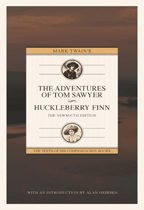
Now, here’s the news flash:  A constant reader tipped me off that Barron’s problem is about to be solved by NewSouth books!  Dr. Alan Gribben is publishing a new edition that, among other innovations, dispenses with the n-word altogether.

Gribben explains that Twain’s novels “can be enjoyed deeply and authentically without those continual encounters with hundreds of now-indefensible racial slurs.” It is the first volume to wash out Twain’s mouth with soap.  Gribben believes that the presence of the n-word has gradually diminished the readership of Twain’s masterpiece.

Gribben said that another radical departure from standard editions is that these will be published as the continuous narrative that he says the author originally envisioned. “People during that time did not think of him as a fiction writer,” the Twain scholar told The Montgomery Advertiser. “Twain had difficulty at times developing plot lines for his novels and much preferred his travel books.”

But dumping the n-word is clearly the controversy that will boost sales.

Original as rough draft for translator

I think he’s on to something.  As a woman, I have always had issues about the ending of Shakespeare’s Taming of the Shrew. You know, the bit where Kate kneels down and blathers on about being her husband’s slave.  Surely one of our modern-day blank verse wizards could crank out something a little less offensive?  For that matter, I would like to see the b-word, the c-word, and the w-word eliminated from our public discourse about females running for office.

And there’s way, way too much violence in the Bible.  Lots of foreskins gathered, a number of rapes (including one gang rape), massacres on a regular basis. Think of all those psalms that begin with rivers or vineyards and end with a wish that someone’s brains be dashed out against a wall.  These nasty bits could do with a serious editing and revision … whoops!  Stephen Mitchell already has.

Seriously, though.  Sam Gwynn’s objections to the book are not to be taken lightly — Sam is a smart guy.  But the Bowdlerization of Twain concerns me.

The new Twain will be out in February.  Can we wait?

Postscript on 1/4:  NewSouth books replies in the comments section below:

Cynthia and Sam, thank you both for your thought-provoking comments about this. The best thing NewSouth’s edition of Adventures of Tom Sawyer and Huckleberry Finn could do is generate more discussion about race, language, and literature, and we were pleased to read your post.

Again, we’ll note that the inspiration for this volume of Twain’s books came from Dr. Gribben’s actual conversations with teachers, uncomfortable with or in some cases restricted from teaching especially Huckleberry Finn because of the language within. We see our edition as a teaching tool with numerous applications, from the teacher who wants to teach Twain’s works without getting into the language controversy, to a teacher who wants to teach the NewSouth edition side-by-side with another edition to specifically discuss controversial language and responses to the two works. Before this edition, that wouldn’t have been possible.

The publisher promises to post the introduction to the book on its website soon.

Postscript on 1/5:  Hey, we started a fire with this one!  First the Book Haven, then the world: check it out here.

Dick Gregory, Charles Barron, Huck Finn, and the n-word

December 30th, 2010
Share

Wants to ban Twain?

Mark Twain was “so far ahead of his time he shouldn’t even be talked about on the same day as other people,” according to comedian and author Dick Gregory.

His friend, Charles Barron, apparently doesn’t agree.  The New York City Councilman and former Black Panther took offense at a Brooklyn principal’s attempt to stop a volume of sexually explicit poems written by Barron’s goddaughter, Tylibah Washington, from being distributed at school.  “I find it interesting that Huckleberry Finn is a classic when it says [the n-word] 200 times. Tylibah’s book is the opposite. It’s very inspiring. I’d like to see Huckleberry Finn banned.”

Shelley Fisher Fishkin, writing in today’s New York Daily News, defended Huck, and she packs a heavy punch [an updated version of the editorial accommodates the latest n-word flap: it’s here — ED.]

“Barron claims to have entered politics to fight bigotry and to protest the sidelining of black voices in the cultural conversation. It’s ironic, therefore, that the principle he’s invoking to ban Mark Twain’s anti-racist classic — that books filled with the n-word shouldn’t be taught – would also ban from the nation’s classrooms many of the greatest and most inspiring works by black writers in the 19th and 20th centuries.

Naughty poet?

The n-word is key to critiques of racism found in nonfiction from Frederick Douglass’ “Narrative,” to W.E.B. Du Bois’s Souls of Black Folk, to Richard Wright’s Black Boy, to James Baldwin’s Notes of a Native Son, to The Autobiography of Malcolm X.

It is just as central to critiques of racism in Paul Laurence Dunbar‘s classic story, ‘The Ingrate,’ and Countee Cullen‘s poem ‘Incident,’ not to mention novels including Richard Wright‘s Native Son, Ralph Ellison‘s Invisible Man, David Bradley‘s Chaneysville Incident, Ernest Gaines‘s A Lesson Before Dying – and, yes, Twain’s Huck Finn.

For to expose a racist society for what it is, you have to show racists as they are, speaking as they would speak.

The gifted black satirist and sportswriter, the late Ralph Wiley, who claimed Twain as his most important teacher, wrote that ‘there is not one use of [the n-word] in Huck Finn that I consider inauthentic, and I am hard to please that way.'”

She also notes the writers inspired by Twain, including Kenzaburo Oe, Japan’s Nobel Laureate.  David Bradley, who won the Pen/Faulkner prize for The Chaneysville Incident, credits Twain with having inspired him to become a writer in the first place, says Fishkin.

And of course she mentions Dick Gregory, who we wrote about here commenting on his best-selling autobiography Nigger (excerpt from Gregory’s essay in Fishkin’s new book, The Mark Twain Anthology: Great Writers on His Life and Works):

“People were afraid to ask for my book, and bookstore owners were afraid to put it in their stores.  Some Black folks would go into a bookstore and say, ‘I want one of Dick Gregory’s what-you-call-it.’  They just couldn’t say the word. And White folks would say, ‘You named that book a title I just can’t say.’ Or they would complain, saying, ‘I just can’t stand the name of your new book.’ I didn’t hear White folks complaining about the word nigger when I was growing up.  I only heard them using it.  If they had complained about the word nigger in the past, there would not have been a need to name my book Nigger. Titling my book Nigger meant I was taking it back from White folks.  Mark Twain threw it up in the air and I grabbed it.”

Quite a wrap-up for the Year of Twain.

Postscript: Just got a note from Patrick Kurp of Anecdotal Evidence:

I just read your Twain post. Well done. I visited Hannibal, Mo., Twain’s home from the age of four, in the summer of 1990. The street ends at the Mississippi River. At the foot of the street, which was a boat landing stood one of those cast-iron historical markers on a post with all the expected stuff about Twain and Huck, etc. Mentioned on the marker was “[ ] Jim.” The brackets represent, obviously, “Nigger,” but a piece of steel plate had been welded over the word. Every literate person who looked that sign saw the offending word, in effect, underlined, italicized and written in boldface. Its censoring screamed it out louder than six letters ever could.

By the way, I spent a day with Dick Gregory, around 1984. I was a reporter in Richmond, Ind., the home of Earlham College where he was speaking. I had a ball with him. He was strident about vegetarianism and so forth but I remember him, during a lecture, sticking his hand in a bag of barbecue potato chips, getting it all greasy and red, and saying, “Look at this shit. What is this shit?” A naturally funny guy.

Some of us over at the Book Haven are rather strident about vegetarianism ourselves…

What? No Kepler’s?

December 29th, 2010
Share

10,000 square feet of books

On Christmas Eve, Flavorwire named the top ten U.S. bookstores here. The article begins in this user-friendly way:  “Bookstores are dying. They’re dying because of jerks who are too cheap to buy a hardcover, or even a paperback, and too lazy to get a library card.”  Odd, for an article that is running online.

Two bookstores in Seattle made the cut, and Powell’s of Portland.  San Francisco’s City Lights is named — no surprise there, either:

Justly famous: City Lights

“Started by poet Lawrence Ferlinghetti and Peter D. Martin, City Lights Booksellers and Publishers in San Francisco, CA offers the best in classic and newly-released literature. Their claim to fame is publishing Allen Ginsberg’s Howl and Other Poems then suffering through the resulting obscenity trial. After all that, the store was designated a San Francisco landmark. Supplementing their in-store performances and promotion is their delightful podcast with news on releases and upcoming events.”

Kepler's in 1955

The comments are filled with protest.  Several nominate San Francisco’s Green Apple Books and one reader voted for Diane Goodman’s Ocean Avenue Books.  But, surprise:  no Cody’s and Moe’s from Berkeley.  And … what?  No Kepler’s?

After all, the fame of Kepler’s is international.  Salman Rushdie, the Shah of Blah himself, lamented during a recent visit that he had “never made it to Kepler’s before” and added “I am delighted to finally find my way to Menlo Park.”

Roy Kepler

Kepler’s was founded in May 1955 by peace activist Roy Kepler. The Grateful Dead gave live shows there early in their career, and they, along with folk singer Joan Baez, often made appearances at the bookstore.  (Management assumed by Clark Kepler, Roy’s son, in 1980.)  Customer loyalty is fierce.

In 1990 Publishers Weekly named Kepler’s “Bookseller of the Year.” However, by 1996, large discount warehouses and Amazon.com were revolutionizing the bookselling business. Kepler’s closed its doors on August 31, 2005.  That’s where the fierce customer loyalty kicked in:  The local community responded with demonstrations. Thousands gathered on the expanse of what is now known as “Kepler’s Plaza” to express support and protest the loss.

The bookstore re-opened in October 2005.

Kepler’s story is told in the documentary, Paperback Dreams, which aired on PBS, tells the tale of two landmark independent booksellers and their struggle to survive. Cody’s and Kepler’s Books helped launch a counter-culture, and for 50 years have protected free speech and celebrated intellectual inquiry. At one time or another, the owners of these stores were harassed, vandalized, threatened, and even suffered acts of terrorism for simply selling books. But their future is uncertain in our fast digital world.  You can order the DVD here.


<<< Previous Series of PostssepNext Series of Posts >>>