Pakistani poetry truck, making the rounds…

November 21st, 2010
Share


Created with Admarket’s flickrSLiDR.

In America, we have National Poetry Month and a few scattered lines on subways and the buses. But we’re not a patch on Pakistan.

One of the lesser known sides of Pakistani life: the chaotic public transport blossoms in color with buses, trucks, rickshaws and taxi cabs that are decked out in bright paint and elaborate designs — and the best part for many is the poetry.

PRI’s Fahad Desmukh reports:

“This is in a very real sense a public conversation which is not in books, which is not in the type of middle class milieus – it’s on the street,” said Manan Ahmed, professor of Islam at the Free University of Berlin.

“The reason these things exist on public transportation is because these conversations are existing in places where the folks driving these vehicles hang out.”

Of course, the drivers aren’t writing these verses in a vacuum. Poetry plays a very prominent role in popular culture here – not just as a form of art, but also as a part of everyday conversation. People use couplets to explain a situation, something like the way proverbs are used. But for the owners of public transport vehicles, it’s also about defining your public identity.

Photos: Fahad Desmukh

Like the snippets that appear on U.S. billboards in April, the Pakistani poems are short — usually just a couplet, two lines with the same meter.

The PRI site translates a couple examples. Here’s one:

“Oh nightingale, why do you cry? Are you without a flower?
I should be the one to cry, for I have no peace in my life.”

Well, as they say, poetry is what gets lost in translation…

The non-award of the Wendy Wasserstein Prize … and the non-award of the Nobel to Liu Xiaobo

November 20th, 2010
Share

What would Wendy do?

The non-award this year of the Theatre Development Fund’s Wendy Wasserstein Prize for young women playwrights — the TDF considered no one up to snuff — has caused a great kerfuffle.  See New York’s Time Out here. She Writes reproduces the strident dialogue between Kamy Wicoff and TDF honcho David LeShay hereFeministing posts its reprise of the conflict here.  A Facebook petition is here.

The upshot:  The TDF is reconsidering.

The $25,000 award is named for Wendy Wasserstein, a popular playwright who died at age 55 from cancer — that’s a lot of money, and I yield to no one in understanding how hard a writer’s life is. I made my living as a free-lance journalist for a decade, and that when I was no longer young and also had a kid to support alone.  The award and recognition could make a big difference in a young playwright’s life.

Nonetheless, doesn’t an award have a right to determine its own criteria, however distressing that may be to the applicants? It’s always a punch in the face for a writer when a jury decides that no award was better than awarding you — especially if the criteria for judgment is bureaucratic, subjective, political, wrong-headed.  Still …

I have no doubt of the enormous gender bias in the theater world, and pretty much everywhere else. (Look at politics.  I’ll never forget the landmark misogyny of the 2008 elections, when the most accomplished woman ever to grace American politics was treated with truly ugly slurs, culminating in a major broadcast journalist called for her to be snuffed while the major feminist organizations were … silent.)

The Facebook page makes the strongest argument: “Your claim that ‘none of the plays were truly outstanding in their current incarnation’ sends a discouraging message to early career theatre artists at a time when these artists need more support than ever. The prize is not to support a production of the play, but the promise of the writer.” [italics mine]

Feministing‘s resorts to retro language, accusing the TDF of reproducing “hierarchies of privilege”  they meant to redress, though heaven knows its too true that “it’s often those who are already have many accolades who are likely to receive more of them.”  Wicoff resorts to a demanding tone and capital letters (“If you can’t figure out a way to give a prize to ONE WOMAN PLAYWRIGHT in the UNITED STATES OF AMERICA, YOU are the problem, not the applicants or the by-laws or whatever.”)

At the end of the Wicoff’s exchanges, she asks, “Anybody else feel a She Writes Prize coming on?”

Now there‘s an idea.

I understand that Wasserstein was a fabulous woman and a beloved friend to many.  But her plays always struck me as formulaic, built on TV models of short scenes and clincher lines, which were often blandly Gail Sheehy-esque:  “The real reason for comedy is to hide the pain.”  And sometimes not even true: “You’re the unfortunate contradiction in terms — a serious good person.”

In any case, the Time Out article hints that the award itself is having financial troubles, and may be discontinued:

But this apparent victory may be Pyrrhic. [Patrick] Healy’s article raised a detail that had not been a subject of general discussion earlier: that the Wasserstein Prize is a four-year project whose future funding is not assured. Toward the end of the piece is an ominous statement from Heidi Ettinger, a key figure in the establishment and funding of the prize: “This is the final year of the grant for the prize, and it will be up for reconsideration next year. All along, we have been changing and refining criteria to insure that the objectives of the prize honoring Wendy and her high standards were met. We have also managed to increase the amount of the award. As a funder, we must be able to insure the integrity of the prize and provide selection panels the freedom they need free of outside pressures.”

Would any of the 19 young playwright applicants wish to accept the award now, under such a cloud?  In a minute.

***

No prize after all

Non-prizes have a long history.  In 2006, the Pulitzer board gave no prize in the drama category in spite of having three nominees from the drama jury. As recently as 2008, it gave no prize for editorial writing.  In 1953, 1964, 1965 and 1981 it gave no prize for music.  In 1920, 1941, 1946, 1954, 1957, 1964, 1971, and 1977, it gave no award for fiction.  The Pulitzer board does not explain its sometime mysterious decisionmaking.

And it appears, in an unhappy development largely overlooked by the media, that there will be no Nobel peace prize this year for Chinese writer Liu Xiaobo.  The Associated Press notes: “Even Cold War dissidents Andrei Sakharov and Lech Walesa were able to have their wives collect the prizes for them. Myanmar democracy activist Aung San Suu Kyi‘s award was accepted by her 18-year-old son in 1991.”

The only precedent for the non-award is 1935, when the Nazi government forbade German journalist and pacifist Carl von Ossietzky to accept the award.  Imprisoned in a succession of concentration camps, Ossietzky had been hospitalized hospital for severe tuberculosis, but the Nazi government prevented him from leaving the country to accept the prize. Someone representing Ossietzky was allowed to receive the Nobel Prize money only.  On the books, it’s “no award” for 1935.

“World within reach”? We think not. Stanford replies to Albany

November 20th, 2010
Share

Safran knocks "disturbing" decision

Yesterday, we excerpted Gregory Petsko‘s  rather scalding letter to George Philip,  the president of the SUNY Albany, who recently announced that the university was cutting its French, Italian, Classics, Russian and Theater Arts departments.  Then we discovered Stanford’s own letter. Not as much fun, alas; nothing beats sarcasm — but still worth a look.

At a school whose motto is “The world within reach,” the elimination of modern languages other than Spanish indicates a confusion of purpose.  The study of modern languages at a high level offers a gateway to international business, diplomacy, and research in all fields.  The study of literature in foreign languages challenges students to cross cultural boundaries and teaches them how to do so effectively.  By rejecting these programs, SUNY Albany is reducing its students’ intellectual breadth and their competitiveness for a range of professions.  It is moving the world out of reach.

This decision is especially disturbing at a school that trains so many of New York State’s teachers.  Three of the programs cut – French, Italian, and Russian – are significant New York heritage languages, and a large French-speaking population lives right over the border in Quebec.  These are languages that New York K-12 students have motivation to study, and even to master.  By making it impossible for future Albany graduates to teach them, SUNY is reducing not only the education and competitiveness of its own students, but those of the state’s high school students as well.  In the case of Russian, where Albany houses the only major program in the SUNY system, this danger is especially real.

Edelstein signed, too

The elimination of modern language programs at Albany appears to be part of a larger reallocation of state funding.  Even while the university saves some $12 million by cutting these departments, $435 million in state funding is going toward a new Institute for Nanoelectronics Discovery and Exploration, which has the stated goal of transforming the Albany region into a high-tech hub like California’s Silicon Valley.  Here at Stanford, located in the real Silicon Valley, it appears especially short-sighted to imagine that the way to foster innovation, investment, and job growth in our increasingly global economy is by rejecting the study of modern languages and cultures.  Rather than firing faculty who are experts in foreign languages, the university should turn to them for help in training students who are able to understand international consumers and investors.  Stanford has engaged its foreign language and literature faculty in creating new administrative structures that can respond effectively to the needs of students at all levels.  We challenge you at SUNY Albany to follow the example of Silicon Valley in deed, not just in words.

Signed by:  Gabriella Safran, Director, Department of Slavic Languages and Literatures, and Chair, Division of Literatures, Cultures, and Languages; David Palumbo-Liu, Director, Department of Comparative Literature; Carolyn Springer, Director, Department of French and Italian Literatures; Russell Berman, Director, German Studies Department; Jorge Ruffinelli, Director, Iberian and Latin American Cultures Department; Elizabeth Bernhardt, Director, Language Center; Amir Eshel, Graduate Chair, Division of Literatures, Cultures, and Languages; Dan Edelstein, Undergraduate Chair, Division of Literatures, Cultures, and Languages.

By the by, if you missed Stanley Fish’s column on this subject in the New York Times, it’s here.

Ouch! A scientist’s sharp letter about the Albany massacre

November 19th, 2010
Share

Science nerd on the attack

Dan Edelstein brought this letter to my attention — a rather scalding letter to George Philip,  the president of the SUNY Albany, who recently announced that the university was cutting its French, Italian, Classics, Russian and Theater Arts departments.

The author, Gregory Petsko, a professor of biochemistry and chemistry at Brandeis, started out as a classics major.  Yet he writes, “Of all the courses I took in college and graduate school, the ones that have benefited me the most in my career as a scientist are the courses in classics, art history, sociology, and English literature. These courses didn’t just give me a much better appreciation for my own culture; they taught me how to think, to analyze, and to write clearly. None of my sciences courses did any of that.”

An excerpt:

“I’m sure that relatively few students take classes in these subjects nowadays, just as you say. There wouldn’t have been many in my day, either, if universities hadn’t required students to take a distribution of courses in many different parts of the academy … You see, the reason that humanities classes have low enrollment is not because students these days are clamoring for more relevant courses; it’s because administrators like you, and spineless faculty, have stopped setting distribution requirements and started allowing students to choose their own academic programs – something I feel is a complete abrogation of the duty of university faculty as teachers and mentors. You could fix the enrollment problem tomorrow by instituting a mandatory core curriculum that included a wide range of courses.

University prez on the defense

“Young people haven’t, for the most part, yet attained the wisdom to have that kind of freedom without making poor decisions. In fact, without wisdom, it’s hard for most people. That idea is thrashed out better than anywhere else, I think, in Dostoyevsky‘s parable of the Grand Inquisitor, which is told in Chapter Five of his great novel, The Brothers Karamazov. In the parable, Christ comes back to earth in Seville at the time of the Spanish Inquisition. He performs several miracles but is arrested by Inquisition leaders and sentenced to be burned at the stake. The Grand Inquisitor visits Him in his cell to tell Him that the Church no longer needs Him. The main portion of the text is the Inquisitor explaining why. The Inquisitor says that Jesus rejected the three temptations of Satan in the desert in favor of freedom, but he believes that Jesus has misjudged human nature. The Inquisitor says that the vast majority of humanity cannot handle freedom. In giving humans the freedom to choose, Christ has doomed humanity to a life of suffering.

“That single chapter in a much longer book is one of the great works of modern literature. You would find a lot in it to think about. I’m sure your Russian faculty would love to talk with you about it – if only you had a Russian department, which now, of course, you don’t.

Bye bye, Fyodor

“Then there’s the question of whether the state legislature’s inaction gave you no other choice. I’m sure the budgetary problems you have to deal with are serious. They certainly are at Brandeis University, where I work. And we, too, faced critical strategic decisions because our income was no longer enough to meet our expenses. But we eschewed your draconian – and authoritarian – solution, and a team of faculty, with input from all parts of the university, came up with a plan to do more with fewer resources. I’m not saying that all the specifics of our solution would fit your institution, but the process sure would have. You did call a town meeting, but it was to discuss your plan, not let the university craft its own. And you called that meeting for Friday afternoon on October 1st, when few of your students or faculty would be around to attend. In your defense, you called the timing ‘unfortunate’, but pleaded that there was a ‘limited availability of appropriate large venue options.’ I find that rather surprising. If the President of Brandeis needed a lecture hall on short notice, he would get one. I guess you don’t have much clout at your university.

Ciao

“It seems to me that the way you went about it couldn’t have been more likely to alienate just about everybody on campus. In your position, I would have done everything possible to avoid that. I wouldn’t want to end up in the 9th Bolgia (ditch of stone) of the 8th Circle of the Inferno, where the great 14th century Italian poet Dante Alighieri put the sowers of discord. There, as they struggle in that pit for all eternity, a demon continually hacks their limbs apart, just as in life they divided others.

“The Inferno is the first book of Dante’s Divine Comedy, one of the great works of the human imagination. There’s so much to learn from it about human weakness and folly. The faculty in your Italian department would be delighted to introduce you to its many wonders – if only you had an Italian department, which now, of course, you don’t.  …” read more here.

Patrick Hunt: Virgil’s Aeneid – the Harry Potter of Pompeii

November 18th, 2010
Share

A colleague saw Patrick Hunts new book,  Myth and Art in Ekphrasis, and asked curiously, “Ekphrasis?  Where’s that?”

What do you say after such a question?  A small city in Hellenic Turkey?  The latest flashpoint in Iraq?  Patrick gave an answer to an intimate, early evening gathering at the Stanford Bookstore on Tuesday: “It’s not a place, but a kind of a place.”  Or rather a long conversation between poets, painters, composers, lasting over the centuries.

“Ekphrasis,” of course, is the translation of one work of art into another medium – traditionally literature, but in others as well.  Think of Virgil’s Dido and Aeneas becoming a Henry Purcell opera more than 1,500 years later.  The moral of the story:  “Great art inspires great art.”

The archaeologist made some interesting connections from ekphrastic remnants.

For instance, he read the passage from Virgil‘s Aeneid (XII 391ff) “[They] brought Aeneas, gashed and bleeding, whose long lance sustained his limping step”  (I’m using A.S. Kline’s translation below):

.

Hunt hunting the Alpine haunts of Hannibal

“He struggled furiously to pull out the head of the broken
shaft, and called for the quickest means of assistance:
to cut open the wound with a broadsword, lay open
the arrow-tip’s buried depths, and send him back to war.

Now Iapyx, Iasus’s son, approached, dearest of all to Apollo,
to whom the god himself, struck by deep love, long ago
offered with delight his own arts, his own gifts,
his powers of prophecy, his lyre, and swift arrows.
But Iapyx, in order to delay the fate of his dying father,
chose knowledge of the virtues of herbs, and the use
of medicine, and, without fame, to practise the silent arts.
Aeneas stood leaning on his great spear, complaining bitterly
amongst a vast crowd of soldiers, with Iulus sorrowing,
himself unmoved by the tears. The aged Iapyx, his robe rolled back
in Paeonian fashion, tried hard in vain with healing fingers
and Apollo’s powerful herbs: he worked at the arrow uselessly
with his hand, and tugged at the metal with tightened pincers.”

Venus heals the hero with the herb dittany, which even the goats roll in to heal their injuries. Hunt broke his foot in the Alps a few years back while looking for the lost Hannibal and had to climb downhill for a day with a broom as a crutch, so the Virgil’s image of fallen Aeneas is more than a little evocative for him.  And of course the doctor is using forceps – apparently a standard feature of an ancient Roman doctor’s toolkit.  Then Patrick pointed to an image from Pompeii (also the book’s cover, above) – the same scene, with the goddess hovering nearby as Aeneas is treated with herbs and the doctor’s painful, prodding forceps.  Exactly as written.

Virgil’s poem – which he once wished to burn, he was so dissatisfied with it – was painted on this Pompeii wall within a decade after the poem was written.  What does it all mean?

“Harry Potter status,” answered one student.  Voilà!

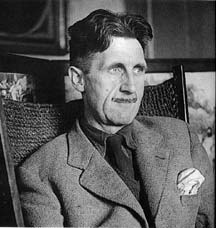
Biographer Peter Stansky on George Orwell and writing

November 17th, 2010
Share

Orwell: No biographies, please

The eminent historian Peter Stansky’s good old-fashioned common sense prevailed in last week’s “How I Write” series — and perhaps after yesterday’s post, it’s timely to revisit George Orwell a bit.  Stansky is the author of more than twenty books, as well as an Orwell  biographer.  In 1972,  he wrote The Unknown Orwell, and followed it up in 1979 with Orwell: The Transformation, with co-author William Abrahams.  The Cambridge-, Yale-  and Harvard-educated writer is also a Fellow of the Royal Historical Society.

“Research is the enemy to completing a book,” Stansky told his sizable audience in his interview with Hilton Obenzinger. “Write as soon as you can – that’s the first thing I tell graduate students.  You’ll have a better sense of what’s missing.”

Despite 2008’s The First Day of the Blitz, he said he’ll pass on writing a biography of Adolf Hitler.  He wouldn’t, he said, want to write any biography of someone he didn’t like – “on the other hand, no one’s perfect.”

Stansky chose wisely

When setting off on a biographical stroll, “You don’t know what you’re going to discover – you might find them less attractive than you thought.”  Hitler saved him time: he was unattractive at the outset.

Stansky’s biographies of Orwell avoided nitty-gritty revelations of his life, instead focusing on “Orwell’s achievement as a writer, a biography that illuminates his writing.”

Wise choice, since Orwell’s forbade any biographies in his will.  Sonia Orwell, the writer’s widow, was practiced in the art of withholding copyright permissions as a way of undermining and controlling scholarship, nevertheless she eventually complained about “errors and misconceptions” in Stansky’s books, without specifying details.

Newsweek noted it’s “not a biography in the usual sense,” and still “the best biographical study of Orwell we have.”

Others biographies have come since, but Stansky is reconciled.  “No historian can discover everything – there’s always more to be found out or a different way of looking at it.”

As for reviews, he admits that “it’s better to be reviewed in a mixed way than not at all.”  Here’s a memorable and illuminating passage I found in Benny Green’s 1980 review in The Nation, recalling the postwar years:

“Orwell was already a distinguished figure, feared for his moral courage and respected for his passionate love of lucid prose, for he knew that when precision of language becomes blurred, then precision of moral judgment will soon be imperiled.  However, in retrospect it seems remarkable that in order to arrive at this position … he had first to become a policeman in Burma. The Burmese episode was indeed the watershed that Stansky and Abrahams say it was, but how extraordinary that he had actually to go there and see blood being shed before he could perceive the possibility that there might be a Burmese here and there who resented the British presence.  In the light of Orwell’s sanctified status today as a Deep Thinker, it comes as a shock to learn that he had been one of those dullards who need to have omelettes stuffed up their nostrils before they can extrapolate the existence of eggshells; the sad truth is that if every polemicist came to a state of grade only after the personal experience of vileness, there would be no world left to save at all.  Orwell’s conversion to anti-imperialism in Burma is in fact uncomfortably reminiscent of a later generation of Vietnam veterans who brought home the sensational news that setting fire to people was not after all entirely honorable – all of which illustrates a truth which Orwell came to know very well, that the saving grace of this world is not the experience of the eyewitness supping on horrors but the possession of a little imagination.”

Bad reviews?  He must have received some, because he apparently speaks from experience:  “Oh, you’re never over it.”

“I don’t believe in rising above it.  Being angry is good for the psyche.”


<<< Previous Series of PostssepNext Series of Posts >>>