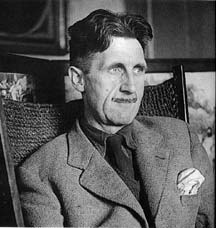
Paul Krugman vs. George Orwell. (Hint: Orwell wins.)

November 16th, 2010
Share

He's right.

Nobel economist Paul Krugman is a smart guy.  So why does he use clichés?  His article today, “The World as He Finds It” refers to President Obama‘s “soaring rhetoric.”  Lordy, I am tired of that term.  A google search for the phrase turned up 136,000 usages for “soaring rhetoric” and Obama — for one suggestive, if not entirely reliable, measure.

To quote George Orwell‘s matchless “Politics and the English Language” (always worth a rereading) this usage falls into a class of “dying metaphors,” notwithstanding its airborne nature:

He's wrong.

Dying metaphors. A newly invented metaphor assists thought by evoking a visual image, while on the other hand a metaphor which is technically “dead” (e.g. iron resolution) has in effect reverted to being an ordinary word and can generally be used without loss of vividness. But in between these two classes there is a huge dump of worn-out metaphors which have lost all evocative power and are merely used because they save people the trouble of inventing phrases for themselves.

Thank goodness Krugman didn’t use “progressives” rather than “liberals,” another cliché, or rather, a marketing term, or maybe just wishful thinking.

“Progressive” always assumes you know which way history is going, and are somehow are ahead of it or on top of it.  Unfortunately, we learned in the 20th century that the road of “progress” usually detours towards the gas chambers, the crematorium, the concentration camps, or the killing fields.  I’m not sure that detour is something I’d want to represent.

In other words, it’s a great marketing term … but isn’t that the same as propaganda?

Late night postscript from Jeff McMahon, or rather from Martin Amis channeled by Jeff McMahon: Martin Amis: “To idealise: All writing is a war against cliché. Not just the clichés of the pen but the clichés of the mind and the clichés of the heart.”  [Joseph Brodsky used to call this “the vulgarity of the human heart.”]

Aleksandr Etkind: Memory, exile, and a four-line revenge

November 15th, 2010
Share

Cooling his heels in the backwaters of empire

I stopped in briefly to hear Aleksandr Etkind‘s talk in Piggott Hall, “From Gogol’s Khlestakov to Tolstoy’s Ivan Ilyich: Imperial Intellectuals, Provincial Officials, and their Literary Hybrids.”  The Cambridge professor with two PhDs is known for his big, fat books (500 or 600 pages is typical).

However, the small man with dark, bright eyes and a thatch of salt-and-pepper hair read quickly from a paper, in a heavy Russian accent, barely moving his lips — hard to follow.

In a show-and-tell, Etkind passed around the newsletter it took a million euros to make“East European Memory Studies,” the written counterpart to the website, “Memory at War:  Cultural Dynamics in Russia, Poland and Ukraine” (which contains another review of Bloodlands by Timothy Snyder here — we wrote about it over the weekend here).

One remark Etkind emphasized, and I have thought about since:  historian V.O. Klyushevsky‘s contention that “The history of a Russia is the history of a country that colonizes itself.”

The Bloodlands, and Klyushevsky’s remark about self-colonization, brought to mind Aleksandr Pushkin‘s colorful fall from favor.  After he had angered the government with his mildly revolutionary activities, he was sent to sticks — the very places where self-colonization would take place. I recalled visiting Pushkin’s modest digs in Odessa, where he hunkered down to begin Eugene Onegin; Etkind’s remark reminded me of what a backwater the Odessa was — a century  before it was Isaac Babel‘s haunt, and still a grimy, tough provincial city. (Kishinev even more so, though I didn’t have a chance during my brief stay to investigate Pushkin’s traces.)

Pushkin was initially pleased he had not been sent to Siberia, and did not realize he was exiled till several years had gone by without his recall. He passed the time  shooting wax bullets into patterns on his bedroom wall and twirling a heavy iron cane wherever he went to strengthen his trigger hand (it didn’t work; he died in a duel anyway). And he also wrote pornographic, blasphemous, lyric and politcal poems.  But he also began his masterpiece, Eugene Onegin, in Odessa.

Alas, these activities were not enough to keep him fully engaged. In 1824, he began a love affair with the wife of the governor general, the Countess Vorontsova in Odessa.  The aggravated count begged the authorities to get rid of the poet.  Pushkin was sent to the Dniester area to investigate crop damage.

Pushkin’s irritated report was brief, and registered his scathing resentment at wasting his short time.  He wrote it in verse, a four-line poem:

The locusts flew and flew over the plain.
They landed on the ground.
Ate everything they found.
And then the locusts flew and flew away again.

Peace Train? The Atlantic revisits Cat Stevens/Yusuf Islam, Salman Rushdie

November 14th, 2010
Share

The paparazzi haven’t caught on yet, but I’m famous, kind of.  I’m in the cyberpages of The Atlantic this weekend, a feature item in “Atlantic Wire’s The Long War Between Salman Rushdie and Cat Stevens” by Max Fisher.  The “war” refers to the “still-running and extremely bitter war of words between the two men.”

However, the words from the crooner were not merely “bitter” — as I described in my post, Cat Stevens/Yusuf Islam was supporting murder, however much he may (or may not) have changed his position since, in carefully crafted ambiguous statements, such as the one here. Stevens clearly wishes to move beyond the controversy, yet fails to show the slightest remorse or concern for the well-being for those whose lives he has further endangered (the list has grown much longer since Rushdie’s 1989 fatwa, including the murder of several people).

Fisher notes:

The conflict reignited most recently when a reporter asked Rushdie for his thoughts on Stevens’s performance at the Washington, D.C., rally held by Jon Stewart and Steven Colbert.

Actually, Rushdie was text messaging a friend in the media, not responding to a reporter’s questions.

Fisher noted in my follow-up post I was “reporting more of Rushdie’s unhappiness.”  Well… yes… I guess “unhappiness” describes it.  I’d be pretty unhappy too if someone endorsed nutters who were putting a bounty on my head.  (He also says Rushdie was telling “another Stanford blogger” — nope, it was still Nick Cohen, a Standpoint blogger.  )

It sounds like Fisher was writing on the trot, like most bloggers.  I plead guilty to the same charge.

Although I was aware that Salman Rushdie was making more and more public appearances (in fact, I covered one here), I wasn’t aware that he has no longer considers himself officially in “hiding.” Brave man.  I understand that a fatwa can only be repealed by those issuing them, and Khomeini is dead.  That means any nutcase who wants to make a name for himself can pick off Rushdie during his guest stint at Emory University or during one of his lectures on contemporary literature.

Fisher comments: “Havens [sic]  concludes by lamenting the state of free speech, although it’s not clear if she’s criticizing Rushdie’s objection that Stevens would appear at the rally or Stevens’s possible support for killing Rushdie.”

Got me again — writing on the trot.  My free-speech comments may have appeared to come out of the blue, so apologies for that.  Here’s where I was coming from:  When I raise topics like these, I get objections that, for example, Rushdie isn’t such a red-hot writer anymore. I must nowadays reaffirm that I support a writer’s right to write even a bad book without being stabbed, gunned down, or beheaded.  Similarly, when I defend Ayaan Hirsi Ali‘s right to exist, even when she’s offensive, I’m told that she’s received support from the right-wingers.  I support non-violent free speech for the left and right.  Similarly, with Molly Norris, I’m told what a bad idea it was to launch a “Everybody Draw Mohammed” day, and that she was “asking for it” by doing so (even though she later withdrew her suggestion and apologized for it) — but the whole point of being a cartoonist is to be edgy, and nobody “asks for” a fatwa.

I will even support Cat Stevens/Yusuf Islam’s right to sing Golden Oldies at a rally for “sanity” — but I also reserve the right to call it out — and I will call out the lazy, ironic, faux-sophistication of Jon Stewart, Stephen Colbert, & co., as they sit on the sidelines on important moral issues, as if the issues do not have anything to do with them.

In the words of Jeff Sypeck:

“As far as I’m concerned, if you’re breaking no other laws, then you can say whatever you want, draw whatever you want, and deface or defile anything that’s your own property, be it a flag, a holy symbol, an effigy, you name it. However, in return, I reserve the right to judge you, denounce you, lobby against you, tell others how wrong you are, and speak vociferously in reply.”

My comments on this issue are becoming boilerplate.  I guess this isn’t covered in 9th grade civics anymore.  Witness this witless comment on the Standpoint article:

… The point is that Jon Stewart didn’t say he was “fine with it,” Salman Rushdie interpreted Jon Stewart’s apology as such. Who cares what Rushdie thinks anyway. Khomeini is dead and Salman Rushdie, well, he’s yesterday’s man too… indeed if it wasn’t for the dated Fatwa no-one would even be talking about him anymore.

Rest in Peace: Theo van Gogh

It’s hard to believe we’ve arrived at a juncture where we have to explain all this stuff.  Again and again and again.

Peace is more than dreaming and singing songs.  Sometimes it requires courage.  In fact, it doesn’t mean much unless it does.  Otherwise, it’s just the easy pacifism of the non-combatant.

Some people “get it.”  Last March, Michael Gordon-Smith wrote for Australian Broadcasting wrote:

Ultimately, however, it’s not something to be made light of. It’s not a yawn. It mattered then and it matters now. Yusuf supported killing a man because someone took offence at what he had written.  …

But 20 years on Yusuf seems to think all the wrongs were done by others. Journalists asked him loaded questions. His replies were misinterpreted. It was the book, not the call for violence that “destroyed the harmony between peoples and created an unnecessary international crisis”.   At worst, his remarks were silly but they were dry English humour. …
He will probably sing Peace Train at his concerts:

Now I’ve been crying lately,
thinking about the world as it is
Why must we go on hating,
why can’t we live in bliss?

It’s time he stopped singing the question and answered it. He had an opportunity to stand for peace and tolerance when the need for such a voice was critical. Instead, when Geoffrey Robertson asked the question, he found no room for tolerance or doubt, but with dogmatic certainty took the side of violence and tyranny.

For me, it remains the most important thing he ever did. Unless he revisits the issue and finds room for difference, in my mind he’s forever defined by the choice he made in those weeks in 1989. The only message I hear from him is the echo of Khomeini’s threat not just to Salman Rushdie but to every free thinker in the world: If you speak your mind we may kill you.

Naimark, Snyder, and Applebaum: When is murder genocide?

November 12th, 2010
Share

An indecently incongruous setting for a discussion of genocide

On one of those legendary California afternoons, full of sunshine and overlooking the magnificent San Francisco Bay, I sat on the patio of the Center for Advanced Study in the Behavioral Sciences, talking with Norman Naimark about genocide.  It seemed a incongruous way to spend an afternoon in the crisp air and almost oppressive sunlight, but so it was.

Naimark’s contention, in his controversial new book Stalin’s Genocides: We need a much broader definition of genocide, one that includes nations killing social classes and political groups. His case in point: Stalin. He argues that the Soviet elimination of a social classes (e.g., the kulaks), as well as the mass execution and exile of “socially harmful elements” as “enemies of the people” were, in fact, genocide.  We miss the big picture when we treat these as discrete episodes.

I had wondered at the time, and still, about the role technology in the last century’s explosion of genocidal episodes. Clearly, incidents within archaic society — for example, the Old Testament “bans” where every man, woman, child, and even livestock were killed to remove every trace of a people — show genocidal intent.  But mass communication and mass transportation have made it possible to coordinate deportation and organize killing on a scale previously unimaginable (even in Rwanda, where the weapons-of-choice were pre-tech machetes, radio was used to incite mobs and track victims) – hence the proliferation of genocide in the 20th century.  Often official enablers act on a genocidaire’s momentary whim, rather than the determined aim to obliterate a people.  So what does “intent” matter, under such circumstances?

The subject has come up again with Anne Applebaum‘s  provocative article, “The Worst of Madness,” in the current New York Review of Books.  She reviews Timothy Snyder‘s  Bloodlands: Europe Between Hitler and Stalin as well as Stalin’s Genocides.  She calls Naimark’s argument “authoritative, clear, and hard to dispute.” Snyder studies the people caught between Hitler’s Germany and Stalin’s Russia, suffering two and sometimes three wartime occupations: “Between 1933 and 1945, 14 million died there, not in combat but because someone made a deliberate decision to murder them,” writes Applebaum.

She takes the notion of genocide a step beyond motive, examining how two dictators, Stalin and Hitler, played off each other in their hatred of the people in the “Bloodlands” — Ukrainians, Poles, and the Baltic states. The sum of the parts was more than the whole.  The two genocidaires used a synergy of murder to kill more, and more hideously, than either nation would have done alone:

Applebaum: Complicating memory

“To the people who actually experienced both tyrannies, such definitions hardly mattered. Did the Polish merchant care whether he died because he was a Jew or because he was a capitalist? Did the starving Ukrainian child care whether she had been deprived of food in order to create a Communist paradise or in order to provide calories for the soldiers of the German Reich? Perhaps we need a new word, one that is broader than the current definition of genocide and means, simply, ‘mass murder carried out for political reasons.’ Or perhaps we should simply agree that the word “genocide” includes within its definition the notions of deliberate starvation as well as gas chambers and concentration camps, that it includes the mass murder of social groups as well as ethnic groups and be done with it.”

She finally questions the whole notion of “remembering” genocide — an argument which reveals how powerfully language can shape the way we think about reality.  Genocide has come to mean pretty exclusively the Jewish Holocaust, shaping and carving and in many cases eliminating from memory what happened to millions of others:

“Finally, the arguments of Bloodlands also complicate the modern notion of memory—memory, that is, as opposed to history. It is true, for example, that the modern German state ‘remembers’ the Holocaust—in official documents, in public debates, in monuments, in school textbooks—and is often rightly lauded for doing so. But how comprehensive is this memory? How many Germans ‘remember’ the deaths of three million Soviet POWs? How many know or care that the secret treaty signed between Hitler and Stalin not only condemned the inhabitants of western Poland to deportation, hunger, and often death in slave labor camps, but also condemned the inhabitants of eastern Poland to deportation, hunger, and often death in Soviet exile? The Katyn massacre really is, in this sense, partially Germany’s responsibility: without Germany’s collusion with the Soviet Union, it would not have happened. Yet modern Germany’s very real sense of guilt about the Holocaust does not often extend to Soviet soldiers or even to Poles.”

The implications of her reading are many:  For the U.S., World War II was the “good war,” against all the ambiguous or “bad wars” that followed—Vietnam, Iraq, Korea.  For Americans, WWII begins with Pearl Harbor and ends with the atomic bomb.  But Western peace was won by selling out whole nations to our murderous ally. “This does not make us bad,” writes Applebaum, “there were limitations, reasons, legitimate explanations for what happened. But it does make us less exceptional. And it does make World War II less exceptional, more morally ambiguous, and thus more similar to the wars that followed.”

And for Western Europe:  “When considered in isolation, Auschwitz can be easily compartmentalized, characterized as belonging to a specific place and time, or explained away as the result of Germany’s unique history or particular culture. But if Auschwitz was not the only mass atrocity, if mass murder was simultaneously taking place across a multinational landscape and with the support of many different kinds of people, then it is not so easy to compartmentalize or explain away.”

Postscript on 11/15:  Speaking of genocide…  “On Wednesday, al Qaeda militants launch a synchronized bombing attack on 11 Christian communities throughout Iraq, killing six and wounding more than 30. That attack followed on the heels of the ghastly assault last month on Christian worshippers attending a service at Our Lady of Salvation church in Baghdad, in which 58 people were brutally murdered and another 60 wounded. …  the Iraqi government has done absolutely nothing to protect the besieged Christian community from further attack, despite a promise from al Qaeda in Iraq that ‘all Christian centers, organizations and institutions, leaders and followers, are legitimate targets for Mujahedeen wherever they can reach them.’  Americans of all faiths must band together and pressure the State Department to do something about the wanton murder of Iraqi Christians before there are no more Christians in Iraq to protect.”  At the Daily Beast here.

Norm Naimark makes his case in the video below:

D.G. Myers on Hitchens, Pausch, and cancer: “Hope is a dicey thing”

November 10th, 2010
Share

Been there

Cancer has been the odd topic of discussion here the last few days — one more thought from D.G. Myers over at the Commonplace Blog (hat tip to Dave Lull, patron saint of bloggers in the cold, cold state of Minnesota).  Myers, who was diagnosed with Stage 4 cancer a few months ago, agrees with Christopher Hitchens on Randy Pausch‘s Last Lecture: “Pausch’s giddiness has nothing to do with real hope, nor with preparing oneself for death. If you recommend it, your friend will conclude—correctly, as it turns out—that you are not serious about what he is going through.”

“Even so, hope is a dicey thing. And as far as I can tell, no one else can raise your hopes for you. There is no standardized method for achieving it, no universally valid argument for its reality. …

"Nothing to do with real hope"

Don’t try to make hopeful sounds, then. What I found consoling was the consolation that was offered to my wife. It helped enormously to know that she and the children would not be left alone, even if I were to leave them. Similarly, I guess, it gave me steel to understand that I was important and dear to some people. Three or four of my friends were particularly good at this, dropping into my hospital room to say, ‘I read something today that reminded me of you,’ or, ‘I listened to something and wondered what your reaction would be.’ Only two people thought to send me books—no one sent me any movies—and even though the books they sent weren’t really to my liking, they meant a lot to me.

Then there were those who never even contacted me, including my own sister. Nothing quite makes you more aware of the nothingness that awaits you on the other side of Stage Four cancer. My advice: say anything, keep it light and trivial if need be—better lightness and triviality, in fact, than the awkward groping for profundity—but say something. If you say nothing, because you are afraid that you will not know what to say, then you are abandoning the cancer patient to his worst fears, and indulging your own self-centeredness and even solipsism at his expense.

Only one thing is worse than silence, he says: telling cancer patients of “alternative cures.”  Hitchens agrees, but during my own experience with the Valley of the Shadow, I collected all the stories I could.  Part of the research effort.  One of the things Bob Beyers taught me – you never know where the help might come from, or from what unlikely people.

Postscript on 11/11/10:  Myers posted his recommended reading list today, here.

Diane Middlebrook: “It’s all been delicious. Every minute.”

November 9th, 2010
Share

Salonnière Diane (Photo: Amanda Lane)

“You felt smarter and more talented and more capable in her presence.”

Such was Kate Moses’s summary of the late biographer Diane Middlebrook’s “genius for friendship” – or at least, that was part of it.

Salonnière Kate read from her “Chocolate Cake for Diane” — featured right now, here, at the online Narrative Magazine — to a roomful of women assembled in her memory last August.  Diane organized several literary salons for women: first in London and San Francisco, and later in New York.  According to Moses, “she admitted without apology that she wouldn’t schedule a salon event in one city while she was in the other because she didn’t want to miss anything.”  The Middlebrook salons continue – a place for women to gather, celebrate their achievements, discuss their work, and network.

In Irv and Marilyn Yalom‘s Palo Alto home tucked away in wooded seclusion off the main streets, one wondered if perhaps the spirit of Diane is contagious.  We were all feeling smarter and more capable in the Bay Area writer’s salon – and boy, there are times we need to.

Kate’s “fertile creative partnership” with Diane flourished as Kate was writing her fictional story of Sylvia Plath and Ted Hughes, Wintering, while Middlebrook was working on her biographical account, Her Husband. “By sharing all of our research, we made twice as much progress in half the time.”

I wrote Diane Middlebrook’s obituary here.  At the time, I found the most arresting part of Diane’s story to be her absolute determination to finish her biography of Ovid, even in the face of a rare and ultimately deadly liposarcoma.

Diane had been reading and studying Ovid since graduate school, and later taught him and lectured on him.

“‘I am not ready to die,’ she said again and again, her voice brisk and emphatic, that elegant index finger aloft,” Kate recalled.  “From the last days of January 2004, when Diane learned that her tumor had returned with a vengeance, she never took her eyes off Ovid.  Through those surreal years her book was her anchor, as the life of her elegant mind had always been.  She was single-minded in her concentration, hoarding away time from successive chemotherapies and monthly dendritic cell treatments and surgeries and the repetitive struggle to recover from every onslaught her body had to withstand.”

She returned to San Francisco to dazzle the salon with a reading from her Ovid manuscript “and an animated talk on the challenge of writing a biography without primary sources.”

Moses recalled the last visit in London:  “We left the Athenaeum arm in arm, descending into the Tube together and kissing goodbye at Leicester Square, Diane calling ’till December!’ as her train pulled away.”

“Nothing, after that, happened the way any of us had planned or hoped or thought possible.” By September, she could no longer keep down solid food.  The doctors turned to palliative care, and she could no longer continue the book on her own.

Salonnière Kate Moses (Photo: Ramona Pedersen)

“She was so weak and in such constant pain she was sometimes not able to hold a pencil, and her pain medications were disorienting: timed-release doses that periodically submerged her mind like a carnival dunking machine.  But she might, with great concentration and will, be able to talk about Ovid, to dictate the blueprint for her book’s final form, and she wanted to try…”

The experiment involved Kate making digital recordings of Middlebrook’s ideas for the books, interviewing her, teasing out ideas and taking notes, with hopes of assembling the book later.

To that end, “Diane asked her doctor to adjust her medications, so that she would have more control over her thoughts and her ability to articulate them.  This meant, in practice, that she would have to withstand more pain in order to work on Ovid, a price she was willing to pay for as long as she could stand it. … it was downright superhuman most of the time, a heroic and determined effort on her part to stay focused and acute when her body was impatiently tugging her in the other direction.  It was often like watching a great, dignified actor remain in character and deliver his staggering final soliloquy as the theater is being dismantled board by board all around him.”

Eventually, Kate was joined by a few other insiders, including Diane’s daughter Leah Middlebrook, to work as a team to shape the manuscript with the notes, recordings, outlines, and Diane’s help.  “Diane was in noticeable pain, but when [we] would ask if she wanted to stop, Diane would grimace, shaking her head no.  ‘Let’s keep going,’ she’d say.  Eventually, they covered it all.  “‘Good,” Middlebrook said, holding her daughter’s hand.  “Because the rest is unthought.” Kate meant to come back for more sorting out, but that was the last time she was able to speak to Diane, who died a week later.

Listening to Kate read in front of a large picture window glowing with the late-afternoon, late-summer sun, its remarkable how many women (and, for the annual August event, men were invited too) were touched by Diane’s life – enough so that a memorial residence for writers is planned by the Djerassi Resident Artists Program.

Salonnière Kate described a more personal goodbye had happened a week earlier, at the hospital, when Kate suddenly felt Diane’s hand on her wrist:

“Every minute has been delicious,” she said dreamily, not knowing if she was truly dreaming or tumbling in the surf of her mind, her focus turned inward. “Every minute with you, Kate,” she said then, holding my gaze, squeezing my wrist.  “It’s all been delicious.  Every minute.  How many relationships can we say that about?”


<<< Previous Series of PostssepNext Series of Posts >>>