Hitchens on cancer etiquette … and Randy Pausch

November 7th, 2010

Share

The Miss Manners of cancer etiquette?

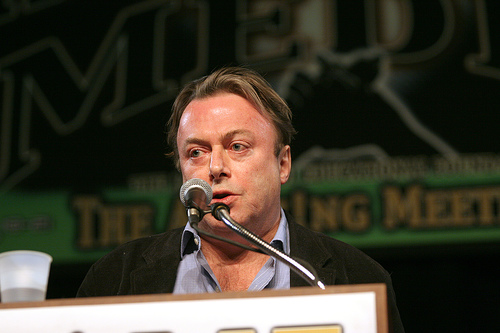
Christopher Hitchens, in a new Vanity Fair piece, sets out a few guidelines about cancer etiquette.  How to deal with the repeated questions, beginning with the simple “How are you”?  When oncology clinic staff ask, he replies simply, “I seem to have cancer today.”

He’s aware of the perils in cataloging gaffes on the part of either patient or non-patient.  He describes the patient’s “unreasonable urge to have a kind of monopoly on, or a sort of veto over, what was actually sayable. Cancer victimhood contains a permanent temptation to be self-centered and even solipsistic.”

While he points out the pitfalls of inevitable awkwardnesses, and the dangers of saying too much and too little, he once again grapples with the clichés of cancer — a subject we discussed earlier.  I always enjoy the ferociousness with which he takes on calcified thinking and stale modes of feeling.  For example, witness this digression into Randy Pausch‘s Last Lecture:

It would be in bad taste to say that this—a pre-recorded farewell by the late professor Randy Pausch—had “gone viral” on the Internet, but so it has. It should bear its own health warning: so sugary that you may need an insulin shot to withstand it. Pausch used to work for Disney and it shows. He includes a whole section in defense of cliché, not omitting: “Other than that, Mrs. Lincoln, how was the play?” The words “kid” or “childhood” and “dream” are employed as if for the very first time. (“Anyone who uses ‘childhood’ and ‘dream’ in the same sentence usually gets my attention.”) Pausch taught at Carnegie Mellon, but it’s the Dale Carnegie note that he likes to strike. (“Brick walls are there for a reason … to give us a chance to show how badly we want something.”) Of course, you don’t have to read Pausch’s book, but many students and colleagues did have to attend the lecture, at which Pausch did push-ups, showed home videos, mugged for the camera, and generally joshed his head off. It ought to be an offense to be excruciating and unfunny in circumstances where your audience is almost morally obliged to enthuse.

Big plans for a small book — kudos for Olga Trusova and Dan Archer

November 6th, 2010
Share

Praise for Borderland, a 36-page comic book telling seven real-life stories about modern-day slavery (we wrote about here and here).  International Organization for Migration will print and distribute copies of the comic to 136 schools in Ukraine.  English, Russian, and Ukrainian versions of Borderland will be available.

Anne Keehn, who has been fighting international slavery for years, wrote on the Human Human Goods website about the work of Fulbright Fellow Olga Trusova‘s and Knight Fellow Dan Archers project:

There are more slaves today than ever in history. Yet, the issue of modern-day slavery has not yet cracked mainstream discourse the way we’d like. So we are always heartened to see when intelligent, creative people use innovative ways to raise awareness about what we see as the human rights issue of our time.

Archer is the art director for the Stanford Graphic Novels Project.

Olga and Dan say on their website:

“The project began with a belief that as consumers of various goods and services, people should be aware of where those come from and at what cost. The U.S. government has tremendous influence on foreign governments and their policies, therefore it is important to bring you, the reader, into the picture, so that when time comes you can influence your government.”

Breaking news: Dana Gioia — new feather, new cap

November 5th, 2010
Share

Academia has captured him at last (Photo: L.A. Cicero)

Does this man ever sleep?  I’ve come to the conclusion he does not.

On my to-do list for weeks now, I have scribbled down a plan to write a nice, leisurely note to Dana Gioia, following his visit to Palo Alto. But I can’t keep up.  Each time I turn my back he gets a new honor, a new book, a new published poem.  I haven’t even listened to the CD, Tony Caruso’s Final Broadcast, he sent to me yet, and now it’s just been announced that that he has taken an endowed chair at the University of Southern California — the Judge Widney Professor of Poetry and Public Culture.  The chair is reserved for eminent individuals from the arts, sciences, professions, business and community leadership.

What could be more fitting? Think of his “Can Poetry Matter?” essay that launched a nationwide discussion of poetry.  Dana’s university-wide appointment includes affiliations with the USC College of Letters, Arts and Sciences, its Thornton School of Music, its Marshall School of Business, and its School of Policy, Planning, and Development.

But he has avoided so many academic appointments in the past, this comes rather as a surprise.  I hadn’t a clue until Ted Gioia‘s announcement of his brother’s honor on his own Facebook page.  Not so much of a surprise, perhaps, is the SoCal locale — Dana was born, after all, in the gritty little burg of Hawthorne, outside Los Angeles.

Said Provost Elizabeth Garrett, senior vice president for academic affairs: “As a poet, literary critic, and innovative arts leader, Dana Gioia has demonstrated that poetry—and the arts—do matter. Through initiatives like Poetry Out Loud and The Big Read, he forcefully reminded us that poetry and literature can be oral art forms, inspiring people of all ages to imagine and to think creatively and critically.”

It will be great to have Dana on the West Coast again.  Perhaps he can catch a nap now?

Postscript on Nov. 6:  I spoke too soon.  When I got home last night, I found in my mailbox Dana’s newest effort, John Donne’s Sacred and Profane Poems, for which Dana wrote a 20-page introduction.  “He alone was master of both the sacred and profane,” Dana writes, though he notes James I’s criticism of the poems, that they “are like the peace of God; they pass all understanding.”  Hadn’t heard that one.

Memorial reading for Morton Marcus on Nov. 6: a literary “bright spot” on West Coast

November 5th, 2010
Share

At Vasili's Greek Restaurant, 2009 (Photo: Valerie Marcus Ramshur)

“If you were going to make a literary map of America, there would be a bright spot on the map at Santa Cruz,” said Robert Hass, who will be the keynote speaker at the first annual memorial for poet Morton Marcus tomorrow night at 7.30 p.m., at the Cabrillo College Music Recital Hall, 6500 Soquel Drive in Aptos.  (Gary Young, Stephen Kessler, Joe Stroud will also read.  Tickets are gone — arrive at 6.30 for no-shows and returns.)

Perhaps Mort is a bright spot on the bright spot.

“He was larger than life,” said Santa Cruz poet Stroud, who knew Marcus for more than 40 years. “Mort loved nothing more than to have a meal and to have a conversation. I think of him as a conductor almost, eating and drinking and driving the conversation this way and that. It was an unforgettable experience.”

I met Morton Marcus via the world wide web — and our relationship, alas, remained an epistolary one.  Poet Jane Hirshfield brought my attention to his remarkable memoir of Czesław Miłosz in his autobiographical Striking Through The Masks, and I approached him about contributing to a book I had in the back of my mind.  (The book, An Invisible Rope: Portraits of Czesław Miłosz, will be out soon — really it will.)  He wrote a note back in September 2006, with some evocative thoughts about Prague:

I’m back now. It was my second trip. This time I was there to teach a poetry composition class in the Prague Summer Program. It really is an incredible city, but a far as I’m concerned not for the reason other people are so enchanted by it. The Renaissance and baroque buildings are masks that cover centuries of suffering which are marked by the extraordinary number of memorials that dot the city. If one looks, one sees a microcosm of all cities in Prague, and one experiences the timeless misery and joy of being alive. Then going to Prague becomes a pilgrimage to pay homage to all our ancestors.

I’m not a professor, by the way. I’ve taught classes at UC, but mainly I taught Literature and Film for thirty-two years down the road at Cabrillo College.

Thanks for your interest, and I hope we’ll meet one day.

Jane Hirshfield

We didn’t.  But in a book that was filled with a not-always-harmonious assortment of contributors, he was one of the most easygoing of the bunch.   Good natured.  Not a prima donna.  It was appreciated.  As we were finishing up in June 2009,  he wrote to me the terrible news:  “I’m glad the book is coming out. When will that be? Since last year, my life has drastically changed: I’ve been diagnosed with terminal cancer. So before I go I have to get as many facts down on paper about new work coming out as quickly as I can.”

He sent me a brief bio for the book, and ended with the comment:  “I’m still standing.  Regards to all.”

I’m told he sank into pain, but never into less than good spirits.  I asked him about second opinions:  “It’s all through my bloodstream with growing tumors in my lungs and liver verified again and again. Second, third and fourth opinions, too. No problem; I’ve had a great life,” he wrote with daunting equanimity.  I offered at last to visit — but thought he might be less interested in meeting pen pals than gathering himself into himself.  I guessed right.  His last note to me said:  “Thanks so much for your thoughts, Cynthia, and the offer of a visit, but as you’ve guessed I’m more interested in solitude.”

Jane wrote to me to tell me he had died on October 28 last year.  His final words were, “I’m ready.”

Two poems from his last collection, The Dark Figure in the Doorway: Last Poems

ALL WE CAN DO

All we can do on this earth is step into the future
with a sense of the many people behind us,
the living and the dead, as if we carried our bodies
like amphorae filled with sunbeams into each new day,
continually reaching inside ourselves
to scatter golden butterflies over the land before us,
or to fling them against the night, not like tears, but like stars
that will guide those who follow across the darkness.

WHAT IS ALIVE IN US

What is alive in us, what vibrates
in our animal skins, is a harp string
that is never still, a harp string
tuned to the drone of silence.
It is the single thread, the radiant filament,
that sews us to our coat of darkness,
the umbilical that holds us
to the planet each of us is
yet allows us to wander among the stars —
the guy rope that secures us
to ourselves, yet lets us venture
into the darkness all the way
to the planet of someone else.

One can see why Miłosz liked him.

I’ve looked at clouds from both sides now

November 4th, 2010
Share

Everyone is still talking about politics today, while I’m muddling along with page proofs and correspondence.  But let me join in the fun for a moment with a few “word clouds.”

Perhaps I am the last person in the Western world to discover wordle and software-generated word clouds.  I’d seen them before, but wasn’t sure exactly what they are supposed to do or mean.  The folks over at Corrente compared Franklin D. Roosevelt‘s inaugural speech with Barack Obama‘s remarks on October 27 address to bloggers:

Here’s Obama:

And here’s FDR:

Interesting discussion about the two here — but really, it’s hard to be too shallow with this stuff.  One of the punters on the site thought the analysis was unjust — after all, why compare a conversation with bloggers to a formal inaugural address?  Point taken, however,  I thought his case would be more persuasive if the wordler hadn’t written “inaugeration.”  In any cases, the image is tiny — click on it for a larger version:

Wordle: Obama Inaugeration Speech

Thought I’d try my own hand at this.  I took no chances, and chose a post that would make me look smarter.  I used my Halloween text, which included excerpts from Nobel laureates J.M. Coetzee and Mario Vargas Llosa to spruce up my own humble words.  Click on the image to see a less lilliputian version:

Wordle: "Dostoevsky, Coetzee, Vargas Llosa, and Paul West on evil"

Now.  Back to silver linings.

It gets worse: More from Salman Rushdie

November 2nd, 2010
Share

Understandably depressed (Photo: Mae Ryan)

I posted yesterday about the appearance of Yusuf Islam — formerly Cat Stevens — at Jon Stewart‘s weekend rally (read it here).  Nick Cohen at Standpoint posted about Salman Rushdie‘s surprise that Stewart “had given a starring role at his ‘Rally for Sanity’ to a crooner who had previously opined that Rushdie deserved to die for deciding of his own free will to abandon Islam and criticise its texts.”  Actually, I thought the 1989 fatwa was specifically for Satanic Verses, but be that as it may…

Rushdie messaged him with more today:

I spoke to Jon Stewart about Yusuf Islam’s appearance. He said he was sorry it upset me, but really, it was plain that he was fine with it. Depressing.

We’ve come to a strange point when we have to explain the need to defend fundamental freedoms, such as non-violent freedom of expression.  Free speech begins where you offend me.  Otherwise it means nothing.  And it doesn’t matter whether Rushdie is past his prime, whether you ever liked his books, or whether you find his attitudes repugnant (in many cases, I do, though I find him brilliantly provocative, as well.)  And no one “asked for it” when it comes to a fatwa.

So I continue to link arms with Susan Sontag, Joseph Brodsky, Andrei Voznesensky, and others.

It’s sad that this kind of point even has to be explained in our “whatever” times, when lives are at stake.

Postscript on 11/14: The Atlantic weighs in — more here.


<<< Previous Series of PostssepNext Series of Posts >>>