
Happy New Year’s to all – from the Book Haven!
January 1st, 2020


The late Choctaw poet William Jay Smith: why is he being disrespected?
Last July, the Book Haven questioned the announcement that Joy Harjo is the first Native American poet laureate. But the blogpost was soon forgotten in the general acclamation on Harjo’s appointment.
The problem is the truth: William Jay Smith, a poet of note, claimed Choctaw heritage, and wrote about his Native American heritage, including long poem on the Trail of Tears. It didn’t seem right, however worthy Harjo is as a successor to the poet laureate title, for her predecessor’s eminent reputation be thrown into the dustbin so that we could falsely claim yet another “first.” (Apparently, there was a time when even the Library of Congress acknowledged and honored Smith’s heritage, as we pointed out with some screenshots in our own post. But the Library of Congress changed its mind. Why? They won’t tell us.)

Forgotten first
Poet and translator A.M. Juster took the matter farther, and he’s written about the experience this month in the Los Angeles Review of Books here.
He briefly wondered if he had made a mistake in writing of Smith as a Choctaw poet:
… I checked two reliable sources known for their fact checking, the Poetry Foundation and The New York Times, which both identified Smith as Native American. I became even calmer when I discovered, with some help from friends at Eratosphere, an online poetry workshop and discussion group, that the Library of Congress had itself identified Smith as “of European and Choctaw ancestry.”
I felt an obligation to notify the Library promptly, which I did. The first contact person had never heard of Smith and transferred me to another person who had not heard of Smith. That person took my name and number, but did not call back.
I too read some of the social media talk and the Eratosphere posts, and was dismayed by the tendency to dismiss or downplay Smith’s heritage, posthumously. After all, he died in 2015 and can hardly defend himself.

Juster got no answers.
Juster wrote a letter to the Library of Congress, asking: 1) had it decided that Smith is not a Native American; 2) if so, what was the standard for this decision, the evidence that supported it, and who made the decision; 3) was this decision made before the Harjo announcement or afterwards? And finally, he asked: 4) is the Library of Congress aware that its website has described Smith as being “of European and Choctaw ancestry” for 15 years?
In the LARB, he writes:
Almost surely the communications department believed that it could tough its way out of the mess it created based on the fact that so many Americans believe — falsely, but in good faith — that they have Native American heritage. Such issues are often resolvable, though, and I decided to try to resolve the question of William Jay Smith’s heritage by hiring an expert in Native American genealogy, Dr. William T. Cross.
Dr. Cross’s research confirmed that everything William Jay Smith claimed about his Choctaw heritage was correct. Rebecca Moshulatubbee King was the oldest daughter of Chief Moshulatubbee and married Samuel Jake Williams. One of their seven daughters, Catherine Permilia Williams, married Samuel Roswell Campster in 1850, and then gave birth to George Washington Campster in 1863. In 1913 George Washington Campster’s daughter, Georgia Ella Campster, married William Jay Smith Sr., the father of our Poet Laureate.
Harjo (Photo: Creative Commons)
Standards for tribal nation membership vary, but the Choctaw Nation of Oklahoma simply requires lineal descent for membership, so William Jay Smith would have been fully eligible for membership if he had applied. There can be no doubt about Smith’s good faith in claiming that he was part Choctaw; at that time the benefits of such a claim would not offset the prejudices that it would generate. Nonetheless, the future Poet Laureate enthusiastically embraced his Choctaw heritage at an early age; it filtered into his poetry at least as early as the 1950s, when in “A Trip Across America” he repeated these lines:
Riding the powerful polished rails
Over abandoned Indian trails…More than four decades later, he would do much more.
In the article, Juster wisely suggests that Harjo organize a conference to honor Smith’s legacy (and, we might add, by doing so honor her own). So what have we heard from the Library of Congress? Crickets.
Kind of disgraceful if you ask me.

Perhaps the most exciting show in the Bay Area this season took place not in the famed City, but about 60 miles south of it, in the remote little burg of San Juan Bautista. I say that not because I have been a regular aficionado of the local theater scene this busy year, but because this year’s La Pastorela was one of the best shows I’ve seen ever.
I had my misgivings. I had been invited to make the trek to the annual Christmas show by a stepson and his wife, with their 10-year-old in tow. The effort is the seasonal offering of the town’s El Teatro Campesino, founded by the legendary Luís Valdez and born in the grape boycotts and agitprop of the 1960s.
The Christmas show (which alternates with La Virgen del Tepeyac) has graced the great San Juan Bautista mission, founded in 1797 (and best known as the setting of Hitchcock’s Vertigo) … until now.
As Valdez explains, “We began performing La Pastorela in the streets of San Juan Bautista in 1977. The cold winter nights had always put our audience and actors through an ordeal, but the steady rain of December 1980 finally washed us out completely.” Miraculously, it seemed to them, the Old Basilica welcomed them, allowing the shepherds to come inside. After nearly half a century, that arrangement came to an end.
I looked at the website a week ago and realized there had been a switcheroo: as of this year, the show will be performed in a nearby playhouse on Fourth Street. I briefly wondered if we could get a refund. After all, the big draw was seeing a centuries-old play in the centuries-old mission, with its heavy dark-wood pews, stucco walls, and saints-in-niches. I had my doubts: the playhouse is less than half the size, a theater in the round (or rather polygon) with effects amplified by several screens.

Luís Valdez: the father of Chicano theater
I read in the program that, with this move, El Teatro Campesino was returning to the cradle that gave them birth: a humble packing-shed playhouse, “with all the creativity, vibrancy and cariño that our 54 year old El Teatro Campesino family can provide,” according to Valdez, in “a gesture of spirit, tradition, and faith by and for our community.”
Briefly, the story of La Pastorela: a group of pilgrims are en route to visit the Baby Jesus at Belém (a.k.a. Bethlehem), but are diverted and rerouted by a group of devils, eventually finding themselves caught in a titanic battle between good and evil, Lucifer and San Miguel.
The drama has been entirely reimagined and restaged for its new setting, under the imaginative direction of Kinan Valdez. The play packs a bigger punch in the smaller space. The singing, dancing, and fighting almost bursts through the walls. San Miguel and his angels – a spray of white feathers for wings on their shoulders to show their celestial affiliation – were outfitted in military uniforms and Che Guevara style berets to fight for the forces of heaven. At the ultimate match-up they wrestle down Lucifer with … doves. That’s right, white feather doves like the kind you see on Christmas trees, only about the size of an arm.

Lucifer and sidekick (Photo: Robert Eliason)
San Miguel has usually been cast as a woman (Linda Ronstadt for the Masterpiece Theater production years ago; Primavera Cabibi for this one). But two of roles have had sex changes: the role of Bartolo has become Bartola (Sylvia Gonzalez), the mother rather than the father of the high-spirited and accomplished Gila (Xochitl Rios-Ellis). However, the most daring change was that Lucifer has become Luzbel – Jessica Osegueda as the demonic generalissimo gives a bravura performance that rocked the theater and stole the show.
Something magical began to happen early in the performance: at the appearance of the devils, one small child began wailing and had to be removed. More events followed. I tried to exercise charity as the tall mother in front of me was constantly leaning over to whisper to her daughter; each hissing remark blocked the stage as effectively as a curtain fall. Then I looked around, and realized that mothers throughout the theater were whispering to children – that, in fact, there was a steady undertow of whispering. The children were whispering because they were engaged, they wanted answers, the wanted to know more about what they were seeing. (The girl with our small party even wanted to join the child actors who were the mini-devils.)
This is what theater is supposed to do but so rarely does, especially for kids who haven’t been much exposed to it. Open worlds. Shift points of view. Expand possibilities. Change lives. Invite engagement. Enchant. And for the children in the theater that day, it hooks them into theater, stories, myths, melodies, Latino culture – impressing on them the foundations of our civilization. If future shows are as good, I would suggest that whole truckfuls of children be carted to future Pastorelas. This one ended far too soon. We attended the very last sold-out performance on a rainy Sunday afternoon.
 It’s not exactly haiku, but Twitter is kind of a cyberspace equivalent. Stanford inventor Ge Wang (we’ve written about him here and here), has gone to see the new film of Andrew Lloyd Weber‘s Cats (based on T.S. Eliot‘s poems) so we won’t have to. His review in 11 tweets is more nuanced than you might expect, however. He says the experience is … well, rather like a cat.
For those who don’t know Ge Wang already (and please, it’s pronounced with a hard “g” – G’wang – not hard), the Stanford professor has created the Stanford Laptop Orchestra as well as the Stanford Mobile Phone Orchestra. He is the designer of the Ocarina and Magic Piano iPhone apps. He is the author of Artful Design: Technology in Search of the Sublime (A MusiComic Manifesto), a book on design and technology, art and life, created entirely in the format of a photo comic book and published by Stanford University Press.
Now, for the review… As Shakespeare wrote, “The eye of man hath not heard, the ear of man hath not seen, man’s hand is not able to taste, his tongue to conceive, nor his heart to report what my dream was.”


A postscript from Ge Wang: “I never expected so many reactions — this movie is really bringing it out in people. For me I still don’t know if I am desperately trying to save people from it or lobbying people to see it. The answer, I think, is not somewhere in between, but both.”
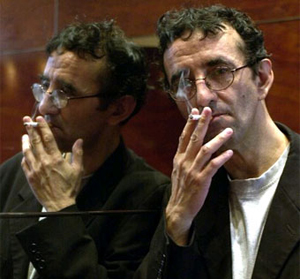 Ann Kjellberg‘s The Book Post is sharing some of its subscriber material as a special Christmas present for all of us. Here’s an excerpt from one, by novelist Àlvaro Enrigue, on the astonishing productivity of Chilean writer Roberto Bolaño (1953-2003) whose works are still being discovered, uncovered, with no end in sight.
It begins:
Not long after the Chilean writer Roberto Bolaño died unexpectedly of kidney failure in 2003—an illness only he and his close relatives and friends knew about—his editor, the legendary Catalonian publisher Jorge Herralde, made public that the author had left in his custody five finished interlinked novels as a sort of life insurance for his child. Those novels became the monumental volume, published as 2666, that cemented his international recognition as the alpha writer of Latin America—even if this recognition arrived only as a literary afterlife. As the years went by, it emerged that those were not the only works he had left unpublished. Nine posthumous books later—some still missing from English—I wonder if we are any closer to seeing Roberto Bolaño’s computer drive run dry. Considering the literary quality of The Spirit of Science Fiction, now coming to American bookstores, it seems we are still far from the moment when Bolaño’s emails and grocery lists hit the market. …
The Mexican writer Juan Villoro, who was close friends with Bolaño, has written about the delirious and very late phone calls he received when they were both living in Catalonia: Bolaño would report, to Villoro’s disbelief, on having spent the night writing another novel. Bolaño knew that his clock was counting down faster than the others’, and he wrote with the same rush and desperation with which his characters experience their youth.
Read the rest here. The Book Post is a by-subscription book review service, bringing book reviews by distinguished and engaging writers direct to your inbox. As a subscriber you can read the full archive at bookpostusa.com. And subscribe to the Book Post here. Meanwhile, some available offerings during the holiday season:
• Joy Williams on Meister Eckhart
• John Banville on Robert Macfarlane
• Marina Warner on Margaret Atwood
• Calvin Baker on David Blight
• April Bernard on Dreyer’s English
• Geoffrey O’Brien on Marvin Gaye
• Robert Cottrell on John McPhee
• Elaine Blair on Sally Rooney
• Padgett Powell on William Trevor
• Your humble editor on Susan Sontag

A society-assisted suicide. He leaves behind a wife and son.
The Los Angeles Review of Books has a long piece on gifted cultural journalist Scott Timberg, who killed himself last week. He was 50. I wrote about it here, and my supposition was correct. He was killed by the “gig economy” he deplored in his 2015 book, Culture Crash: The Killing of the Creative Class, which discussed how digital technology and economic polarization were damaging American cultural life.
The LARB piece ends with a range of tributes, one of them from from a close friend, Dana Gioia, California poet laureate and former chairman of the National Endowment of the Arts:
I knew Scott Timberg for over 25 years. He was not only a close friend and colleague — he was a constant presence in my life. For many years he emailed or phoned me nearly every day to discuss what he was reading or writing. In 2003 we edited a book together on the new literary Los Angeles for which Scott came up with the perfect title, The Misread City.
Scott was determined to give Los Angeles the careful reading that it deserved. I don’t think anyone covered LA culture so prolifically or omnivorously. He wrote about everything happening in the Southland — rock, poetry, fiction, film, theater, jazz, classical music, and the visual arts. He produced hundreds of articles, which had the special Timberg quality of being simultaneously open-minded and opinionated.

Dana Gioia: “something wrong with our culture”
In an age of cultural specialization, Scott’s range was invaluable. His commentary reflected the needs of the general reader who explores the arts with curiosity but finds little intelligent guidance in the media. Scott provided this animated coverage for nearly thirty years at a variety of publications, mostly notably The Day in New London, New Times LA, Los Angeles Times, and Salon.
Thousands of musicians, artists, writers, publishers, and presenters profited from Scott’s meticulous attention and advocacy. He was not so fortunate. His professional career was slowly eroded by the economic and technological changes that transformed the contemporary media. Despite his immense productivity, he struggled to earn a living for himself and his family.
Scott combined his difficult personal experiences with his capacious knowledge of the arts and media to create a brilliant study, Culture Crash: The Killing of the Creative Class (2015). This underrated volume remains the best diagnosis of our current cultural dilemma in a society where “information” corporations have become as large as nation states while the writers and artists whose work they exploit can no longer make a living.
Scott’s suicide was a tragic act. He was so greatly loved and so conspicuously talented. No one can truly know what despair or temporary madness motivated it. But his death makes at least one thing obvious to any attentive observer. There is something wrong with our culture when Los Angeles, which now has more artists than any other city in North America, including New York, cannot provide a living wage for such a hard-working and gifted critic.
In his death, Scott Timberg becomes a representative figure, a bitter symbol for thousands of other writers and artists who have been marginalized by our much-touted “creative culture.” I mourn him personally and publicly. His passing diminishes the California culture he did so much to honor.
Read the whole thing here.
A postscript from Dana’s brother, the jazz scholar Ted Gioia, on his Facebook page (we also quoted him in our earlier post here):
Los Angeles Review of Books has published a collection of heartfelt tributes (from me and 18 others, including my brother Dana) to our friend Scott Timberg, a brilliant arts & culture journalist who took his own life last week, leaving behind his wife Sara and 13-year-old son Ian.
I feel compelled to add a few more comments here—because Scott seemed like surrogate member of my family at times, and his passing has left such a mark on me (as it has on so many others—I note that around 600 people have donated to the GoFundMe campaign for his family).
 When someone you know commits suicide, the first reaction is disbelief. More than almost any other human act, suicide resists attempts to find meaning in it. Even so, in this case a kind of larger significance has been attached to Scott’s death by many who knew him well—and it started happening almost within hours of his passing. To many of us, his death seemed to have uncanny and disturbing connections with his professional life over the last decade, when he emerged as our leading chronicler and champion of the many people who have lost their bearings in the “culture business”—a group that, for Scott, included everyone from artists and arts journalists like himself all the way to the film lover who once worked at the local video rental store (before it closed) or the minimum-wage clerk at the indie bookstore.
Scott had lost his job at the Los Angeles Times shortly before he turned 40. As an outsider, I was mystified by this turn of events, because Scott was one of the finest arts and culture writers in the country, smart and passionate and capable of delivering insightful articles at short notice on almost any subject. He never recovered his bearings after leaving the Times. Thrust into the turbulent freelance economy, he continued to do outstanding work, but with fewer opportunities and smaller rewards.
He increasingly focused his attention on others like himself who had been squeezed and displaced in the shrinking arts economy. He drew on his own experiences in writing a book on the subject, the harrowing (even more so after his death) Culture Crash, published by Yale University Press.
A different person with Scott’s talents would have reinvented himself in a different career or setting. But Scott loved journalism—he believed it was the highest possible profession, almost a kind of priesthood—and he loved Los Angeles too. He loved them too much perhaps. It may seem like a gross simplification to say that losing his position at the L.A. Times caused his death, but there’s some truth in that. I believe he would still be alive today if he had been able to do the work he was destined to pursue in his adopted hometown.
The narrative that has emerged in the last few days presents Scott as a martyr to the cause he chronicled in his writing. From this perspective, he is the patron saint of the suffering culture professional in the gig economy—and his own death has turned into a commentary on his life. It’s easy to criticize this way of packaging a tragedy that (for me and others) will never lose its sting. But there’s a large dose of truth in it too. All the pieces fit together, almost too well.
More to the point, it gives some small circumference of meaning to something otherwise so meaningless. And, frankly, I suspect Scott would have no disagreement with such a framing of his life and death. He saw the challenges he faced echoed in the lives of so many others, and he cared deeply about all those who suffered in this way. The notion that his abbreviated life might serve as potent symbol for the compassion owed to those squeezed by the shift in our culture, would have given Scott a small bit of gratification. I know it gives me some consolation.
The Book Haven is proudly powered by
WordPress
Entries (RSS)
and Comments (RSS).
© Stanford University. 450 Serra Mall, Stanford, California 94305. (650) 723-2300. Terms of Use | Copyright Complaints

