The biz side of Les Miz: it was the first international book launch in publishing history

January 6th, 2019

Share

Dominic West as Jean Valjean in BBC production (Photo: BBC)

Are you all ready? Are you braced for the new version of Les Misérables …. it’s coming … it’s coming … it’s here!!! See trailer below. The BBC has a new all-go-to-hell production, and The Financial Times is contributing to its glory.  

The BBC production premiered on December 31st in the UK. When will it be available for those of us in the colonies? Who knows. But meanwhile, an article from the Financial Timeswhich (appropriate to its purview) discusses the biz side of Les Miz. “That hulking monument of French literature, Les Misérables owes a heavy debt to Queen Victoria’s Royal Mail.”

It was the first planned international book launch in publishing history: “Cutting-edge technology helped speed the birth and broadcast the fame of Les Misérables,” writes Boyd Tonkin. “Steam-driven printers that cranked out high-volume, low-cost editions; regular mail-carrying steamers; expanding railway and telegraph networks: all came together to ease the book’s passage.” 

The book that was meant to touch everyone has touched some unexpected, flinty hearts: a production opened last month in Tehran, of all places: “It turns out that Ayatollah Ali Khamenei, Iran’s supreme leader, is an avid Hugo fan who once praised Les Misérables as “a book of wisdom” that everyone should read. Somewhere in the non-denominational hereafter envisaged by Hugo’s cranky personal religion, the old man must be enjoying a very long, and very hearty, last laugh.”

A few excerpts:.

As David Bellos records in his study of the book, The Novel of the Century, the Parisian daily La Presse could claim that, in this work nobody had yet read, “all the raw issues of the nineteenth century are compressed into . . . characters who will enter universal memory and never leave it”. Pre-release blurbs hardly come more gushing — or more true.

Dominic West with David Oyelowo as Javert.

Hugo cannily boosted his new product with brash announcements that proclaimed his novel to be “the social and historical drama of the nineteenth century”.

***

No book had ever debuted with this multi-platform fanfare. It hardly mattered that Hugo’s rivals sneered: that Alexandre Dumas likened it to “wading through mud”, or that those catty diarists the Goncourt brothers bitched that Hugo had made a pile “for taking pity on the suffering masses”. The first two volumes sold out in two days. Queues clogged the narrow streets of Paris when new volumes arrived. In workers’ clubs, members banded together to buy volumes. Across the Atlantic, the polymath Charles Wilbour had completed his five-volume translation by December 1862. It sold in its hundreds of thousands. Shorn of Hugo’s denunciation of slavery, censored pamphlets of Wilbour’s translation became the favoured campfire reading of weary Confederate soldiers in the American civil war. They took to calling themselves (Robert E.) “Lee’s Miserables”. In politics, Hugo backed well-managed change. His novel pleas for “progress that has a gentle incline”. As a worldwide cultural phenomenon, however, Les Misérables looks like a wholly revolutionary coup. No French novel, not even Dumas’s all-conquering The Count of Monte Cristo in 1844, had ever earned so much so quickly, moved so fast, spread so far — or made such a planet-spanning noise. For Hugo and his entourage, soaring idealism went hand in hand with commercial nous. The former mandated the latter.

***

His novel moved the masses because its author and his crew drew on every smart weapon in the armoury of 19th-century industrial society — its financial instruments; its media networks; its transport infrastructure. Hugo’s ultimate message, of integrity, loyalty and solidarity, may be simple. “To love or to have loved is enough,” we learn when Valjean’s ward Cosette marries the student Marius: “Don’t ask for anything more.” The method of its delivery, though, was as strategically artful and complex as his age allowed. It worked then. It works now. From London to Tehran, Les Misérables still manufactures outrage and uplifts with the same steam-hammer force as in 1862.

Postscript on 1/7: I should add that the all-time highest ranking post ever in the Book Haven is: “Enjoy Les Misérables. But Please Get the History Straight.” – it’s here.

Happy Twelfth Night, everyone! From the Book Haven!

January 5th, 2019
Share

America’s most underrated poet? Maybe so…

January 3rd, 2019
Share

Obviously, this poet is a she, not he. That’s one strike against her in the poetic sweepstakes for the “greats.”  Moreover, her poetry smacks more of the nineteenth century than the twentieth, with its formal diction and meticulous (yet seemingly breezy, offhand) iambic pentameter lines – but not, surely not, in their crazy amorous abandon.

The pages below were brought to my attention by poet and translator A.M. Juster on Twitter. Most educated poetry-lovers will know the graceful, sensual sonnets below, and recognize the poet who made her reputation and hit her stride in the 1920s and died, far too young, in the 1950s.

I will not say who it is, but let you guess. That will give you now the chance to explore her poems as I did, beginning at age sixteen, rolling luscious lines like these over my tongue as I wandered through Michigan’s wintertime woods, thinking I wished a larger life than the one I had. Nor will I post her picture … but her slippers are at right. You can read more about her here.

Postscripted thought: I think I like poems #2 and #3 the best – in retrospect should have put them on top! But perhaps in this sequence – the sequence of the collection – they tell a story…


Best New Year’s resolution for 2019 – from the third monkey on Noah’s Ark

January 2nd, 2019
Share

The best resolution of the incoming 2019 may be the one that appeared on my Facebook newsfeed, by author and former bank robber Joe Loya, who served Lompoc Federal Penitentiary, with two years in solitary for violent behavior.

Why do I like it? Perhaps it’s because I, too, feel like the third monkey on the ramp of Noah’s Ark. Joe was profiled in the movie Protagonist, directed by Jessica Yu. He worked closely with director Edgar Wright on the 2017 film Baby Driver, which received three Academy nominations.

What’s he doing in 2019? Right now, he told me, he’s in the Bay Area producing a podcast about his recovery from childhood abuse, crime, prison and “an overall violent way of being.”

“I’m script consulting on films. Like Baby Driver 2″ – I consulted on the first Baby Driver film and even had a cameo in which I played a bank guard who was dispatched by bank robber Jamie Foxx. Ironies still abound in my life.”

And below his resolution, my own favorite New Year’s Eve Facebook post from Henry Venema. And below that, a photo from my own solitary (and curiously pleasing) New Year’s Eve over my laptop, with a fine single malt in my mother’s Waterford crystal, Józef Czapski‘s Inhuman Land, and The New York Review of Books holiday issue, which has a review of Evolution of Desire: A Life of René Girard. As Maria Adle Besson put it, “un reveillon d’intellectuelle.” Doesn’t get better than that.

It’s going to be a busy year – and I hope one as miraculous as 2018 has been. Thank you all for sharing it.


The sentence “People are afraid that all people are equal” is one of the chapter epigraphs and in the text of Evolution of Desire – it’s from a conversation with Stanford’s Dantista, Prof. John Frecceroa lifelong friend of René Girard.

Happy New Year everyone, from The Book Haven!

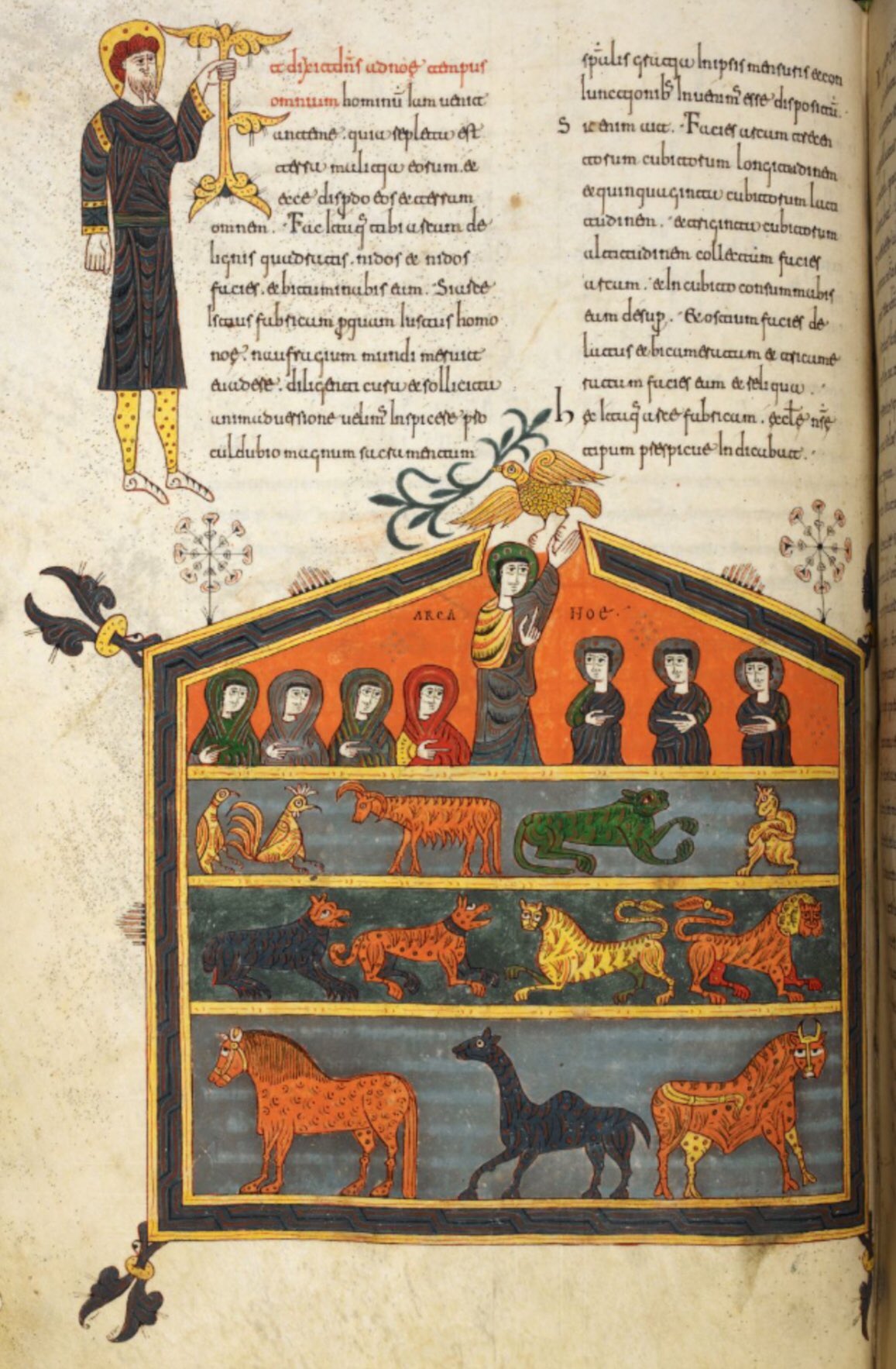
Postscript on Jan. 2: Well, Joe, it appears there’s a precedent for a stowaway on the Ark, so we’re in luck. From an illustration of Beatus of Liébana‘s commentary, The ‘Silos Apocalypse’; 1091-1109. Thanks to Ennius (@red_loeb) for the find on Twitter. Ennius asks: “Can you spot the stowaway on Noah’s Ark?” (Elisha ben Abuya @Elishabenabuya adds: “There is a Midrash that Noah had to take two of every living thing, so that included demons as well. – Midrash Rabbah Berashit 31:13)

Reykjavik for book lovers? Who knew? Now you’ll know why…

December 31st, 2018
Share

Our well-traveled journalist-photographer Zygmunt Malinowski, at Solheimjokull glacier.

A guest post from our roving photographer Zygmunt Malinowski, this time reporting from Iceland, which he visited over the summer. (All photos are copyrighted by him, of course, and used with permission.)

Who knew that Iceland’s cosmopolitan capital is designated as a UNESCO “City of Literature”? UNESCO looks at several criteria for the tag: quality, quantity, diversity of publishing; the range of libraries and bookstores; its literary events.

Jules Verne’s Snaefellsjokul volcano.

During the cool mostly drizzly summer of 2018, Reykjavik’s main street, Laugavegur, is full of strolling foreigners and locals stopping at one of its many cafes, restaurants, bars and shops. Several chain bookshops are available here, too. Many of the visitors are backpackers heading out to experience this exotic land of “Ice and Fire,” In fact Jules Verne’s well-researched 1864 novel Journey to the Center of the Earth was inspired by this region’s volcanic landscape. Its characters descend into the bowels of the earth.

One way to see Reykjavik is to take a literary walking tour. I booked the one offered by the City Library called “Dark Deeds.” Its theme was crime fiction and ghoulish stories (i.e., Scandinavian Noir). The intention “was not to give an historical overview of literature in Reykjavik but rather to give a small sample of the varied works set in the city…. This walk takes the participant to several locations in the city center for viewing a world connected to both older and contemporary Icelandic literature, although the emphasis is on recent compositions.”

Gathering for “Dark Deeds” next to Gröndal House.

We visited eight sites, and two young men, Salvar and Guttormur, gave a brief introduction and a short reading from each author’s work at each stop. A visit to the harbor revisited a story of a luxury yacht with no passengers crashing into the harbor – a mystery thriller and international best seller, 2014’s The Silence of the Sea by Irsa Sigurðarsdóttir (translated by Victoria Cribb). A nondescript building, formerly a hospital during the 1918 Spanish flu, recalled a detective, a young inspector “drawn into the underworld of the city” in 2015’s  Reykjavik Nights by Arnaldur Indriðason (also translated by Victoria Cribb). At Briet Square, we learned about Gerður Kristný an award-winning author, a former journalist and editor-in-chief of literary monthly, who wrote “Drápa” (a form of skaldic poetry) about a senseless murder based on a real crime. Its an epic novel in verse, which takes its form from old Norse poetry and its mood from modern crime.” An excerpt from the 2018 book:

Snowflakes floated
onto the pavement

The city vanished
overcome by night
into drifting snow

Rabid winds
besieged the town
sent downpours down
to its very core

The winter war
had begun

City-dwellers
ran for shelter

(Translated by Rory McTurk.)

Benedikt Grondal’s notebooks

A more cheerful site was the home of Benedict Gröndal (1826-1907) – a writer, poet, teacher, illustrator of Icelandic birds, translator of Iliad, autobiographer, and natural scientist. His love of nature was one of his strongest characteristics. He was one of the founders of Natural History Society of Iceland and became its first director. His autobiography Dægradvöl (Pastime) is considered one of the classics of Icelandic literature known for it historical value, satire and sincerity.

Inside renovated Gröndal House which was relocated and now is open to the public, on one of the panels there is a quote. The author muses about his legacy when he addresses the future reader:

“I hope dear guest that you will give yourself time to dwell at this window into my life and works. What you will see here is of course no proportion to my body of work, but I hope you will at the end send some warm thoughts my way and give praise to the works I so exerted myself to creating. Many of them were never appreciated by certain people during my time.”

Info column at Grondal House.

One of the amusing poems read at the home, “To Bother,” was popular as a song several years ago. In English translation’:


To Bother (Nenni)

I don’t always read I can’t always be bothered to read
I do n’t always bother writing I can’t always be bothered to write
I don’t always paint I can’t always be bothered to paint
what do I bother then? so what can i be bothered to do?

I always love to love I always bothered to love
I always bother to drink
I always bothered to drink I always bother to dream I can always be bothered to dream
something I bother then so I can be bothered to do something


Gröndal House in Reykjavik.

According to statistics, Icelanders are avid readers and it is said that one in ten here is an aspiring writer. Having seen only a few folks reading books, I asked the librarian and the National and University Library located at the nearby University of Iceland campus. He confirmed that Icelanders are readers – but mostly at home. Then he added that he also would like to write a book.

He also pointed out that Icelanders can read the ancient Viking sagas in the original language. Because of Iceland’s isolation their language did not change as much as it did as in other Scandinavian countries. The sagas – narrative prose – have an important role in Icelandic literature and are still widely read. They are valued by literary experts for their clear style, originality and uniqueness, which was hundreds of years ahead of its time in Europe (the Gaelic language would be a notable exception, however).


Reykjavik across the city lake.

At Gröndal House (his illustrated book of Icelandic birds is in the case)

National and University Library at University of Icelabd.

Russia: “Is there anywhere else where poetry is so common a motive for murder?”

December 27th, 2018
Share

Osip Mandelstam died in a transit camp near Vladivostok on this day, December 27, 1938. Here’s his NKVD photo from the same year. “Only in Russia is poetry respected, it gets people killed,” he wrote. “Is there anywhere else where poetry is so common a motive for murder?”


<<< Previous Series of PostssepNext Series of Posts >>>