What’s next for Man Booker winners Olga Tokarczuk and Jennifer Croft? A 900-page epic – in English next year.

June 19th, 2018


Share

Author Olga Tokarczuk and translator Jennifer Croft (Photo: Janie Airey/Man Booker Prize)

We posted about last month’s big win for Olga Tokarczuk and Jennifer Croft, winners of the Man Booker International Prize for the Polish author’s Flights (Fitzcarraldo Editions). Croft is the translator. She also translates from the Spanish and Ukrainian and is the founding editor of the Buenos Aires Review. In a new interview in Scroll, she discusses her craft. A few excerpts:

The original Polish title of Flights, which is Beiguni (or Wanderers), gestures to the Slavic sect who have rejected settled life. I also read elsewhere that an early title for the book was Runners. Tell us about your choice for the English title – and how this captures the book’s central themes.

Signing books in London.

The original title of the novel is Bieguni, which comes from a Slavic root that means “to run”. But the word in Polish is a strange one – not a word people use, though they would recognise the root. The word “runners” in English is much more prosaic, much less evocative. I chose a word I thought would accurately reflect Olga’s tendency throughout her work to create networks of associations, a tactic that is especially important in a book like this one, where fragments may appear at first glance to be disconnected from one another, yet in reality they’re linked conceptually as well as though subterranean formal bonds, including the resurgence in different sections of related words. “Flights” suggests plane travel, imagination (“flights of fancy”), fleeing (which is closer to the original Polish title), etc.

***

It’s taken a decade for the English-language version to hit the bookshelves since the book was first published in Poland. And for this reason Tokarczuk has said that while she’s pleased it has gained renewed pertinence, she also feels “conversationally jet-lagged” talking about it now. With this distance in mind, what are your thoughts on translations as the after-lives or second-lives of a book?

This is a fascinating topic that also gets at the question of what a translation is, whether it constitutes its own artwork, how independent it can be from an original, how independent an original can be from it. I’m planning to write more about this in the future.

***

You’re also translating Tokarczuk’s magnum opus, the 900-page epic The Books of Jacob, which won the “Polish Booker” [That would be the Nike – ED.], and which is slated to be released in 2019. What can readers expect?

Olga Tokarczuk’s The Books of Jacob is a monumental novel that delves into the life and times of the controversial historical figure Jacob Frank, leader of a heretical Jewish splinter group that ranged the Habsburg and Ottoman Empires and the Polish-Lithuanian Commonwealth, seeking basic safety as well as transcendence. Tokarczuk’s twelfth book, considered by many critics to be her masterpiece, The Books of Jacob is also a suspenseful and entertaining novel that remained a national bestseller for nearly a year after its November 2014 release.

Although set in the eighteenth century, The Books of Jacob invokes a decidedly twenty-first century zeitgeist. It encourages its readers to reexamine their histories and reconsider their perspectives on the shape Europe will take in coming years. It celebrates and problematises diversity in its plot and characters. It subtly participates in the debates dividing Europe – and the world – on how to protect tolerance, how to define intolerance, how to set and abide by the limits of contemporary sovereignty, and on specific issues such as how to handle an influx into Central Europe of refugees in both practical and moral terms.

Read the whole Q&A here.

A night at the opera with Andy Ross – actually, four nights, because it’s Wagner’s Ring Cycle.

June 17th, 2018
Share

“I’ll be at Das Rheingold tonight at the San Francisco Opera,” Andy Ross told us. He’s a literary agent and former proprietor of Cody’s Books in Berkeley. We’ve written about his face-off with a fatwa here, but now he’s facing another battle: the San Francisco’s Wagner fest, which continues into July (read about it here). Andy is a longtime fan of Richard Wagner’s corpus: “I discovered it in college. Most people liked the Beatles. I liked Wagner. People thought I was weird.” Now there’s no turning back.

“I’ve got my spear and horned helmet and I’m ready to go.” Let’s go with him. Here he is on the first night.

“Just got back from Das Rheingold. It was great.”

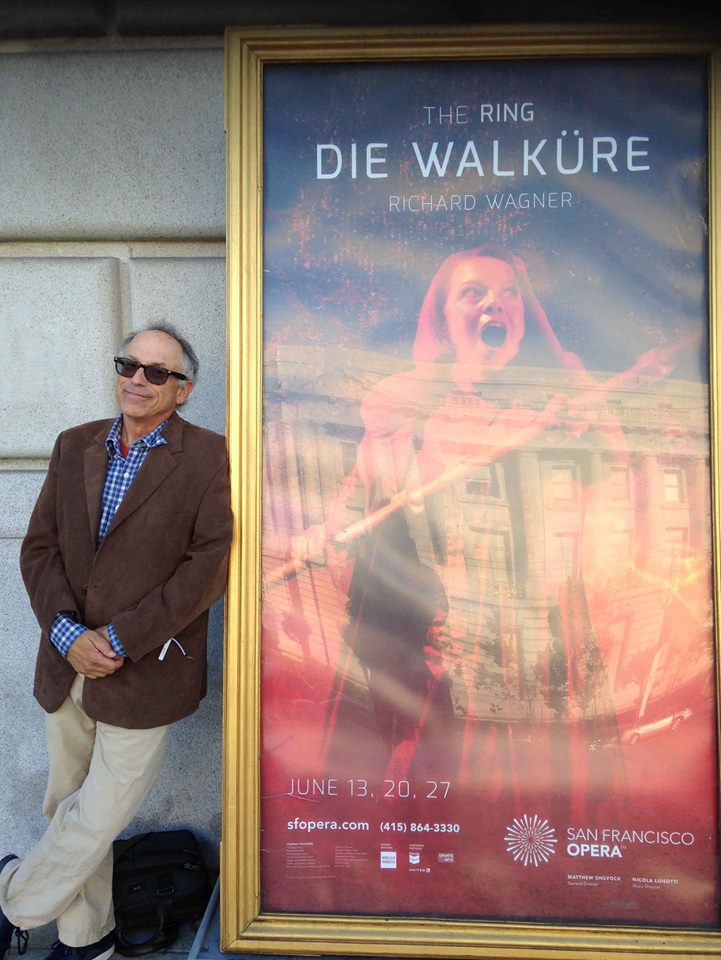
Night 2: At Die Walküre last night. My favorite Ring opera. Magnificent performances by the artists and the orchestra. It even managed to distract me from the weird post-modern staging. (Although I have to admit to a certain admiration in the third act with the Valkyries dropping onto the stage from parachutes looking like Amelia Earhart).

Walküre is the most human of all the Ring operas. The Ring is myth, and the characters sometimes become more symbolic of universal qualities than than flesh and blood human beings. Moreover, Wagner’s tendency to overlay the story with Schopenhauerian philosophical musings means that the opera doesn’t always find its way to the heart. But not so in Walküre. The first act is, in my mind, the greatest love scene in all of opera, from the glimmering recognition of Siegmund and Sieglinde to the climactic moment when Siegmund pulls Wotan’s sword from the tree as Sieglinde looks on in ecstasy. Its emotionality is amplified by the vulnerability of the characters and the knowledge of their impending doom. In the following acts, the immortals, Brunnhilde and Wotan, find their own humanity – literally for Brunnhilde, who, in the heartbreaking final scene of the opera, is banished from Valhalla, deprived of her immortality, and laid to rest by Wotan, who surrounds her with the magic fire that can only be penetrated by a hero who is without fear. Not a dry eye in the house.

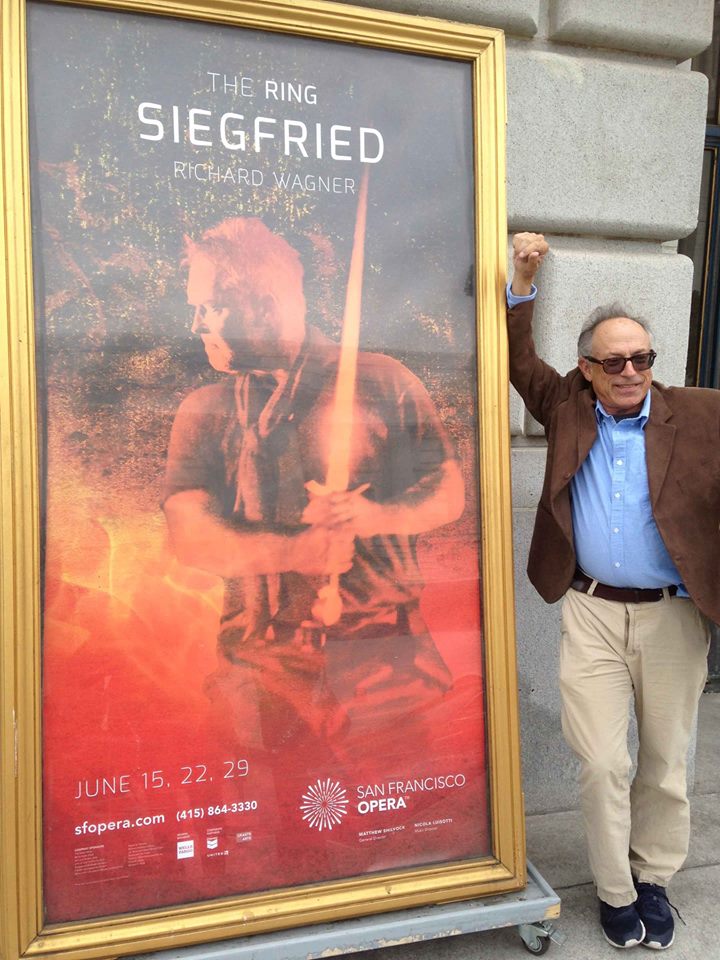
Night 3: Last night, David Ross and I saw Siegfried, the third opera of Wagner’s Ring. Siegfried has always seemed to me the Ring’s problem child. I find the music and the drama in the first two acts disappointing. The biggest disappointment is the character, Siegfried. That’s a problem because he is on stage for most of the four hours of the opera. Wagner’s hero seems more like a cross between a boy scout and the lug who played JV guard in high school. Moreover, Wotan comes on stage very early on, always a sign that maybe it’s time to go out to the lobby and check your email. True to form, he goes on a long unmusical backstory exposition. The second act is just plain boring. The music is thin and unmemorable. The shimmering “forest murmurs” sound a little like mediocre Debussy. Even Fafner, the dragon, is something of a bore. I’ve always felt Wagner had simply run out of steam by Act 2 of Siegfried. He had lost his mojo.

Then the orchestra begins the prelude to Act 3, and something miraculous happens. To backtrack a little, Wagner put down the score to The Ring after composing Act 2 and didn’t go back to it for a decade. During that time, he composed his two great mature masterpieces, Tristan und Isolde and Die Meistersinger von Nurnberg. When he returned to Siegfried, you see the transformation right away. The orchestra, always Wagner’s strong suit, is fuller, richer, deeper, more complex. The music is powerful and evocative. Even Wotan, who makes his final appearance in The Ring, has compelling music. And nothing quite prepares us for the electrifying and triumphant love duet that ends the opera. Wagner composed three great love scenes: the second act duet of Tristan, Siegmund and Sieglinde’s duet in Act 1 of Walküre, and this final scene of Siegfried’s awakening of Brunnhilde. This love duet lacks the eroticism of Tristan, and the heartbreaking tragic quality of Walküre. It isn’t even particularly romantic. But it puts forth a kind of heroic, triumphant message that love will change the world. It was a thrilling end that brought the entire house to its feet. There’s really only one other ending in opera packing that kind of titanic power. We’ll be hearing it on Sunday.

David Ross and I spent the last six hours seeing the final opera of Wagner’s Ring. Götterdämmerung isn’t the most popular opera in the Ring. That would be Die Walküre with its heartfelt humanity. Götterdämmerung‘s characters do not engage the listener in the same way. The music is relentlessly dark and foreboding. But this is the opera that best expresses Wagner’s musical vision of a completely integrated work of art. If you were able to ask Wagner what his most perfect work was, I have no doubt he would say it is Götterdämmerung. More than in any of the preceding operas, the orchestra dominates the story to the point where it becomes the most prominent voice. This is best seen in the incomparably glorious final scene, Brunnhilde’s immolation.

Wagner’s place in the pantheon of great composers is permanently established. But he stands apart, not because of his greatness, but because of his flaws. One would be hard-pressed to identify a flaw in any of Mozart‘s work. They are perfect. Wagner’s works are all flawed masterpieces. But he maintains his place because of the splendor of his greatest moments. The Ring, flawed though it is, is perhaps the most monumental work in Western Art. I suppose you could include Dante‘s Divine Comedy, and maybe Michelangelo‘s Sistine Chapel with that. And after seeing the complete Ring, one must admit that the music has done what was seemingly impossible, living up to the grandiosity of Wagner’s vision. Seeing it was special. We are glad we went.

And we’re glad we went with him. Read more about the San Francisco Opera’s Wagner festival, which continues into July, here.

Timothy Murphy may be the most prolific lyric poet in English ever – and he’s dying.

June 15th, 2018
Share

Tim in North Dakota

Update on June 30: Tim Murphy’s last email to me said that we would talk when he got over his thrush, which made conversation difficult. “Hell of an affliction for a poet,” the Dakota poet added in an email on June 2.  

His body was riddled with what he called “six warring cancers.” Then he broke his hip, too. I tried calling some time later, and he said, “I am in agony.” A few days ago, his family had silenced his phone and were not answering messages. “There are scores of unanswered emails. His family is deluged,” wrote Jennifer Reeser, who, as his executor, says she is now “Tim’s agent on earth.” He died in his home in the early hours this morning – peacefully, she says. I don’t doubt it. He had earned it.

His Last Poems? was 168 pages long when he sent it to me in mid-May, but had grown to some 230 pages by the time we last communicated – he said he’d send it. He signature line: “so yes, I’m writing better and faster than I ever have.  fondly, Tim”

Tim Murphy is dying and he knows it. He received the news on January 10, his 67th birthday. Now the poet is in advanced stages of cancer at his North Dakota home, and he is writing quickly, feverishly,  fiercely, a poem or two a day, despite physical limitations, heavy medications, and overwhelming setbacks. He is racing against extinction.

North Dakota State University Press is preparing to issue a Collected.  It’s a daunting effort: his fourteen collections total something like 1,400 pages. “That makes me the most prolific lyric poet in English,” he crowed in a recent email. His Last Poems collection followed his diagnosis (the version I have totals 168 pages) and describes his grim predicament, its origins and inexorable destination:

Owning It

Family history is just so clean
cancer never intruded on my thought.
I’ve hunted hard each fall, I’m whippet lean,
but my twin vices have been dearly bought.

My brother Jim embraced a grimmer view:
“No Murphy ever drank and smoked like you.”

We met at the West Chester Poetry Conference, at the turn of the century, and kept up a sporadic correspondence. I published a long Q&A with him, and I still think it reads rather well. He did, too, when he recently reread it. From my introduction:

Timothy Murphy, all dressed up.

Photos don’t do him justice. Tim Murphy is harder, leaner, smaller, and more prominently beaked than any news photographer has caught to date. Moreover, his brilliant red hair, set off by a welter of freckles, softens to a dull, inexpressive gray in newsprint black-and-white. Face to face, Murphy brings to mind a fierce, small hawk over the North Dakota wheat fields of his native Red River Valley.

In addition to being a poet of note, Murphy is also a venture capitalist and partner in a farm that produces 850,000 hogs a year. “I do the dirtiest, most difficult job on a farm,” he often quips to reporters. “I borrow the money.”

His poems have received kudos from high sources, including Pulitzer prize-winning poet and former U.S. Poet Laureate Richard Wilbur, who praises Murphy’s wide learning, the elegance of his writing, and his “extraordinary conversancy with a lot of the poets of the past, in many languages.”

“Tim uses rhyme and meter in a songlike way––which a great many modern poets have forgotten how to do. Most poets nowadays are not lyric in that sense. Tim writes poems that a composer could set to music,” says Wilbur. Moreover, “his poetry is lucid. When he is subtle, it’s the kind of subtlety that leads you into understanding. He uses forms without showiness and always with a point.”

At Yale University, where Murphy was Scholar of the House in Poetry, he studied with Southern agrarian poet Robert Penn Warren (another Pulitzer prize-winner and former poet laureate), who had grown up on a Kentucky tobacco farm.

Warren, however, refused to give him a recommendation after Yale. Murphy was courting the East Coast literary world and aiming for a poet-in-residency at a prestigious academy. “I needed to cultivate the sense of place which I so fervently admired in Yeats, Hardy, and Frost, but which I had not yet found in the land of my own birth,” Murphy wrote in Set the Ploughshare Deep. “Go home, boy,” Warren had told him. “Buy a farm. Sink your toes in that rich soil and grow some roots.”

Richard Wilbur and “Charlee” were friends.

Murphy took the advice. Twenty years later, he published The Deed of Gift (Story Line Press, 1998). During the intervening two decades, he distilled his blowsy iambic pentameter narrative lines to the briefest of dimeters and trimeters, often in poems of a dozen lines or less.

The openly gay Murphy describes himself as a “Faggot Eagle Scout Libertarian Factory Farmer Carnivore Poet.”

Well, read the whole Q&A over at the Cortland Review here.

His story didn’t end there. Alan Sullivan, his beloved friend, as well as editor, translator, and collaborator, succumbed to cancer seven years ago. Both underwent late-life conversion experiences. I haven’t had a chance to read thoroughly and thoughtfully the manuscript Tim sent me a few months ago, but I flagged this as a personal favorite, having met the late great poet Richard Wilbur and his wife “Charlee” at that same West Chester Poetry Conference, seventeen years ago (Pistis, elpis, agape – St. Paul’s faith, hope and love):

Prayer to Charlotte Wilbur

Your death day Holy Tuesday, Charlee, pray
.   hard for your “young” friend
 facing a painful end,
chemo and radiation. Day by day

I trudge to treatment, trailing my slender hope,
 wishing only to write.
 Burdened, I wake at night
weighed by an anchor eye-spliced to a rope,

symbol of elpis. Pistis, agape too,
.   with these must I surround
 my soul and stand my ground,
trying to die unbowed. I pray to you,

much cherished matron in the Heavenly Host.
Put in a warm word with the Holy Ghost.

Postscript on July 1, from poet and translator A.M. Juster on Twitter:

Can’t get a copy of Evolution of Desire: A Life of René Girard? Here’s why.

June 13th, 2018
Share

Can’t get a copy of Evolution of Desire: A Life of René Girard? Here’s why: they’re gone. No copies at the publishing house. Or the warehouse. And certainly not at Amazon. We’re sold out. Completely.

Second printing should be here next week. Stay tuned, or pre-order on Amazon, or check your local bookstores.

(Update: There appear to be a few copies available on European Amazon sites. You could fly to Warsaw and pick up a copy. But honestly, it might be better to wait till next week.)

How Andrei Sinyavsky’s papers wound up at Stanford – and a long-ago trip to Fountenay-aux-Roses to get them.

June 11th, 2018
Share

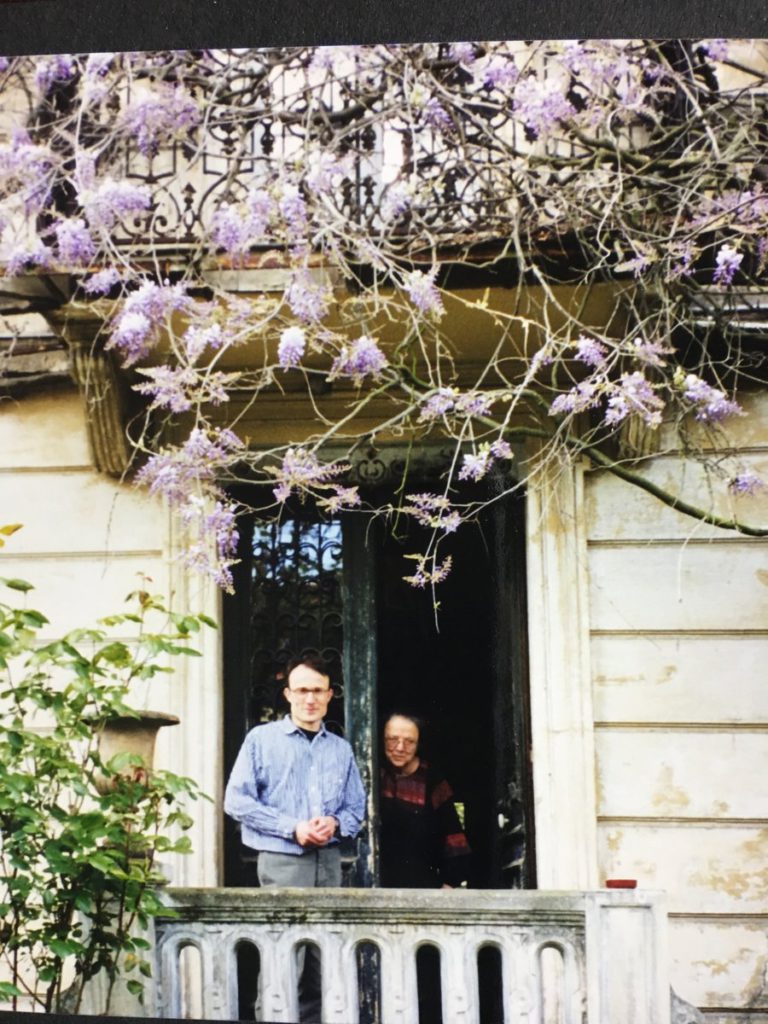
Mother, son, and wisteria at the rue Boris Vilde.

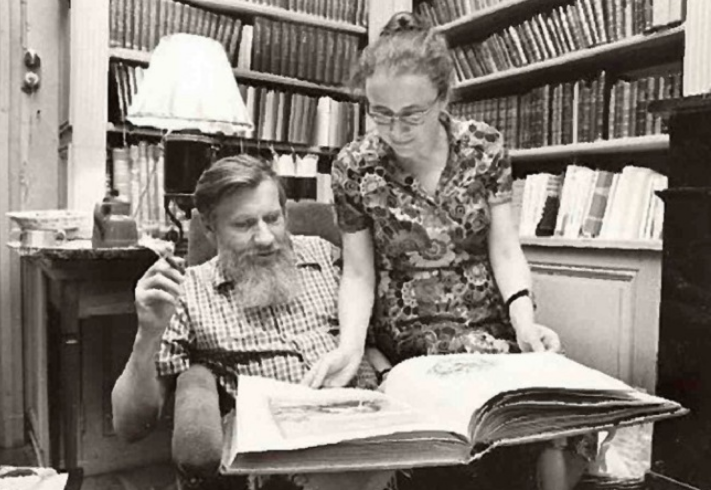
It’s a small world, of course. And even smaller if you’re at Stanford. No sooner had I posted yesterday’s thoughts about the Russian writer Andrei Sinyavsky (pen name Abram Tertz), then a tweet surfaced in cyberspace from a dear friend: “”Cynthia Haven brought back memories of reading Abram Tertz, then meeting him in the Hoover Archives reading room as Sinyavsky. Both he and his wife Maria Rozanova were regulars in the Hoover Archives reading room in the 1990s. They just could not stay away.” No wonder. With its extensive collections on the Soviet era, it would have been a miracle to them.

Elena Danielson, the friend, and also the former director of the Hoover Institution Library and Archives, told me that Hoover had, in fact, acquired the papers of Sinyavsky, and she herself had collected them from France.

I noodled around google a bit and found the Stanford press release from October 1998. It’s another story of Hoover’s truly remarkable archival rescue efforts:

The Hoover Institution has acquired the papers of the Russian writer and human rights activist Andrei Siniavski. Siniavski’s writings and his trial for allegedly publishing anti-Soviet slander in foreign countries are considered key in mobilizing the human rights movement that contributed in significant ways to the forces that discredited and toppled the Soviet system. “Siniavski was a writer whose fiction provoked the regime to frenzy and galvanized the movement that eventually brought it down,” said Hoover Institution Senior Research Fellow Robert Conquest after hearing about the acquisition.

Beginning in the 1950s, Siniavski sent abroad writings under the pseudonym Abram Tertz that he could not publish legally in the Soviet Union. He was arrested in 1965, tried in 1966 and sentenced to forced labor.

Demonstrations against the trial galvanized young intellectuals, among them Vladimir Bukovsky and Alexander Ginzburg, and inducted them into the human rights movement. In response to international protests at Siniavski’s mistreatment, the regime allowed him to emigrate to France in 1973.

Siniavski’s wife, Maria Rozanova, also publicized her husband’s plight and refused to leave the Soviet Union without his papers. Authorities relented in order to dispatch her abroad, and she was able to save the record of her husband’s life and work.

Once in the west, Siniavski taught at the Sorbonne, served as a visiting professor at Stanford and received an honorary doctorate from Harvard. He died in 1977. [Correction: it was 1997.]

The collection contains biographical information on Siniavski and his father, who was arrested for political activity; unpublished manuscripts and correspondence from before his arrest; materials on smuggling his manuscripts abroad, including secret codes he used; evidence of his influence on students at Moscow University; evidence of people spying on him; materials on his arrest and trial; a copy of the KGB interrogation files, notes on the search of his home and photographs from the early days of the human rights movement; papers from the emigration and continuing human rights activities abroad, including broadcasts for Radio Liberty and tapes of complete interviews and sections not broadcast; and papers on emigre politics.
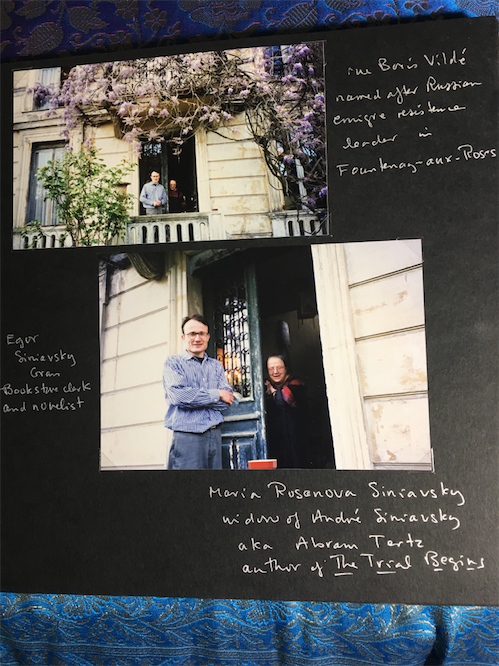
“The trip to rue Boris Vilde was such fun, about 1998 I suppose,” Elena recalled. “The wisteria covered house was classic French, and the interior, stuffed with papers on make-shift shelving, was so very Russian. The son, Iegor Sinyavsky Gran, is a novelist and a charming guy.”

She went back to her notebooks and files to find some photos for me.

“Maria Rosanova and Iegor Sinyavsky, rue Boris Vilde, Fountenay-aux-Roses,…I’ve just found the wisteria-covered house, stuffed with the late Andre Siniavsky’s papers in boxes, on shelves, overflowing the furnitures…Maria looked around in despair ‘Bumagi, bumagi, bumagi…'” (That would be бумаги, бумаги, бумаги. Or “papers, papers, papers…” to the rest of us.)

Elena

“The widow was totally bewildered by the huge stacks of papers,” she recalled. “But we got it all shipped and cataloged.” Then, a little later, “Such charm. The two of them made the collecting trip into one of the highlights of my career.” I could almost hear her sigh, all the way from Twitterland.

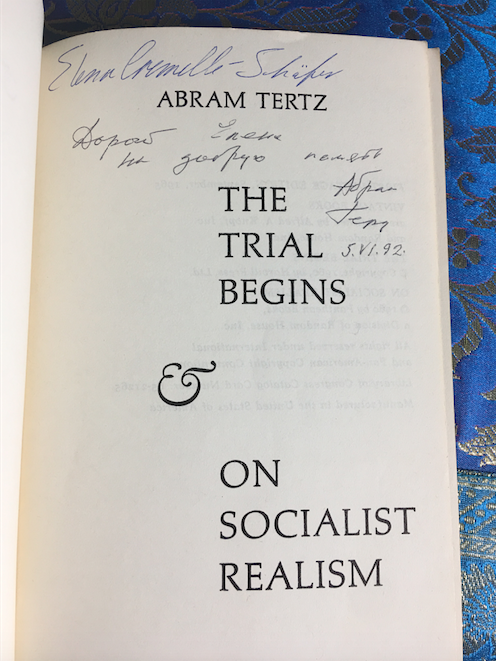
And she had another souvenir in her house from his days at Hoover, way back in the 1990s. She explained: “I bought The Trial Begins with an intro by Czesław Miłosz for a class at Berkeley, so in the 1965-1969 era. I just found the book which he autographed for me in the Hoover Archives reading room, dated 1992. He signed it Abram Tertz.

More from Elena’s albums:


Letters as “a listening device, a means of silent communion, a snare or net”: wise words from Andrei Sinyavsky

June 10th, 2018
Share

Sinyavsky reunited with the woman who was waiting on the other side.

I’ve been laboring over a text on Russian prosody this weekend, so Russia is clearly still on my mind, even after Friday night’s post on “Eating and (mostly) drinking with Dostoevsky.” However, in an idle moment I turned to yesterday’s post over at  Anecdotal Evidence, and apparently Russia is on blogger Patrick Kurps mind, too.  I didn’t think many others in the West remembered  Andrei Sinyavsky, who wrote under the pen name borrowed from a Russian-Jewish gangster, Abram Tertz (a move that didn’t keep him from getting arrested).

As Patrick explains: “In 1966 he was sentenced to seven years of forced labor for trying to ‘subvert or weaken the Soviet regime.’ That is, he sent a pamphlet and stories to Paris for publication. Totalitarian regimes pay writers the compliment of taking their work seriously. Modern democracies don’t care, and let’s hope it stays that way.” Let’s hope indeed. Sinyavsky was freed in 1971, and emigrated to Paris, where he died in 1997.

Patrick, in turn, was inspired by a web article a few days ago by John Wilson, the founding editor of Books & Culture. Also worth a read.

All this returned me to my own well-worn 1976 copy of A Voice from the Chorus (translated by Kyril Fitzlyon and Max Hayward), with my London phone number scribbled in the front cover. I can’t remember when or for whom I wrote a review. I just remember the book reshuffling my internal dynamics.

These are Sinyavsky’s letters from a labor camp. He was allowed to write to his wife Maria Rozanova only twice a month. The book is poignantly fragmentary – sometimes a sentence or a words overheard in the camp, sometimes the words spill into a mini-essay of several pages. The inside front cover of my book is full of penciled notes for passages I wanted to remember, like this one:

What makes us what we are? It probably all depends on our relationship to surrounding space. A man unconfined in space constantly aspires to go forward into the distance. He is sociable and aggressive, and needs ever new pleasures, impressions and interests. But if he is constricted, cut down to size, reduced to the minimum, then his mind, deprived of forests and fields, creates an inner landscape out of its own immeasurable resources. This is something that monks well knew how to take advantage of. To give away all your worldly goods – is not this to throw out ballast?

Not a man, but a well.

We are not outcasts or prisoners, but reservoirs. Not men, but wells, deep pools of meaning.

But above all these are love letters to the woman waiting for him on the other side, year after year. “I often sit down to a letter not because I intend writing anything of importance to you, but just to touch a piece of paper which you will be holding in your hand…”

And here:

“Oddly enough, all this idle chatter in my letters is in large measure not so much self-expression on my part as a form of listening, of listening to you – turning things over this way and that and seeing what you think about them. It is important for me, when I write, to hear you. Language thus becomes a scanning or listening device, a means of silent communion – absolutely empty, a snare or net: a net of language cast into the sea of silence in the hope of pulling up some little golden fish caught in the pauses, in the momentary interstices of silence. Words have no part in this, except in so far as they serve to mark off the pauses. We use them only to jolly ourselves along as we make our way towards silence, perfect silence.”


<<< Previous Series of PostssepNext Series of Posts >>>