Eating and (mostly) drinking with Fyodor Dostoevsky

June 8th, 2018

Share

‘Take some cold coffee and I’ll pour a quarter of a glass of brandy into it, it’s delicious …”

A man after my own heart. Unfortunately, he’s a baddie. Fyodor Kamarazov is the father of The Brothers Karamazov – licentious, wheedling, self-exculpatory, self-indulgent. Nonetheless, he had the right idea about ice cold coffee. I have it every morning. It’s basic. No frills. Nothing to cook or bake. On a tense, nervous afternoon pounding out a rough draft, half-a-shot of brandy in very strong coffee works wonders.

He knew a thing or two about onions, too.

Ahhh… the simple life. Gluttony is thought to be on the way out – or is it?  Go into Whole Foods. See the pyramids of oranges and onions. Watch the worshippers crowding around the displays, conducting pilgrimages through the aisles. You tell me that’s not a temple? Food has become both the religion of our time and the object of worship.

No surprise. We live in perhaps the first era in history where food is not the biggest chunk of our budget – it’s dwarfed by our Wifi bills, car payments, rent and mortgage. We can get plenty of anything from the supermarket – from kimchi to kiwi fruit. So now  we want not quantity, but quality. A certain tiny fish from the mid-Atlantic, lightly sautéed in organic butter and sage leaves, served on patta sal. Then we take selfies with it and post them on Facebook.

Fyodor Dostoevsky‘s  The Brothers Karamazov is perhaps my all-time favorite novel. So I was intrigued to see Valerie Stiverlatest entry in her “Eat Your Words” column in The Paris Review here.  This time she’s “Cooking with Dostoevsky.”  You can even make learn to make kvass from fermented Russian bread. The chef d’œuvre, however, is the onion vatrushki.

Her take on the Russian masterpiece is so-so, but she appreciates the virtues of a good onion:

“An Onion” is one of the most famous chapter headings in Dostoyevsky’s The Brothers Karamazov and refers not to Russian cuisine, in which onions are a staple ingredient, but to a story the character Grushenka tells about a wicked old woman being pulled up from the fires of hell by holding onto an onion proffered by her guardian angel. The woman lived a bad life but once gave an onion to a beggar, and it’s this single good deed that might save her. The anecdote is meant to demonstrate the possibility of God’s forgiveness, and its teller, Grushenka, says of herself in one of the book’s climactic scenes, “Though I am bad, I did give away an onion,” indicating her readiness to be saved. (As for the old woman, the other dammed souls try to grab her feet and be pulled up too, and she selfishly starts kicking them away. The onion breaks, “and the woman fell into the lake and she is burning there to this day.”)

And that, of course, sent me to my bookshelves, for I remembered that the same story is retold, in a slightly different way, in another of my favorite books: Life and Fate by Vasily Grossman. I didn’t find it, but I found this instead: “Kindness is powerful only while it is powerless. If Man tries to give it power, it dims, fades away, loses itself, vanishes.” Grossman was a reporter for the Red Army covering the defense of Moscow and the fall of the Berlin during World War II. He was also Jewish, and reported on the opening of Treblinka. He continues:

“Human history is not the battle of good struggling to overcome evil. It is a battle fought by a great evil struggling to crush a small kernel of human kindness. But if what is human in human beings has not been destroyed even now, then evil will never conquer.”

Meanwhile, enjoy Grushenka’s pear tarte – “Grushenka,” of course, means “little pear” in Dostoevsky’s Russian.

The company we keep: “Evolution of Desire” climbs the charts

June 6th, 2018
Share

The Book Haven and other duties keep me pretty busy, but even overworked writers need to catch a break. What better opportunity than a new vice? Ladbrokes has nothing on Amazon when it comes to the addictive power of chasing the ratings.

We’ve been hooked for days and weeks now, watching Evolution of Desire: A Life of René Girard climb and fall in the ratings.  In particular, it’s fun to chase Amazon’s featured rankings in the realms of “social philosophy” and “memoirs.” We climbed to the top ten in “social philosophy” books over the weekend, and we’re still chuffed about that. But we haven’t dug deeper and checked out the competition.

A colleague sent me the screenshot below yesterday, however, and it gave me pause.  Jordan Peterson? Steven Pinker? Michel FoucaultEvolution of Desire has hit the big-time, at last.

Stay tuned.

Postscript: From Ted Gioia: “I am not surprised. From the start, this book was destined for success—it’s the right time, the right subject, the right author, the right stuff. I expect to sell well for years to come.” From your lips to God’s ears, Ted!

Postscript on June 7: Whoops! We’re out of books! The first printing is sold out! Numbers drift downwards until new books arrive!

Does good literature inoculate us against lies? Poet Tomas Venclova thinks so.

June 3rd, 2018
Share

“Above all, love language” (Photo: Dylan Vaughan)

I was one of the few people to review Magnetic North, the great Baltic poet Tomas Venclova‘s book-length Q&A with poet and translator Ellen Hinsey certainly in the West, when I wrote for the Times Literary Supplement earlier this year. The book was never going to get a huge commercial audience, certainly, but seeing the long excerpt in the current Music & Literature makes me wonder if the book will have a second (and maybe third and fourth) life in excerpts.

I’m willing to help the process along, so here is an excerpt of the excerpt in the tony online journal (and if you don’t know Music & Literatureyou should): 

Before we go on to speak about other poems, I’d like to ask about poetic inspiration. In her book Hope Against Hope, Nadezhda Mandelstam says that for poets “auditory hallucinations” are a reoccurring occupational hazard, and that Osip Mandelstam experienced poetic inspiration as a musical phrase insistently ringing in his ears. Early on, did you notice any particular sensations that heralded the onset of a poem?

I’m not a very musical person. My imagination is more visual than aural: I admire (and, I hope, understand) architecture and painting, and I love Bach, Handel, and Purcell primarily because they remind me of architecture. Thus, the phenomenon of auditory hallucination described by Nadezhda Mandelstam comes to me not so much as musical phrases sensu stricto, but rather as rhythmic units that can also be understood in spatial terms. But yes, I experience an insistent and intrusive, even irksome feeling of something constantly repeating itself and demanding a liberating effort. It is frequently preceded by a general feeling of unease and a bout of bad mood. In my youth, I learned to understand this as the signal: “A poem is coming.”

Interlocutor

The passage above was the first that caught my eye in the Music & Literature article, but then another further dow, picked up a theme I’d discussed only a few days ago in The Book Haven post, “’Bro – he lives!’ Joseph Brodsky on the morality of uselessness, and the need to ‘switch off’. The Lithuanian poet Venclova’s work, from the beginning “constituted his own specific universe,” as his interlocutor, said his translator, Ellen Hinsey. 

I think Brodsky had in mind not just Soviet reality, but reality as such. True, Soviet reality was grimmer than most. After the nightmare of the camps and executions, from which we were trying to awake (to quote Stephen Dedalus, whose experience was milder than ours), we were confronted by an ugly and monotonous present that promised no further change. We were surrounded by the absurd. And that was only a part—one of the worst parts, to tell the truth—of the chaos and nonsense of life. Poetry—and art in general—was a way of resisting that chaos, holding it at bay. This also had political consequences. Politics, seen from this perspective, was something transitory (even if one had to make decent choices in everyday life). On the other hand, it would be an overstatement or even a distortion to assert that we were totally apolitical in our work. The stifling Soviet atmosphere, aggravated by the smug audacity of the authorities, provoked not only disdain, but resentment and indignation that could not help but find its way into our verses. …

Everything possible

Akhmatova frequently speaks about how the Soviet period robbed individuals of the chance to live out their own destinies. In your “A Poem about Memory,” and elsewhere, you reflect on “such a shortage of authentic fate—”

In her magnificent poem, the fifth “Northern Elegy,” Akhmatova speaks about all the things she was denied due to the circumstances of her era. She nevertheless states that she perhaps did everything that was possible in the only life left to her. I was stunned by these proud words. Naturally, our situations were not comparable, but in “A Poem about Memory,” I attempted to understand the way to “do everything possible.” …

He loves architecture.

All literature of quality provides the reader with patterns and insights that enable him or her—perhaps not systematically, but frequently enough—to resist false doctrines. Poetry, in particular, is somewhat mysteriously linked to ethics; and poetic discipline to the fortitude of the spirit. Many poets, including Zbigniew Herbert and Akhmatova—and her protégé, Joseph Brodsky—insisted that refusal to succumb to evil is primarily a matter of taste. I was of the same mind. …

Thus the human quality of tenacity also becomes an important component of personal and poetic ethics. Or as you described in “A Poem about Friends,” dedicated to Natasha Gorbanevskaya, and written after the 1968 demonstration against the invasion of Czechoslovakia in Red Square: “And those who live are chosen by the fog, / Deserted houses, journeys into the distance, / Their weapons are staunchness, abstinence from speech”—

During this period, it seemed as though the course of events were governed by laws of raw power, that is, by statistics. The force of words and human solidarity were our means to counter this, even if this meant prison or exile, as was the case for many of my friends. Speech—or, at least, a silent refusal to lie—was the axis of their existence. I tried to convey this in the very title of my book.

And the title of the book is Magnetic NorthRead the Music & Literature piece here

Who was René Girard? Wall Street Journal tries to answer the question.

June 1st, 2018
Share

Evolution of Desire: A Life of René Girard is in the Wall Street Journal weekend edition. The newspaper asks its readers “Who Was René Girard?”  And Marilyn Yalom, a French scholar and officier de l’Ordre des Palmes Académiques, tries to answer. She was the French theorist’s first graduate student at Johns Hopkins University in 1957, and was already at Stanford to greet him when he arrived here in the early 1980s. So she was the perfect person to review Evolution of Desire for the eminent WSJ.  

We couldn’t be more pleased and honored. The Wall Street Journal is the largest newspaper in the nation, with 2.3 million subscribers internationally. You don’t get a bigger audience that that. 

She writes: “Her carefully researched biography is a fitting tribute to her late friend and one that will enlighten both specialists and non-specialists alike.” Well, that’s what I had intended when I wrote the book.

The review is behind a paywall, alas, but here’s an excerpt:

René Girard (1923- 2015) was inducted into the French Academy in 2005. Many of us felt this honor was long overdue, given his international prominence as a French intellectual whose works had crossed the boundaries of literature, history, psychology, sociology, anthropology and religion. Today his theories continue to be debated among “Girardians” on both sides of the Atlantic. He is now the subject of a comprehensive biography by Cynthia Haven called “Evolution of Desire.”

A officier and a gentlewoman…

The title is apt. A key concept in Girard’s philosophy is what he called “mimetic desire.” All desire, he argued, is imitation of another person’s desire. Mimetic desire gives rise to rivalries and violence and eventually to the scapegoating of individuals and groups—a process that unites the community against an outsider and temporarily restores peace. Girard believes that the scapegoat mechanism has been intrinsic to civilization from its beginning to our own time.

My personal acquaintance with René Girard began in 1957, when I entered Johns Hopkins as a graduate student in comparative literature at the same time that he arrived as a professor in the department of Romance languages. With his thick dark hair and leonine head, he was an imposing figure whose brilliance intimidated us all. Yet he proved to be generous and tolerant, even when I announced that I was to have another child—my third in five years of marriage. …

Ms. Haven’s ability to interweave Girard’s life with his publications keeps her narrative flowing at a lively pace. For a man who woke every day at 3:30 a.m. and wrote until his professorial duties took over, it would be enough for any biographer to focus on his intellectual life, without linking his thoughts to a person ambulating in the world. Fortunately, Ms. Haven portrays Girard as he interacted with colleagues, students, friends and family.
 
Read the whole thing here, if you’re able.

Fitzcarraldo publisher Jacques Testard: “He is the best thing that has happened to the anglophone literary world in years.”

May 31st, 2018
Share


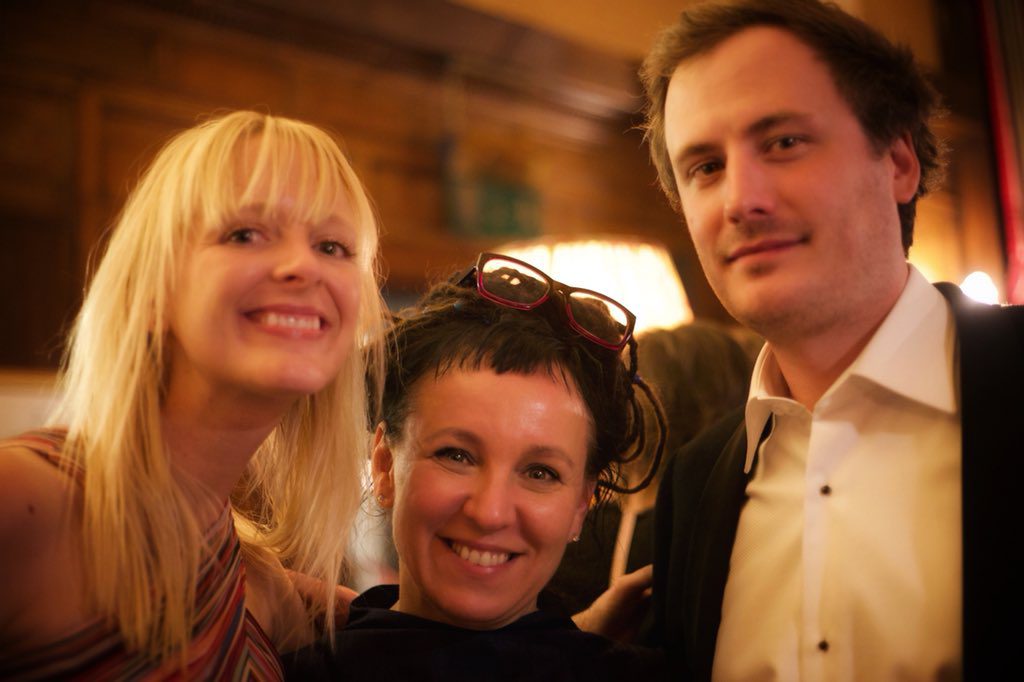
Translator Jennifer Croft, author Olga Tokarczuk, publisher Jacques Testard at the Man Book International Prize.

A few days ago, we discussed a remarkable man, Jacques Testard, founding publisher of Fitzcarraldo Editions. The tony new house published this year’s winner of the Man Booker International Prize, Olga Tokarczuk‘s FlightsI quoted friend and editor extraordinaire Daniel Medin of the American University of Paris, who was in London for last week’s ceremony:

Author and translator at signing

But in the applause for the author (and in this case translator, too), many forget the role of the publisher. Not Daniel, who also had praise for Fitzcarraldo Editions and its founding publisher Jacques Testard, with whom he has worked closely at The White Review for many years. “He is the best thing that has happened to the anglophone literary world in years. Firstly, for co-founding The White Review, which helped launch the careers of so many compelling English-language writers in the UK and in translation. Then, for Fitzcarraldo, which has brought the work of intrepid writers like John Keene, Kate Briggs and Claire-Louise Bennett to a larger audience. These are the first three that came to mind but his list is strong across the board, and includes of course many works in translation.

“It’s extraordinary that his books have won the Nobel and Man Booker International within a few years of launching. The best part’s that this is only the beginning. Jacques is playing the long game: his first translated title was by Mathias Enard, a finalist last year who will be eligible with his forthcoming novel, Tell Them of Battles, Kings, and Elephants.

“Fitzcarraldo should be competitive next year with Esther Kinsky‘s remarkable novel, River. (Incidentally, Kinsky translated Flights into German and won a major prize for her rendering of Tokarczuk’s House of Day, House of Night.)”

I did a little digging, and found this: “Interview with a Gate-Keeper: Jacques Testard,” a Q&A from 2017 with Kerri Arsenault over at LitHub. How did the house get its name? I wondered, and apparently so did Arsenault. The answer: “The name of the press, which comes from the Werner Herzog film about the man who wants to build an opera house in the jungle, is a not very subtle metaphor on the stupidity of setting up a publishing house—it’s like dragging a 320-ton steamboat over a muddy hill in the Amazon jungle.” From the interview:

Publishing today…

JT: I suppose my original interest in editorial work specifically came from a misguided notion of the glamour involved in the job, the mythology around great publishers of yesteryear, and the intellectual nature of the job. I wouldn’t say I had an easy time becoming an editor—in the early days I never managed to get the jobs I was applying for and so I ended up doing it in this long, unusual and convoluted way, working my way in from the margins by starting up my own project with a friend in order to eventually get to do it for a living.

KA: You mean editing isn’t glamorous?

JT: Publishing is a fairly low-adrenaline job, particularly when you work for a small independent press. I spend a lot of time on my own, editing, but also doing everything else you need to do to keep a small press ticking. I’ve had a few glamorous moments—the pinnacle was the Nobel Prize dinner for Svetlana Alexievich in Stockholm—but I spend a lot more time carrying big bags of books to the post office than drinking martinis with famous authors. In fact, carrying books around is quite a big part of the job.

The publishing house got an early boost when it published little-known Svetlana Alexievich’s Second-hand Time, “which we managed to pick up before she won the Nobel Prize, thus rendering any future prize successes utterly meaningless by comparison.” It was nominated nonetheless:

KA: I see Second-hand Time was longlisted for the Baillie Gifford Prize, the UK’s most prestigious award for nonfiction. What has publishing Alexievich meant for Fitzcarraldo?

The Nobel helped.

JT: A lot. It gave the company financial stability in our second year of operations—thanks to the rights sales we were able to slowly grow the company, going up initially to eight books a year, and now ten. It also gave Fitzcarraldo Editions a platform, a visibility which it might have taken a bit more time to achieve—that book was reviewed absolutely everywhere and critics and literary editors pay attention to what we publish as a result. It also gave us our first significant publishing success, from having to manage successive reprints to making contingency plans in the event of a prize-win, to organizing a ten-day tour for a Nobel Prize laureate. In that respect it’s given me the opportunity to learn more about my job as a publisher.

So is publishing still a madman’s dream?  “Kind of. I guess the suggestion is that publishing is so difficult and financially precarious that to set out to publish the kinds of books that we do is akin to dragging a 320-tonne steamboat up a hill. It’s possible, but it’s going to be extremely difficult.”

It’s looking better with last week’s Man Booker International Prize. Can’t wait to read Flights. Read the interview here.

“Bro – he lives!” Joseph Brodsky on the morality of uselessness, and the need to “switch off”

May 28th, 2018
Share

Sentenced to hard labor in Norenskaya, after a show trial.

Nobel poet Joseph Brodsky famously said that the only thing poetry and politics have in common are the letters “p” and “o.” In a sense, that observation can be said to be the topic of Rachel Wiseman‘s “Switching Off: Joseph Brodsky and the Moral Responsibility to Be Useless,” over at The Point. 

It was the poet’s birthday a few days ago (he would have been 78), but it was also very soon after Philip Roth‘s death, so I didn’t post. Yet it would be ungrateful not to say something about the man who gave so much to me.

Fortunately, David Streitfeld of the New York Times sent me this article this morning, and it’s too good not to let the world know about it. (It’s one of a series on intellectuals – here.)

Спасибо, David

Wiseman begins with the 1964 show trial, where the Nobel poet, then 23, was labeled a social parasite. Then she contrasts his position with journalist Keith Gessen‘s criticism of him:

“If a poet has any obligation to society,” Brodsky said, “it is to write well. Being in the minority, he has no other choice.” The Soviet trial judge is not the only one who has taken this attitude to indicate a lack of social conscience. The novelist and critic Keith Gessen, in a 2008 article for the New York Times Book Reviewfaulted Brodsky’s generation of intellectuals and those who followed for being “powerless to stop Putin from terrorizing the country, not because they feared him, but because after the destruction of the Soviet Union they retreated into ‘private life,’ which is what they wanted all along.” Gessen is a great fan of Brodsky the poet, but wishes he would be more of a critic. In a New Yorker essay from 2011, he condemned Brodsky for allowing himself to become a “propagandist for poetry.” Gessen searched Brodsky’s oeuvre in vain for an example that might undercut the unapologetic aestheticism that had “hardened into dogma.” Not unlike the judge, Gessen seemed to demand of Brodsky, How were you useful to the motherland? How could someone of Brodsky’s intelligence actually believe that aesthetics governs ethics and not the other way around?

In a sense, she begins to demonstrate the point the article is trying to make. It sags in midway, as she addresses growing up in the “multicultural, bubblegum Nineties” and the politics du jour (“national nightmare”) – the piece becomes predictable and rote in outlook. It fades into outrage, repetitive emotions, and the mob before it regains altitude:

Every generation of intellectuals finds a way of coming to terms with the limits of their agency. Brodsky’s chose poetry; mine and Gessen’s took the train downtown. It’s not a strict binary, of course: these two tendencies can coexist in the same individual and express themselves in different ways. But we might consider that switching off, for Brodsky, was a way of performing his social responsibility, not shirking it. In Brodsky’s view, politics was one level of human existence, but it was a low rung. The business of poetry, he thought, is to “indicate something more … the size of the whole ladder.” He held that “art is not a better, but an alternative existence … not an attempt to escape reality but the opposite, an attempt to animate it.” What compels a poet to write is less “a concern for one’s perishable flesh” than “the urge to spare certain things of one’s world—of one’s personal civilization—one’s own non-semantic continuum.”

Gessen critiques

Hard to know what to quote because so much of it is so good. But let’s end at the ending. Those who have sent me emails know my standard footer: “Evil takes root when one man starts to think that he is better than another.” It’s a remarkable quote, and true in just about every case I can think of. Here’s where it comes from, embedded in his remarks on the Biblical passage enjoining us to turn the other cheek:

Brodsky gives an account of the standard interpretation of the lines of scripture that inspired this doctrine of passive resistance and then goes on to mention the ending, which is less commonly quoted. The idea is not just to turn the cheek to the person who strikes you—you are also supposed to give him your coat: “No matter how evil your enemy is, the crucial thing is that he is human; and although incapable of loving another like ourselves, we nonetheless know that evil takes root when one man starts to think that he is better than another. (This is why you’ve been hit on your right cheek in the first place.) At best, therefore, what one can get from turning the other cheek to one’s enemy is the satisfaction of alerting the latter to the futility of his action. ‘Look,’ the other cheek says, ‘what you are hitting is just flesh. It’s not me. You can’t crush my soul.’”

As David wrote to me when he sent the link, “bro – he lives!” Then he added, “anyway, what was it exactly they used to call him?  joe the bro, no? it was a play off  ‘joe the pro.'”

С днем ​​рождения, Иосиф. It’s true. “Bro, he lives.”

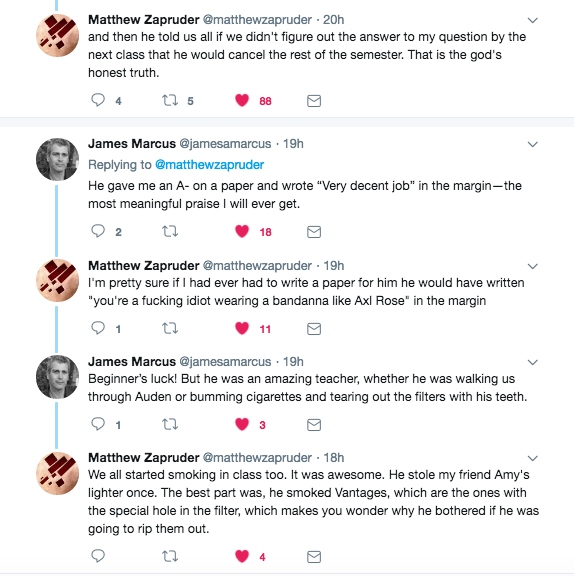
Postscript: Oh, but I forgot to include the tweet David sent a few minutes earlier. It’s below. Sounds about right, except … a “green velour suit”? In the 1970s, maybe … but the 90s?  I went to twitter and a whole stream of postscripts followed, including some from James Marcus:

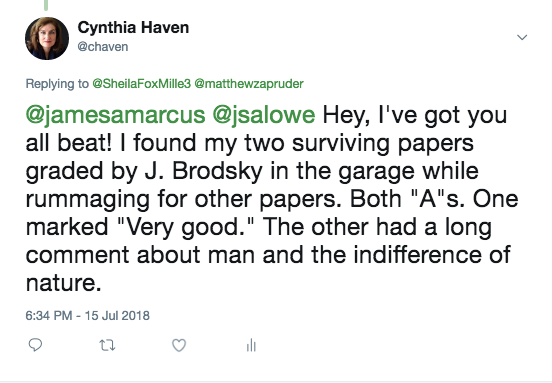
Postscript on 7/15: Look what I found in the garage, while looking for other records. Naturally, I was so chuffed I had to tweet:


<<< Previous Series of PostssepNext Series of Posts >>>