Posts Tagged ‘Dana Gioia’

The “satiric, terrifying” legacy of poet Weldon Kees

Monday, December 8th, 2025

Share

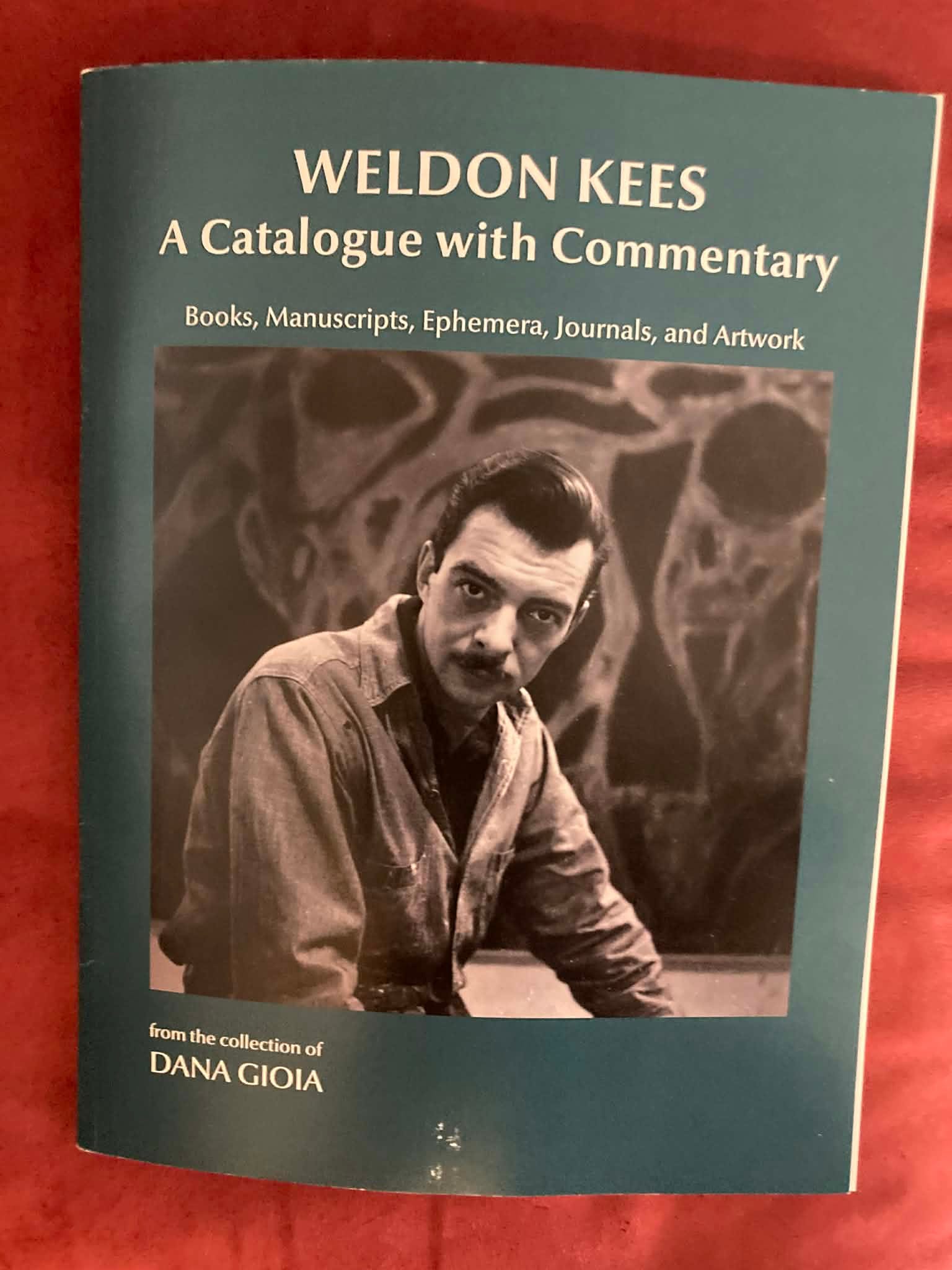
From my mailbox: Dana Gioia, poet and former chairman of the National Endowment for the Arts, sent me the latest fruits of his labors. Dana has long been a champion of the of the overlooked poet Weldon Kees (1914-1955). According to poet Donald Justice, “Kees is original in one of the few ways that matter: he speaks to us in a voice or, rathre, in a particular tone of voice that we have never heard before.” Dana has just published a catalogue of his own collection with commentary, including works of fiction and non-fiction, broadsides, journals, music and recordings, critical works, and more. Here is the preface:

I first discovered the poetry of Weldon Kees in 1976—fifty years ago—while working a summer job in Minneapolis. I came across a selection of his poems in a library anthology. I didn’t recognize his name. I might have skipped over the section had I not noticed in the brief headnote that he had died in San Francisco by leaping off the Golden Gate Bridge. As a Californian in exile, I found that grim and isolated fact intriguing.

“I had found the poet I had been searching for.”

I decided to read a poem or two. Instead, I read them all, with growing excitement and wonder. I recognized that I was reading a major poet. He was a head-spinning cocktail of contradictions—simultaneously satiric and terrifying, intimate and enigmatic. He used traditional forms with an experimental sensibility. He depicted apocalyptic outcomes with mordant humor. I had found the poet I had been searching for. Why had I never heard of him? Embarrassed by my ignorance, I decided to read everything I could find by and about him.

It was a Saturday afternoon. I had the rest of the weekend free. I drove to the main branch of the Minneapolis Public Library, heady with anticipation. I was eager to read all of his books. I also wanted to see what other readers thought about him. I knew my way around libraries—an important skill in those pre- internet days. Whatever books and commentary existed, I would find.

What I found after two days of searching was nothing. There was not a single book of any kind by or about Weldon Kees in the Minneapolis library system. His work, I also discovered, did not appear in standard anthologies. (I had read one of the only two anthologies that had ever featured a large se- lection of his poems.) There was no biography. There were no entries about him in the standard reference works. Nor were there chapters on him in the numerous critical books on contemporary poetry.
He went unmentioned in the biographies of his contemporaries. There had never even been a full-length essay published on his work.

By Sunday evening, I realized why I had never heard of Kees. Hardly noticed during his lifetime, in death he had been almost entirely forgotten. A suicide at forty-one, Kees had succeeded in his last endeavor—vanishing. His body had never been recovered. Kees had been washed away from posterity with- out rites or remembrance. All his work was out of print. Worse yet, most of it—the stories, novels, plays, and criticism—had never been collected. Some of it, such as his first novel, had been lost entirely. Only the poems, a small, brilliant body of work, survived precariously—without criticism or commentary, almost without readers.

I decided then I would write a long, comprehensive essay on his work. It was not the sort of thing I had done before. I could not begin, however, without knowing more. I did not own any of his books. I knew few facts about his life. I began to search, gather, and collect. I not only found books, journals, and eventually manuscripts; I found people who had known and worked with him. I also discovered I was not alone in my intense admiration.

Three years later I published my essay in a special issue of the Stanford literary magazine, Sequoia, edited by my brother [jazz scholar] Ted Gioia. The issue stirred up a surprising amount of interest. I was soon planning an edition of his short stories, which had never been published in book form. That task led me to new material and new people. I had not realized that Kees had been a true polyartist who had not only mastered fiction and poetry, but also painting, photography, filmmaking, and jazz. I kept working on new projects, and the collecting never stopped. His audience also grew, though not among academics. His admirers were writers, artists, printers, and musicians.

This catalogue documents some of what I found in my search for Weldon Kees. It is not a conventional bibliography. It describes a personal collection with commentary. It tries to tell the story of a writer through his books. It evokes Kees’ polymathic imagination from his art, music, and photography. It also reveals the existence of three of his large notebooks which document his prime years as a poet. I wrote this little book mostly for myself and a few friends. I hope it appeals to other readers, writers, and collectors. If this book is for you, you’ll know it.

Find some of Weldon Kees’s poems at the Poetry Foundation here.

Seneca’s “The Madness of Hercules”: a stunning performance, a brilliant new translation!

Sunday, June 29th, 2025
Share

Actress and singer Grace Wade as the betrayed and angry goddess Juno.

This month Seneca made his first appearance in the Bay Area in many years, if ever. The occasion was a staged reading of The Madness of Hercules, on Saturday, June 14, at St. Patrick’s Seminary in Menlo Park. The dramatic setting in front of the brick portico at dusk intensified a drama that needed no intensification. Let’s hope it’s the start of a Seneca revival. It’s long overdue.

In addition to the mesmerizing performance of Grace Wade as Juno/Megara, the other performers included: Kyle Ryan as Hercules; John O’Malley as Amphytrion; Joseph Bissex as Theseus/Lycus.

The text is newly translated by poet and former NEA chair Dana Gioia, also a former California poet laureate. The new edition of Seneca’s play was published by Wiseblood Books. (Excerpt from the text coming in another post.) Buy the book. More than a third of the volume is an insightful introduction to “Seneca’s Tragic Vision,” Seneca and European Culture, Roman Tragedy and Roman Politics, Seneca’s life, and more.

The slim volume was praised by poet Frederick Turner: “Dana Gioia’s Hercules Furens is a poetic and critical tour de force. By giving us a translation as graceful, vivid, and natural as the original must have been, he paradoxically brings out its essential strangeness to our sensibility. His poetry makes it a sort of dark existentialist Bunraku theater, an allegory of the horrors of Nero’s Rome and perhaps a warning to us today. His coinage of the term ‘lyric tragedy,’ connecting the play with the birth of opera fifteen hundred years later, aptly notes that strangeness.”

“It’s a fantastic translation, clear and powerful. Dana Gioia does a great job of reconciling Seneca’s calm philosophy and emotionally charged drama.” That’s a mini-review by someone known online only as “TheophileEscargot.”

The Antigone Journal ran Dana’s interview with Mateusz Stróżyński, a classics professor at the Adam Mickiewicz University in Poznań. Here’s an excerpt:

What drew you to Hercules Furens? Does this tragedy help illuminate or reflect any contemporary situation or circumstance?

DANA GIOIA: I’ve always been interested by verse tragedy, even before I knew I was going to be a poet. I didn’t study Greek tragedy in high school, but I read Sophocles and Euripides on my own (in the Robert Fitzgerald and Richmond Lattimore translations). The first elective course I took at Stanford was a two-term freshman seminar on tragedy taught by a courtly older man who chaired the Spanish Department. (He preferred Racine to Shakespeare and often lamented the haphazard methods of Golden Age Spanish theater.) We read every major tragedian in the Western tradition, except Seneca. That struck me as odd. There was a similar silence at Harvard grad school. Finally, when I left academia, I explored Seneca. I knew Classical Latin poetry but nothing about Roman tragic theater. I read Thyestes in translation, and I was dazzled by its violent splendor. I read the other plays, one by one.

I chose Hercules Furens to translate because of its fabulous account of the Underworld. The play was the missing link between Virgil’s Aeneid and Dante’s Inferno. My interest wasn’t scholarly. Those poems were foundational to my own sense of being a poet. I particularly admired Virgil and Dante’s ability to create powerful, multi-leveled narratives that never lost their lyrical impulse. Musicality is the necessary magic of narrative poetry. It is also a quality missing from most contemporary poetry. From Seneca I learned how to present drama that alternates between regular action and sudden but sustained moments of extreme emotion. You can call these high points verbal arias or poetic oratory. In theater, they are called “show-stoppers”. Seneca’s lyric tragedies helped me write poetic texts for opera.

MATEUSZ STRÓŻYŃSKI: I became interested in Hercules Furens during my research on Euripides’ Heracles and Medea, which I began around 2010. I tried to look at the meaning of infanticide in those two plays, from a psychoanalytic perspective, trying to bring together my interest in Classical drama and psychoanalysis as well as my experience as a practising psychoanalytic psychotherapist. What struck me was that Seneca’s Hercules was much more similar to Euripides’ Medea than to his Heracles. Both seem to give an incredible insight into what has been conceptualized in psychoanalysis as pathological narcissism, especially by authors such as Herbert Rosenfeld, Heinz Kohut, and Otto Kernberg.

Seneca’s Hercules (like Medea) describes a destruction of the inner capacity to love and depend on others, through a desire to control both the self and the others. I think the horrifying sterility of the Underworld in Seneca reflects the inner emptiness and deadness of a narcissistic personality, which inevitably manifests itself in aggression and destruction. But as we can see in Seneca, this narcissistic dynamic is often masked by a narrative of saving the world from monsters in order to bring peace and harmony.

Hercules, at first, is presented by others and himself as a saviour and monster-killer who is going to establish a mythical Golden Age. But the ultimate result is that his wife and his children are destroyed in a most horrifying way.

I think this narcissistic dynamic, which has taken control over Western society in the last few decades, has been depicted powerfully also by J.R.R. Tolkien (the Ring in Lord of the Rings destroys the soul of its bearer in exchange for invisibility and power) and J.K. Rowling (in the Harry Potter novels, the Horcruxes of Voldemort give him ‘immortality’ at the price of splitting his soul). Seneca’s play is unfortunately prophetic in the way it describes how we, as a society, sacrifice what is most fragile and precious in our pursuit of utopian control over our own bodies and minds, and those of people around us.

Read the whole thing here.

I have a special reason for taking an interest in the play, besides my more than a quarter-century friendship with Dana. He dedicated to me, with the words, “Tanquam Explorator.” I treasure that. Thank you, Dana!

“There is no art that I love more than opera,” says Dana Gioia. And he’s written a book to prove it.

Wednesday, November 20th, 2024
Share

Poet and former National Endowment for the Arts chairman Dana Gioia has been busy. He’s just published a spate of new books: Poetry as Enchantment and Other Essays (Paul Dry Books); Dana Gioia: Poet & Critic (Mercer University Press, edited by John Zheng and Jon Parrish Peede); and last and shortest (205 pages), Weep, Shudder, Die: On Opera and Poetry, also with Paul Dry Books. He calls the last “an idiosyncratic book about the extravagant and alluring art of opera.” He also calls opera “the most intense form of poetic drama.” We couldn’t agree more.

From the Preface:

“This is a poet’s book about opera. To some people, that statement will suggest writing that is airy, impressionistic, and unreliable, but a poet also brings a practical sense of how words animate opera, lend life to imaginary characters, and give human shape to music. And a poet knows about love. There is no art that I love more than opera. I have written this book for those who, sharing the devotion, have wept in the dark of an opera house.”

He adds that “the libretto is not a shabby coat rack on which the magnificent vestments of music are hung. Operas begin with their words. Strong words inspire composers, weak words burden them. Ultimately singers embody the words to give the music a human form for the audience.”

A mutual friend of ours, poet Boris Dralyuk, author of My Hollywood and Other Poems, concurs: “As an opera lover myself, I agree with him. Especially when it comes to the way that libretti tends to be overlooked for music: “The literary elements of opera are misunderstood. There is an assumption that in opera words hardly matter, that great operas can be built on execrable texts. But the libretto is not a shabby coat rack on which the magnificent vestments of music are hung. Operas begin with their words. Strong words inspire composers, weak words burden them. Ultimately singers embody the words to give the music a human form for the audience.”

He continues: “Dana Gioia has done as much as any living poet in the last half century to restore music and drama to the increasingly tuneless and predictable realm of American verse. Now, with Weep, Shudder, Die, the fruit of a lifelong love affair with opera, he restores poetry and drama to their rightful place in the realm of classical music. Gioia argues that ‘in opera the words come first,’ but that the real gift of the medium—to poet, composer, performers, and audience—is the opportunity to collaborate in the creation and experience of a uniquely stirring work of art, a meeting of Muses like no other. This brief book is itself a showcase of critical acuity and stylistic flair, which, like the best librettos, will leave you humming long after the performance is complete.”

On revising manuscripts: “Mistrust everything that is effortless!”

Thursday, June 13th, 2024
Share
Muriel Spark’s approach? Not for him.

We’ve written about Trevor Cribben Merrill‘s novel Minor Indignities here. We’ve written about Trevor here and here and here). And we’ve also written about fascinating substack, Writing Fiction After Girard, and we recommend a look, especially today, as he writes about “Dana Gioia and René Girard on the Art of Revision.”

An excerpt:

The British novelist Muriel Spark (author of The Prime of Miss Jean Brodie among many others) is said to have revised her work very sparingly, if at all. In this interview on the BBC she cheekily summarizes her novel-writing method: “I begin at the beginning, I write the title, then I write my name, I turn over, I write the title of the book, I write ‘chapter one,’ and then I write on. I leave a space so I can make alterations as I go along, but I don’t revise it afterwards. And then it goes to the typist, and she types it, and I revise that, and that’s the book. That’s finished.”

Trevor riffs on that theme: “’Man mistrusts everything that is effortless,’ the philosopher Joseph Pieper once wrote, and much as I love her novels, I will confess to mistrusting Spark’s approach to the art of fiction. But this may only be because I am so incapable of emulating it. I am the sort of writer whose drafts are usually bad to an embarrassing extent, though as a rule I only realize this in retrospect. Perhaps you have had the experience of sending what you think is a finished piece of writing off to a friend. No sooner has it escaped your control than its flaws become glaringly, horrifyingly obvious. Or else you close your laptop and go to bed in the smug belief that you have written something masterful, only to wake up the next morning, reread the previous night’s pages, and realize how abysmally wrong you were. If these experiences have the ring of familiarity about them, then you and I are the same sort of writers.

The first reaction in such cases is usually to do everything possible to save face—frantically revise and resend, begging your recipient to ignore the previous message; delete the subpar pages and, chalking their mediocrity up to fatigue, pretend they never existed. I suspect that this is because most of us, deep down, feel somehow that we should be capable of tossing off novels (or poems, plays) with the same ease as Muriel Spark. We see our imperfect drafts as evidence of a shameful defect from which our artistic betters have been spared.

Read the rest here.

Cheers to the man whose name is a rhyme! Poetry champion Mike Peich turns 80!

Monday, May 20th, 2024
Share
Mike Peich tirelessly shares his fine press books to visitors. Here in 2014

Way back in 1995, a literary movement was born: the West Chester Poetry Conference, with 85 poets and scholars in attendance gathering in the small burg outside Philadelphia. The original core faculty members included Annie Finch, R. S. Gwynn, Mark Jarman, Robert McDowell, and Timothy Steele.

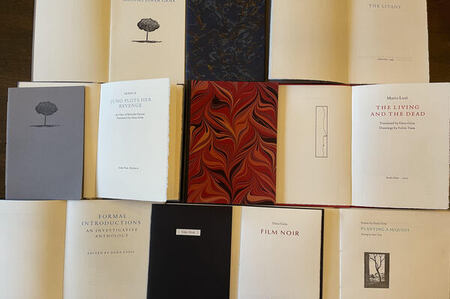
Mike Peich’s “Aralia” fine press books on display

They had a mission. In a world where poetry has become almost irrelevant, the poets gathered in West Chester wanted to return it to a general audience. Their weapons of choice? Traditional forms, rhyme and meter, those age-old tools of the poet’s craft, which fell out of fashion in the last century but were making a startling comeback. Why did it appeal? Because it echoes with cadences that have been familiar to English-speakers for centuries.

The conference was co-founded by a maverick California poet, Dana Gioia, and a local fine-press printer, Michael Peich. It soon became perhaps the largest such ongoing symposium in America, with more than 200 by the time the century turned. The Philadelphia Inquirer called it “a true event, one of the most important such conferences in the United States.” Over the years, it’s pulled in such heavyweights as Richard Wilbur – arguably America’s greatest living poet – as well as Anthony Hecht and Britain’s Wendy Cope, among others. Together, Gioia and Peich made this small suburban campus into an unlikely literary mecca.

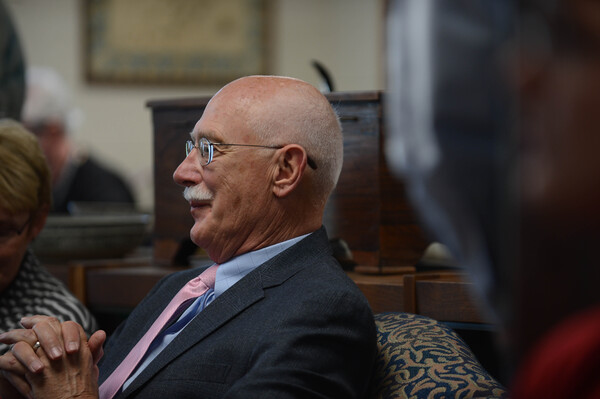
The birthday boy: Mike Peich turned 80 last weekend on May 18.

Not everyone was a fan of what the West Chester conference represented. The movement that gave birth to it – loosely called “New Formalism” – has been locked in a David-and-Goliath struggle with several of the more powerful institutions in today’s poetry world. Notable among them is Philadelphia’s prestigious American Poetry Review, which in 1992 published a blistering attack on it as “dangerous nostalgia” with a “social as well as a linguistic agenda.” Another critic labeled the group “the Reaganites of poetry.” And a recent issue of the American Poetry Review makes a dismissive reference to “neo-conservative formalism.”

Well, you can read the whole story here. It’s disappeared from the Philadelphia Magazine online, but we have preserved the article, “The Bards of the ‘Burbs,” just for you.

Meanwhile, many of the West Chester veterans praised him in – what else? – poetry, beginning with Dana himself, riffing on Tennyson‘s “Ulysses” with his good friend and fellow poet David Mason:

ULYSSES IN WEST CHESTER
or
Michael Peich Turns Eighty

It little profits that an idle man
By a still press, with a half-empty can
Of beer should undertake a survey of his life.
One might as well carve water with a knife,
And water passeth underneath a bridge.
He flushes and returneth to the fridge.

The long day wanes. The game shows now begin. 
The existential question—switch to gin?
It is the evening makes him think this way,
As repetitious as a roundelay.
He can’t stay up too late, can’t see the stars,
The doctors have forbidden him cigars.

Old age hath yet its honor and its trauma,
From scheming poets and their endless drama,
Their endless readings and their endless woes,
Self-laureled poets with their souls of prose.
No blinded Cyclops roaring in a rage
Is half as awful as some poet’s page.

Such steady service to the Thankless Muse 
Would drive a less heroic man to booze.
(A recreation he can’t even try;
His poet friends have drunk his cellar dry.)
But wise Ulysses sees his shelf and smiles.
The books he printed are his Happy Isles.

Turn off the screen, and let the low skies darken.
Time to reread Dick Wilbur, Kees, and Larkin.
Though much is taken, he will undertake—
For Dianne and his worthy spirit’s sake—
To strive, to seek, to find, and not to growse,
Or let another poet in the house.

From Meg Schoerke

Tell all the truth but tell it “Peich”—
Success in Printing lies
Not in Broadsides, nor Matchless proof,
No Letter out of Line—
But Truest—be—the Type of man
For whom Ink Brayers roll—
His Font of Generosity
And Impress on our Soul—

From Leslie Monsour

Dear Mike,

The time has come, now that you’re eighty,
To turn to matters deep and weighty.
By now, you must be sage and wise;
No need for doubt or compromise.
Of lessons, you have gathered plenty.
Your insight measures twenty/twenty.
Now share with us your deepest findings
And what you’ve learned from life’s hard grindings.
And, while you share all this and more,
Don’t hesitate to freely pour,
Along with your profoundest self,
That twelve-year-old Macallan…up there…on the shelf. 

From James Matthew Wilson

To Michael Peich on His Eightieth Birthday

The great Romantic poet speaks of acts
Of “unremembered . . . kindness and of love,”
As, in our human lives, redeeming facts,
Graces descending like a blazing dove.
How many are the poets you have aided
In finding their first feet in verse and rhyme?
Your memory of such things may, now, have faded
As do most things beneath the wash of time.

So, at the rounding of these eighty years,
I write to recollect your kindest deeds
While offering you as well my hearty cheers
As your ninth decade in the world proceeds,
Such cheers come as a sonnet to ensure
That they and you alike may long endure.

From Robert B. Shaw

For Michael Peich’s Birthday

Poets, if you are out to seek
a paradigm for life and art,
observe how Peich has scaled his peak.
What’s eighty years? A fresh new start.

From Shirley Geok-lin Lim

Unfortunately,
I never met Mike.
This counts as a strike
Against me. No like
On FaceBook. Dislike
Me. I’ll take a hike,
You poets, a shrike
Among songbirds. 

From Mark Jarman & Robert McDowell

Celebrating Michael Peich
Is like riding a Schwinn bike.

Though he’s hardly a tyke,
He’s still someone we like.

He’s younger than Ike, 
He’s Mighty Mike!

Need a patched dike?
Depend upon Mike.

Transcontinental Mike
Drives home the golden spike.

You’ll quickly cycle
Through the best rhymes for Michael. 

But he is unique
Like the tip of Pike’s Peak.

If it’s favors you seek
Any day of the week

In a pet or a pique
He will soothe you and speak

Of the beauty of books
In crannies and nooks

Handcrafted, handmade
And never mislaid.

That’s the magic of Mike
Whom you know that we like.

On horseback or trike
Our Michael will strike.

And what is our takeaway?
80 bells for his birthday!                  

And a personal favorite from David J. Rothman:

Michael Peich
Is no longer a tyke.
His thoughts are more weighty
Now that he’s…fifty.

Is Seneca staging a comeback? Maybe…

Sunday, July 9th, 2023
Share

For 1,500 years, no writer except Virgil held more esteem in the classical world than Seneca. And today? “We read every major tragedian in the Western tradition, except Seneca,” says poet and author Dana Gioia, a former chairman of the National Endowment for the Arts. He’s setting out to rectify that situation.

“If Seneca’s plays survived the sack of Rome, the burning of libraries, the leaky roofs of monasteries, the appetites of beetle larvae, and the erosions of rot and mildew, they have not had a conspicuously easier time among modern critics,” he continues. “His tragedies have been dismissed both for too closely resembling Greek models and for too freely departing from them. As the classicist Frederick Ahl has noted, ‘no field of literary study rivals that of Latin poetry in so systematically belittling the quality of its works and authors.’ , “No Roman genre has suffered more consistent disparagement than tragedy.”

Seneca may be the season’s comeback kid. The former California poet laureate has just published a new verse translation of Seneca’s The Madness of Hercules (Wiseblood). Wiseblood notes that the violent and visionary play “takes the reader to the extremes of human suffering and beyond – including a descent into the Underworld, an account that echoes through the ages to Dante and Eliot.” The also book includes a rich introduction that is almost as long as the text – a good reason in itself to buy the book. After so much neglect, a thorough reintroduction is more than overdue.

The book is twenty years in the making – and every step of the way, Dana Gioia was convinced no one cared. But Seneca may be getting a major reconsideration, fueled in part by a new stoic movement taking place among the young. (Go here for a blogpost on the statesman, satirist, philosopher, and dramatist.)

Host Jaspreet Singh Boparai on Zoom

Poet/translator Gioia did another favor for Seneca: an hour-long discussion of the play and the translation that was hosted on May 30 by the Faculty of Polish and Classical Philology at Adam Mickiewicz University in Poznań. It’s on Youtube here. The conversation between Dana Gioia and Prof. Mateusz Stróżyński was hosted by classicist Jaspreet Singh Boparai – and as Dana noted, the university had the “kindness and courtesy” to host the event in English, not Polish.

Their discussion of the challenges they faced was excerpted in The Antigone Journal.

Here’s a bit of it:

DANA GIOIA: I chose Hercules Furens to translate because of its fabulous account of the Underworld. The play was the missing link between Virgil’s Aeneid and Dante’s Inferno. My interest wasn’t scholarly. Those poems were foundational to my own sense of being a poet. I particularly admired Virgil and Dante’s ability to create powerful, multi-leveled narratives that never lost their lyrical impulse. Musicality is the necessary magic of narrative poetry. It is also a quality missing from most contemporary poetry. From Seneca I learned how to present drama that alternates between regular action and sudden but sustained moments of extreme emotion. You can call these high points verbal arias or poetic oratory. In theater, they are called “show-stoppers”.  Seneca’s lyric tragedies helped me write poetic texts for opera.

Mateusz Stróżyński in convo with Dana Gioia on Zoom

MATEUSZ STRÓŻYŃSKI: I became interested in Hercules Furens during my research on EuripidesHeracles and Medea, which I began around 2010. I tried to look at the meaning of infanticide in those two plays, from a psychoanalytic perspective, trying to bring together my interest in Classical drama and psychoanalysis as well as my experience as a practising psychoanalytic psychotherapist. What struck me was that Seneca’s Hercules was much more similar to Euripides’ Medea than to his Heracles. Both seem to give an incredible insight into what has been conceptualized in psychoanalysis as pathological narcissism, especially by authors such as Herbert Rosenfeld, Heinz Kohut, and Otto Kernberg. …

How do we conceive of performing Hercules Furens for a modern audience? 

DG: I wrote the first version of The Madness of Hercules to be performed. I was fascinated by the idea of reviving verse theater. I hoped to create a faithful poetic version of Hercules Furens that worked in live theatrical performance. I wanted the audience to feel the power of both the dramatic action and the poetic speech. There was a young businessman in New York City, Richard Ryan, who told me in a bar one night that he wanted to mount the project. (He was not rich, by the way, he was just enthralled by theater and poetry.) Ryan created Verse Theater Manhattan to stage my translation.  He went on to produce many other verse plays.

We made a radical production decision – we trusted Seneca and the play. We cut the text only slightly. The staging was minimal. The actors were directed to perform the text as verse – to let the power of the language animate their characters. The long speeches were not the impediments that most scholars declared; they were the driving forces of each scene.

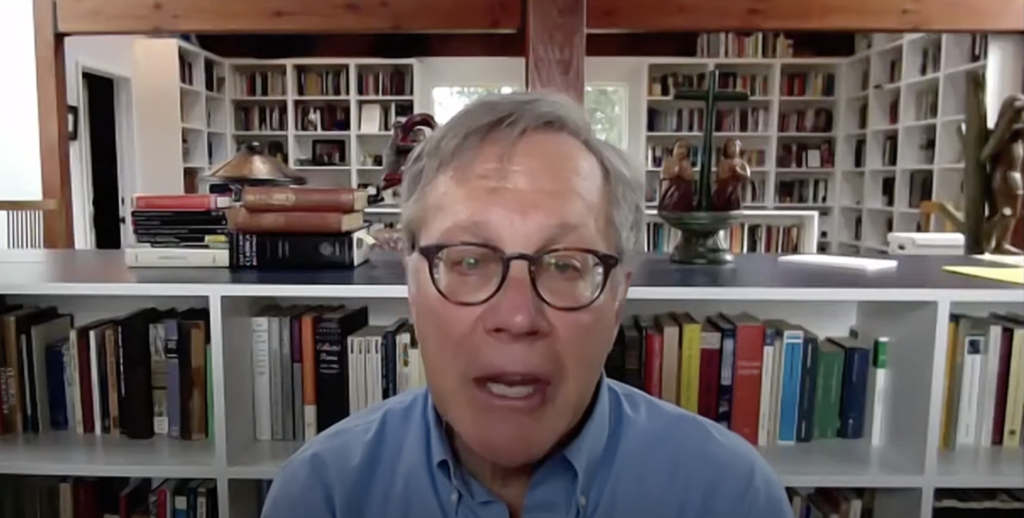
Dana Gioia zooming to Poznań from his home library

My translations tried to preserve Seneca’s rhetorical design and recreate the poetry. I thought of the major monologues as great operatic arias for the actors.  They need poetry to work. The Madness of Hercules was produced in a mid-sized theater in lower Manhattan. We sold out both nights, and the audience responded enthusiastically.

Seneca’s Hercules (like Medea) describes a destruction of the inner capacity to love and depend on others, through a desire to control both the self and the others. I think the horrifying sterility of the Underworld in Seneca reflects the inner emptiness and deadness of a narcissistic personality, which inevitably manifests itself in aggression and destruction. But as we can see in Seneca, this narcissistic dynamic is often masked by a narrative of saving the world from monsters in order to bring peace and harmony.

Read the whole thing at the Antigone Journal here. Watch the Youtube video here.

I have a special reason to be grateful to this edition The Madness of Hercules. Dana has kindly dedicated the volume to me:

For Cynthia Haven
Tanquam Explorator

Ben Jonson used “Tanquam Explorator,” so I am in good company!

Postscript on July 10: A note on the dedication from Latin teacher Kevin Rossiter:

The Latin from Seneca’s Moral Epistles to Lucilius, letter 2, line 5.: “Hoc ipse quoque facio; ex pluribus quae legi aliquid apprehendo. Hodiernum hoc est quod apud Epicurum nanctus sum–soleo enim et in aliena castra transire, non tamquam transfuga, sed tamquam explorator–: ‘honesta’ inquit ‘res est laeta paupertas.”

“Explorator” is a spy, an eavesdropper. “tamquam” is like “so to speak”. There’s a line in Seneca where he talks about benefitting from reading people he disagrees with, saying “I go into enemy camps not as a deserter, but so to speak as a spy.”

My own translation would be: “For I am accustomed even to cross into the enemy camp, not so much like a deserter, but so to speak as an eavesdropper/spy.”

I see now that ‘tamquam explorator’ is being applied to you in the dedication – so, ‘an eavesdropper, so to speak’ does nicely, don’t you think? Every great writer is always a great eavesdropper!”