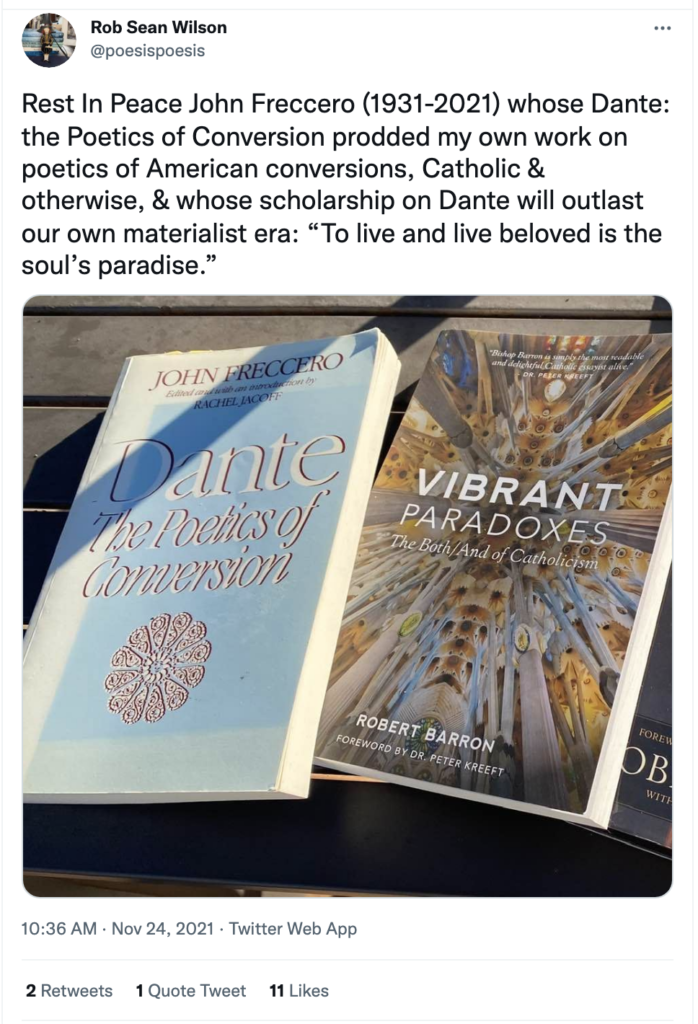
Posts Tagged ‘John Freccero’

Requiescat in Pace, Dante Scholar John Freccero (1931-2021)

Thursday, December 2nd, 2021

Share

One wonders what Stanford Prof. John Freccero, one of the world’s leading Dante scholars, would have made of his own death, during the year the world is celebrating as the 700th anniversary of his Florentine master’s demise. No doubt he would have been honored and gratified. The author of the seminal Dante: The Poetics of Conversion had long since disappeared from the scene, quietly retreating within his home on Amherst Avenue. He died on Nov. 22.

“It seems natural that Freccero chose to devote his academic studies to Dante,” according to Johns Hopkins Magazine in 2008. “In one of his earliest memories, he’s a boy sitting on the lap of his Italian immigrant grandfather, staring at the frightening images accompanying The Inferno. ‘There is no Italian of my grandfather’s generation who didn’t know Dante,’ Freccero says. ‘That’s one of the things that’s so bizarre about him, that he is at once the most learned and the most popular of poets. Can you imagine a barber in Baltimore reciting Shakespeare? Of course you can’t. But you can’t imagine a barber in Italy not knowing Dante.'”

I interviewed him in the summer of 2012, and those encounters are cited in my book about his close friend and colleague, Evolution of Desire: A Life of René Girard. (“I feel sometimes I am not worthy” of the friendship, he told me.)

Going back through those interviews this morning, I was surprised at their offhand depth and range, the casual erudition. (I’ve written about him before: Early sci-fi: how Dante warps time and space, and “By Love Possessed”? René Girard and John Freccero on Francesca da Rimini, among other places.)

I had studied with the Dantista some years before, in the late 1980s or early 1990s. As I wrote in Evolution of Desire:

“I met John Freccero at Stanford decades ago, when I attended his lectures on Dante—I remembered a potent concoction of urbanity, insight, and endless erudition. He assigned the multi-volume Charles Singleton prose translation of The Divine Comedy, urging us to buy the epic poem and commentary by Singleton as the definitive translation in English. Because of him, I still regularly refer to the thick gray volumes I found secondhand at Black Oak Books in Berkeley. “Why not a poetic translation?” a plaintive voice had queried from somewhere at the back of the large lecture hall. Freccero volleyed back with an appealing smile, “Because you should never give up on learning the Italian.”

“He disappeared from my life after the course was over, and returned when I realized that he had been a friend of Girard’s for nearly sixty years. He was a pivotal figure during Girard’s time at Johns Hopkins. Years later, Freccero helped bring Girard to Stanford. His observations were persuasive, and helped shape my understanding of the theorist I knew only in his last decade. Girard acknowledged the role of two Dantisti in his life during these years …”

The outpouring since John Freccero’s death has been subdued – it occurred during Thanksgiving week, and the 90-year-old Dante scholar had long been in frail health. So far, the only comments I’ve seen have been on Twitter. (See below.)

In a life as intellectually radiant as his own, such a quiet death seems out of place – but perhaps one could say the same of Dante’s own malarial death, on returning from Venice, in 1321.

Let us quote another maestro, “Rest perturbèd spirit,” may angels guide thee… Dante described so many of them, after all.

Postscript on 12/3 from Stanford Prof. Grisha Freidin: Farewell, John. Your Dante course I sat through at Stanford in 1980 changed my life. For one, it was clear to me that one ought to be ashamed of teaching lit in a university without a serious study of Dante. I was fortunate to be able to audit his course at the outset of my career. It shaped my research, too, in many ineffable ways. John was also a good friend during his stint at Stanford that ended tragically when he lost his wife, a ballet dancer, to cancer. We lost touch after that, though I ran into him on occasion. Robert Harrison was his student, too, and held him in great esteem. Passing of a giant, who was part of the great tradition of Dante scholarship going back to Curtius and Auerbach.

Early sci-fi: how Dante warps time and space

Saturday, March 2nd, 2019
Share

Was Dante a precursor to modern notions in sci-fi? Perhaps so. I was recently reading Disorder and Order, the book that came out of Stanford’s remarkable 1981 conference of that name organized by René Girard and Jean-Pierre Dupuy. I had seen the volume before, but somehow overlooked the brilliant essay, with the unalluring title, “Cosmology and Rhetoric,” written by one of the world’s leading Dante scholars, Stanford’s own John Freccero. In it, he makes the case for the written language as a spatial representation of time. He begins the discussion this way:

He recaptured time too.

“…I would like to cite the representation of the solar disc and zodiac in the pavement of the baptistry in Florence. Surrounding the Romanesque wheel of the heavens is a nearly effaced inscription – En giro torte sol ciclos et rotor igne – which may be roughly translated, “Behold the sun in its cyclical gyres and the wheel of fire!” Its significance is not in what it says but rather how it says it. The phrase, in fact, is a palindrome which reads the same from left to right and from right to left. In a tradition that goes back at least to Plato‘s Timaeus, the two apparent motions of the sun diurnally moving from east to west and zodiacally from west to east were described as a motion to the right and to the left. …

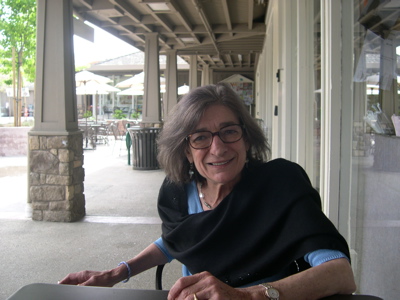
Dante’s disciple, John Freccero

“Dante’s literary cosmology is infinitely more complex, although elements like this can be discerned here and there in his voyage through the heavenly spheres. The complexity arises from the fact that the tautological structure of his poem warps the categories of time and space so that his voyage ends where it begins and time is recaptured. The arrow of temporality is also reversed in the final part of Proust‘s work where Le Temps retrouvé marks the end and therefore, paradoxically, the beginning. But the space was Paris, or at least the corklined study. In Dante’s work, however, space is a figure for this temporality so that it too bends back upon itself, boundless and all-encompassing, yet encompassed by the time that it takes to traverse it. The space-time continuum was familiar to Dante through the metaphor of written language which is a spatial representation of time. We are made surprisingly aware of this each time we run across phrases such as ‘as we saw above’ or ‘as we shall see below.’ The surprise comes from our temporal representation of space which is, in fact, the act of reading, in which we lend to space our own temporality as does a machine to the film frame placed before it. In the case of a book, however, the claim to totality is implicitly made – bound up and bounded by its covers, encyclopedic in the etymological sense of the word. When such a claim is translated into temporal terms, then all of time must be contained within it. When Dante refers to the primum mobile with one of his most bizarre images, referring to the outermost heavenly sphere as the flowerp0t in which time has it roots, he is making a claim not only for his voyage but also for the poem, which is coextensive with it. Since his story is in part how this story is written, it is inevitable that the closing of the book be its ending in which all of time and space are contained.”

The only way up is down: Rachel Jacoff and Robert Harrison discuss Dante’s Inferno

Thursday, December 7th, 2017
Share


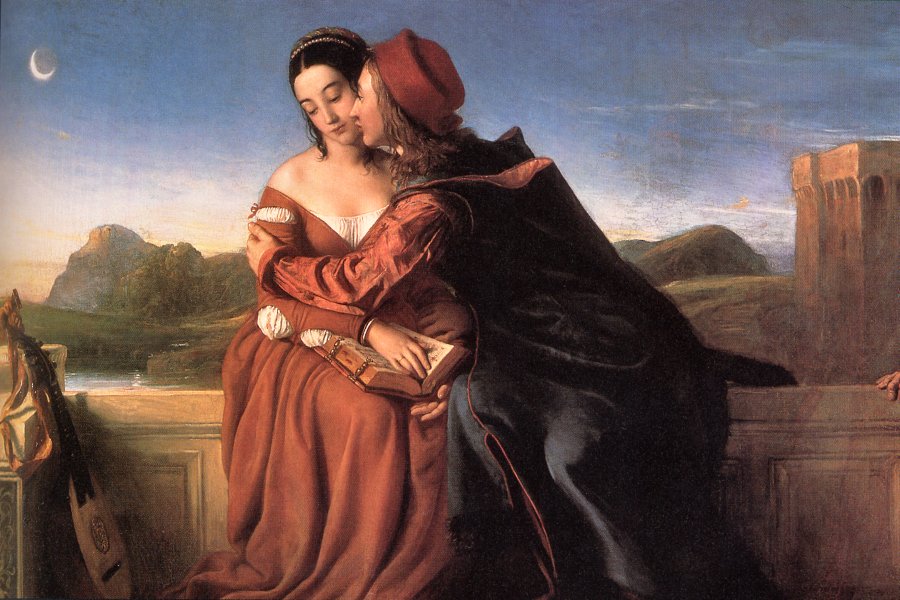
The fatal kiss of Francesco da Rimini and Paolo Malatesta, as portrayed by William Dyce in1837.

The world of Dante scholars is a small and close-knit one, and Rachel Jacoff is one of its leading luminaries. In this Entitled Opinions conversation, she discusses The Divine Comedy, and more particularly The Inferno, with her former student, our Entitled Opinions host Robert Pogue Harrison, himself a major Dante scholar. It’s over at the Los Angeles Review of Books here. (It’s part one of a three-part series – but don’t worry; each operates as a stand-alone interview.)

They begin with the setting of the Divine Comedy, and the spiritual, existential, biographical, and political crisis in which it is born. The epic poem takes place in the Jubilee year 1300, when the Florentine was 35 years old, at the midpoint of his life. He was in the middle of two prose works he couldn’t finish, Convivio and De Vulgari Eloquentia. Instead, he undertakes the major work for which he is most remembered, The Divine Comedy.

Da man.

Entitled Opinions host and guest discuss the great poem’s background, the spiritual crisis that gave birth to it, the mysterious role of Virgil as Dante’s guide, and the role of women in the drama (both as mediators to Dante’s spiritual climb, and as sexual sinners in the Inferno). And, inevitably, they discuss the renowned Canto V, with the adulterous lovers Francesca da Rimini and Paolo Malatesta. (More about the doomed couple from two other Stanford scholars, René Girard and John Freccero here.)

The discussion begins with the First Canto, and Harrison’s comments on the Florentine’s immortal opening to his Divine Comedy. Dante has hit an impasse, and the only way up is down:

“There’s always a before, and always an after, to the beginning. Every beginning starts in the middle of something. That’s what the ancients meant by in media res. For Dante, in medias res meant in the middle of a forest: ‘In the middle of our life’s way, I found myself in a dark wood, where the straight way was lost.’ What kind of middle of the way is this, where forward motion hits a dead end, where life’s vital energies come to a terrifying standstill, where every step you take could be your last step? This is the midpoint, a strange and uncanny place. It’s not the halfway point on a straight finite line. It’s not equidistant from beginning and the end. No, it’s a sentiero interrotti – a path without issue. It’s a place where all footing is lost, and where, if there’s to be any resumption of motion, it will have to be on a different footing altogether. That’s what it means to begin in the middle of the way. To find a new footing, and in so doing, to undergo a turn, a swerve, a clinamen, rather than continue on the same rectilinear course. The midpoint represents a turning point. … The only way up is down.”

Potent quotes:

Jacoff @Stanford

Rachel Jacoff:

“If we only had only the first canto, we wouldn’t know anything about the political crisis, we wouldn’t know about the exile, we wouldn’t even know Dante was a Florentine. … The language is deliberately vague enough so that almost everyone can find their own mid-life crisis in this language.”

Rachel Jacoff:

“People have read this as a poem about depression, they have read it as a poem about many different things, because they’re able to connect with the sense of a dead-end.”

“It has collective epic community, but also lyric individuality. It becomes a first-person epic, which distinguishes it. There is an ambiguousness about its autobiographical nature … and yet it is generic. There is a way in which Dante has to be an everyman.”

“Reading Virgil might have given him the idea that maybe he was writing the wrong book. He shouldn’t be writing a philosophical book, he should be writing a poem – and a poem informed on many levels by The Aeneid, in particular, the journey to the other world.”

“It is a very Christian poem; Virgil is a pagan. This is a primary, extraordinary fact. Unlike other texts with visions of the journey to the other world, in which the guides are angels or saints, Dante chooses a poet, and perhaps the most important thing to Dante, a poet of Rome and of the Roman Empire.”

Go to the new Entitled Opinions channel at the Los Angeles Review of Books here.

Robert Harrison:

“In Dante’s age, there was no analysis or psychotherapy, no prozac. Help took a different form – the form of a literary ghost, the ghost of Virgil who comes on the scene.”

“Wouldn’t it also be fair to say that Dante was also chosen by Virgil? … He had been rereading Virgil’s Aeneid massively. Something changed in rereading of that poem about the founding of the Roman Empire. He landed in a dead-end as a result of reading Virgil, and so perhaps only Virgil could get him out.”

“Sometimes the living adopt their ancestors, but sometimes the dead have a way of adopting the living.”

“Dante was primarily a lyric poet before he wrote The Divine Comedy. Virgil perhaps provided a model for how he might go from being a lyric poet to writing a Christian epic.”

“By Love Possessed”? René Girard and John Freccero on Francesca da Rimini

Sunday, March 20th, 2011
Share

By literature possessed?

Patrick Hunt is off on his usual wanderings — this time he’s in London till the end of the month, but he did take time to drop me a quick note when he was  “again reminded how profound René Girard‘s impact has been on literature – not to mention other disciplines – in this Dante essay by John Freccero on Francesca da Rimini“:

The phenomenon of mimetic desire is at the center of the work of René Girard, one of the most powerful theorists of culture of our time. Perhaps because his early work on the novel has been overshadowed by his profound influence in anthropology, social studies and comparative religion, few students of Dante seem to know his essay of fifty years ago, dedicated to the canto of Francesca. In the briefest of terms, his point was that the desiring subject imagines, as does Francesca, that desire springs spontaneously from within, while the truth that is revealed by Dante and the greatest of novelists, is that desire is always triangular, “mediated” by the desires of the other—in this case, as in the case of Don Quixote, by a book. In a few mordant pages, Girard debunked the romantic reading of Francesca’s story, showing that it was simply a repetition of her own initial mystification. When Girard wrote, the best-selling love story of the time was entitled By Love Possessed; Girard’s title was polemic, summing up the delusion propagated by all such “romance” stories: “By Literature Possessed.” His point was that desire is essentially imitative, searching for a model, and that literature provides it with an imaginary map. Dante’s text was not complicit in “romantic” deception. On the contrary, Francesca’s last words exposed the roman as a panderer and seducer, leading the lovers to their destruction. Her story anticipated those of Chaucer, Shakespeare and Cervantes in the genre of the “anti-roman.”

Patrick added,  “I’ve heard Freccero lecture on Dante at Stanford, and only wish I’d heard Girard as well on Francesca and Canto 5 of the Inferno. I’ve written poems on this story – seemingly like everyone else! – and the tale of Francesca is nigh well eternal, as you know, and not just from Robert Browning onward. One magister’s encomium to another: from Dante to Girard to Freccero and this forthcoming book also has an excellent new essay by Robert Harrison on this same never-ending story. The haunting Ingres painting on this Dante passage is one of my absolute favorite ekphrases.”  Not to mention Tchaikovsky‘s opera.

Patrick’s own edited volume on the subject, Critical Insights:  The Inferno, will be out in September.  It includes Freccero’s essay.

Actually, I studied Dante with the world-renowned expert Freccero years and years ago — he assigned the Charles Singleton prose translation, he said, because we should never give up on learning the Italian.  I remember him emphasizing that the Paolo Malatesta, far from being the George Clooney of an earlier era, has become the voiceless lunk by Francesca’s side, and her attitude towards him is almost contemptuous.   “Amor condusee noi ad una morte.”