In her book, Moscow Is Much More Beautiful than Paris: Life Between Two Worlds (and thanks to Kurt Leutgeb for bringing the book to my attention), the award-winning translator and author describes how news of the emigration began with a phone call while she was getting her hair done: “I sat, my head with curlers sticking out all over, under the dryer hood with dear Mrs. Luise. ‘Telephone for you!’ I crept out from under the hood. ‘Hi, Markstein?’ The voice spoke Russian. ‘It’s Joseph Brodsky here.’ He has had to emigrate, he says. Could we pick him up from the airport today right away? It was the 4th of June, 1972. ‘Of course. We will be there.’” Markstein recalls their first meeting at the home of scholar Efim Etkind:
 I had met Joseph Brodsky a few years before at the Etkinds’ place in Leningrad. I was there with our daughter Mirli; she must have been three years old. I had put her to sleep on a couch in the living room. (No one would expect that a Soviet university professor had a guest room!) So: Brodsky came in, beaming with happiness because on this day his son was born. We all congratulated him. Mirli could not think of sleep after this and flirted with Joseph. He, in a good-natured way, flirted back.
The trip to the airport was unnecessary. Brodsky’s publisher [Carl Proffer] came from the States to meet him. We didn’t connect with Joseph until that evening. He was confused, despairing, full of longing for his homeland. He had left his country, because even after his trial and the resulting banishment, the KGB was after him tirelessly. While still in Leningrad, before the flight, he had written a letter to Brezhnev, then the Soviet arbiter over the fate of men. Many people criticized Brodsky for this, accusing him of being craven and servile. But me, I was so moved by the letter, which had been published in a newspaper—a proud and at the same time helpless pleading. A significant poet begged for mercy from an completely senile Kremlin lord. For that reason, I’d like to quote a few sentences from it: “It is bitter for me, to leave Russia. I was born and grew up here, I lived here and am indebted to this country for everything that is in my heart. All the bad things that have happened to me, my country generously compensated me with good things, and I never felt myself to be disadvantaged. Not even now. I ask you to give me the chance to continue my existence on the Russian soil and in Russian literature.” To be published in Russia—Brodsky’s only wish. A pure fantasy. The few things of his that had appeared in print would be removed from the Soviet libraries, like the books and translations of all other involuntary emigrants.
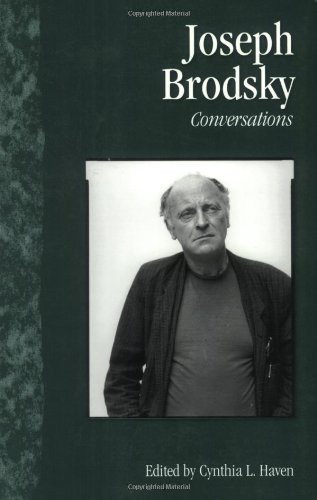
The late Carl Proffer, who founded the Russian publishing house Ardis with his wife Ellendea Proffer, shared his own memories in her indispensable Brodsky Among Us, recently published in Russia, where it skyrocketed to #2 on the bestseller list (we wrote about its debut here): “It was Sunday, June 4, and the flight arrived more or less on time at 5:35. As the bus approached from the plane I saw Joseph in the window, and he saw me. He gave a V-for-victory finger flash. Downstairs at the window there was a ten-minute delay when one of his two bags was lost, the first of a series of mechanical details that would slow everything down for days. As Joseph emerged and we embraced, I discovered that a Viennese with strong ties to Russia, Elisabeth Markstein, and her husband were also there to meet him. He and I took a cab together; his repeated reactions were one of nervousness, saying, ‘strange, no feelings, nothing,’ a bit like Gogol‘s madman. The number of signs made his head spin, he said; he was puzzled by the vast variety of cars of different makes. He said there was so much to see that he couldn’t see (he repeated this for several days).”  Brodsky and Proffer had dinner with Heinz and Elisabeth Markstein that evening, and they discussed the Brezhnev letter. Carl Proffer’s memories: “Markstein said he should publish the letter, but Joseph said ‘No, it was a matter between Brezhnev and me.’ Markstein asked, ‘And if you publish it, then it’s not to Brezhnev?’ And Joseph said, yes, precisely. The Marksteins were very kind, and they offered the services of their young daughters to show us both around Vienna. But for the most part we were on our own, and since for the first time we were spending a great deal of time together alone, we talked a lot, especially at night.” (The Brezhnev letter, or one version of it, is included in the new Stanford collection – I wrote about that here.) Ellendea continues the story: “The shock of arrival converted to anger in Joseph: as the two men walked around Vienna, Joseph began spontaneously condemning entire groups of writers (especially Evtushenko and Voznesensky) and dissidents in general. These were things he had said before, but now it was with a kind of hysterical intensity and much more profanity.” In the Baffler interview, he attacks some of his closest friends and colleagues left behind in Petersburg. This then, was the context for his remarks. Several readers have commented on his surprising hostility – it may be one reason why the interview remained unpublished. But this interview is fascinating for many other reasons – really, almost all the Russian poets interviews are worth reading and rereading (that’s why I recommend my Joseph Brodsky: Conversations – it’s terrific, and not because of me). From the Markstein interview:
EM: Do you consider yourself a Soviet poet?
JB: I object rather strongly to all definitions except Russian, because I write in Russian. Still, Soviet would be correct. Whatever its accomplishments and crimes, it exists, and in it I existed for thirty-two years. And it did not destroy me.
EM: I’m glad you brought this up. There are émigrés, and Soviet citizens too, who try to deny its existence, pretend it’s not there. But how can you? The Soviet Union is a historical and cultural fact.
JB: A cultural fact. Exactly. So many Soviet artists drew their inspiration not from divine intervention but from the idea of resistance. That is something to consider, with gratitude even. True, I unexpectedly found myself in the position where one can feel grateful. While you actually live there . . . I’m not sure what it is, what is wrong with my nervous constitution, but when I lived there, I couldn’t quite raise myself to anger or to hatred. Anger, yes, but never hatred. I always remembered, you see, that the regime and its manifestations were individual, ordinary people. I couldn’t give it a single face. For a resistance fighter, for a questing dissident, such emotion is death. Therefore, I’m not a fighter. An observer, perhaps.
 The Viennese Markstein spent her childhood in Switzerland, Moscow, and Prague. She was expelled from the Communist Party and barred from the Soviet Union in 1968 (according to German Wikipedia) when she was discovered smuggling letters of Alexander Solzhenitsyn out of Russia. She was appalled by the Soviet invasion and apparently said so. She continued that line of thought with the poet:
EM: In Czechoslovakia in 1968, in some cities during the first seven days of Soviet occupation, or maybe it was just one city, there was a slogan, “Remember that you are people of culture.”
JB: This is precisely what ruined their cause.
EM: How so? I believe they had won more ground than was expected.
JB: I really don’t think so. They behaved like schoolchildren. They decided that the principles they were defending, that somehow they had discovered a new way of defending those principles. But in fact, if you really want to enforce them, if you don’t want them to remain just empty words, bubbles in the air, then the only way to do it is by shedding blood. Otherwise, all you will get is a better or worse form of slavery. Once you start talking freedom, how you deserve it, how you want it, how it’s been denied you, how you refuse to remain a slave, you’ve got to take up arms. There is no other way to fight a slave-master. True, they did disgrace the Soviet Union, but pragmatically speaking . . .
EM: I used to think that death is preferable to life on one’s knees. But now I’m not so sure. I’m beginning to think that any life is better than death.
JB: True. But still, the question is, what should we remain alive for? Man is not a rock, he can’t exist just for his own sake. There’s always the “what for.” I understand that here, in the West, I won’t find the answer. Because when I look around, I don’t understand what people live for. My impression is that they live for the sake of shopping. That human life exists for the sake of shopping. The only solution is to stay on the margins, to not get too involved—in shopping, I mean. If I had grown up here, I don’t know what I would have become. This is a very disorienting feeling. I just don’t understand what it’s all for. It must be a very Russian, very totalitarian idea that something so good must come only as a reward, not as a given.
Read the rest here. In her memoir, Markstein notes: “Brodsky continued his flight to London. I never expected letters from him. At the end of 1972, we received a postcard from Venice with greetings for us and the girls for Christmas and the New Year. ‘Imagine: All washed up on these shores. Because there is no place in the world for me.’ I translate intentionally literally, because only then is the pain audible. Still, Venice soon became Brodsky’s favorite city – and where he, it so happened, wanted to be buried, on the Island San Michele. Years later Brodsky was again in Vienna, but didn’t call on us. What does that mean? It confirms for me once more that poets definitely must be egocentric.”

The Proffers with Brodsky in San Francisco, 1972 (Photo courtesy Casa Dana)