Russia’s unprovoked military campaign against its neighbor Ukraine has left many of us asking: What do the Russian people think of Vladimir Putin‘s infamous and deadly adventure? Are it’s cultural leaders speaking out?
Editor-in-chief
One of them has made a powerful and courageous statement.
We’ve written before about Maria Stepanova, author of the acclaimed In Memory of Memory and one of Russia foremost poets and writers. She also has another hat: she is the founding editor of the crowd-funded Colta, a high-traffic Russian online journal that has been called the Russian equivalent of The New York Review of Books.
Here’s what it had to say this week in a front-page editorial about Russia’s attack on its Ukraine, titled simply “No War”:
This morning the Russian government launched a military operation on Ukrainian territory. This is an unbelievable step. In the 21st century, when the world has trended towards reducing violence, including in international relations, this decision throws our nation back to an archaic time, politically and culturally – not even back to the to the end of the twentieth century, but back to the first half, when war still seemed to be a way of solving international problems. Civilized people have always tried to oppose violence, in whatever form it may appear and to whomever it may be directed. COLTA.RU is a publication that deals primarily with cultural issues. But today we cannot got to work as usual, pretending that nothing happened. What is happening now will become and has already become a huge tragedy for millions of people.
Let’s hope Putin listens. The whole world is watching.
When American tourists visiting Soviet Moscow asked Russian Nobel poet Joseph Brodsky where they could get the best view of the Kremlin, he responded gleefully: “from the cockpit of an American bomber.”
He left more quietly, however, on a when he was famously expelled from his homeland in 1972 – but not without sending a letter to the head of the U.S.S.R.: Leonid Ilyich Brezhnev, who held that position longer than anyone except Stalin. The poet told Brezhnev he was “leaving Russia against my will, which you may know something about.” Then he made a job plea: “I want to ask you to give me an opportunity to preserve my presence and my existence in the Russian literary world, at least as a translator, which is what I have been until now…” He was denied this modest role.
“We all face the same sentence.”
His letter of June 4, 1972, begins:
“Dear Leonid Ilich . . . A language is a much more ancient and inevitable thing than a state. I belong to the Russian language. As to the state, from my point of view, the measure of a writer’s patriotism is not oaths from a high platform, but how he writes in the language of the people among whom he lives . . . Although I am losing my Soviet citizenship, I do not cease to be a Russian poet. I believe that I will return. Poets always return in flesh or on paper.”
“From evil, anger, hate – even if justified – we none of us profit. We all face the same sentence. Death. I who write these lines will die; you who read them will, too. Only our deeds will remain, but even they will suffer destruction. It’s hard enough to exist in this world – there’s no need to make it any harder.”
He never published the letter. When asked if he should, he replied, “No, it was a matter between Brezhnev and me.” “And if you published it, then it’s not to Brezhnev?” And the poet replied yes, precisely. Ellendea Proffer Teasley recalled in Brodsky Among Us, “Joseph was bold when he approached the famous and the accomplished. It was not that he was egotistical – although he had a strong ego – it was that he took his calling seriously. This is why he felt he had a right to address Brezhnev – he was a poet and therefore equal to any leader.”
Brezhnev never answered. Why would he answer a letter from an impertinent nobody? And Russia never learned. We mourn the catastrophic decisions today to roll back the clock to the 1980s. As Anne Applebaumwrote today in The Atlantic: “Despite everything that was said, everything that was promised, and everything that was discussed, Ukraine will fight alone. At a dinner last night, a Ukrainian woman whom I first met in 2014—she began her career as an anti-corruption activist—stood up and told the room that not only was she returning to Kyiv, so was her husband, a British citizen. He had recently flown to London on family business, but if there was going to be a war, he wanted to be in Ukraine. The other Ukrainians in the room nodded: They were all scrambling to find flights back too. The rest of us— American, Polish, Danish, British—said nothing. Because we knew that we would not be joining them.”
“All tyrannies rule through fraud and force, but when the fraud is exposed they must rely exclusively on force.” ~ George Orwell.
“The very pineapple of politeness.” Photo: Brigitte Carnochan
Bliss Carnochan, a kind and benevolent presence for the humanities on the Stanford campus, died on January 24 of congestive heart failure. He was 91.
The professor emeritus of English grew up in Manhattan and had never been farther west than Pennsylvania when he arrived at Stanford in 1960. He never left. Now it’s hard to imagine the campus without him.
“Bliss Carnochan’s passing leaves those of us who knew him feeling downcast and impoverished,” English Prof. Terry Castle wrote in a letter on the Stanford website. “It is melancholy enough to have to speak now in the past tense of Bliss’s tact and kindness and human warmth, the unfeigned delight he took in everyday life and the wider world, the intellectual generosity and comradeship he evinced toward colleagues, students, and friends over many years at Stanford. He was, as Mrs. Malaprop might have said, the very pineapple of politeness: a patrician mixture of decency, intelligence, and unstinting affability. Much missed, no doubt, will be those strange, deep, exuberant bursts of laughter he sometimes emitted—awkward, boomingly so, but somehow always sweet nonetheless: the perfect reward, one felt, when one had been lucky enough to pass on some tidbit of academic idiocy he particularly relished. Bliss Carnochan was a stunning, splendid man; Bliss the scholar likewise.”
Terry Castle
“Bliss continued to write according to his own elegant sensitive lights, in a style at once pellucid and bracing, witty and relaxed. His prose was a kind of neoclassical slow-cookery; and I and many others learned a great deal from him about writing well.”
We’ve featured him in the Book Haven, though collecting old posts is not as much fun as sitting with him over coffee at the Stanford Bookstore:
Do you get the feeling that he’s of Scottish descent?
Bliss Carnochan is survived by his wife, the photographer Brigitte Carnochan (one of her photographs is featured on the Book Haven here), five children and 10 grandchildren. All joined him last Christmas Day to celebrate his 91st birthday. A memorial service is being planned for later in the year at the Stanford Humanities Center.
Terry Castle concluded with a direct address: “Though you achieved a magnificent old age (while somehow always managing to look fifty years younger than you were) our bliss, we find, has indeed been momentary: date-stamped, ephemeral, too brief for words. Or so it must feel – acutely enough – from here on out. Farewell, old friend; I miss you starting now.”
“Did anyone ever tell you that you have beautiful cheekbones?” That was the opening line rock icon Roger Waters used with Kamilah Chavis, the woman he married in October 2021. But it wasn’t her face that first drew Waters to Chavis. In fact, during their first meetings, she kept her back turned to him.
Waters told the story in a widely-quoted 2018 interview with Argentine media outlet Infobae. The reporter asked, “Is Kamilah an artist?” No, Waters replied. “She worked in transportation.” More precisely, she was a chauffeur.
“I actually met her at one of my concerts a couple of years ago,” Waters explained. “She was driving the car that was taking me. I was in one place for two weeks and there were many transfers between the hotel and the venue. My security sat in the front with her and they talked, while I stayed in the back. I don’t know, something about her attracted me…”
There was something about her, but what could it be? It wasn’t love at first sight. Waters spent most of their time together staring at the back of Kamilah’s head. She didn’t even talk to him. So what sparked Roger’s interest in Kamilah? Was it her lovely black hair? The way she held her head? Her entrancing perfume?
Mark Anspach gives us his own take.
Curiously, when Waters recalls the attraction he felt for his future bride, nothing he says is about the woman herself. It’s all about the circumstances: she was driving the car, up front with the security, while Waters rode in back. That hardly sounds like a romantic setting, yet he was mysteriously drawn to her. Why?
Waters gave little clue when announcing his wedding on social media. He said only, “I’m so happy, finally a keeper.” This is less an ode to his new bride than a back-handed slap at his previous wives. Clearly, Waters had reflected on why his first four marriages ended in divorce and identified a common flaw in all his exes: they weren’t “keepers.”
Read the rest of it here. It’s not only insightful, it’s fun.Wait! Wait! Here’s also Bill Benzon’s “Crisis in Shark City: A Girardian reading of Steven Spielberg’s Jaws.” As a bonus prize, a Girardian take on Alfred Hitchcock’s 1955 To Catch a Thief:
As you may know, René Girard is a theorist of imitation, desires, violence and sacrifice. His core concept is that of mimetic desire, a desire which one person acquires by imitating the actions of another. Take Alfred Hitchcock’s 1955 film, To Catch a Thief [3]. Cary Grant plays John Robie, a cat burglar who is retired to the French Riviera along with the rest of his gang, all of whom have been paroled in recognition of their work for the French Resistance. A recent string of burglaries leads the authorities to suspect Robie because the burglaries follow his old modus operandi.
In the (somewhat involved) process of trying to clear himself Robie arranges to go swimming with a young heiress, Frances Stevens (played by Grace Kelly). Robie arrives at the beach where he is met by Danielle Foussard (played by Brigitte Auber), who is the young daughter of one of his old comrades in the Resistance. They swim out to a raft where Danielle proceeds to flirt with Robie. Frances swims out to them, sees Danielle flirting with Robie, and decides that she will pursue Robie. She is imitating Danielle’s desire. In Girard’s terms, her desire is thus mediated, it is mimetic desire. Danielle and Frances thus become rivals and rivalry can lead to violence. Though we don’t know it at this point in the movie, Danielle is the cat burglar. She too is imitating Robie.
She was a woman from another era, in the finest sense of the word. The up-to-date term “networker” would trivialize Valentina Polukhina‘s indefatigable labors – yet never was it more apparent since her death in the early hours this morning how wide her network was. The Keele University professor who was one of the world’s leading scholars on Nobel poet Joseph Brodskyseemed to know everyone, and kept up a wide circle of correspondence. Her Facebook page was flooded with reminiscences and condolences.
Joseph Brodsky and Valentina Polukhina
She died quietly at her home in Golders Green, London, in the early morning hours of February 8, at age 85. There is no one like her, and no one to take her place. She will be very much missed – and not only in the world of Brodsky scholarship. She was a generous scholar, a kind and wise human being, and a dear friend. She was the recipient of the A. C. Benson Medal and the Medal of Pushkin. Valentina, the widow of translator Daniel Weissbort, will be remembered most of all, I think, for her tireless work on the multi-volume Brodsky Through the Eyes of His Contemporaries. That unique masterwork will grow in importance and meaning with time.
And what a fascinating effort it was: a massive collection of in-depth interviews with those who knew the Russian Nobel poet – including friends from his Leningrad days before his 1972 expulsion from the USSR, which brought him to Ann Arbor and the University of Michigan, and the new friends he made in exile. The volumes include interviews with fellow Nobelists Seamus Heaney, Czesław Miłosz and Derek Walcott, Swedish author Bengt Jangfeldt, Lithuanian poet Tomas Venclova, British author John le Carré, Susan Sontag, and dozens and dozens of others, some famous, others relatively unknown colleagues from Russia. Think of it: a firsthand record of what it was like to live, love, and work with one of the great geniuses of our time. She took flak for this effort – not least of all from Brodsky himself – but I have no doubt these volumes (two in English, three in Russian) will stand the test of time, and be an endless literary and cultural goldmine for generations to come.
Yuri Leving of Dalhousie University, who has written about Brodsky’s artwork, agrees: “While reading obituaries and sketches today about the main and, without exaggeration, the most selfless guardian of Brodsky’s heritage, I involuntarily caught myself thinking of the bright portraits in Brodsky Through the Eyes of his Contemporaries. I took this photograph (above) at her home in Golders Green in August 2010 when her husband, the remarkable poet and translator Daniel Weissbort, was still alive. The following ten years included a few more meetings and regular correspondence – everything about Brodsky was sacred to her, and it could not help but attract her. In 2021, when I was preparing to go to London again, Valentina wrote: ‘Alas, I can no longer cook dumplings. Instead, I will invite you to lunch at my club Athenaeum, where Joseph appeared in jeans at the invitation of Sir Isaiah Berlin. You really need to be in a suit and tie for this.’ My trip was exactly a week after Valentina was discharged from the hospital (she had been injured in a fall) so we agreed to postpone the appointment. Now is forever and ever.”
She was a 21st century networker, but also something from a much older tradition: one of those Russian women (some scholars, some not) who dedicate their lives to a timeless literary figure, one such as Joseph Brodsky. Among her many books: Joseph Brodsky: A Poet for Our Time (Cambridge University Press, 1989, 2009), Brodsky’s Poetics and Aesthetics (Macmillan Press, 1990), Joseph Brodsky: The Art of a Poem (Macmillan Press, St. Martin’s Press, 1999), and others. That’s in addition to the two thick volumes of Brodsky Through the Eyes of His Contemporaries, which I reviewed for The Kenyon Reviewa decade ago.
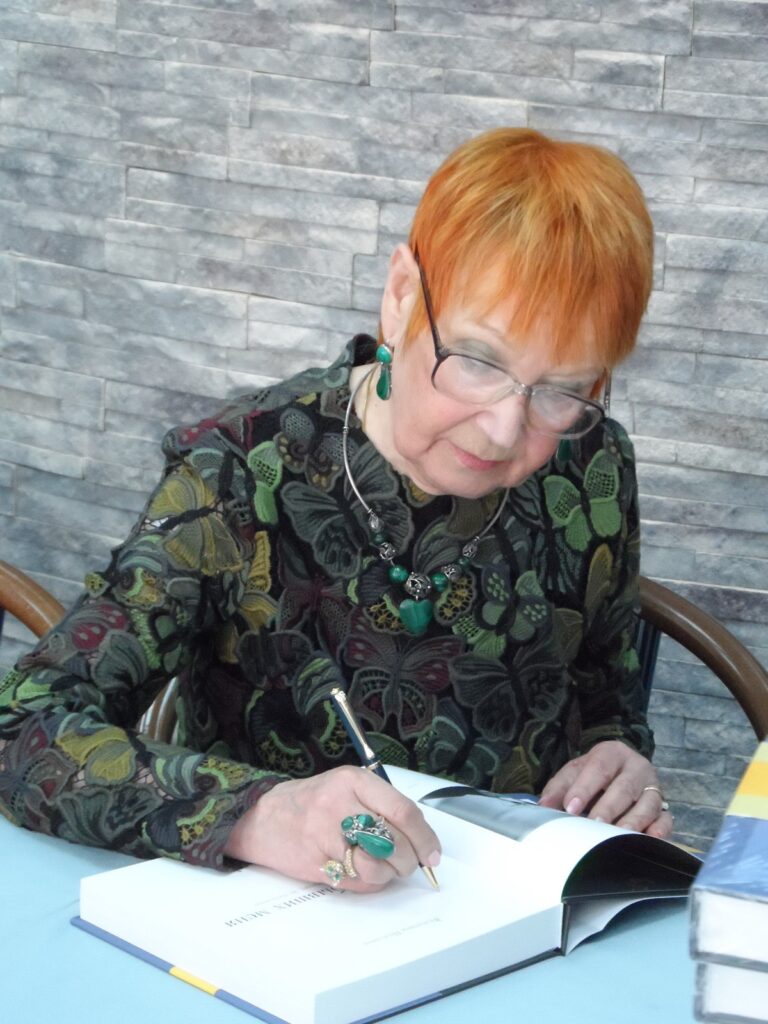
Book signing
From author Maxim D. Shrayer of Boston College: “The passing of Valentina Polukhina, literary scholar best known for her writings about Joseph Brodsky, is a terrible loss. Our family and Valentina have been friends for over twenty-five years. She was endowed with a remarkable and rare talent—to love and cherish poetry and poets, and to do so outside the grid of literary politics. How bitter it is to realize that Valentina Polukhina is gone. Memory eternal.”
I was a recipient of her generosity during our work with The Man Who Brought Brodsky Into English: Conversations with George L. Kline. She was an invaluable firsthand source. I will always treasure the time we spent together in London back in 2018. The advice she gave, the additional material she supplied from her own rich archive, all enriched the small volume.
She was a matchless hostess as we worked, for she generously invited me to stay in her charming Golders Green home for a week. And that was an unforgttable event, too – a place infused with her history and memories, her Russian taste, her vivid colors, her rich Orthodox heritage, made an indelible impression.
We were going to get together in London to celebrate with champagne the publication of The Man Who Brought Brodsky into English … when the coronavirus epidemic subsided, when travel resumed. Now I will have to lift a glass of bubbly to her memory by myself – here, far away, on the shores of the Pacific.
Postscript on February 11: Over at her blog The Stone and the Star, poet and publisher Clarissa Aykroyd remembers meeting Valentina at a reading: “I asked her about her writing and work and she told me that she had written many books about Brodsky. She then mentioned that her husband was the late Daniel Weissbort. I was a bit dumbfounded – Daniel Weissbort died only a few months ago and I had read many tribute articles and obituaries. He was the founder of Modern Poetry in Translation, along with Ted Hughes. She herself was Valentina Polukhina, not only a Brodsky expert but a major scholar and advocate of Russian literature for English speaking audiences. I told her that I didn’t know a lot about Brodsky but that I adored Mandelstam, and she said “The advantage of Mandelstam is that he has been translated by many different people, so you have a lot of choice.” I also told her, quite sincerely, that I would rather read Modern Poetry in Translation than most journals dedicated to contemporary English-language poetry, and she seemed happy about that. When we introduced ourselves, she said to me that the name Clarissa was also found in Russia, but that it was considered quite aristocratic. It was a lovely, striking encounter.” Read the whole thing here.
Also, Britain’s premier publisher of poetry, Bloodaxe Books, has a summary of her career here.
Postscript: A small example of her cultural efforts on behalf of the Brodsky legacy in 2018, in The Guardian here.
At the Russian Cultural Center in Kensington, 2018. Valentina at lower left, and me in the Harris tweed.
The Book Haven has been pretty mum on our our newest offering, Czesław Miłosz: A California Life, just out with Berkeley’s Heyday Books (we wrote about its origins here). But we’ve been speaking about it – in Berkeley, in Chicago, in San Francisco, and on podcasts (listen to us at the Athenaeum here). Let’s end our blog silence now with the words from one of America’s most eminent literary critics, Leon Wieseltier:
“Cynthia Haven’s book is delicious. She evokes so much so vividly and so intelligently; for me her pages were a restoration of a richer and less lonely time. And her intuition is right: Czeslaw Milosz and California are indeed a chapter in each other’s history.”
We’ve written about Ilya Kaminsky, author of Deaf Republichere and here. We’re honored that he chimed in, too: “Czesław Miłosz: A California Life asks about the meaning of exile, about the possibilities of a new home, about the transformation of a poetic perspective, about alienation and the building of literary bridges. But in the end, the book asks one big, nearly impossible question: How did the great Polish exile Miłosz change his newfound home—and how did California, after so many years, transform Miłosz’s own metaphysics? For it is a metaphysical question, after all: How does a place change the poet, and what does a poet do to shift our perspective on the place? On this unending journey, Cynthia L. Haven is an illuminating guide, one who brings knowledge, precision, and grace. There is much to learn from this book about Miłosz and California, yes, but also about poetry and the world.”
“The irony is that the greatest Californian poet… could well be a Pole who wrote a single poem in English,” suggests journalist Haven (Evolution of Desire) in this detailed biography of Czesław Miłosz (1911–2004). California was crucial to Miłosz’s life and work, Haven argues, and notes that the Polish poet had a complicated relationship with the U.S.: “He longed for America yet loathed it, too.” The narrative follows Miłosz as he worked in U.C. Berkeley’s Slavic department starting in 1960 and taught Polish literature, during which he found American students “unreliable and undisciplined.” Haven also traces the poet’s relationship to his home country: when he returned for the first time in 30 years after he won the Nobel Prize in 1980, he had questioned “whether he still had any audience in his native land—after the censorship, after the years in exile—and so the crowds stunned him.” Much has been written about the poet, and Haven finds new ways into his life by inserting herself into the narrative—discovering Miłosz’s Bells in Winter in a Palo Alto Bookstore, visiting him in his Grizzly Peak home, attending his packed last public reading at Berkeley—and her examinations of the influence of place on his poetry are insightful. Fans of Miłosz’s work should give this a look.