Happy 107th birthday, Elizabeth Bishop! “The contemporary language is not equivalent to the contemporary fact.”

February 8th, 2018

Share

It is the poet Elizabeth Bishop‘s 107th birthday. I celebrated her centennial here, remembering my long-ago trip to her home in Brazil, outside Petropolis, which is outside Rio. The trip from the Rio de Janeiro airport was an all-day saga. From my article in the Times Literary Supplement:

Brazilians use the expression “toda vida” — for all life — where we would say, “continue to the end of the road”. On the narrow, bumpy brick roads around Petropolis, about sixty miles outside Rio de Janeiro, you may indeed feel you will reach life’s end before you reach your destination: Sitio Alcobacinha, the long-time home of the poet Elizabeth Bishop, in the outlying village of Samambaia. You have to stop every few minutes to question a resident, typically one of the ubiquitous men, shirtless and enervated by the Brazilian summer, drinking beer in the street-side cafes of this trendy, if slightly threadbare, former imperial capital. Continue down the left fork, they will tell you, “toda vida”.

Outside Petropolis … her home for years

Bishop didn’t quite end her days here. But certainly a crucial era of her life concluded in Samambaia in 1967, when she left Brazil after a sixteen-year stay that began as a lark, endured as a deep and difficult love affair, and ended with a death. She was to return to Brazil, more particularly to the home she bought and refurbished in Ouro Preto, another 150 miles or so due north, but she never stayed long, and visited more and more sporadically, until she finally left Brazil for good in 1974.

More here. For this year, a few seminal thoughts she wrote at the prescient age of 23, taken from Edgar Allan Poe & The Juke-Box: Uncollected Poems, Drafts, and Fragments, (via Brainpickings)

Much can be done by means of pretense. Children pretend to speak a foreign language or inscribe its imitation alphabet in their school books, and inspired by the same motives, grow up to become linguists, grammarians, and travelers. Lord Byron, looking in the mirror, pretended to be the Byronic man, and the Byronic man, with his curls and collars, came into existence by the hundred. The growth of the small nation into the empire contains infinities of such pretense, gradually turning to the infinite realities of empire.

***

One of the causes of poetry must be … the feeling that the contemporary language is not equivalent to the contemporary fact; there is something out of proportion between them, and what is being said in words is not at all what is being said in “things.” To connect this disproportion a pretense is at first necessary. By “pretending” the existence of a language appropriate and comparable to the “things” it must deal with, the language is forced into being. It is learned by one person, by a few, by all who can become interested in that poet’s poetry.

But as this imaginary language is elaborated and is understood by more people, it begins to work two ways at once. “Things” gave rise to the language; now the language arouses an independent life in the “things,” first dimly perceived in them only by the poet.

“Ozymandias”: Who wore it better?

February 6th, 2018
Share


Is this Ozymandias? And would he have liked the name change? (Photo: BabelStone)

Last month we wrote about the birth of the Mary Shelley‘s novel Frankenstein: “The story was born on the shores of Lake Geneva in the summer of 1816, the coldest summer on record. The 18-year-old Mary Godwin had eloped with the poet Percy Bysshe Shelley, ‘at that time, more of an incorrigible trouble-maker than a poet…the nineteenth-century equivalent of a rock star.’ She had been disowned by her family and was still haunted by the death of her infant first child. One stormy night, the couple huddled in a villa with the poet Lord Byron and a few others. Their discussion is fueled by the era’s cutting-edge discussions of evolution, materialism, electricity, and the animating principle of life. They cited Coleridge and talk about their dreams. Finally, they devise a contest to create a ghost story during their Swiss sojourn.”

But wait! It’s not over! Percy Shelley and Lord Byron obviously lost their silly contest to a teenager. But Percy, at least, hadn’t had enough. Two years laters – two hundred years ago this very month! – he pulled the same stunt again. This time he challenged another friend, Horace Smith (1779–1849) to a poetic duel. Shelley had a head start: he had been working on a poem since 1817, when the British Museum announced its acquisition of a large chunk of a statue of Rameses II from the thirteenth century B.C. The statue was late, and so was the poem, apparently. Smith published his Petrarchan sonnet a few weeks after Shelley’s published his in The Examiner. There are obvious differences: one ends on a science fiction-y note in London, the other stays put with Rameses in Egypt.

Who wore it better? You decide.

.

.

Competitive

Percy Shelley’s “Ozymandias”

I met a traveller from an antique land
Who said: Two vast and trunkless legs of stone
Stand in the desert… near them, on the sand,
Half sunk, a shattered visage lies, whose frown,
And wrinkled lip, and sneer of cold command,
Tell that its sculptor well those passions read
Which yet survive, stamped on these lifeless things,
The hand that mocked them and the heart that fed;

And on the pedestal these words appear:
‘My name is Ozymandias, king of kings;
Look on my works, ye Mighty, and despair!’
Nothing beside remains. Round the decay
Of that colossal wreck, boundless and bare
The lone and level sands stretch far away.


Horace Smith’s “Ozymandias”

Not so bad yourself, Ace-man!

In Egypt’s sandy silence, all alone,
Stands a gigantic Leg, which far off throws
The only shadow that the Desert knows:—
“I am great OZYMANDIAS,” saith the stone,
“The King of Kings; this mighty City shows
“The wonders of my hand.”— The City’s gone,—
Nought but the Leg remaining to disclose
The site of this forgotten Babylon.

We wonder,—and some Hunter may express
Wonder like ours, when thro’ the wilderness
Where London stood, holding the Wolf in chace,

He meets some fragment huge, and stops to guess
What powerful but unrecorded race
Once dwelt in that annihilated place.


John Milton: the dispensable poet? A pitch for the Paradise bard

February 4th, 2018
Share

The original anti-hero

John Milton the dispensable poet? Not so! Simon Hefferover at The Telegraph, insists that “to some of us he is the greatest poet in the English language.

So why is Milton so often left off university syllabi and must-read lists, even among poets who should know better?

“Perhaps as this is a secular age his predominantly religious subjects – not just Paradise Lost and Paradise Regained, but also Samson Agonistes – have little appeal,” he writes. “Yet in these works we see, and hear, what Wordsworth meant by ‘majestic’… Sometimes Milton is like an art house screenplay. One should not be deterred by the subject, any more than one should be deterred from reading the King James Bible or the 1662 Prayer Book just because one is not an Anglican. The sheer beauty of the words, and the musicality for which they are chosen, are among the characteristics that make Milton great.”

“To see his breadth, read his English sonnets: they are contemporary (as in his exhortation of Oliver Cromwell), reflective (as on his painful memories of his deceased wife), polemical (notably about religion), humorous (his sonnet defending his pamphlet Tetrachordon) and movingly humble. That last judgment applies to his most famous sonnet, ‘On His Blindness’, in which he promises to serve God dutifully however he can – ‘Thousands at his bidding speed / And post oe’r land and ocean without rest: /They also serve who only stand and wait’.”

Selfish, selfish, selfish…

According to Micah Mattix, writing last week about “Milton’s Morality” over at the Weekly Standard, “Milton’s lines can be both digressive and tight, packed with allusions and neologisms. An exceptional student of Latin and a gifted linguist, Milton coined more English words than Shakespeare, many of them first appearing in Paradise Lost (like ‘terrific,’ ‘jubilant,’ ‘space’ to refer to outer space, as well as ‘pandemonium’).”

Hefner agrees: “His choice of diction is always original and therefore arresting. Time spent with the Oxford English Dictionary will soon show how many words he brought into our vocabulary, from the Latin and Greek of which he was a master. He also, as befits a blind man, has a stunning visual sense: when millions of fallen angels draw their flaming swords in Paradise Lost and “the sudden blaze / Far round illumin’d Hell”, Milton depicts a vivid moment with remarkable economy of words. His use of rhythm in his blank verse is intensely musical; his command of the sonnet form is finer than Spenser’s, and no worse than that ascribed to Shakespeare.”

But perhaps Milton’s feelings would not have been hurt at the neglect. Heffer argues that poetry was dispensable for Milton  –  a sideline. He had been the Latin secretary for Cromwell, and composed all the Puritan leader’s diplomatic correspondence. Poetry became his main only after 1658, when he began to compose Paradise Lost. The direction got a little extra omph after 1660, when the government of the newly restored monarch, Charles II, issued a a warrant for Milton’s arrest as a collaborator with the regicidal Cromwell regime. “He decided, wisely, to keep a low profile, that he had the time and the seclusion to write verse. But admirers of Milton know that he was as good a polemicist as he was a poet, and during the 1640s and 1650s wrote several of the greatest works of political argument in the canon. They came from the heart, covering subjects that deeply affected or annoyed him.”

Courageous in front of a crowd…

The upshot: while Austen’s bicentennials pop up regularly, and even Mary Shelley – whose Frankenstein was so heavily influenced by Milton – has been fêted with a bicentennial this year, poor Milton is still in exile, stirring the fire and waiting for his daughters to serve him porridge. “How did a poem that was lauded even by Milton’s enemies as not only above ‘all moderne attempts in verse, but equall to any of ye Ancient Poets,’ as Sir John Hobart put it in 1668, and that was translated in its entirety into Latin in 1690 and used in English-speaking classrooms to teach rhetoric instead of classical texts lose so much ground to both Shakespeare and Austen, particularly in Western countries?”

It should not be so. Given that Lucifer is the unabashed hero of Paradise Lost, in all his grim and serious-minded glory, isn’t it time to take another look at the poet who gave us heaven and earth? “The point of all this mirroring is to show how closely evil resembles good. Poole writes in Milton and the Making of Paradise Lost that Milton “regards evil as disarmingly close in appearance to the good,” and it is only by careful moral reasoning that the two can be separated,” writes Mattix.

The poet Percy Bysshe Shelley [that would be Mr. Mary Shelley – ED.] praised Milton’s Satan as “a moral being . . . far superior to his God . . . who perseveres in some purpose which he has conceived to be excellent in spite of adversity and torture.” The problem is that Satan’s “excellent” purpose is the destruction of “harmless innocence” for personal and political ends. This makes him, Carey writes, “English literature’s first terrorist.”

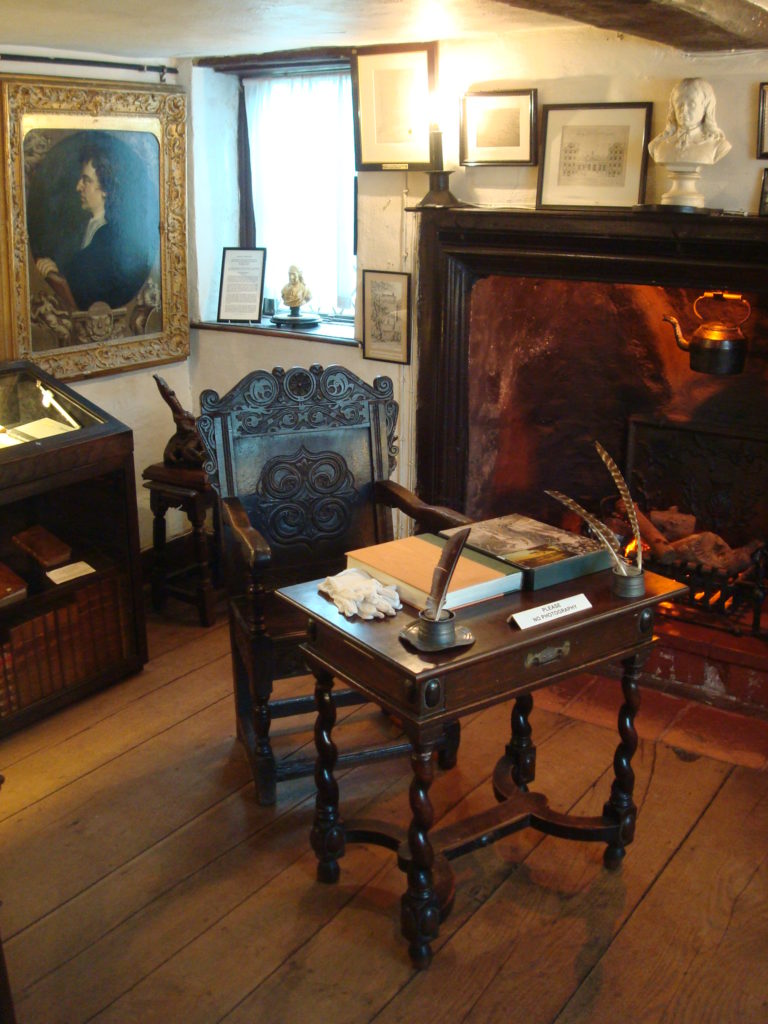
He sat here.

In short, Satan says all the rightly compassionate things only to the “right” people, who are, of course, his people, and only when his own interests are at stake. He is unflappable only in front of a crowd, courageous only when it is personally advantageous. He acts like a good leader, father, and husband—and even argues with nearly perfect reasoning that he is more morally upright than God himself—all while serving only himself. He is a god of unchecked liberty, and, therefore, in Milton’s view, a god of chaos and destruction.

What is particularly chilling about the character of Satan is the extent to which he believes all his actions, no matter how violent, are not only justified but morally right. As C. S. Lewis put it, “we see in Satan . . . the horrible co-existence of a subtle and incessant intellectual activity with an incapacity to understand anything,” particularly his own selfish motivations. Satan wants the freedom to do as he pleases, but it is a freedom that always comes at the expense of others’ liberty.

There you have it. Read the Heffer article here. And the Mattix article here.

Poet Tomas Venclova in the TLS: “All will end well, but I will not see it.”

February 2nd, 2018
Share

A “historical optimist” (Photo: Dylan Vaughan)

My review of  Lithuanian poet, essayist, and freedom fighter Tomas Venclova‘s Magnetic North, “No Pigeons in the Attic,” is featured in this week’s Times Literary Supplement here. Readers of the Book Haven will recognize the name of the eminent European intellectual, although it is, in general, too little recognized on this side of the Atlantic. We’ve written about him here and here and here and here, among other places. Magnetic North is a book-length Q&A with translator Ellen Hinsey, recapping his life, his art, and his nation’s turbulent history.

A few excerpts from my piece:

He rejects the romantic notion that a poet’s work only thrives in his or her homeland. “It would be absurd to maintain that a writer needs permanent contact with his or her native soil and withers when deprived of it”, he says, citing Marina Tsvetaeva, Nabokov and Brodsky among the dislocated Russians; Mickiewicz, Norwid, Miłosz and Gombrowicz among the Poles. He finds something fortunate even in exile, and seems to enjoy the role of lucid observer: “As a rule, one sees the general contours of the country’s development more clearly if one is not embroiled in local squabbles. For  an ‘outsider,’ these contours are projected on the larger screen of history”. But his international wanderings have not eroded his love of country – he has written three books on Vilnius, one of them the most commercially successful of his long career. He likens his beloved capital to a European Jerusalem. “I once said that these heterogeneous, asymmetric, and extraordinary buildings kept us from forgetting the very idea of civilization”, he recalls. “I still believe this.”

***

Lithuanian, the native tongue of 3 million people, continues to fascinate and sustain him, as it is “not only archaic, but rich and sonorous, virtually on a par with the Greek of Homer and Aeschylus. To me, as a poet, this has been rewarding”. He likens its rough phonetics to feldspar, adding that it has retained an archaic vocabulary and grammatical structure akin to preclassical Latin of the third century BC. And, Venclova points out, while it is one of the classical Indo-European languages, like Latin, Ancient Greek, Gothic, or Old Slavonic, it is the only one of them that  is still alive. It nearly was not so. In the nineteenth century, it was in serious decline, like Gaelic or Welsh. Venclova compares it to the former, another archaic language that embodies an ancient past. Neighbouring Poland views Lithuania the way the English view Scotland, as wild and untamed, with “more primeval forests and a valiant but not-too-civilized people”.

***

And the historical winner is…

Venclova has described himself as an “historical optimist”, which he characterizes thus: “All will end well, but I will not see it”. He views with dismay the growing nationalism that is threatening the cosmopolitanism he embraces. He notes that everyone in the twentieth century was a “loser” – Franz Joseph, Wilhelm II, Nicholas II, Hitler, Mussolini, Stalin and Churchill, even Mahatma Gandhi. All except for Archduke Franz Ferdinand’s assassin, an obscure Serbian nationalist: “The only winner was Gavrilo Princip, since his mentality has survived – indeed, it has resolutely endured”.

 Read the rest here.  As for the title,  “No Pigeons in the Attic,” well … read the article.

Postscript on 2/21: And some nice feedback in the TLS letters column, as tweeted:

Anton Chekhov, a lady, and her dog: “the casual telling of a nuclear experience in an ordinary life.”

January 31st, 2018
Share

I’m working rather feverishly to finish writing against an important and non-negotiable deadline, and began two blog posts to you, Faithful Readers, but got strangely tangled up in my own words and couldn’t finish. Nevertheless I finally got a chance at last to read poet Dana Gioia‘s discussion of Anton Chekhov’s 1899 short story, “The Lady with the Pet Dog.” His thoughts about it are over at his website here. In the course of it, he writes, the hero (if you can call him that) “undergoes a strange and winding course of emotional and moral growth that few readers would expect.” Vladimir Nabokov called it “one of the greatest stories ever written.”

Dana begins with some background on Chekhov:

Anton Chekhov’s late stories mark a pivotal moment in European fiction–the point where nineteenth-century realist conventions of the short story begin their transformation into the modern form. The Russian master, therefore, straddles two traditions. On one side is the anti-Romantic realism of Maupassant with its sharp observation of external social detail and human behavior conveyed within a tightly drawn plot. On the other side is the modern psychological realism of early Joyce in which the action is mostly internal and expressed in an associative narrative built on epiphanic moments. Taking elements from both sides, Chekhov forged a powerful individual style that prefigures modernism without losing most of the traditional trappings of the form. If Maupassant excelled at creating credible narrative surprise, Chekhov had a genius for conveying the astonishing possibilities of human nature. His psychological insight was profound and dynamic. Joyce may have more exactly captured the texture of human consciousness, but no short story writer has better expressed its often invisible complexities.

Dana and friend.

It is an instructive irony that at the end of the twentieth century current short fiction seemingly owes more to Chekhov than to Joyce or any other high-modernist master. In 1987 when Daniel Halpern asked twenty-five of the noted writers featured in his collection, The Art of the Tale: An International Anthology of Short Stories 1945-1985 (New York: Viking, 1987), to name the most crucial influences on their own work, Chekhov’s name appeared more often than that of any other author. Ten writers–including Eudora Welty, Nadine Gordimer, and Raymond Carver–mentioned Chekhov. (James Joyce and Henry James tied for a distant second place with five votes each.) Chekhov’s preeminent position among contemporary writers is not accidental; no other author so greatly influenced the development of the modern short story. As the late Rufus Matthewson once observed, Chekhov fully articulated the dominant form of twentieth century short fiction: “the casual telling of a nuclear experience in an ordinary life, rendered with immediate and telling detail.” Chekhov was the first author to consciously explore and perfect this literary method in his vast output of short stories.

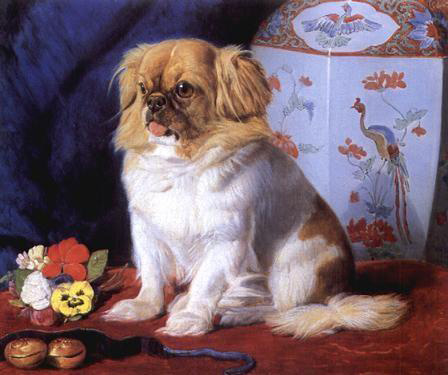
What do you know? I got this off without too much fuss. And I even found an image of a small yapping dog (you can read the story behind the painting here.) Read the Dana’s essay here.

Bohumil Hrabal, a glass of water, and “a lightning strike of a novel.”

January 29th, 2018
Share

It’s a busy Monday, but our mind keeps straying to the seminal Another Look event last week on Frankenstein. And it brought to mind other Another Look events … for example, our February 2016 event on Bohumil Hrabal‘a Too Loud a Solitude.

One of the book’s most enthusiastic is Peter Orner, writing in “Night Train to Split” in Guernica (an excerpt from his new book Am I Alone Here?: Notes on Living to Read and Reading to Live (Catapult):

“The first time I finished Too Loud a Solitude, I was up in Letná Park, and I remember leaping off the bench and running around in circles, holding the book above my head and shouting because I believed I’d experienced some religious illumination. A brief, ninety-eight-page, lightning strike of a novel, the book is about a man named Haňťa who has been crushing paper beneath a street in Prague for the last thirty-five years. People throw paper and books, books by the barrelful, down Haňťa’s hole in the pavement. Before he crushes them, Haňťa reads. The book of Ecclesiastes, the Talmud, Goethe, Schiller, Nietzsche, Immanuel Kant’s Theory of the Heavens. Kant, who argues that the heavens are not humane, nor is life above or below.”

There’s another reason Hrabal came to mind, however. Before last week’s event, we had a nice chat with Meri Mitsuyoshi, who shared  this arresting photo she took last year while reading Hrabal’s dystopian mixture of enlightenment, hope, and despair. “A lighting strike of a novel”? I think the whimsical and grim Czech writer would prefer the rainbow that flashed across the page where he described the Gypsy girls.


<<< Previous Series of PostssepNext Series of Posts >>>