“Sanctuary!”

August 9th, 2015
Share
durham

The sanctuary knocker Quasimodo would have used. (Photo: myrabella/Creative Commons)

So you have committed a murder or two – okay, maybe three – in 13th century Paris or London or Rome. The judicial systems of that era meant certain execution, whether or not you are guilty. What’s a poor bugger to do?

Leg it the hell to the local church. Thanks to the long tradition of sanctuary, which existed from the earliest centuries, even the most heinous villain could find refuge. The most famous example is from The Hunchback of Notre Dame. Fans of Victor Hugo will remember the hunchback bellringer Quasimodo nabbing the gypsy girl Esmeralda en route to her execution for witchcraft. While I knew of the medieval institution of sanctuary, I certainly didn’t know its ins and outs, and I hadn’t connected the dots to ancient Greece and Rome. Remember Oedipus takes a sort of asylum at the sacred grove of the Erinyes in Colonus? Or the young Troilus seeking sanctuary in the temple of Apollo? (Well, that didn’t work out very well for him – Achilles hunts him down and kills him there.)

durham2

Sanctuary in Durham (Photo: dun deagh/Creative Commons)

As a recent article in Slate explains (read the whole article here), “Of course, these sites were not just hidey holes where fugitives could go to thumb their nose at the authorities; petitioners for sanctuary had to atone and pay penance for their crimes.” The article is informed by Karl Shoemaker of the University of Wisconsin, the author of Sanctuary and Crime in the Middle Ages, 400-1500From the article:

In order for asylum seekers to gain sanctuary, they had to simply enter a church and wait for an appointed officer of the crown (known as a coroner) to arrive. Once the coroner arrived, the seekers had to confess to their crime, whether they committed it or not, and they were then under the protection of the church. In some cases, more specific action was required, such as ringing a certain bell, sitting down on a special bench (known as a “frith-stool”), or wrapping their hand around a special door-knocker, as was the case at the Durham Cathedral, and giving it a rap, not unlike a historic, legal version of freeze tag.

During the existence of English sanctuary laws, which lasted until 1624, countless thousands of felons claimed sanctuary. Shoemaker claims that “in some counties as many as half of the recorded felonies would end in a sanctuary claim rather than a trial.” This could be even higher in some counties, where up to two-thirds of all the felonies were “resolved” in a sanctuary. During this period all Christian churches offered sanctuary within their walls. Certain churches also offered a widened area of protection that was extended to areas surrounding the church, demarcated by monuments known as “sanctuary stones” or “sanctuary crosses” Those churches (there were at least 22, including Westminster Abbey) that offered a wider sanctuary usually had to be approved by a charter from the king.

Ahhh, those were the good old days. It didn’t last.

shoemakerAs the centuries rolled on, the length of sanctuary afforded to fugitives began to increase, with many churches extending their fugitives indefinite stays. This form of sanctuary began looking pretty attractive to some criminals, who would flock to these church safehouses, essentially forming small dens of thieves under the protection of the church. Again from Shoemaker: “We have evidence of [the fugitives] are going out in marauding bands. Robbing shopkeepers, robbing others. Then retreating back to these sanctuaries.” This began to change the perception of church sanctuaries among the people of England, and was likely the death knell of English sanctuary law.

Shoemaker believes that the changing nature of the role of law during the late 16th century in English society was the ultimate downfall of church asylum. Previously, sanctuary was seen as an act of kindness, forgiveness, and piety on the part of both Christianity and the crown. But as the feeling that an effective criminal system would deter wrongdoing through punishment began to grow in the country, the view of sanctuary’s penitent treatment of fugitives seemed only to be rewarding the criminal acts by allowing asylum seekers to avoid the official penalty.

Is it all over? Not entirely. Slate seems to have an ongoing interest in the matter. The publication ran a story in 2007 when a Mexican immigrant-rights activist took sanctuary in a Chicago church rather than risk deportation and separation from her young son.  It’s here. That article, by the way, says the custom of sanctuary goes back even earlier:

The Old Testament mentions safe haven at the altar for criminals who commit accidental murder and even suggests the establishment of six “cities of refuge” for killers. By around the fourth century, the right to sanctuary had become formalized among the early Christians. At first the sanctuary rule applied if the criminal had one part of his body in a church building or grasped the rings attached to the church doors. Within a few centuries, the sanctuary zone included the churchyard, graveyard, cloisters, and a 35-pace radius around the bishop’s residence.

But for most of us, the image of sanctuary is forever frozen in time with Quasimodo swinging down from Notre Dame for his dramatic rescue effort. Here is a scene from one of the greatest films of the 1930s, with Maureen O’Hara as Esmeralda, Sir Cedric Hardwicke as the chief justice, Edmond O’Brien as the Gringoire, the man who loves her, and the immortal Charles Laughton as Quasimodo.

Indefatigable spirit: Remembering the legendary Robert Conquest (1917–2015)

August 5th, 2015
Share
Conquest at work (Photo: L.A. Cicero)

My favorite photo of him, by the matchless Linda Cicero.


To each of those who’ve processed me
Into their scrap of fame or pelf:
You think in marks for decency
I’d lose to you? Don’t kid yourself.

Robert Conquest wrote these lines in his last collection of poems, Penultimata (Waywiser, 2009). I suppose, although he was too polite to say so, I might be included in his roster, since we met when I interviewed him – here.  Although the interview form is a kind of exploitation, I suppose, it didn’t exactly bring me either fame or pelf, but something much better. I expect my own “processing” will continue for some time now, as I digest, in future years, his work over a long lifetime. As everyone now knows, the Anglo-American historian and poet died on Monday, after long illness. He was 98.  (Obituaries from the New York Times here, the Wall Street Journal here, and London’s Telegraph here.) He was working until his last few weeks on an unfinished memoir called Two Muses. I hope there’s enough of it to publish.

The short quatrain above refers, I expect, to his dirty limericks and light verse, rather than his sobering prose and more serious poems. “Limericks are not very gentlemanly – or it’s a special kind of gentleman,” he told me. But perhaps the lightness of much of his verse was a necessary psychological counterbalance to the grim history he relentlessly documented in the books that were his major achievement, chronicling the devastation caused by the Soviet regime, throughout its existence. His landmark book, The Great Terror reads like a thriller, and is a detailed log of Stalin’s assassinations, arrests, tortures, frame-ups, forced confessions, show trials, executions and incarcerations that destroyed millions of lives. The book instantly became a classic of modern history, and other titles followed, including The Harvest of Sorrow: Soviet Collectivization and the Terror-Famine (1986) and a 1977 translation of Alexander Solzhenitsyn‘s 1,400-line poem, Prussian Nights, undertaken at the author’s request.

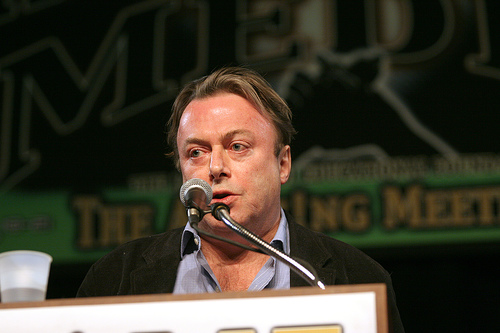
The late Christopher Hitchens, a close friend, praised Bob’s “devastatingly dry and lethal manner,” hailing him as “the softest voice that ever brought down an ideological tyranny.” Timothy Garton Ash said“He was Solzhenitsyn before Solzhenitsyn.”

When he revised The Great Terror for republication in 1990, his chum Kingsley Amis proposed a new title, I Told You So, You Fucking Fools.” Catchy title, although Bob settled for the more circumspect The Great Terror: A Reassessment. 

conquest4

Mentor and mentee, 2009.

“His historical intuition was astonishing,” Norman Naimark told the New York Times (we’ve written about Norm here and here and here). “He saw things clearly without having access to archives or internal information from the Soviet government. We had a whole industry of Soviet historians who were exposed to a lot of the same material but did not come up with the same conclusions. This was groundbreaking, pioneering work.”

My 2010 interview, however, wasn’t my first encounter with the poet-historian, although it was his first encounter with me. I was one of a throng of people who attended a 2009 ceremony at Hoover event when Radosław Sikorski, then Poland’s minister of foreign affairs, awarded him the country’s Order of Merit. (I wrote about the occasion here. Incidentally, Bob received a U.S. Presidential Medal of Freedom in 2005.)

“His books made a huge impact on the debate about the Soviet Union, both in the West and in the East. In the West, people had always had access to the information about Communism but were not always ready to believe in it,” said Sikorski at that time. “We longed for confirmation that the West knew what was going on behind the Iron Curtain. Robert Conquest’s books gave us such a confirmation. They also transmitted a message of solidarity with the oppressed and gave us hope that the truth would prevail.”

An excerpt from my 2010 article:

Susan Sontag was a visiting star at Stanford in the 1990s. But when she was introduced to Robert Conquest, the constellations tilted for a moment.

“You’re my hero!” she announced as she flung her arms around the elderly poet and acclaimed historian. It was a few years since she had called communism “fascism with a human face” – and Conquest, author of The Great Terror, a record of Stalin’s purges in the 1930s, had apparently been part of her political earthquake.

Sitting in his Stanford campus home last week and chatting over a cup of tea, the 93-year-old insisted it’s all true: “I promise. We had witnesses.” His wife, Liddie, sitting nearby confirmed the account, laughing.

Conquest, a Hoover Institution senior research fellow emeritus, moves gingerly with a walker, and speaks so softly it can be hard to understand him. But his writing continues to find new directions: He published his seventh collection of poems last year and a book of limericks this year, finished a 200-line poetic summa and is working on his memoirs.

He’s been a powerful inspiration for others besides Sontag. In his new memoir, Hitch-22, Christopher Hitchens described Conquest, who came to Stanford in 1979, as a “great poet and even greater historian.” The writer Paul Johnson goes further, calling Conquest “our greatest living historian.”

conquest6

He deserved the medal. In 2005.

I made a few return visits to that immaculate and airy Stanford townhouse on the campus. Liddie was always bubbly, intelligent, and hospitable – a thorough Texan, and always a charming and welcoming hostess. Often the two of us were talking so quickly and with such animation Bob couldn’t keep up – he spoke barely above a whisper. He was still a terrific conversationalist, one just had to listen harder. Among his considerable gifts, “He had a wicked sense of humor and he loved to laugh: the look of playful delight that animated his face as he nailed a punch line is impossible to forget,” said Bert Patenaude (I also wrote about Bert here). “His poems and limericks convey a sense of his mischievousness—and naughtiness—and his late poems chronicle the aging process with sensitivity and, one is easily persuaded, acute psychological insight.”

Another of our mutual friends, the poet R.S. Gwynn, agreed: “As a poet Bob is funny, intensely lyrical and deeply reflective,” he said. “Whenever I read him I think of how rarely we are allowed to see a mind at work, and what a mind it is.” (I’ve written about Sam Gwynn here and here.)

Bert said that Bob’s final speaking appearance on the Stanford campus may well have been his participation in an annual book event, “A Company of Authors,” where he discussed Penultimata on April 24, 2010. “Bob seemed frail that day, and at times it was difficult to hear him and to understand his meaning, but no one in the room could doubt that the genial elderly man up there reciting his poetry could have carried the entire company of authors on his back. Seated next to me in the audience was a Stanford history professor, a man (not incidentally) of the political left, someone I had known since my graduate student days—not a person I would ever have imagined would be drawn to Bob Conquest. Yet he had come to the event, he told me, specifically in order to see and hear the venerable poet-historian: ‘It’s rare that you get to be in the presence of a great man. Robert Conquest is a great man.’ Indeed he was.”

In the last few months, I tried to visit – but the Conquests were either traveling or packing, or else, more distressingly, he was in the hospital or recovering from a round of illnesses. And finally time ran out altogether. Time always wins. We don’t have time; it has us.

Postscript on 8/7: My publisher Philip Hoy pointed out in the comments section below that Penultimata was not Bob’s final collection of poems, it was (as the name suggests) a penultimate one. Blokelore & Blokesongs was published by Waywiser in 2012.

conquest3

A pleasure to know you, sir. (Photo: L.A. Cicero)


“You whom I could not save”: Remembering Krzysztof Baczyński, who died this day, 1944

August 4th, 2015
Share
baczynski

“Asthmatic, of frail health…a disciplined soldier…sheer effort of will.”

My friend Kasia Wozniak reminded me that today is the day Krzysztof Kamil Baczyński was killed as a platoon commander, on the fourth day of the Warsaw Uprising, August 4, 1944. He was 23.

It was what he himself imagined, apparently: a shower of bullets, grenades, hitting the dirt, and “one charge only, straight up to heaven.” Let us hope so.

His beloved wife Basia was wounded and died a month later, not knowing of her husband’s death. The ancient city was entirely leveled – the vengeful Germans brought in architects to more effectively make sure the city was demolished block by block. “In January 1947 Baczynski’s body was dug out of the ruins of the City Hall and Krzysztof and Basia were finally laid to rest together in one grave at the Insurgents’ cemetery at Powazki,” according to this page commemorating him.

He was an only child, the son of a father who was a literary critic and a mother, Stefania Zielenczyk, the sister of the well-known philosopher, Adam Zielenczyk. He grew up in one of those rare periods of Polish history, a free and independent Poland. His early enthusiasm for Marxism-Trotskyism evolved into a romantic nationalistic Messianism. “Asthmatic, of frail health, he became a disciplined soldier of the Home Army by sheer effort of will,” Czesław Miłosz wrote.

Little from this prolific writer exists in English – no book, certainly, but there are a few poems here. He was considered a very fine poet, “whose rich imagery served more and more overtly, as he developed, to point up his central theme of self-immolation for the sake of an ideal Poland.” That’s from Miłosz again. “Those critics were right who maintained that he strangely resembled Juliusz Słowacki in his concept of redemptive martyrdom.” Miłosz had little sympathy for this Polish nationalism and idealism, yet he mourned its many victims in the doomed attempt to protect Warsaw from the Nazis. And he memorialized them.

While search for something online to say about him, I ran across my own article about the Miłosz and Robert Hass collaboration, here, in which I quote from the then (in 2001) newly translated edition of Treatise on Poetry:

Krzysztof Kamil Baczyñski

Idealists died first.

No ancient Greek hero entered into combat
So deprived of hope, in their heads the image
Of a white skull kicked by feet in passing . . .

Trzebinski, the new Polish Nietzsche,
Had his mouth plastered shut before he died.
He took with him the view of a wall, low clouds
His black eyes had just a moment to absorb.
Baczynski’s head fell against his rifle.
The uprising scared up flocks of pigeons.
Gajcy, Stroinski were raised to the sky,
A red sky, on the shield of an explosion.

On this day I also think of the Nobel poet’s famous “Dedication.” Miłosz scholar and translator Clare Cavanagh impressed upon me that this poem, often read didactically, with a rhetorical flourish, in fact has a singular “you.” It was directed at a single listener, which very much changes the way one read it. Was it Baczyński? I wonder.

You whom I could not save
Listen to me.
Try to understand this simple speech as I would be ashamed of another.
I swear, there is in me no wizardry of words.
I speak to you with silence like a cloud or a tree.

What strengthened me, for you was lethal.
You mixed up farewell to an epoch with the beginning of a new one,
Inspiration of hatred with lyrical beauty;
Blind force with accomplished shape.

Read the whole poem here. And do check out the excellent commemorative page here.

Dante: did he really go to hell?

August 3rd, 2015
Share

Dante_GiottoDante Alighieri was one of the world’s greatest prophets and poets, yes, but what was he like to have dinner with? What did his neighbors think of him? What was he like to hang with?

First, the externals: He was of middle height, “and after he had reached mature years he walked with somewhat of a stoop; his gait was grave and sedate; and he was ever clothed in most seemly garments, his dress being suited to the ripeness of his years. His face was long, his nose aquiline, his eyes rather large than small, his jaws heavy, with the under lip projecting beyond the upper. His complexion was dark, and his hair and beard thick, black, and crisp; and his countenance always sad and thoughtful.”

The black, crisp beard was very much to the point, and apparently he was a bit of a ham, too. His fame and his Commedia – especially the Inferno – preceded him everywhere, and he was recognized on sight. One day in Verona, “as he passed before a doorway where several women were sitting, one of them said to the others in a low voice, but not so low but that she was plainly heard by him and by those with him, ‘Do you see the man who goes down to Hell, and returns at his pleasure, and brings back news of those who are below?’ To which one of the others answered in all simplicity: ‘Indeed, what you say must be true; don’t you see how his beard is crisped and his color darkened by the heat and smoke down below?’ Dante, hearing these words behind him, and perceiving that they were spoken by the women in perfect good faith, was not ill pleased that they should have such an opinion of him, and smiling a little passed on his way.”

He enjoyed his mystique, then. The words are, of course, Boccaccio‘s, recounted in a recent blog post over at Rhys Tranter‘s blog on literature, philosophy, and the arts. Here’s another anecdote he great Italian maestro:

dante… on one of the occasions when he was in Siena, he chanced to be at an apothecary’s shop, where a book was brought to him which had been previously promised him, this book being one of much reputation among persons of worth, and having never yet been seen by him. As he happened to be unable to take it elsewhere, he leant over on to the bench in front of the apothecary’s shop, and there, placing the book before him, began most eagerly to examine it. Soon afterwards, in that same quarter, close to where he was, on the occasion of some general festival a great tournament took place among the noble youths of Siena, accompanied, as is usually the case on such occasions, with a great deal of noise caused by the various instruments and shouts of applause from the bystanders; yet, in spite of all this, and of many other things likely to attract the attention, such as fair ladies dancing, and youths’ sports of all kinds, he was never seen to stir from his place, nor so much as to raise his eyes from his book. Indeed, although it was about noon when he took his stand there, it was not until past the hour of vespers when, having examined the book thoroughly and taken a general survey of its contents, he got up to leave it. He afterwards declared to several persons, who asked him how he could refrain from looking on at such a splendid festival as had taken place in his presence, that he had been wholly unaware of it—an answer which made his questioners wonder even more than they had done at first.
Read the whole thing here.

Ukrainian poet Serhiy Zhadan at the end of Europe

July 31st, 2015
Share
Serhij Żadan

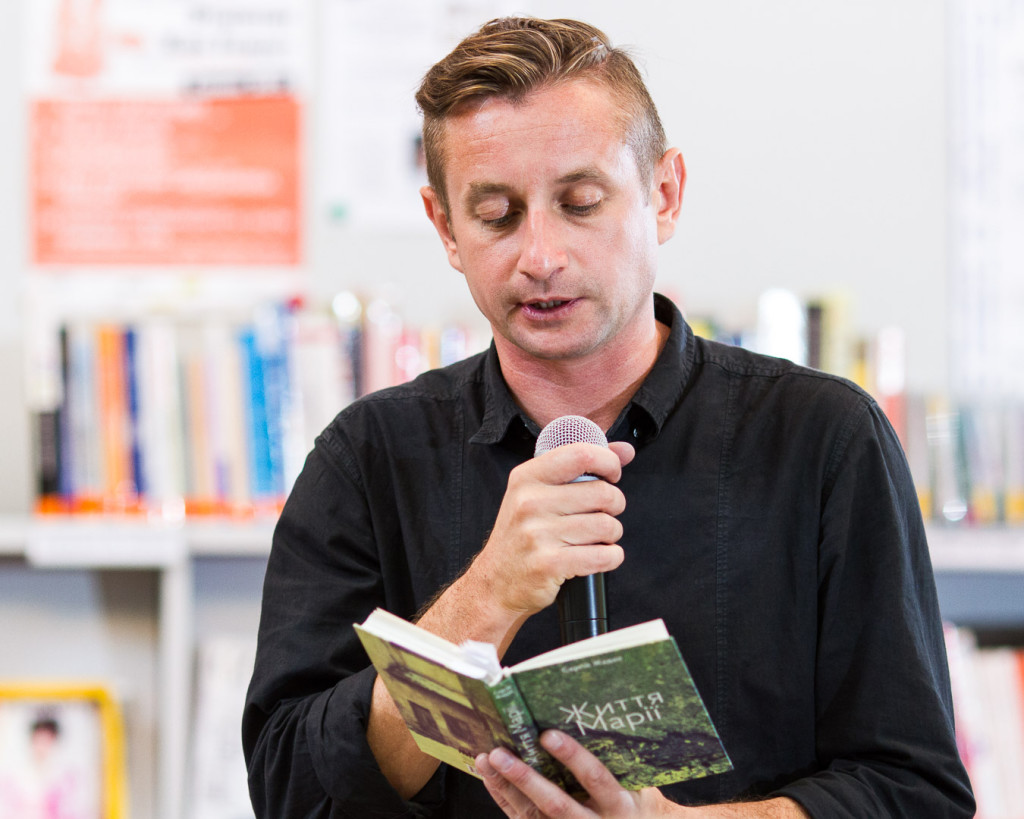
Reading from “Lives of Maria” in Wrocław, earlier this year. (Photo: Rafał Komorowski)

We wrote about Serhiy Zhadan, Ukrainian poet, novelist, essayist, and translator over a year ago, in a post titled, “They told him to kneel and kiss the Russian flag. Then he told them to…” That’s when the pro-Russian demonstrators broke his skull with bats in his native Kharkiv, the second largest city of Ukraine, a place that has the misfortune to be close to the Russian border.

“Americans need to understand, in Eastern Europe, writers still have a huge influence on society,” Vitaly Chernetsky, a professor of Slavic literature at the University of Kansas told the New Yorker in a story here. “It may sound like an old-fashioned ‘poet stands up to tyranny’ story, like something out of Les Miz—‘Can you hear the people sing?’—but it’s really kind of like that. … He’s a writer who is a rock star, like Byron in the early nineteenth century was a rock star.”

We were happy to see him appear last week in a New York Review of Books blogpost by Timothy Snyder, “Edge of Europe, End of Europe.” Tim said “What Zhadan actually seems to aspire to – and here his willingness to risk his life for Europe is a clue – is what [writer Mykola] Khvylovy called ‘psychological Europe’: the acceptance of conventions, the work to transcend them, and the absolute indispensability of freedom and dignity for the effort.” The discussion includes Czesław Miłosz as well:

Zhadan’s most recent work, a collection of poetry published earlier this year entitled Lives of Maria, is a book of Ukraine’s war and of Zhadan’s own survival: “you see, I lived through it, I have two hearts/do something with both of them.” Yet as the book proceeds the meditations are increasingly religious, the poems often taking the form of conversations with Maria herself. No one, in eastern Slavic culture or anywhere else, combines the writerly personas of tough guy and holy fool as does Zhadan. He raps hymns.

A happenstance Californian.

Kindred spirit?

At points in Lives of Maria, Zhadan sounds like Czesław Miłosz, the twentieth-century Polish poet, who also strove toward Europe through both the local and the universal: “I wanted to give everything a name.” Miłosz was the preeminent poet of a borderland, one to the north of Kharkiv, Lithuanian-Belarusian-Polish (and Jewish) rather than Ukrainian-Russian (and Jewish). His position, not so different from Zhadan’s perhaps, was that Europe can best be recognized on the margins, that uncertainty and risk are more substantial than commonplaces and certainty. And indeed, the last section of Lives of Maria is devoted to Zhadan’s translations of Miłosz. Zhadan begins with two of Miłosz’s poems, “A Song on the End of the World” and a “A Poor Christian Looks at the Ghetto,” that ask the most direct questions about what Europeans did during the twentieth century and what they might and should do instead. The second poem communicates the pain and difficulty of actually seeing and trying to learn from the Holocaust, which was, or at least once was, a central idea of the European project. The first transmits, almost breezily, certainly eerily, what a European catastrophe might feel like. It concludes: “No one believes that it has already begun/Only a wizened old man who might have been a prophet/But is not a prophet, because he has other things to do/Looks up as he binds his tomatoes and says/There will be no other end of the world. There will be no other end of the world.”

Where Miłosz wrote in Polish that the old man had other things to do, Zhadan writes in Ukrainian that there were already so many prophets. Perhaps so. Pro-European Ukrainians are taking a chance, not demanding a future. They watch the Greek crisis too, and their position is often more scathing than anything western critics of the EU could muster. The point then is not certainty but possibility. Zhadan might well have died for an idea of Europe; other Ukrainians already have. Yet the risks he has taken, both physical and literary, are not in the service of any particular politics. Many of his essays and poems are about the attempt to understand people with whom he disagrees. He is an outspoken critic of his own government. Like Miłosz, who described Europe as “familial,” or like Khvylovy, who called Europe “psychological,” Zhadan is pursuing experimentation and enlightenment, a sense of “Europe” that demands engagement with the unmasterable past rather than the production and consumption of historical myth. “Freedom,” writes Zhadan in Lives of Maria, “consists in voluntarily returning to the concentration camp.”

It rather makes me hanker for a translation. Anyone? Oh well, you can read all of Tim’s article here.

Salman Rushdie: “We are living in the darkest time I have ever known.”

July 29th, 2015
Share
©Zygmunt_Malinowski_

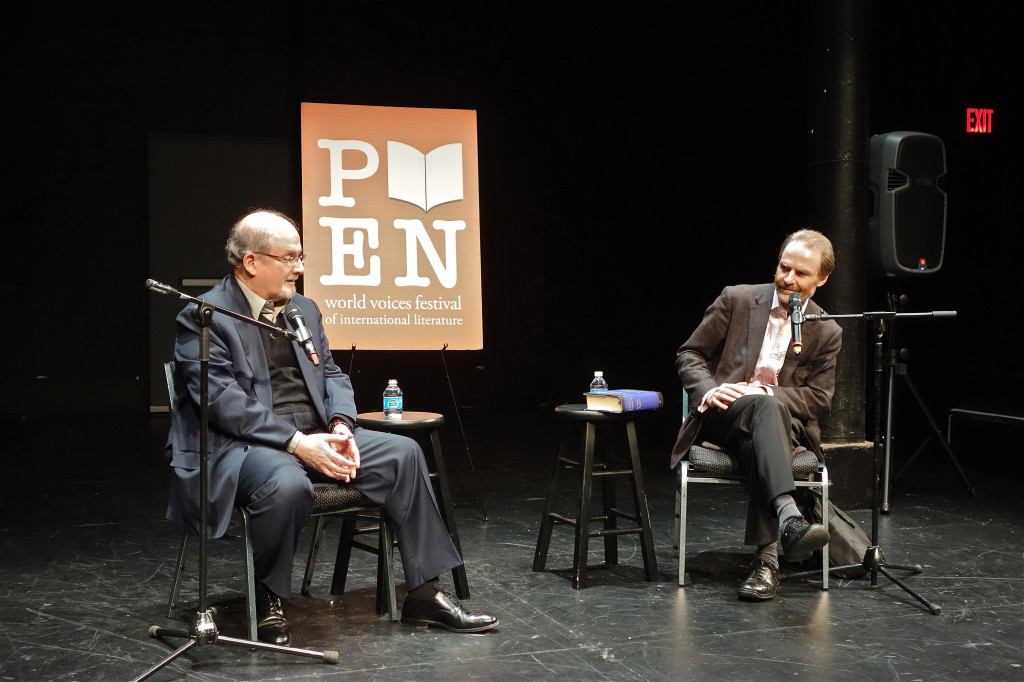
Would people defend him today? He thinks not. With Timothy Garton Ash last year. (Photo: Zygmunt Malinowski)

Charlie Hebdo has announced that they will publish no more cartoons featuring Mohammed, although every other religion and public figure will continue to be fair game. In other words, the terrorists have won. “We have drawn Mohammed to defend the principle that one can draw whatever they want… We’ve done our job,” said Laurent “Riss” Sourisseau, Charlie Hebdo’s editor-in-chief.

It’s hard to be nostalgic about a fatwa, but Sir Salman Rushdie‘s recent comments in The Telegraph remind us that his Valentine’s Day card from the Ayatollah Khomeini in 1989 were the good old days. Leading figures from around the world linked arms to express solidarity with him, and to protest any encroachment on freedom of speech. Susan Sontag, Norman Mailer, Joseph Brodsky, Christopher Hitchens, Seamus Heaneyand others stood for Rushdie. There was no backing down. And today?

Said Rushdie, “We are living in the darkest time I have ever known.” The author of the condemned Satanic Verses, told France’s L’Express. “I’ve since had the feeling that, if the attacks against Satanic Verses had taken place today, these people would not have defended me, and would have used the same arguments against me, accusing me of insulting an ethnic and cultural minority.”

Everblooming friendship

Thank you, Christopher.

In particular, Rushdie said he was dismayed by the protests that followed a decision by the American branch of the PEN writers’ association to award a prize for courage to Charlie Hebdo after a dozen of its staff were massacred in January. More than 200 writers, including Michael Ondaatje, Teju Cole, Peter Carey, and Junot Díaz, signed a letter objecting to PEN rewarding the satirical magazine for publishing “material that intensifies the anti-Islamic, anti-Maghreb, anti-Arab sentiments already prevalent in the Western world.”

“It seems we have learnt the wrong lessons,” Rushdie told L’Express. “Instead of realizing that we need to oppose these attacks on freedom of expression, we thought that we need to placate them with compromise and renunciation.” Cole explained to him that his case was different – 1989 protesters defended Rushdie against charges of blasphemy; Charlie Hebdo’s cartoons, he argued, were an expression of Islamophobia.

Rushdie thinks it’s a case of political correctness gone wild. “It’s exactly the same thing,” he said. “I’ve since had the feeling that, if the attacks against The Satanic Verses had taken place today, these people would not have defended me, and would have used the same arguments against me, accusing me of insulting an ethnic and cultural minority.” (To be clear, I find Charlie Hebdo cartoons tasteless and not very funny. That’s not the point.) 

Let’s remember Sontag, president of PEN, in that 1989 moment. Hitchens wrote: “Susan Sontag was absolutely superb. She stood up proudly where everyone could see her and denounced the hirelings of the Ayatollah. She nagged everybody on her mailing list and shamed them, if they needed to be shamed, into either signing or showing up. ‘A bit of civic fortitude,’ as she put it in that gravelly voice that she could summon so well, ‘is what is required here.’ Cowardice is horribly infectious, but in that abysmal week she showed that courage can be infectious, too. I loved her. This may sound sentimental, but when she got Rushdie on the phone—not an easy thing to do once he had vanished into the netherworld of ultraprotection—she chuckled: ‘Salman! It’s like being in love! I think of you night and day: all the time!’ Against the riot of hatred and cruelty and rage that had been conjured into existence by a verminous religious fanatic, this very manner of expression seemed an antidote: a humanist love plainly expressed against those whose love was only for death.”

sontag3

Thank you, Susan.

Sontag and Hitchens were famous people, of course, who lived in high-rise apartments and could go into hiding, as Rushdie did. But a lot of other people put their lives on the line. Hitoshi Igarashi, the Japanese translator of The Satanic Verses, was stabbed to death on the campus where he taught, the Italian translator Ettore Capriolo was knifed in his Milan apartment, and in Oslo, William Nygaard, the novel’s Norwegian publisher, was shot three times in the back and left for dead.

Others at risk included bookstore owners, bookstore managers, and the people who worked for them. So let me take a few moments to recall the heroism of one of them, Andy Ross, owner of Cody’s Books in Berkeley, which was bombed in the middle of the night two weeks after the fatwa was announced. On his own blog (he is now a literary agent) he wrote:

I spoke of the fire bombing that occurred at 2 AM. More troubling was that as we were cleaning up in the morning, an undetonated pipe bomb was found rolling around the floor  near the poetry section. Apparently it had been thrown through the window at the same time as the fire bomb. Had the pipe bomb exploded, it would have killed everyone in the store. The building was quickly evacuated. … As I walked outside, I was met with a phalanx of newsmen. Literally hundreds. Normally I was a shameless panderer for media publicity. At this point I had no desire to speak. And I knew reflexively that public pronouncements under the circumstances were probably imprudent. …

Codys2006

Cody’s in 2006. (Photo: Creative Commons/Pretzelpaws)

One-time heroism wasn’t enough. How were they to react to the attack? Would they continue selling the book? Would they put it at the front of the store, or hide it somewhere towards the back? Or would it, like 1950s pornography, be offered by request only, in a brown paper bag?

I stood and told the staff that we had a hard decision to make. We needed to decide whether to keep carrying Satanic Verses and risk our lives for what we believed in. Or to take a more cautious approach and compromise our values.  So we took a vote. The staff voted unanimously to keep carrying the book. Tears still come to my eyes when I think of this. It was the defining moment in my 35 years of bookselling. It was the moment when I realized that bookselling was a dangerous and subversive vocation. Because ideas are powerful weapons. It was also the moment that I realized in a very concrete way that what I had told Susan Sontag was truer and more prophetic  than anything I could have then imagined. I felt just a tad anxious about carrying that book. I worried about the consequences. I didn’t particularly feel comfortable about being a hero and putting other people’s lives in danger. I didn’t know at that moment whether this was an act of courage or foolhardiness.

But from the clarity of hindsight, I would have to say it was the proudest day of my life.

The story wasn’t over. Rushdie visits the Bay Area regularly (I wrote about his visit to Kepler’s here). And even while in official hiding, he insisted on calling on Cody’s several years later (Berkeley rents finally did what bombs could not, and the valiant bookstore closed its doors in 2008). Ross recalls Rushdie’s appearance at Cody’s:

We were told that we could not announce the visit until 15 minutes before he arrived.  It was a very emotional meeting. Many tears were shed, and we were touched by his decision to visit us. We showed him the book case that had been charred by the fire bomb. We also showed him the hole in the sheetrock above the information desk that had been created when the pipe bomb was detonated. One of the Cody’s staff, with characteristic irreverence, had written with a marker next to the damaged sheet rock: “Salman Rushdie Memorial Hole”. Salman shrugged his shoulders and said with his wonderful self-deprecating humor, “well, you know some people get statues – and others get holes.”

Read the whole thing here.


<<< Previous Series of PostssepNext Series of Posts >>>