J.R. Ackerley’s My Father and Myself comes to Stanford

October 8th, 2013

Share
ackerley

Roger and Joe Ackerley, 1913 (Photo courtesy Harold Ober Associates)

J.R. Ackerley led an outwardly quiet life between his flat in suburban Putney and his London office at The Listener, the BBC’s weekly magazine, where he worked from 1935 to 1959.  Though he was the leading literary editor of his generation, he was in no hurry to publish his own work – hence, his controversial memoir appeared posthumously.

Now his following is growing.  It’s likely to expand further when Stanford’s “Another Look” book club takes on My Father and Myself, exploring Ackerley’s life as a gay man and his determined outing of long-held family secrets. A book discussion will be held Oct. 29 at 7:30 p.m. in the Stanford Humanities Center’s Levinthal Hall.  The event is free and open to the public.

The evening will be moderated by Terry Castle, professor of English and author of  The Professor and Other Writings. She will be joined by Adrian Daub, an associate professor of German studies, and Jeffrey Fraenkel, founder of San Francisco’s Fraenkel Gallery for photography.  The event launches the second year of “Another Look,” founded by the English/Creative Writing Department.

It’s not the first time Stanford has had a role in beating the drums for My Father and Myself.  When Edwin Frank, a former Stegner Fellow in Stanford’s Creative Writing Program, founded the New York Review Books Classics in 1999, none of Ackerley’s books were in print.  Frank republished all four – they were among the first titles of the eminent series that rediscovers out-of-the-way classics.

Given current critical esteem, their former obscurity is surprising, but Frank cites several reasons why this was so. “He published one book early on, and it was a success.  Then he didn’t write anything for years on end. If you do that, you will have a more vulnerable career as a writer,” he explained. “My Dog Tulip was published privately.  My Father and Myself was posthumous.  We Think the World of You was published in 1963 – it was a relatively open picture of a gay relationship between two none-too-appealing people.

“Each of the books is odd,” said Frank.  “They don’t match anybody’s expectations. Ackerley’s books are not good in the way people expect them to be good.”

Read the rest here.

There’s more.  At the “Another Look” website here, you can read:

“The Many Loves of J.R. Ackerley”

J.R. Ackerley was sitting on a park bench with Forrest Reid in Hyde Park, when the older writer asked him, “Do you really care about anyone?”

In My Father and Myself, Ackerley says he pondered the remark long afterwards. “To this searching question I do not know the answer, it goes too deep; since people and events vanish so easily from my memory it may be no.”  Not everyone shares his assessment. “It is characteristic of him to report against himself – he fears he is an uncaring person,” said Edwin Frank, founder of the New York Review Books Classics.

When accused of hating the human race, however, Ackerley was quite startled: “I am not a misanthropist,” he insisted. “I like people and get on well with them; I am only a numerical misanthropist.” To stem the rising population tide, he recommended homosexuality. No one could be entirely sure how serious he was.

8Read the rest here.

“Sometimes Love Really is a Bitch” 

My Father and Myself is dedicated simply “To Tulip.”

Tulip’s identity is no enigma. Although the real name of J.R. Ackerley’s dedicatee was “Queenie,” his editors worried the name had racy connotations, even for a dog, and hence the title of his earlier book had been My Dog Tulip. It is perhaps the only story of a man and his dog in which the two are treated as equals.

Read the rest here.

A new look for Janet Lewis’s Cases of Circumstantial Evidence

October 7th, 2013
Share

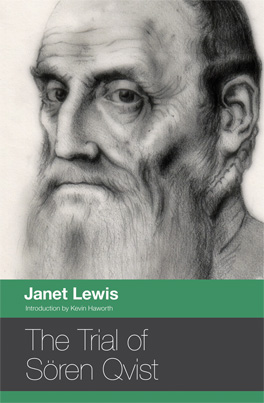
lewis_wife-of-martin-guerre-fcDuring last winter’s Janet Lewis celebration with the “Another Look” book club at Stanford, I didn’t have an opportunity to write about this enticing bit of news: Ohio University Press/Swallow Press is reissuing all three novels in Lewis’s Cases of Circumstantial Evidence series in new editions with fancy new covers.  They’re gorgeous.

The publisher (full disclosure: who is also my publisher) sent me the advance review copy of The Wife of Martin Guerre, her best-known work (I wrote about it here and here) about a now-famous case of mistaken identity.  The jacket cites praise I had not included in my earlier writing. The New Yorker said it was “Flaubertian in the elegance of its form and the gravity of its style.” Larry McMurtry, writing in the New York Review of Books, called it “a masterpiece … a short novel that can run with Billy Budd, The Spoils of Poynton, Seize the Day, or any other.” This from novelist Ron Hansen in the Wall Street Journal:  “Janet Lewis brings the haunting qualities of fable to this novella …”  Michael Dirda of the Washington Post wrote: “One of (the short novel’s) most perfect examples is Janet Lewis’s The Wife of Martin Guerre.” Heady praise indeed.

In a new introduction to the 1941 work, Swallow Press’ Kevin Haworth writes that the book is “a short novel of astonishing depth and resonance, a sharply drawn historical tale that asks contemporary questions about identity and belonging, about men and women, and about an individual’s capacity to act within an inflexible system.”  Maybe, but it’s a relentless and draining novel sans merci, all the way to its ruthless end.  I admit I didn’t have as much sympathy for Bertrande de Rols as I should have – and I developed instead a sneaking affection for the rakish Arnaud du Tilh, the baddy who comes on the scene to run a scam, but winds up falling in love, reforming his life, and effectively running an extended household. He is the only one who finds any kind of redemption in the novel – and naturally is destroyed. (How did such a nice woman write such a hard-hearted book?)

lewis_fc-trial-of-sören-qvistMore from Haworth: “This close attention to an individual’s moral choices in the face of strange circumstances links The Wife of Martin Guerre with the two novels that follow in the Cases of Circumstantial Evidence series. Though each of the novels stands on its own, they remain united by their shared origins in the history of law, discovered by Lewis in the same legal casebook where she first found the story of Bertrande de Rols and Martin Guerre.  The setting shifts to seventeenth-century Denmark in The Trial of Sören Qvist, which focuses on a devoted parson, albeit one with a harsh temper, who is accused of killing one of his workers. Again the law closes in on a man who may or may not be guilty, and again the characters struggle as much with their own consciences and the changing times as they do with the ambiguous legal facts in front of them. In The Ghost of Monsieur Scarron, Lewis returns to France, this time during the reign of Louis XIV. In this longest and in some ways most complex of the three novels, a bookbinder becomes enmeshed in a political drama that spirals out of control – the king is denounced in a pamphlet, leading to criminal charges – but the real crime is domestic, an adulterous affair that contributes to the tragedy as much as the public trial that follows. …

“To European critics, Lewis seems quintessentially American. To American critics, her fondness for European settings leads to comparisons as expected as Flaubert and as unusual as the Provençal writer Jean Giono. The New York Times compared her to Melville and to Stendhal. Another critic sees her, based on The Invasion and some of her short stories, as a definitive voice in Western regional writing. In some ways, Lewis’s writing remains elastic, allowing other writers to see in her a powerful reflection of their own interest. In short, as with all the best writers, her work and her decades-long career defy simple categorization or comparisons.”

As for Lewis herself, she hardly thought of herself at all. Hence, her refreshing sanity amid a world of egos. When asked if she deserved a bigger audience, she responded, “I think I’ve had as much recognition as I need and probably as much as I deserve.”

Man on the move … Dante, Robert Harrison, and The Divine Comedy in the NYRB

October 5th, 2013
Share
Dante_Giotto

Da Man.

Links to Robert Pogue Harrison’s essay in the current New York Review of Books are everywhere – why should we be an exception?  All the more so, since we wrote about him a few days ago here, celebrating his most recent honor and title, Chevalier de l’Ordre des Arts et des Lettres de la République Française, which has a rather pleasant ring to it. His latest review, “Dante: The Most Vivid Version,” considers Mary Jo Bang‘s translation of the Inferno and Clive James‘s translation of The Divine Comedy, as well as Dan Brown‘s Inferno.

I had the privilege of attending Robert’s class on Dante’s masterpiece a year or so ago, and so it’s no surprise to me that his essay focuses on … motion:

… the big difference between the sinners in Dante’s Hell and the penitents in his Purgatory is that the former are going nowhere, while the latter are moving toward a goal, namely the purgation of their sins and their eventual assumption into Paradise. In Purgatory time matters, and motion has a purpose. In Hell, by contrast, no matter how much the souls may be buffeted by storms, or run on burning sands, or carry heavy burdens, motion leads nowhere. In Dante’s vision Hell is a never-ending waste of time.

The great metaphysical doctrine underlying The Divine Comedy is that time is engendered by motion. Like the medieval scholastic tradition in which he was steeped, Dante subscribed to Plato’s notion that time, in its cosmological determinations, is “a moving image of eternity.” He subscribed furthermore to the Platonic and Aristotelian notion that the truest image of eternity in the material world is the circular motions of the heavens. Thus in Dante’s Paradiso, the heavenly spheres revolve in perfect circles around the “unmoved Mover,” namely God.

In the final analysis there are two kinds of motion in the world for Dante: the predetermined orderly motion of the cosmos, which revolves around the Godhead, and the undetermined motion of the human will, which is free to choose where to direct its desire—either toward the self or toward God. Yet be it self-love or love of God (love of neighbor is a declension of the latter), what moves the heavens is the same force that moves both sinners and saints alike, namely amor.

infernoRobert’s familiar music made for wonderful reading last night, but here’s the surprise.  He rather likes Bang’s translation.  If one one is going to take liberties with the translation – and she does– there should be a payoff, and “the payoff is a highly dynamic phrasing, with imagery and rhythms that intensify the sense of entrapment and disorientation,” he writes. I haven’t followed the reviews for Bang’s translation, let alone read the book, but most of the early critical bouquets were thrown by jazzed-up media types who like their Dante to sound like an addled meth addict.  Robert’s reading is more nuanced and intelligent than those hasty reactions … we have waited over a year for it.

Clive James does ring Robert’s bell on occasion – he singles out this passage towards the end of the essay, from the end of the Paradiso:

…but now, just like a wheel
That spins so evenly it measures time
By space, the deepest wish that I could feel
And all my will, were turning with the love
That moves the sun and all the stars above.


Reviving marrons glacés

October 3rd, 2013
Share
2013-09-28 13.25.21

Good with my morning coffee.

Some of you may remember my passionate encounter with marrons glacés last winter, and the Proustian rites associated with them.  Imagine my dismay when my daughter and her significant other rejected the small bag I had brought back from Paris’s oldest bakery, the Boulangerie Pâtisserie au Grand Richelieu, right around the corner from my little walk-up on the Rue des Petits Champs.  They were tearful and repentent … but they couldn’t get the hang of them. Chestnuts, after all, are not an American thing.  Or certainly not much of a thing for the under-30s.

By time I retrieved the few remaining marrons glacés (they had tried, and tried again, to like them … in vain, in vain), some months had already gone by.  So what was I to do with leftovers, worth $2 apiece, with the price rapidly dropping as they dried out day after day? There was nothing for it but to leave them in my fridge for another 8 or 9 months as I puzzled what to do.

2013-09-28 08.46.59

Not so hard after all.

Finally, I bravely pulled up the recipe I had bookmarked from the Epicurian Table here.  Could I refresh them by putting them through the same process again?  I boiled, I stirred (that’s my finger in photo at right), I let rest for 24 hours and tried again, I baked for 2 hours in a slightly open oven. Voilà!  It worked. Or it seemed to. They weren’t quite as fresh, and the chestnuts seemed to have jellied a bit with the additional cooking but… definitely edible.  And not all that difficult.  Besides, I seem to have forgotten how they tasted last winter … nothing to do except to go back to Paris and refresh my memory.

But here’s the bad news: they’ll never taste the same as the ones I brought home with me.  Grand Richelieu, to the shock of French people the world over, closed its doors just after I left … was it something I said?  No!  Landlords increased the rent from 18,000 euros ($22,860) per year to 35,000 euros ($44,450) per year.

Baker Claude Esnault, who has run Grand Richelieu for 43 years, decided to pack it up.  You can read about it here and here.  “It’s the end.  A sad end,” he said. The new owners will sell sweets, not baguettes. A modern version of “Let them eat cake!”

Grand Richelieu had been in business for more than two hundred years – Napoleon could have come in, and ordered a whole-wheat baguette. And it’s almost certain that I was the very last to have a marron glacé from this pâtisserie. Video of a long tradition below:

Evelyn Waugh vs. the BBC

October 1st, 2013
Share
Evelyn-Waugh

Younger version

Just found this intriguing interview between Evelyn Waugh and John Freeman of the BBC.  It’s the first time I’ve seen him on camera, or heard his voice.  As T.S. Eliot writes in “East Coker,” “It was not (to start again) what one had expected.”  There’s about three or four silly minutes at the beginning of this, “framing” the 1960 interview for us modern viewers, warning us how tetchy Waugh was during this session.  I don’t find him tetchy at all – I do find some of the questions a bit impertinent and testy. Waugh is terse in his answers – “everyone thinks ill of the BBC,” he says cheerfully when questioned – but then, this was his first appearance on TV.  Why did he do it? “Poverty,” he explained succinctly to Freeman.  “We’ve both been hired to talk in this deliriously happy way.”  Enjoy.

Postscript on 10/7:  We received a note from our favorite Polish photographer, Zygmunt Malinowski: “What an enjoyable BBC interview with Evelyn Waugh. Thank you! To me he appeared as  a very pleasant person bombarded by so many personal questions. No wonder some of his answers were short. Besides, he did not seem to appear irritable until the very end. Right in the beginning what intrigued me were the fluid portrait drawings and, to my surprise, at the end Feliks Topolski was credited as the artist. If I remember correctly, one of Topolski’s portraits is hanging in the Polish Instytut of Arts and Sciences in NYC.  Next time I am there I will check what writer he depicted.”

Congratulations, Robert Harrison, Chevalier de l’Ordre des Arts et des Lettres de la République Française!

September 28th, 2013
Share
He deserves it. (Photo: L.A. Cicero)

He deserves it. (Photo: L.A. Cicero)

Robert Pogue Harrison had a surprise when he arrived back at Stanford after his Italian summer.  In his mailbox, an official-looking letter had arrived from the French Minister of Culture, Aurélie Filippetti,  awarding him the diploma and bestowing the honorific title of “Chevalier de l’Ordre des Arts et des Lettres,” one of the highest cultural honors France offers.

The award was established in 1957 to “recognize eminent artists and writers and those who have contributed  significantly to further the arts in France and throughout the world.” In the past, it has awarded  T.S. EliotVáclav Havel, and Seamus Heaney, along with George Clooney, Frederica von Stade, Bono, and Sean Connery.  Think of Robert maybe as a cross between Havel and Clooney.  We’ve written about him before here and here and here and here.  He is one of Stanford’s most prolific and eminent authors, contributing to the New York Review of Books, oh, here and here and here.

Robert is the author of The Body of Beatrice (1988), Forests: The Shadow of Civilization (1992), The Dominion of the Dead (2003), and Gardens: An Essay on the Human Condition (2008). All acclaimed and widely respected. His next book, Juvenescence: A Cultural History of Our Age, will be published by the University of Chicago in Autumn 2014. “It’s hard to characterize succinctly what it’s about,” he said to me. “What kind of age are we, culturally speaking, at this time? How old are we in this particular age?”

His esteemed books notwithstanding, he may be best known as the host (and founder) of Entitled Opinions, a weekly radio talk show that explores literature, ideas, ancient and modern history – all aspects of human experience, really. His guests are Stanford faculty and the scholars, writers and thinkers who visit the campus. (All the programs are available on the Entitled Opinions website.)

medailles

All three, please. Ta very much.

It’s not entirely a surprise that Robert, who is Rosina Pierotti Professor of Italian Literature, has come to the attention of France in recent years. Three of his books have been translated into French.  Moreover, in Paris two years ago, he gave a well-received series of lectures at the prestigious Collège de France, founded by Francis I in 1530, on “Le phénomène de l’âge – Littératures modernes de l’Europe néolatine.”

However it came about, the honor, which is competitive and selective, is quite a coup. He will get a fancy little medallion and ribbon (see photo at right), which will be pinned to his left breast during a ceremony at the French consulate in San Francisco later this year.

Robert has been an invaluable inspiration to many over the years, persuasive in his thinking, passionate in his convictions, wise in his insights.  One of my own cherished memories of him was when he opened up a rather staid workshop on Hannah Arendt with a talk on “passionate thinking”:

The “overwhelming question” in the humanities, he said, is “How do we negotiate the necessity of solitude as a precondition for thought?”

“What do we do to foster the regeneration of thinking? Nothing. At least not institutionally,” he said. “Not only in the university, but in society at large, everything conspires to invade the solitude of thought. It has as much to do with technology as it does with ideology. There is a not a place we go where we are not connected to the collective.

“Every place of silence is invaded by noise. Everywhere we see the ravages of this on our thinking. The ability for sustained, coherent, consistent thought is becoming rare” in the “thoughtlessness of the age.”

He  is known as a brilliant scholar  – but among insiders, he is also celebrated as a loyal friend and a generous colleague.  In an academic environment renowned for egotism, Robert has been tireless in promoting others – not only the work of the great (for example, René Girard and Michel Serres, immortels of the Académie Française, are his friends as well as colleagues at Stanford), but also students, younger colleagues, the humble and the obscure.  I sat in on his Dante class last year; I know he is a gifted teacher as well.

The Ordre des Arts et des Lettres was confirmed as part of the Ordre National du Mérite by President Charles de Gaulle in 1963, adding to the luster of the award, which is competitive and selective. The order has three grades:  commandeur, officier, and chevalier.  From chevalier, one can rise within a few years to officier, and then commandeur.

But so far, Robert likes the title he’s got. Is it Chevalier Robert or Chevalier Harrison? Either way, it has a certain ring to it.  “I’ve always had a chevalier gallant complex,” he joked.  Does he award bestow anything beyond a medal?  “I’m looking for a horse.”  So we thought we’d find him one, here at right.  It’s a white one.

Postscript on 9/30:  Look what we found online!  Robert’s talk on “passionate thinking.”  Enjoy.  I know I will.


<<< Previous Series of PostssepNext Series of Posts >>>