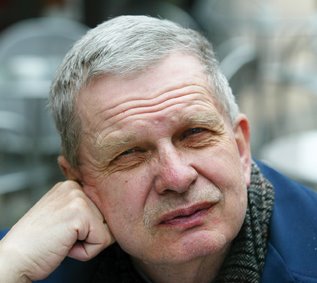
New feather for Arnold Rampersad’s cap

July 15th, 2012

Share


Accepting the National Humanities Medal last year

Shelley Fisher Fishkin wrote to tell me what I’d already heard from other sources – Publishers Weekly, among them.  Arnold Rampersad, the award-winning biographer of Harlem Renaissance poet Langston Hughes, has won the 77th Annual Anisfield-Wolf Book Awards Lifetime Achievement Award, widely recognized as a highly prestigious prize.  It’s the only juried literary competition devoted to recognizing books that have made an important contribution to society’s understanding of racism and the diversity of human cultures.

Henry Louis Gates Jr. headed the jury, which included Rita Dove, Joyce Carol Oates, Steven Pinker, and Simon Schama.

It tops a very good year for the author and literary critic: President Obama awarded him a National Humanities Medal last year.

Rampersad has already won a previous award with the organization, when the first volume of The Life of Langston Hughes, published in 1986, won an Anisfield-Wolf Book Award for Nonfiction in 1987. Volume Two, published in 1988, was a finalist for the Pulitzer Prize in 1989.

His other award-winning books have profiled W.E.B. Du Bois, Jackie Robinson, and Ralph Ellison. He has also edited critical editions of the works of Richard Wright and Langston Hughes.

Shelley, who co-edited Oxford University Press’ Race and American Culture series with the prizewinner from 1993 to 2003, called the new award “really special. … a major honor that is very well-deserved.”

He’s in especially good company now.  The Lifetime Achievement award has recognized some of the most widely-respected and influential writers and artists  of our time. Past winners include poet Derek Walcott;  playwright August Wilson;  fiction writers Ernest Gaines, Dorothy West, William Melvin Kelley, Paule Marshall, and John Edgar Wideman; photographer Gordon Parks;  writer and critic Albert Murray; and historian John Hope Franklin.

Here’s what Shelley said:

An extraordinarily elegant writer, a meticulous researcher, and a scholar gifted with the ability to focus on what matters most about any subject that he tackles, Arnold Rampersad richly deserves this honor.

A winner

His biographies and his literary scholarship have had an enormous impact on our understanding of American culture, illuminating issues of race and racism in America in groundbreaking, crucial ways. He has been a role model for generations of scholars in American Studies, English, and African American Studies. I congratulate the Anisfield-Wolf jury for recognizing his important contributions to the cultural conversation with this award.

New award for Rampersad tops an exceptional year – not only for him personally, but for a number of other folks in Stanford’s English and Creative Writing Department.  I wrote about that here.

Old friends, new friends, and more from the Monterey Coast

July 14th, 2012
Share

When he wasn't starting forest fires, he was here.

Old friends, new friends:  Thursday’s post about reconnoitering with an old friend James Bryant, thanks to an Islamic prayerbook, fell into grateful and unfamiliar hands.

I received a pleasant note from Dwight Green, who was on his way to Monterey about the time he ran across my jottings.  He was already planning to visit the Robert Louis Stevenson house, where the author chilled while  awaiting the divorce of his wife-to-be. (“Yeah. It was complicated,” says Dwight.) I was pleased to discover that Dwight is a kindred spirit in the blogosphere: he runs the excellent blog, “A Common Reader”  – so you can read about his whole visit here.  He also points out that there’s some fascinating background about Stevenson’s stay in California here, But thanks to my heads-up, he also stopped into Carpe Diem and, given its excellent selection on California and the American West, resolved to save his pennies for the next visit.  (He also stopped into another Book Haven – no relation.)

The crowded shelves of Carpe Diem

And do yourself a favor and make a visit to this rugged stretch of the Pacific coast yourself: “The waves which lap so quietly about the jetties of Monterey grow louder and larger in the distance; you can see the breakers leaping high and white by day; at night, the outline of the shore is traced in transparent silver by the moonlight and the flying foam; and from all round, even in quiet weather, the distant, thrilling roar of the Pacific hangs over the coast and the adjacent country like smoke above a battle.”

Meanwhile, what is it about famous authors and forest fires?  Are they just more careless than other people?  I wrote about Mark Twain, Henry David Thoreau, and burnt acres on the Fourth of July here – now this from the Robert Louis Stevenson website:

While in Monterey, RLS also started a forest fire. He was fascinated by the many fires that spring up in the Californian forests and wondered whether it was the moss growing on the trees that first caught fire. The moss did catch fire – and quickly spread. RLS later described the incident in “The Old Pacific Capital” (1880).

Otherwise, I’m having a quite day, transcribing notes and revising a draft. Hope you are enjoying Bastille Day in a livelier way.

The best bookstore I’ve never seen: Carpe Diem in Monterey

July 12th, 2012
Share

A bit of heaven in Monterey... if heaven isn't redundant on the Pacific Coast.

Fate does strange things.

Kismet.

Some time ago I had written a short article on an Islamic prayerbook, “Beauty with an Unknown Past” (it’s here).  A Stanford curator found the mystery book in a small bookshop in Monterey.

The article generated some interesting reaction – but the biggest reaction was mine, when I got a letter from the proprietor of the bookshop (who is also a fan of the Book Haven, incidentally).  It turned out to be a long-lost friend, James Bryant, whom I met over three decades ago in London.  And the bookshop is Carpe Diem Fine Books.  With his wife, Mary Hill, he has been running Carpe Diem since 1995, in a charming 1930s Carmel-stone building in historic Old Monterey.  It’s a few doors down from Robert Louis Stevenson‘s house.

Lunch at the Faculty Club followed a few weeks later, with a long chat to swap memories and bring us up to 2012. He had become an eminent bookseller and patron of the arts, while Humble Moi remains a lowly writer, tapping on a keyboard in the blogosphere, into the wee hours.

Later, he sent me photos from Carpe Diem. Wow. I’m a sucker for the Carmel style – the Robinson Jeffers home is still one of my favorite houses anywhere – and this shop epitomizes it.  No surprise, then, that its “discriminating selection” of out-of-print, signed and unusual books in all fields has a special emphasis on the history and literature of California and the West.  (It also has a special collection of signed John Steinbeck books here.)

The AAA magazine Via wrote, “The entire shop … is a bibliophile’s delight.”  A local magazine, Pebble Beach, claimed it was “simply the Best… featuring a constantly changing inventory – from the classics to the unexpected…”

As for me, I still haven’t seen it yet.  But I hope to sometime between September 13 and 16.  You see, the bookshop is just one of James’s ventures.  He’s also one of the founders of the Art in the Adobes Festival, which is featuring a program, “Rediscovery: Monterey Peninsula Artists at Home and Abroad” this year.

Organizers claim that “influential artists, important paintings, and some of the roots of Western U.S. art will all be rediscovered at the Art in the Adobes Festival weekend.”

How good are the paintings?  You can get an idea from Abel Warshawsky‘s Paris Studio, circa 1930, at left  (courtesy City of Monterey).  But stop and browse Carpe Diem’s shelves while you’re there.

See you in Monterey – Insha’Allah.


Joseph Brodsky’s “Gorbunov and Gorchakov” onstage

July 11th, 2012
Share

Artur Smolyaninov as Gorchakov and Nikita Yefremov as Gorbunov. (Photo: Sovremennik Theater)

In the Moscow Times today, a review of Joseph Brodskys “Gorbunov and Gorchakov,” which Yevgeny Kamenkovich mounted on the small stage at the Sovremennik Theater – a play which the Nobel laureate never intended to be a play. Rather it’s a 14-part poem of 7,600 words, recalling his stints at the psychiatric hospitals Kanatchikov Dacha and Pryazhka over the Christmas holidays of 1963, while the 24-year-old was awaiting trial in the U.S.S.R. as a “social parasite.” His friends had hoped a diagnosis of mental instability might spare him a harsh prison sentence.  But instead he felt he was indeed losing his mind, and begged his friends to get him out.

The result, written in 1968, was “Gorbunov and Gorchakov,” a conversation between two inmates, which he apparently claimed to have overheard.

His friend Lev Loseff writes in Joseph Brodsky: A Literary Life:  “As time went on, Brodsky grew more skeptical of the worth of much of his early work, but twenty years after writing ‘Gorbunov and Gorchakov,’ he still consider it an ‘especially solid piece.’ The years that produced the poem were perhaps the the most dramatic in all his life: police persecution, arrest, trial, exile, return; reconciliation with the love of his life, the birth of a son, a final break.”

Loseff adds that work on the poem “truly became part of the poet’s work on himself:  the next-to-last line of the third canto contains a prayer in which the author’s alter ego asks God-in-Heaven to grant him ‘victory over silence and suffocation.'”

Not much exists in English, alas.  But the poet’s early translator, George Kline, translated a few of its cantos.  An excerpt:

And silence is the future of all days
that roll toward speech; yes, silence is the presence
of farewells in our greetings as we touch.
Indeed, the future of our words is silence –
those words which have devoured the stuff of things
with hungry vowels, for things abhor sharp corners.
Silence: a wave that cloaks eternity.
Silence: the future fate of all our loving –
a space, not a dead barrier, but space
that robs the false voice in the blood-stream throbbing
of every echoed answer to its love.
And silence is the present fate of those who
have lived before us; it’s a matchmaker
that manages to bring all men together
into the speaking presence of today.
Life is but talk hurled in the face of silence.’

Ted Gioia’s “Year of Magical Reading” looks at Robertson Davies

July 10th, 2012
Share

Jazz baby

Jazz scholar (and lit critic)  Ted Gioia has been celebrating “A Year of Magical Reading” – ranging from Salman Rushdie‘s Midnight’s Children to Lewis Carroll‘s Alice in Wonderland.  Until today, I hadn’t read a word of it.  I’m not terrifically fond of magic realism, as a genre – but I am terribly fond of Robertson Davies (in fact, we had a blog birthday card for him here).

Today, Ted is discussing Davies’s Fifth Business.  The author himself discussed the book in 1989 with Elisabeth Sifton during his  Paris Review interview. He described  the book’s genesis this way:

I did not write Fifth Business until ten years had passed since I first became aware of the idea that lay behind it: it was simply a scene that kept occurring in my mind, which was of two boys on a village street on a winter night—I knew from the look of the atmosphere that it must be just around Christmastime—and one boy threw a snowball at the other boy. Well, that was all there was to it, but it came so often and was so insistent that I had to ask myself, Why is that boy doing that and what is behind this and what is going on? Then the story emerged quite rapidly. …

Well, you see, I hesitate to talk about this, because it sounds mystical and perhaps rather absurd, but I assure you it is not: the minute I recognized that the picture meant something I should pay attention to, the whole thing began to come to life, and I knew who the boys were and I knew what the situation was and I quickly became aware of what lay behind it. Some of it had to be invented, some of it had to be fetched up and rejected—a great deal is rejected in the course of such work—but it was all there as soon as I began to work. And when I began writing, I wrote from the beginning to the end as I always do. I know that many writers—Joyce Cary for instance—compose the principal scenes of a novel before putting the connective work around it; other people work backward and do all sort of interesting things, but I don’t. I just go from start to finish, and that’s the first draft.

Ted laments the recent neglect of the Davies, who died in 1995 at age 82, and attributes it in part to the tendency to pigeonhole him as a Canadian writer: “Davies is too large a talent to be pigeonholed as a regionalist, and his name is not out of place alongside those of his contemporaries Saul Bellow, Graham Greene, Albert Camus and Walker Percy.”  Interestingly, then, Bellow’s name is one of the names that comes up in the Paris Review interview.

Sifton asked: “Saul Bellow once said—and was roundly criticized for it— that American writers, presumably excepting himself, fail to grapple with what he called the central human enterprise. Grappling with the essential human enterprise may be a numbing matter, but what—in the end—is the aim of the novelist?”  Davies, apparently, did not think much of American lit – at least the variety he read in the New Yorker: “I admire their subtlety—but I get so sick of it. I wish they would deal with larger themes.”

I grew up in the only part of the continental U.S. where you have to go south to get into Canada, and am a quarter Canadian – yet Davies’s description of the Canadian psyche hit me with a jolt of immediate recognition:  The problem is, he wrote, we view Canada as a queer mix midway between the U.S. and Canada.  Its mindset is instead closer to the Nordic countries – it is a nation shaped by its northernness, and by winter.

Something I didn’t know, however, until Ted told me: Davies’s epigraph from the novel, attributed to  Danish scholar Tho. Overskou, is a literary hoax, and so is the epigraph that provides a thematic through-line for the novel’s protagonist:  “Those roles which, being neither those of Hero nor Heroine, Confidante nor Villain, but which were nonetheless essential to bring about the Recognition or the dénouement, were called the Fifth Business in drama and opera companies.”

It fooled me, and it fooled many.  Ted writes:  “Many have taken this at face value, and anyone researching ‘fifth business’ on the Internet today, will be reassured by dozens of web sites that it is an old theatrical term.  But Davies invented it for his story—not an inappropriate gesture for a work focused on the ways in which myths are created and disseminated.” And not a surprising gesture for a well-known literary prankster.

By the way, Ted’s brand new book,The Jazz Standards: A Guide to the Repertoireis already getting a lot of buzz.


Ellen Hinsey and “that most archaic idea, ‘thou shalt not kill.'”

July 8th, 2012
Share

Are we facing the start of an "unlawful age"?

I’d heard the name Ellen Hinsey before.  We have a mutual friend in the eminent Lithuanian poet Tomas Venclova (although I am mostly a long-distance friend, and she is a longstanding colleague).  She has had the pleasure and labor of translating his poems into English for Bloodaxe’s The Junction: Selected Poems of Tomas Venclova.  I had the privilege of publishing an essay by Tomas in An Invisible Rope: Portraits of Czesław Miłosz.

The Paris-based poet is not usually mentioned in the New Yorker, however, so I noted her mention in this week’s “Page-Turner” blog post in the magazine about the closing of Village Voice (I wrote about it here). The relevent passage:  “On the night of the farewell party, it must be said, not everyone was teary. The novelists Jake Lamar and Nancy Huston, the poets Ellen Hinsey and Denis Hirson, and dozens of others were trading sentimental stories.”

Poetry International has a fascinating Q&A interview with her in 2009.  It starts slowly, but picks up considerable steam. It picks up precisely at the point where she said that a central concern in her The White Fire of Time and Update on the Descent was,  years following a murder in her family,  “how we can renew our belief in that most archaic idea, ‘thou shalt not kill.'”

She also poses “a question that I think we are extremely afraid to confront”:  “The last few years have brought us perilously close to an unspoken fear that we are losing the battle against violence, and that the climate of relative decency we have known is no longer holding firm. Or even that, if we do not do our best to battle against it, we may be facing the start of an unlawful age.”

"Above all, love language" (Photo: Dylan Vaughan)

Let me cite the final portion of the interview:

…Some years ago I mentioned that I was interested in the possibility of a “poetics of radical reflection.” For me this means, as Hannah Arendt wrote in the Life of the Mind, the idea that perhaps thought itself can help us to maneuver and survive the dangers around us—the dangers of our own making. With the end of the 20th century we found out that, incredibly enough, we did not arrive at the end of History. History and terror—as well as the possibility of meaning—are still with us. We didn’t escape their noose: they are, and will always be, things with which we must wrestle.

Q.  In the last poem in your book, “Update on the Last Judgment,” there is no “Judgment,” but only an “abyss.” What, then, is “judgment” and who is passing that judgment?

A.  This was a complex poem for me. When you begin to write a poem, you don’t always know exactly what you think about your subject. Regarding the topic in general, I tend to agree with what the Lithuanian poet Tomas Venclova wrote in his poem “Verses for a Child’s Birth”: “it’s best to keep silent/ because we don’t know yet if God hovers/ above the empty featureless waters.” However, it seems fair to say that until we arrive at that unknowable moment, we are entirely responsible for our actions here on earth and it is to our peril that we look for recourse or justification for those actions in any kind of afterlife. For the foreseeable future, we only have judgment with a small “j”, which is to say the mortal, imperfect and fallible judgment that we possess as human beings and with which we have to attempt to make sense of our world. Despite how terribly fragile it is, it is all that we possess. But it is still immense.

I had already bookmarked that particular poem, “Update on the Last Judgment” – the Poetry Foundation has it here.  Read the whole thing.  I’m not going to try to excerpt it.

.


<<< Previous Series of PostssepNext Series of Posts >>>