What he meant: postscript on Adam Michnik, Czesław Miłosz, and the Warsaw Uprising

May 26th, 2011

Share

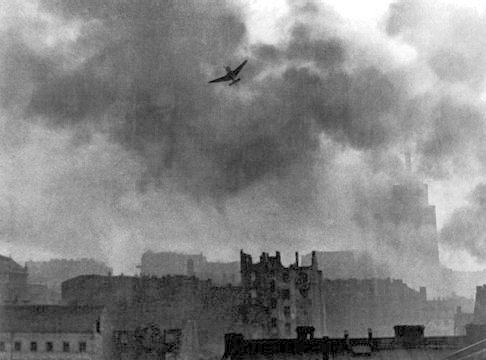
The bombing of Warsaw's Old Town

A few days ago,  I reported on Adam Michnik‘s haunting remarks during the Czesław Miłosz festival.  He recalled a few brief months of freedom in 1981, with the heady rise of Solidarity and the Polish poet’s return to Warsaw after decades of exile:


“It was a time of euphoria, carnival – it was our victory,” he said.

Miłosz was more cautious.  He told Michnik, “The atmosphere feels like just before the Warsaw Uprising. Please be careful.” Tanks rolled into Warsaw and martial law was declared a few months later.

I was intrigued, but somewhat puzzled by Miłosz’s comment.  I had always assumed that the days before the Warsaw Uprising were full of terror and apprehension. I chalked up Michnik’s recollection to pure prescience on Miłosz’s part.

Then, bumping along in the train between Warsaw and Vilnius, I found my answer.  I ran across this passage in the new collection of essays, Proud to Be a Mammal, in a reprinted piece called simply “G.G.”

Little by little the time was drawing near for the destruction of Warsaw. The uprising was a blameworthy, lightheaded enterprise … Handfuls of people stood on street corners, watching with a quiet smile as trucks were loaded with wardrobes, mirrors, rugs – the contents of German offices and private homes. They were fleeing. No one was afraid of them anymore.

Michnik remembers

In other words, what the Polish people saw as a retreat was simply the Germans evacuating a city they knew was about to be destroyed.

The posters that had been tacked up, ordering all males to report for work on the fortifications, were received with jeers.  You could already hear Russian artillery fire. Rumors of an armed uprising were greeted joyfully: a chance to throw oneself at one’s tormentors and take revenge … Soon, however, came the news that there would be no uprising. One of my Socialist colleagues told me that to take any sort of action now, when Mikołajczyk, the premier of the London government [in exile], was flying to Moscow, would be nonsense.  Stalin was too clever to negotiate with anyone using such a trump card, and whoever tried to outsmart him would never be forgiven.

The military leaders (caught between two fires, because the Russian Radio broadcasts called for the taking up of arms) did not enter into such subtleties; as a result their judgment was incompetent. The command was given so suddenly that it found most of the units without weapons. …

That day, the first of August, Janka and I were walking over to Tiger’s for an after-dinner chat and a cup of tea. I had something terribly important to discuss; namely, my new translation of an English poem. On leaving for a walk one should never be too sure of returning home, not only because something may happen to one personally, but also because the house may cease to exist.

The older I get, the more uncomfortable I am with any group emotions – whether crowd hatred or crowd euphorias.  And sometimes the euphorias are more blinding than the hatreds.

Why people don’t “get” Czesław Miłosz

May 25th, 2011
Share

Miłosz: "...the complete undoing of essences, of eternal truths."

For a moment, let me return to the Aula in Jagiellonian University’s Collegium Novum.  (In fact, I must return to it in more than a literary sense in just a few minutes, when I go to meet a leading Miłosz scholar and Jagiellonian professor Aleksander Fiut).

Artur Sebastian Rosman, in a paper on Czesław Miłosz and Hans von Balthasar, recalled his own “first encounter with an honest-to-God, no holds barred, direct American reception of Milosz’s work and its religious dimension”:

It took place at an evening poetry discussion at the Elliott Bay Book Company in Seattle.  It was a meeting devoted to [Miłosz’s] Second Space, which had recently appeared in English.  All, and I mean all, of the Americans there were convinced that Miłosz was most likely a postmodern spiritual seeker, probably much like them, possibly fascinated by archetypes, certainly spiritual, and definitely not religious.  Had Miłosz been there he might have recycled the words he hurled at Kisiel in A Year of the Hunter, “[They don’t] take into account a particular, quite fundamental fact: all my intellectual impulses are religious and in that sense my poetry is religious.”  No such luck.  Yet, unbeknownst to me, I had an ally who was in on the joke Miłosz was playing, in absentia, upon this poor but sincere American audience.  This stranger/ally clearly had an Eastern European accent and he kept taking up my cause.  He kept waving the flag of Miłosz as a homo religiosus and, anathema sit, a practicing Catholic!  We  quoted poems from Second Space, made reference to his other work, and cited countless details of his biography.  All to no avail.  I’m convinced the Americans thought we were trying to play an inverse Polack joke on them.

His comments meshed quite nicely with my own reflections from An Invisible Rope. I cited one of my contributors, Natalie Gerber, Miłosz’s former assistant in Berkeley, now an associate professor at SUNY-Fredonia, where she teaches the poetry of Miłosz, among others:

The students come from a range of majors and, not infrequently, are intimidated by or resistant to reading poetry. Few have much experience with verse, and almost none have read poetry that overtly wrestles with conscience and historical circumstance, as does Miłosz’s, or, for that matter, poetry that requires its reader to work as hard as his does to understand both its literal meaning and its ethical import. … used to a culture that conditions all of us to read carelessly—they misread it and mistake its core lessons, its vital distinctions, at who knows what cost. … [they] don’t presume that the morally complex and personally engaged stances taken by the speakers in Miłosz’s poems are even possible.

Artur's not laughing

It alarms me that we are increasingly unable as a society to meet an authors on their own terms, in their own times.  We make them “like us” and therefore fail to mark, learn, and inwardly digest from earlier modes of thinking, of being.  We need not live wholly in our own era and subscribe to all its follies and fashions – we have an historical and international palette to choose from.  These thoughts always return me to Robertson DaviesWhat’s Bred in the Bone, where the protagonist, a Canadian painter, cannot relate to the modern era and instead creates new masterpieces of the early Renaissance, which only after his death are revealed to be “fakes” – but are they? An extreme and admittedly arguable case, but Miłosz argued more simply for the world of Thomistic esse. As he said to me in 2000 on Grizzly Peak:

“We are in an era of flux, of change. We live in the world of devenir. We look at the world of être with nostalgia. The world of essences is the world of the Middle Ages, of Thomas Aquinas. In my opinion, it is deadly to be completely dissolved in movement, in becoming. You have to have some basis in being.”“In general, the whole philosophy of the present moment is post-Nietzsche, the complete undoing of essences, of eternal truths. Post-modernism consists in denying any attempt at truth.”

No violence, please.

At the end of his talk, Artur said:  “Milosz is almost universally recognized as a poet of wartime atrocities, the problem of evil and the ugliness of modernity, however, we should not make the mistake of identifying his frequent references to these 20th century phenomena as a preference for them. Just like René Girard is not an aficionado of violence.”

Of course, I thought he was joking, and we both laughed about it afterward.  Except him.  No, it’s not a joke, he said.  After such books as Violence and the SacredRené Girard told a colleague that enthusiastic readers were sending him slasher films, because they thought the mild-mannered and highly civilized Académie Française scholar would enjoy them.

I rest my case.

Joseph Brodsky: “If we have all this here, why do we need Europe?”

May 23rd, 2011
Share

The city where Adam Mickiewicz taught secondary school. (Photo: C. Haven)

“If we have all this here, why do we need Europe?”  That’s what Joseph Brodsky reportedly said in 1966 when he surveyed not Rome, not Athens, but humble Kaunas, Lithuania’s second largest city.

The words come from Ramūnas Katilius, fils, quoting his father, Ramūnas Katilius, père, from this vantage point overlooking the city.  The elder Romas, a physicist, was one of the poet’s greatest chums, sometimes seeing the poet several times a day when they were in Leningrad.  Romas was in the photos of Joseph Brodsky departure from the Soviet Union forever in 1972.

Both Romas and Algirdas Avižienis, professor emeritus at director of the Czesław Miłosz Birthplace Foundation, hosted my visit to Miłosz’s Issa Valley.  I’ve just returned to Poland.

While much of my discussion with Romas was about his friend, Tomas Venclova, the physicist was interested when I told him that I had been a student of Joseph’s (he called me part of “the family”) – and hence our discussion returned to his memories of Leningrad, and J.B.’s time in Lithuania. There’s even a plaque in downtown Vilnius where the Russian Nobel poet stayed.

Admittedly, the quote I have cited above is secondhand, but it’s suggestive of how much the poet liked Lithuania. You could guess that, perhaps, from his poem “Lithuanian Divertissement.”

Ramūnas Katilius, Joseph Brodsky, Tomas Venclova in 1972 (Photo by Marija Etkind from the archive of Ramūnas Katilius and Elė Katilienė)

This remote and stunning little city was the temporary capital of Lithuania, when the Polish army occupied Vilnius in 1920.  The Nazis occupied it during the war, of course, and it was a Soviet Socialist Republic at the time Joseph Brodsky visited.

It’s also very early evidence, before he had seen Venice, Paris, or New York, of his early partiality of the cozy places on the outskirts of empire.  He was later to defend Russia’s historic hegemony in an acrimonious exchange with Miłosz, Derek Walcott and Susan Sontag, as described in Irena Grudzińska Gross‘s Czesław Miłosz and Joseph Brodsky: Fellowship of Poets.

I’m in Poland right now, and obviously don’t have access to Irena’s book or anything else in my library, but a Keith Gessen’s piece in today’s New Yorker (with a dynamite photo by Irving Penn) makes the same point:

Poetry was immortal, he argued: “That which is being created today in Russian or English, for example, secures the existence of these languages over the course of the next millennium.” But this wasn’t true, as Brodsky eventually acknowledged in a great and furious late poem, “On Ukrainian Independence,” in which he berated the independence-minded Ukrainians for casting aside the Russian tongue. “So go with God, you swift cossacks, you hetmans, you prison guards,” it says, and concludes:


Just remember, when it’s time for you, too, to die, you bravehearts,
as you scratch at your mattress and visibly suffer, you’ll forget
the flatus of Taras, and whisper the verses of Alexander.

Alexander Pushkin, that is. Despite itself, the poem is an anguished admission that a Russian state and Russian-speaking subjects are still vital to the project of Russian poetry.

Now.  Here’s an interesting bit about the photo above.  See the white double spires?  That’s the Jesuit church.  Now take a look at the rather nondescript yellowish building in front of it.  That’s where Adam Mickiewicz, the Polish language’s ur-poet (and, like Czesław Miłosz, he was born in Lithuania) taught at secondary school to pay off his university tuition  at the Jesuit’s Vilnius University.

Note to self:  Must read Mickiewicz when I get back to California.  Anyone know the best translations?

Life in wartime Warsaw … not quite what you thought

May 21st, 2011
Share

The apple tree that marked the spot

Very little of prewar Warsaw is left – 85 percent of the city was destroyed by the Nazis.  But the street where Jadwiga Piotrowska (I wrote about her here) and her family ran a clandestine operation to hide Jewish children remained standing after the war – though interiors were burned and some floors destroyed, much remained intact.  The bullet holes in the walls have been filled, and the elegant flat with parquet floors retains its prewar charm.  Even the apple tree where Irena Sendler and her cohort, Ms. Piotrowska, buried the famous jar linking the whereabouts and real names of the rescued Jewish children continues to grow to this day.

Jadwiga Piotrowska’s daughter, Hana Rechowicz, remembers playing with the Jewish children in their house – one youth stayed for four years.  Irena Sendler?  She remembers her and her cohorts being bubbly and vivacious, not tense and paralyzed with fear as they are, for example, in Courageous Heart of Irena Sendler.  After all, said Hana, life went on.  Six  years was a long time.

The picture she described of a life in Żegota, the Polish underground operation to save the Jews, was not quite what many may imagine.

One part of Warsaw that wasn't completely demolished

Far from being a clandestine operation, she said, everyone knew the multi-generational household was hiding Jews.  She named a number of households in their immediate neighborhood were doing exactly the same.

When she says everyone, she means everyone.  The household had servants, and they knew.  Communication in the pre-phone tapping days meant everyone who overheard phone calls knew.  Weren’t informants around?  There really weren’t that many, she insisted, implying a good deal of solidarity among the Poles of goodwill.

Czesław Miłosz, in an essay I have been reading in Proud to Be A Mammal, recalled the war being a time of parties with plenty of vodka – German-imposed curfews meant there was a regular ritual of unexpected visitors overnight, which made not only for wartime trauma and tension – but also, politically incorrect as it may be to say so, sometimes a lot of fun.  In fact, Hana remembered Miłosz as a regular visitor to their household – she even found a letter from him.

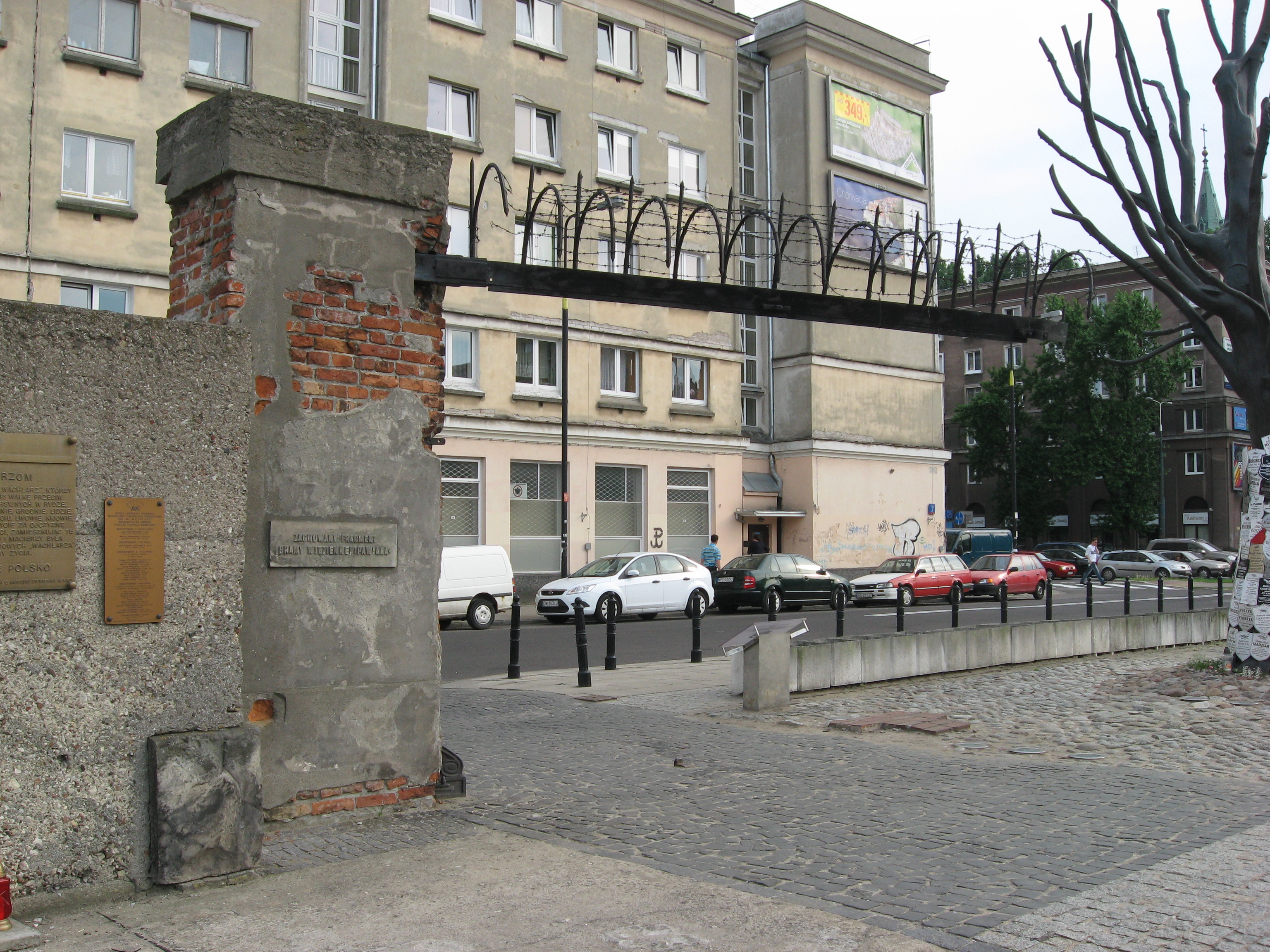
The surviving gateway to notorious Pawiak

Hana recalled the war as being a time of family closeness, due to the same curfews and wartime restrictions – a closeness that’s been lost in the postwar years.

She hastened to add that tension and terror were part of their lives, too.  The children they harbored were traumatized, in transit from household to household as they were prepared for life in disguise.  She recalled the Jewish child who screamed at them  “Who are you people?  I want to be home with my mother and father and grandparents!  I hate you.”  But six years is a long time to be afraid and tense, she emphasized, and they were young and full of life.

Unreal

Of course, all that ended when Warsaw was razed to the ground in 1944.

Not much is intact, but something of a museum has been made of what’s left of Pawiak Prison, where Sendler was tortured for several months before an escape on her way to execution. Filmmaker  Leszek Cicirko took me for a quick tour before we visited Hana.

Outside the prison-museum is a “tree” where the names of the dead have been posted.

Here’s more of what I meant in my previous post:  The tree at left is not a real tree.  It’s a recreation of a dead tree.  People have real emotions about a replica of a dead tree.  Odd.

Korczak in Warsaw: “I do not know why our hearts did not break.”

May 20th, 2011
Share

From Andrzej Wajda’s 1990 movie

Among my first errands in Warsaw was delivering several DVDs of Mary Skinner’s In the Name of Their Mothers to Warsaw filmmaker Leszek Cicirko, who worked with Mary in Poland, and Hana Rechowicz.  She is the daughter of Sendler’s co-worker,  Jadwiga Piotrowska – I wrote about her here.

On the train from Kraków to Warsaw, I finally got back to Anna Mieszkowska‘s  Irena Sendler: Mother of the Children of the Holocaust.  It’s a problematic book, crying out for a good editor and better organization, but it’s all we’ve got in English or Polish on the woman who saved 2,500 Jewish children in the Warsaw Ghetto from certain death.  It’s filled with long excerpts from Sendler’s own writings, which redeems its many flaws.

I reached the point in the book where Sendler describes the Polish Jewish pediatrician and children’s author, Janusz Korczak, who had established a Jewish orphanage along the lines of his educational theories.  (Culture.pl, an online magazine promoting Polish culture, has a biographical article here.) Sendler had of course worked worked with the doctor in the Ghetto, after the orphanage was moved inside its walls in 1940. Korczak refused many offers to be smuggled out of the Ghetto – he would not abandon the children in his care. And so he died with them.  On August 5, 1942, Korczak joined nearly 200 children and orphanage staff members were rounded up for deportation to Treblinka, where they were all put to death.

In Sendler’s words:

“He walked at the head of this tragic procession.  He held the younger child in his arm and with his other hand he was leading another infant. That’s how various people have recorded it in their memoirs, whereas others record it differently, but this doesn’t mean anyone has made a mistake.  One has only to remember that the route from the orphanage to the Umschlagplatz was long. It lasted four hours. I saw them when they were turning from Żelezna Street into Leszno Street.”

Curiously enough, Korczak was the subject of a recent email from Helen Pinkerton, who had seen my posts on Mary Skinner’s PBS film, which reminded her of Edgar Bowers‘ poem, “In Defense of Poetry,” in his Collected Poems. The poem ends:

An old light shining new within a world
Confusing and confused, although their teachers
Deny the worth of writing – my latest colleagues,
Who hope to find a letter in the mail,
Are happy if their children study Shakespeare
At Harvard, Penn or Yale, write articles
To prove all writing writers’ self-deception,
Drive Camrys, drink good wines, play Shostakovich
Or TV news before they go to bed,
And when their sleeping or their waking dream
Is fearful, think it merely cinema,
Trite spectacle that later will amuse.
But when my mind remembers, unamused
It pictures Korczak going with his children
Through Warsaw to the too substantial train.”

Curiously, too, this poem was also the subject of a recent post by Patrick Kurp in Anecdotal Evidence, who compared its quiet power to Clint Eastwood’s Mystic River, where “Every frame is too emphatic, too loud, too cartoonish, too insistently certain of its own bravery in the face of evil.”

Andrzej Wajda also made a movie, Korczak – so Korczak’s story has entered the world of art.

But I’m always a little uncomfortable when suffering of this magnitude gets turned into a poem or painting or even movie – it’s too easy to appropriate the suffering of others to give massiveness to one’s ideas, and to subtly enhance oneself.  Regardless of the artistry of the result, the process is morally questionable.  I know Czesław Miłosz felt much the same way about his own “Campo dei Fiori.”  As I noted in an article a few years ago, “The Doubter and the Saint“:

“Later, in Conversations with Czesław Miłosz, the poet called it an ‘immoral’ and dishonest poem, ‘because it was written from the point of view of an observer about people who were dying.’ It was too easy, he seemed to be saying: the poet observes an atrocity, writes a poem in protest, and is pleased at having written a beautiful poem; conscience slackens.”

The real Korczak

Moreover, it’s a strange process by which we begin to prefer the glossiness of the artistic version – in fact, I just proved it.  While looking for a photo, I quickly latched onto Wajda’s movie image of Korczak, which was much preferable to the real doctor at right, who wasn’t an actor and didn’t have a cameraman.

Sendler, who was on site for the unspeakable event, recalls that Korczak had, a few weeks before, directed the children to perform Rabindranath Tagore’s play,   Post Office,  which describes how a child striving to escape his sickroom confines, ultimately dies, with death seen as, in Tagore’s words, “spiritual freedom” from “the world of hoarded wealth and certified creeds.”

But I think Sendler’s artless words are simplest and best when describing the atrocity:

“I was at the orphanage to see that play. And then, when on August 6, 1942, I saw that tragic parade in the street, those innocent children walking obediently in the procession of death and listening to the doctor’s optimistic words, I do not know why for me and for all the other eyewitnesses our hearts did not break.”

“But our hearts remained intact, and what also remained were thoughts that to this day cannot be understood by any normal person.”

En route to Szetejnie, and a Celtic meditation on cheap flights

May 19th, 2011
Share

The road to Szetejnie...

Right now, I am planning the long, winding, and endlessly complicated trip to Warsaw, Vilnius, Kaunas and Szetejnie, the birthplace of Czesław Miłosz, on the invitation of Romas Katilius, a friend of Tomas Venclova‘s, and Algirdas Avižienis, professor emeritus at Vytautas Magnus University (we met last week at the conference).

I am apprehensive about the trek, especially after this morning’s unnerving business with Vol de Nuit Airlines, which repeatedly cut off phone calls, when they weren’t trying to extort six euros a shot for the privilege of talking to them.  That was while they laughingly rejected (a small, metallic chuckle emanated from my computer) my online transactions from such small-time organizations as Bank of America and Paypal. The allocated funds for the ill-fated transaction are nevertheless kept from my wallet in permanent deep freeze by my bank. I’m told they’ll be released in a year or two. In between my weepy phone calls, Vol de Nuit employees would entertain themselves by jacking up the airfares, which began around $250 and, last time I checked, were hovering between $600 and $700.

I have decided to travel instead by a combination of train, bus, and, for part of the journey, muleback.

Internet access is likely to be bumpy during this saga.  Be patient.  Meanwhile, the thoughts in the youtube video below express my sentiments exactly.


<<< Previous Series of PostssepNext Series of Posts >>>