In the aftermath of the Google books decision: disappointment … and persistence

April 21st, 2011

Share

No prophet

U.S. Circuit Judge Denny Chin‘s rejection of a deal between Google and book publishers happened while I was in New York City.  You can read about it here.  The federal judge in Manhattan said the deal, which would allow the search engine company share digitized copies,  “goes too far” and would give Google “a significant advantage over competitors, rewarding it for engaging in wholesale copying of copyrighted works without permission.”

It took a few weeks, but Andrew Herkovic at the Stanford University Libraries has issued his characteristically graceful comment on the Google brouhaha in his newsletter:

BooksIn the wake of last month’s judicial rejection of the proposed settlement of litigation between Google Books and various publishers and authors, there are only two firm facts that can be confidently stated about what’s next: first, nobody, with the possible exception of the litigants, knows anything; and second, the litigants aren’t talking. Thus we have the conditions for rampant public speculation, and many have risen to this temptation. I shall not.

Instead, I remind readers that the scanning of millions of books by the Google Books project has never abated, either at Stanford or among the many other participating libraries. Every weekday, a truckload of books goes to Google and a like number come back from them, in a smoothly choreographed process that assures both safekeeping and tracking of the books. The total to date is in the vicinity of two million volumes, and we anticipate continuing this process for years to come. We do not know how or even if any given book will be used by Google, but we are certain of the utility to Stanford in having our holdings preserved and being made searchable through digitization. We are hopeful of additional beneficial outcomes for Stanford.

The key word in Stanford’s public reaction to the demise of the proposed settlement was “disappointment.” That, almost five years after the class-action suits were initiated against the project, there is no resolution whatever is certainly disappointing; any decision might seem preferable to none. That a startling vision of public access to a vast amount of text as articulated in the proposed settlement has been occluded is another disappointment. That the “orphan works” and other copyright issues remain in limbo is a lesser disappointment, if only because efforts are underway to address them by legislative rather than judicial means. However, the key word I wish you to take away is “persistence.” We persist in scanning books through Google (as well as in our own labs). We persist in developing techniques to help scholars use digitized texts. We may be confident that the litigants will persist in seeking some eventual resolution to the court case. We persist in hoping that the discordance between copyright law and the realities of the digital age will be harmonized, at least with regard to printed literatures, before the century is much further along. We persist in fulfilling a vision and mission that depend on both digital and artefactual means of providing and preserving information.

Looking forward, but unprophetically,

Andrew Herkovic

Clare in NYC

A couple of postscripts:  Speaking of New York, I’ve added a photograph of Clare Cavanagh at last month’s Czesław Miłosz centennary event at the 92nd Street Y – thanks to David A. Goldfarb and his camera.

And, after reading my piece on Kay Ryan‘s Pulitzer, Dave Lull kindly sent me yesterday a Wall Street Journal “Speakeasy” Q&A with Kay Ryan, in which she says:

I never, ever worry about poetry or its survival because it’s the very nature of a poem to be that language that does survive. Poems are even better than tweets – they don’t require any electronic equipment. They can lodge right in your brain. They are by nature short. You don’t even have to remember all of them — you can remember just a phrase. That can be something you can turn to in any emergency, good or bad. You’ll pluck out a little group of words, just maybe a phrase, and that’s exactly what poetry is for. It’s for the things that really last. Because it lasts.

Garrison Keillor, August Kleinzahler, and the perils of one-sided fisticuffs

April 19th, 2011
Share

A polished schtick (Photo: Andrew Harrer)

Sam Leith at the Guardian revisits August Kleinzahler‘s 2004 Poetry magazine “full-frontal assault” on Garrison Keillor’s “appalling taste”.

The occasion was the publication of Keillor’s anthology, Good Poems.

Kleinzahler wrote this:

Now, had Keillor not “strayed off the reservation” and kept to his Prairie Home Companion show with its Norwegian bachelor farmers and Lutheran bake sales (a sort of Spoon River Anthology as presented by the Hallmark Hall of Fame), comfort food for the philistines, a contemporary, bittersweet equivalent to the Lawrence Welk Show of years past, I’d have left him alone. But the indefatigable and determined purveyor of homespun wisdom has wandered into the realm of fire, and for his trespass must be burned.

Full disclosure: I was asked to review Keillor’s poetry anthology some years back (was it for the San Francisco Chronicle? I can’t remember) and I gave it a pass.  I’d seen nothing in the vaunted Prairie Home Companion to convince me that Keillor’s tastes would make his anthology worthwhile reading (and I gave the same pass, for the same reasons, when Camille Paglia‘s anthology came out).  So as far as aesthetics go, I’m probably more along the Kleinzahler end of the spectrum, except for the ire.  Of Kleinzahler’s long-ago review of Keillor, “No Antonin Artaud with the Flapjacks, Please,” Leith writes:

I looked it up: a dismissive review that took two and a half thousand words in the dismissing. It’s been said that criticising P.G. Wodehouse is like “taking a spade to a souffle“. This was something similar; and if you hit a souffle with a spade, you get egg on your face.

Keillor’s taste in poetry may differ from Kleinzahler’s, and his understanding of what it’s for may differ – caricaturally, he thinks it does the soul good, and that makes Kleinzahler wince with embarrassment.  … But it strikes me as odd that the response is not indifference but active rage …

Leith continued:

The divide isn’t actually between people who want to stitch rhymed verse into samplers and sell it in tourist shops, and those so high-minded they think Basil Bunting was a sellout. It’s between people happy for both views to co-exist, and people for whom it isn’t enough to play in the Premier League – you have to be energetically affronted by the existence of Sunday league.

In a calmer moment (Photo: Poem Present)

It isn’t elitist to think that Four Quartets is chewier, profounder and more artful than If or The Song of Hiawatha: it is simply common sense. Indeed, it is so obviously common sense that to be shrill in asserting it makes you look . . . well, weird. Is poetry so sickly that Geoffrey Hill catches a cold when Pam Ayres sneezes? Is the whole project of making high art threatened by the existence of low art? Nobody sensible can think so.

So the Keillors – the live-and-let-live brigade – will always look bigger than the Kleinzahlers. They are in a position to extend what you might call repressive tolerance. As it happens, to view Keillor as a dim, benevolent sweetie-pie – a manatee ripe for harpooning – is to be naive in any case: it is to mistake him for his persona. Nobody who remembers his caustic review of Bernard-Henri Lévy‘s book about America in the New York Times could make the mistake: Keillor skewered Lévy as “a French writer with a spatter-paint prose style and the grandiosity of a college sophomore”, and ended: “Thanks for coming. Don’t let the door hit you on the way out.”

But for Kleinzahler, who swallows the persona in one gulp, Keillor is prepared to kill with kindness. His response, years after the attack, is one of superbly malevolent benignity: “I believe in vigorous free speech. Does no damage whatsoever that I can see. Bless his heart. I wish him well.”

I remember well Keillor’s scalding review of Bernard-Henri Lévy – “On the Road avec M. Lévy” – when I was briefly in the Frenchman’s thrall. It’s a classic.

Otherwise, however, I could never quite “get” the charm of Garrison Keillor’s Prairie Home Companion. Too often I, too, have swallowed the schtick in one gulp  – though I shouldn’t have needed Leith to remind me.

The only part of Keillor I ever really enjoyed was the song below:

Kay Ryan wins the Pulitzer Prize: “I would like my work to be weightless.”

April 18th, 2011
Share

In praise of lightness: Marin's self-sytled "Sheriff of Emptiness" (Photo: L.A. Cicero)

Kay Ryan has won this year’s Pulitzer Prize for The Best of It: New and Selected Poems.  I wrote about the Marin poet here during a recent visit to Stanford.  I blogged some outtakes from my interview with her eight years ago here. And I’ve written about her elsewhere, too – oh, for San Francisco Magazine, in an October 2004 article, “Let There Be Lightness,” which isn’t, alas, online.  (Postscript on 4/19:  It is online now – here.)

An excerpt from that piece, in honor of the occasion:

A bubble. The foam on a stein of beer. A tulip quivering on a slender stem. A feather, to counterpoise the world’s density, inertia, heaviness.

Lightness is a much underrated virtue, and a much misunderstood one. “Lightness” does not mean being vapid or intellectually shallow. It means looking at the world from a different perspective, with a different system of weights and measures. Marin County poet Kay Ryan—a very quiet writer who is suddenly creating a lot of noise—does exactly that in her poems.

It’s a pickle, this life.
Even shut down to a trickle
it carries every kind of particle
that causes strife on a grander scale….

The lightness of atoms inhabits Ryan’s fey, easy-on-the-ear poetry, which wins her instant fans at her occasional, low-key readings. She explains what she’s after this way: “It’s the object of my life to get things to float. Because I like it. Because it’s a relief. It is relief. It’s freedom. So I would like my work to be weightless.”

But in today’s grim and weighty world, she’s been rebuked with charges of insubstantiality, even frivolity. Library Journal gave Ryan’s 1994 book of poems, Flamingo Watching, a stern “not recommended,” commenting, “Ryan’s cramped syllabics have a monotonous density that too often mistakes sound for sense… these poems are derivative and lacking in substance.”

The winning book

There’s nothing frivolous, however, about the attention Ryan has been getting lately, finally, after decades of writing and six books of poetry, including 2000’s Say Uncle. Within a few months last spring, she won both a $40,000 Guggenheim Foundation fellowship and the $100,000 Ruth Lilly prize from Chicago’s esteemed Poetry magazine.  The award, praising a “singularity and sustained integrity that are very, very rare,” establishes her in an enviably successful firmament that includes Adrienne Rich, Philip Levine, Anthony Hecht, John Ashbery, and W.S. Merwin—heavyweights all.

One thinks of Ashbery’s avant-garde experimentalism. One thinks of the erudite Hecht’s dark and troubled formal verses. One thinks of Rich’s heavy-duty poems on poverty, racism, lesbianism, violence. Or of Levine’s obsessions with working-class life in Detroit, or Merwin’s dreamy, densely imagistic poems, with their long lines. One thinks of millions of poems everywhere, trying to impress you with their suffering and how very seriously they take themselves. Clearly, Ryan is hacking out a path of her own, but with a scalpel, not a machete.

She’s not so much treating serious things lightly as she is turning the world upside down—not being drawn into its heaviness, not letting its heaviness inhabit her. In a sense, she’s been keeping the darkness of the world from extending its territory, which is a signal act of defiance, perhaps more so than that of many “protest” poems. (Witness the leaden dullness of so much of the work in the Poets Against the War movement.) Ryan’s poems may shimmer on the surface— and how is that a bad thing?—but they are compelling in the quiet knowledge they bear.

You can read the rest here.

***

Congratulations to Bruce Norris, whose Clybourne Park, won the Pulitzer for drama.  We had the pleasure – and it was indeed a pleasure – of seeing the smart, politically incorrect play a few months ago at San Francisco’s American Conservatory Theater.  The San Francisco Chronicle‘s little man was out of his seat clapping, and Robert Hurwitt had this to say:

The jokes, lobbed like grenades, are more offensive than funny. The reactions to them are hilarious. And revealing. For us, as for the characters in Bruce Norris’ scathingly observed “Clybourne Park,” the only thing more cringe-inducing than a tiptoe around the taboo topic of race is confronting it.

As seen Thursday, “Clybourne” is the kind of trouble-making comedy of manners that tears the lid off good intentions and hypocrisies to amusing and salutary effect. And it’s being performed to discomforting perfection by the ACT cast in the pinpoint-precision stagings of California Shakespeare Theater Artistic Director Jonathan Moscone in his company debut.

Attitudes toward gender, patriotism, marriage, the touchy topic of real estate and various ethnicities come under fire, but race is the elephant in the room. That would be the spacious living room of the house in Chicago’s (fictional) Clybourne Park, which undergoes its own remarkable transformation …

“Not poetry, but the idea of poetry”: Charles Bernstein disses National Poetry Month

April 17th, 2011
Share

Bernstein has a counterproposal

Courtesy of David Sanders‘s weekly Poetry News in Review, another diss for National Poetry Month, this time from language poet Charles Bernstein, who points out that the whole bland endeavor “not poetry but the idea of poetry, and the idea of poetry too often has meant almost no poetry at all.”

National Poetry Month is about making poetry safe for readers by promoting examples of the art form at its most bland and its most morally “positive.” The message is: Poetry is good for you. But, unfortunately, promoting poetry as if it were an “easy listening” station just reinforces the idea that poetry is culturally irrelevant and has done a disservice not only to poetry deemed too controversial or difficult to promote but also to the poetry it puts forward in this way. “Accessibility” has become a kind of Moral Imperative based on the condescending notion that readers are intellectually challenged, and mustn’t be presented with anything but Safe Poetry. As if poetry will turn people off to poetry.

That’s just the beginning.  He notes that some of the sponsors who have backed the Academy of American Poets‘ National Poetry month are among the corporate chains that have driven small presses and independent bookstores out of business.  Then he goes on a tear:

“I also note this year that The New York Times is a major sponsor of National Poetry Month; but if the Times would take seriously the task of reviewing poetry books and readings, it would be doing a far greater service to poetry than advertising its support for National Poetry Month. The whole thing strikes me as analogous to cigarette makers sponsoring a free emphysema clinic.”

He suggests an anti-poetry month, with full-page ads:
.
Go ahead, don’t read any poetry.
You won’t be able to understand it anyway:
the best stuff is all over your head.

And there aren’t even any commercials to liven up the action.

Anyway, you’ll end up with a headache trying to figure out
what the poems are saying because they are saying
NOTHING.

Who needs that.

Better go to the movies.

Robert Harrison, Atlantis, Athens, and us: “The communication of the dead is tongued with fire”

April 15th, 2011
Share

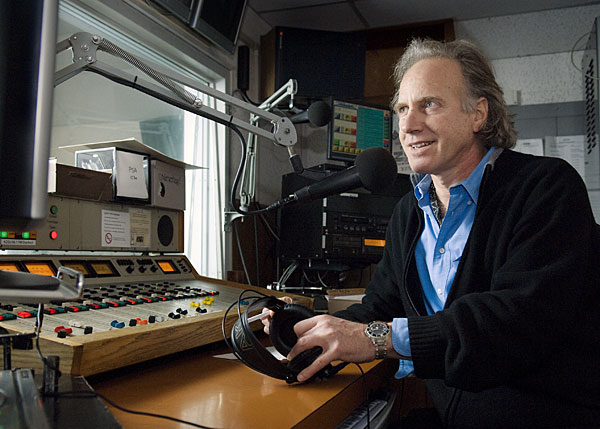
Robert Harrison, DJ for radio show "Entitled Opinions" (Photo: L.A. Cicero)

Before I attended the Workcenter’s I Am America the other night, I stopped by Cubberley Auditorium, where Robert Harrison was speaking about the communication between the living and the dead.  How could one resist such an intriguing topic?

T.S. Eliot said that “The communication of the dead is tongued with fire beyond the language of the living.” But the program was tamer: “the most ancient vocation of poetry – whether lyric or epic – is to keep open the channels of communication between the past and the present.”

Alas, because of the 8 p.m. curtain on the other side of campus, I didn’t get much farther than Rush Rehm‘s introduction (he called Robert “the most valuable humanist at the university”) before I had to dash.  But Robert kindly left me an intriguing scrap of what he’d said, inspired by Plato‘s Timaeus.

It begins with Critias telling Socrates an “old world story” that he had heard from his grandfather, who was over 90. The grandfather had heard it from his father, who had heard it from Solon the sage, who had heard it from an old priest during his visit to the Egyptian city of Sais.

...and Socrates told it to him.

“Athens, he declares, is even more ancient in its founding than the city of Sais, but the Greeks have no memory of its origins, due to the annihilations of its former civilizations.  These annihilations, brought on by periodic ‘declinations’ of the heavenly bodies, unleash ‘a great conflagration of things upon the earth.’ It was one of these conflagrations that destroyed Atlantis, an ancient civilization of which Solon’s Greek’s have no memory, even though it was their forefathers who thwarted the transoceanic Atlantean conquest of Europe.”

The old man concluded: “and so you have to begin all over again like children, and know nothing of what happened in ancient times, either among us or among yourselves.”

Then Harrison continued:  “Today we have the privilege of seeing this volcanic process at work up close, in technicolor, as it were, as the entire Christian-humanist civilization that slowly consolidated itself in the wake of Rome’s collapse unravels before our eyes.  It was said of President James Garfield that in moments of boredom or to amuse his friends he would take a pencil in each hand and compose sentences in Greek and Latin at the same time.

Ambidextrous

“If one considers that, as a student, Thomas Jefferson used to translate the Greek Bible into Latin, and vice versa, one realizes to what extent the ‘heavenly declinations’ have unleashed their fury upon the American presidency.

“It was not so long ago that a university professor in the classroom would typically leave Greek and Latin quotes untranslated. Then he began to provide a translation for the Greek but not for the Latin. Nowadays he must tell his students that there was once such a thing as the Greek and Latin tongues, that there was once a place called Athens, and so forth. Shortly the professor won’t know even that much. Oh he’ll know it, in a way, but he will not know what to make of it, and when you don’t know what to make of something you eventually forget about it.”

Ginsberg: “America when will you be angelic?”

April 14th, 2011
Share

They kept their clothes on.

One thing I learned from last night’s performance of I Am America was that 80 minutes of Allen Ginsberg is an awful lot of Allen Ginsberg.

Workcenter, founded on the principles of Jerzy Grotowski, performed I Am America, based on Ginsberg’s writing.  (I wrote about the Workcenter at Stanford here.)  Much of the script is taken from Ginsberg’s poem “America,” which begins “America I’ve given you all and now I’m nothing…”

America when will you be angelic?
When will you take off your clothes?
When will you look at yourself through the grave?
When will you be worthy of your million Trotskyites?
America why are your libraries full of tears?
America when will you send your eggs to India?
I’m sick of your insane demands.

…………………………………………………………………

I’m addressing you.
Are you going to let our emotional life be run by Time Magazine?
I’m obsessed by Time Magazine.
I read it every week.
Its cover stares at me every time I slink past the corner candystore.
I read it in the basement of the Berkeley Public Library.
It’s always telling me about responsibility. Businessmen are serious. Movie
producers are serious. Everybody’s serious but me.
It occurs to me that I am America.
I am talking to myself again.

See what I mean?  The show was high energy, the performers are vibrant and accomplished, the singing of the African diasporic songs are simply astonishing, but again … a little of Ginsberg goes a long way.

A little dab'll do ya...

Mario Biagini told me:

When I see something living, something starts to live in me. When I do this job, it helps me to live,” he said.Part of the search for something alive led to Ginsberg, and Ginsberg’s fiery, apocalyptic visions. Timely, said Biagini, in a world of environmental catastrophe, terrorism and nuclear meltdowns.

“These times are interesting, peculiar. Every day something shows us that the future is completely unknown. It needed a practical reply,” he said – a reply to “the arrogance of reality, the arrogance of life.”

Mario spoke to the audience after the small show, and told me something I didn’t know … or perhaps knew only peripherally, the way you know things in the back of your mind and then forget.  Ginsberg’s papers are at Stanford.  The library bought them, he said, for “a fabulous sum of money.” Where did it go?

“A lot of it went to taxes,” he said.  “A lot of it went to a very, very beautiful apartment in New York City.”  It’s now home of the Allen Ginsberg Trust.


<<< Previous Series of PostssepNext Series of Posts >>>