Meet you in Manhattan!

March 20th, 2011
Share

I’m off!  Or at least I will be in a few hours.

I’m on my way to a week of gigs honoring the Czesław Miłosz centenary in New York City — with a side order for Zbigniew Herbert.  I posted about them a while back here.

Come up and say hello if you see me — otherwise, prepare for a few logistical delays, but I expect to be posting about Clare Cavanagh, Robert Hass, Edward Hirsch, Adam Zagajewski, Anna Frajlich, Bogdana Carpenter, James Marcus, and many others in the coming days.

See you there!

“By Love Possessed”? René Girard and John Freccero on Francesca da Rimini

March 20th, 2011
Share

By literature possessed?

Patrick Hunt is off on his usual wanderings — this time he’s in London till the end of the month, but he did take time to drop me a quick note when he was  “again reminded how profound René Girard‘s impact has been on literature – not to mention other disciplines – in this Dante essay by John Freccero on Francesca da Rimini“:

The phenomenon of mimetic desire is at the center of the work of René Girard, one of the most powerful theorists of culture of our time. Perhaps because his early work on the novel has been overshadowed by his profound influence in anthropology, social studies and comparative religion, few students of Dante seem to know his essay of fifty years ago, dedicated to the canto of Francesca. In the briefest of terms, his point was that the desiring subject imagines, as does Francesca, that desire springs spontaneously from within, while the truth that is revealed by Dante and the greatest of novelists, is that desire is always triangular, “mediated” by the desires of the other—in this case, as in the case of Don Quixote, by a book. In a few mordant pages, Girard debunked the romantic reading of Francesca’s story, showing that it was simply a repetition of her own initial mystification. When Girard wrote, the best-selling love story of the time was entitled By Love Possessed; Girard’s title was polemic, summing up the delusion propagated by all such “romance” stories: “By Literature Possessed.” His point was that desire is essentially imitative, searching for a model, and that literature provides it with an imaginary map. Dante’s text was not complicit in “romantic” deception. On the contrary, Francesca’s last words exposed the roman as a panderer and seducer, leading the lovers to their destruction. Her story anticipated those of Chaucer, Shakespeare and Cervantes in the genre of the “anti-roman.”

Patrick added,  “I’ve heard Freccero lecture on Dante at Stanford, and only wish I’d heard Girard as well on Francesca and Canto 5 of the Inferno. I’ve written poems on this story – seemingly like everyone else! – and the tale of Francesca is nigh well eternal, as you know, and not just from Robert Browning onward. One magister’s encomium to another: from Dante to Girard to Freccero and this forthcoming book also has an excellent new essay by Robert Harrison on this same never-ending story. The haunting Ingres painting on this Dante passage is one of my absolute favorite ekphrases.”  Not to mention Tchaikovsky‘s opera.

Patrick’s own edited volume on the subject, Critical Insights:  The Inferno, will be out in September.  It includes Freccero’s essay.

Actually, I studied Dante with the world-renowned expert Freccero years and years ago — he assigned the Charles Singleton prose translation, he said, because we should never give up on learning the Italian.  I remember him emphasizing that the Paolo Malatesta, far from being the George Clooney of an earlier era, has become the voiceless lunk by Francesca’s side, and her attitude towards him is almost contemptuous.   “Amor condusee noi ad una morte.”

“A new music” — Brad Leithauser on the late W.H. Auden

March 18th, 2011
Share

A few days ago I mentioned W.H. Auden — but I didn’t name the poem I was citing.  It’s the “Nones” section from his Horae Canonicae, written between 1949 and 1955 the whole thing is here. It’s gorgeous, and I adore it, though it is part of his much-disparaged “late poetry.”

So I was pleased to read  Brad Leithauser‘s  Wall Street Journal review of Aidan Wasley‘s Age of Auden (Princeton University Press):

“Mr. Wasley takes a dim view of Auden’s final years. The once innovative poet was left behind; he receded into ‘cultural conservatism and contented domesticity.’ He became a ‘figure of sad diminishment.’ This is a plausible view—probably a majority view. But a notable minority feels otherwise. Two of the poets Mr. Wasley embraces, James Merrill and Anthony Hecht, saw the old master further extending himself in his final decade, discovering a new music— a strain of poetry that blended heartbreak with aplomb. The poem ‘A Lullaby,’ in which Auden wittily sings himself to sleep (‘Let your last thoughts all be thanks’), is a haunting example.

Though Auden’s influence is powerful and broad, The Age of Auden helpfully delineates its borders. The battle of literary reputations takes place in a dusty arena, and W. H. Auden will surely be one of those titanic figures that loom through whatever dim clouds arise. He will remain unignorable.”

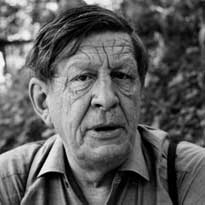
(Picture of the elder Wystan at left.  Toward the end of his life, he described his face as looking like “a wedding cake left out in the rain.”)

Getting personal: NBCC’s quiet winner Clare Cavanagh

March 17th, 2011
Share

“Poetry makes nothing happen,” W.H. Auden famously observed.

That doesn’t mean it doesn’t try.

One of the more unnoticed of this year’s National Book Critics Circle award-winners is Clare Cavanagh‘s Lyric Poetry and Modern Politics: Russia, Poland, and the West. Clare takes on the notion of poets as “unacknowledged legislators” (Percy Bysshe Shelley) and “the would-be prophet, who publicly takes his people’s suffering upon himself so that his oppressed, applauding nation might be free.”

The secret police may be the true unacknowledged legislators, but it takes the secret police both to make and to break a nation’s acknowledged, if unauthorized poet-prophets.  … Tyrants make the rules, not poets, and dictators’ deeds change worlds far more often than artists’ words do.  Poetic legislation has its limits: “No lyric has ever stopped a tank,” [Seamus] Heaney remarks. Indeed, by the mid-eighties … [Adam] Zagajewski had challenged his compatriots preoccupation with poetry as a form of collective resistance. He chose to “dissent from dissent,” to break ranks with would-be artist-legislators by setting his lyric “I” against the defiant “we” that had shaped his poetic generation. The “unacknowledged legislator’s dream” has a nasty habit of becoming the acknowledged prophet’s nightmare, as Zagajewski suggests in his programmatically unprogrammatic Solidarity, Solitude.

biographer ...

Of course, being immersed in Polish literature, I’ve known Clare by name for years before I met her in person.

And were it not for Ewa Domanska, I still might not have met her.  Ewa, who teaches at Stanford every spring and then returns to Poznań, gave me a heads-up about a “Workshop in Poetics” on May 27, 2008, led by Clare.  Of course I dropped by.

Clare was a surprise.  Given her heavyweight credentials (she is, among other things, Milosz’s official biographer), I expected someone intimidating.

She is not.  This daughter of Eire is affable and down-to-earth.  I should have expected as much from her chapter, “Job and Forrest Gump,” in An Invisible Rope: Portraits of Czesław Miłosz, describing the period after Carol Miłosz ’s death, including a few travails in her own role as biographer:

The visiting got more difficult. I knew he had black moods when Carol was alive, but Carol was famous among his friends for driving them away. But I really saw the doubts, the moods, and the black sides—he could give Jehovah a run for the money when it came to striking terror—only after Carol died. Sometimes it would be yet another younger poet attacking him; “He called me ‘Moscow’s dancing bear,’” I remember Miłosz saying bleakly about one young writer. The attacks came on a fairly regular basis, and he took them all to heart. I suppose this was the reverse side of the childlike joy at every compliment. I once gave a Kraków cabdriver Miłosz’s street address—I never mentioned his name—and he recognized it right away. “Are you going to visit Czesław Miłosz? Please give him the best regards of the cabdriver in the red Mercedes,” he asked requested. Miłosz beamed.

...subject

Sometimes the doubts ran deeper—his life, his poetry, his soul. And sometimes the doubts were about me: “You will produce not my life, but only some facsimile,” he said with a scowled in the summer of 2003. He spent several weeks that summer putting me through the biographer’s equivalent of boot camp. I’d come armed daily with the best questions I could muster, written with the help of a small army of poets, professors, and Miłosz specialists. And every day he gave the same response: “Takie oszywiste pytania,” “(Such obvious questions).” Then he’d would invite me for another session the next day, when yet another set of questions would be dismissed and after an excruciating hour or two, I’d would be sent home to think up some “questions no one’s asked me yet.” Questions no one has ever asked Miłosz. It was like Rumpelstiltskin in Polish, but worse.

Finally, after a sleepless night spent reading and rereading Druga przestrzeń (the then-untranslated Second Space), I went in and asked about the poems, and about religion. Those were the questions he wanted. And that was what I’d wanted to talk about, too, but I’d thought biographers were supposed to do something different. We talked about “Father Seweryn” and “The Treatise on Theology”—I said I’d been surprised by the Virgin at the end, and he laughed and said, “I was, too.”

The next morning, Clare and I chatted and gossiped at Starbucks, at the impossible and dangerous intersection of Stanford and El Camino, before she returned to the Northwestern University.

I don’t remember much of what she said during that seminar (I have notes somewhere), but she read Miłosz ’s canonical “Dedication,” which opens:

You whom I could not save
Listen to me.
Try to understand this simple speech as I would be ashamed of another.
I swear, there is in me no wizardry of words.
I speak to you with silence like a cloud or a tree.  …

As she does in her new book, she pointed out that something obvious that slipped away in the English translation:  The first word, in Polish, is singular, not plural.  Read that way, this is not the declamatory, rhetorical address to nations and peoples.  It is personal, not something to be read over a public address system. He’s speaking urgently to a particular person who perished, in a plea that ends:

They used to pour millet on graves or poppy seeds
To feed the dead who would come disguised as birds.
I put this book here for you, who once lived
So that you should visit us no more.


Literary pilgrimages here and there, and Sylvia Plath in Chalcot Square

March 15th, 2011
Share

Mells, Somerset

Okay. I’ll admit it’s a habit. When I travel, I often check out literary landmarks — the place where a favorite author was born, died, wrote, or was buried.  I’ve seen Mikhail Bulgakov‘s digs in Kiev, Elizabeth Bishop‘s glorious hideaway outside Samambaia, C.P. Cavafy‘s modestly exotic flat in Alexandria, Siegried Sassoon‘s grave in Somerset — I even visited Boris Pasternak‘s idyllic dacha in Peredelkino.

Milton scholar Martin Evans shares my enthusiasm.

His journeys to London are sometimes literary pilgrimages — he’s intrigued by the fact that his beloved John Milton and (my beloved) John Donne were both born on Bread Street.  He wants to show you these and more literary coincidences for your next trip.  Hence his new website,  Authorial London.  Please, do not be daunted.  It’s not complicated at all.  It’s  a really easy site.  And if you’d rather read about it than look at it, try Corrie Goldman‘s description of the site and how it came about here.

One passage intrigued me:

Nice man, odd habit (Photo: L.A. Cicero)

Readers may be surprised to learn that Sylvia Plath once lived in the same modest house in Primrose Hill in which W.B.Yeats lived many years earlier. In Plath’s time, it was a working class area beset with blue-collar workers and struggling artists. These days, glamorous socialites like Kate Moss and Sienna Miller have been dubbed by the British tabloids as the “Primrose Hill set.”

The website explains that Plath’s apartment consisted of a small bedroom, a kitchen, a living room and a bath. “Plath loved it, at least at the beginning,” the website explains. Here, Plath wrote her great social commentary of mental illness, The Bell Jar.

I was among the readers not surprised by this revelation — in fact, Plath moved to this flat precisely because Yeats had been a previous tenant.

I remember a trip to London — oh, over a decade ago — when I was writing a piece for the San Jose Mercury on the British reception of Sylvia Plath (a bare-bones, unillustrated version of it is here; the August 20, 2000 piece has disappeared from the Mercury‘s website).

The article opened:

Yeats lived here, too

IN THE Primrose Hill area of London, where Gloucester Road and Prince of Wales Road wind back on each other in a hopeless bend, one arrives at 3 Chalcot Square, a turquoise door on a five-story building painted the color of raspberry sorbet.This summer, a simple plaque was added to the building’s facade:

Sylvia Plath
1932-1963
Poet
lived here 1960-1961

Question: Why has it taken Britain nearly 40 years to offer this first, minimalist postmortem recognition for the American poet who spent her last five years in London?

One answer: The British hardly see the need for it. When it comes to Plath, one of America’s most celebrated female poets, the British just don’t get it.

Alas, since the painting of the building has disappeared over the years, we are left with these newer images.  The torquoise door remains — but raspberry sorbet?  I think not.

“No Other Place, No Other Time” — I discuss Miłosz, Brodsky in the Kenyon Review

March 13th, 2011
Share

In the spring issue of the illustrious Kenyon Review, I review two books: Irena Grudzińska Gross‘s Czesław Miłosz and Joseph Brodsky: Fellowship of Poets (Yale University Press) and Brodsky Through the Eyes of His Contemporaries, vol. 2, edited by Valentina Polukhina (Academic Studies Press).

That’s the good news.  The bad is that you are only allowed to read the first page online.  It’s here.

So here’s a little more from the piece, for free:  Joseph Brodsky‘s reading style has been much remarked upon, and I open my article with Brodsky’s first engagement outside Russia, at London’s 1972 Poetry International Festival, in the first few dizzying weeks of his exile: “the poet poured out his poems in the hypnotic incantation that was to become his trademark: an archaic sound — a lament from a lost civilization, an ancient prayer, or simply a metronomic wail.”

Daniel Weissbort remembers Brodsky reading this way:

“ . . . his hands straining the pockets of his jacket, his jaw jutting, as though his attention had just been caught by something and he were staring at it, scrutinizing it, while continuing to mouth the poem, almost absent-mindedly, that is, while the poem continues to be mouthed by him. His voice rises symphonically: ‘syn ili Bog’ [‘son or God’], already on the turn towards an abrupt descent; and then the pause and a resonant drop, a full octave: ‘Ya tvoi’ [‘I am thine’]. As the poet, with an almost embarrassed or reluctant nod, and a quick, pained smile, departs his poem”.

I continue:

Gross recounts that Brodsky was asked about his declamatory bent during his triumphant tour of Poland, and landed this punch: “Today’s poet is afraid of the sardonic laughter of his reader, and because of it he tries to soften his poems . . . This is a mistake. The poet should charge his public like a tank, so that the reader has no escape. Poetry is an act of metaphysical and linguistic attack, not of a retreat. If a poet wants to be modest and nonaggressive, he should stop writing.”

Not Miłosz’s style, to put it mildly, and so he gently chastised the younger poet. Miłosz also lamented Brodsky’s poetry in English: “The resistance against writing poetry in other languages should be considered a virtue. . . . We are born in a concrete point of the Earth and we have to remain faithful to this point, restrained in our following of foreign fashions.”

This was more than a case of brass meeting polish. Miłosz saw history as a horror he wished to escape, but in a larger sense, he was also at home in the wider story of centuries. He was a son of the Polish-speaking landed gentry in Lithuania and had a law degree from Stefan Batory University. The urbane elder poet had the educational context lacking in Brodsky, the defiant autodidact who dropped out of school as a teenager. When cornered on an error or a prejudice, Brodsky covered himself by firing off a belligerent blast; Miłosz could put his views into a historical framework, whether by referring to pronouncements of the medieval popes or the legal system of the Res publica. History, language, tradition connected with Catholicism because, writes Gross, “Without God there is no history.” But where Miłosz turned to tradition and his Catholicism, Brodsky was in a tailspin and could not find peace.

From Irena’s book, I recount this devastating story:

Few have written about solitude and time with Brodsky’s urgency, before he was finally felled, at fifty-five, by the heart ailments that had dogged him for decades. “Miłosz was very busy, yet he sounded like a person who was not pressed for time. Brodsky ran against time,” writes Gross. “In that fight he was not supported by religion or by history — national or private.” Time was truly his enemy.

Gross recounts this riveting anecdote: “In 1994, when he was forced to visit a cardiologist during his stay in Sweden, he told him that he felt like a wounded animal who simply tried to survive. He expected to die at any time; when leaving his hotel room, he would put his papers in order. ‘Hurry sickness’ was the diagnosis of the psychologist who interviewed him on that occasion”.

The Kenyon Review can be ordered online here.


<<< Previous Series of PostssepNext Series of Posts >>>